
This lesson is essential for mastering how to interact safely and legally with pedestrians, a critical aspect of urban moped riding in Spain. You'll learn the DGT's rules regarding pedestrian crossings, ensuring you understand priority situations and are prepared for your AM licence theory exam. Mastering these rules will help you avoid hazards and drive confidently in city traffic.

Lesson content overview
Understanding pedestrian crossings and the rules of right-of-way is fundamental for every moped rider, especially within the context of the Spanish Driving License Theory – AM Category. Pedestrians are among the most vulnerable road users, and their safety is paramount. This lesson provides a detailed guide to navigating various pedestrian crossing scenarios, ensuring you understand your legal obligations and how to contribute to a safe urban environment.
In Spain, traffic regulations are designed to protect all road users, with particular emphasis on those most vulnerable. Pedestrians, due to their lack of physical protection, are granted significant legal priority in many situations. As a moped rider, comprehending and respecting this priority is not merely a courtesy but a strict legal requirement.
Absolute pedestrian priority means that at certain designated locations, pedestrians have the unequivocal right to cross the road, and all vehicular traffic, including mopeds, must yield to them. This rule simplifies decision-making for both pedestrians and riders, minimizing potential conflicts and enhancing safety. It implies that you, as a rider, must always be prepared to stop and allow pedestrians to cross safely.
The legal framework granting pedestrians absolute priority is rooted in the principle of protecting vulnerable road users (VRUs). Pedestrians are at a higher risk of severe injury or fatality in a collision compared to occupants of vehicles. By assigning clear priority, the law aims to reduce the likelihood of accidents and foster a predictable traffic flow where pedestrians can cross with confidence. This core principle underpins nearly all regulations regarding pedestrian crossings.
Marked pedestrian crossings, commonly known as "zebra crossings" due to their distinctive white stripes, are the most recognizable type of crossing where pedestrians generally hold absolute priority. Moped riders must approach these crossings with extreme caution and be ready to stop at any moment.
A zebra crossing is easily identified by its alternating white stripes painted on the road surface, typically accompanied by a specific traffic sign.
When you approach such a sign or the markings on the road, it signals an area where pedestrians might be present or intending to cross. Your obligation as a moped rider (Category AM) is clear: if a pedestrian is waiting at the curb to cross or is already on the crossing, you must stop before the stop line and yield the right-of-way. This rule applies regardless of whether other vehicles are present or if you perceive sufficient space to pass.
Never assume a pedestrian has seen you or will wait for you to pass. Always be prepared to stop.
At non-signalized zebra crossings, the pedestrian's priority is absolute. This means there are no traffic lights dictating who goes when; the presence of a pedestrian is the sole determinant of right-of-way. You must slow down significantly when approaching these crossings, scan for pedestrians, and be ready to come to a complete stop. Only when the crossing is completely clear, and there are no pedestrians waiting to cross, may you proceed.
Ensuring you can stop safely before a pedestrian crossing is critical. Your speed must always be adjusted to allow for sufficient braking distance, especially considering various road and weather conditions. A safe approach involves:
Anticipation: Scan far ahead for road signs, markings, and any indication of pedestrians.
Speed Reduction: Begin to reduce your speed well in advance, taking into account road conditions (wet, dry, gravel) and visibility.
Observation: Actively look for pedestrians on both sides of the crossing and those already on it. Pay attention to children, the elderly, or individuals with mobility aids, who may take longer to cross or act unpredictably.
Positioning: Maintain a stable and controlled position on your moped, ready to apply brakes smoothly and effectively if a pedestrian appears.
Under dry conditions, a moped traveling at 30 km/h requires approximately 12 metres to stop completely. This distance increases significantly in wet or slippery conditions, potentially extending to 20 metres or more. Therefore, maintaining ample space and reducing speed are essential.
Signalized pedestrian crossings introduce traffic lights to coordinate movements, but the fundamental principle of pedestrian priority often remains, especially during specific phases of the signal cycle. Moped riders must understand how these signals interact to avoid conflicts.
Signalized crossings feature two sets of lights: one for vehicles and one for pedestrians. Pedestrian signals typically show a green "walk" symbol or a red "don't walk" symbol. Vehicular traffic lights follow the standard red, amber, and green cycle. These signals are synchronized to manage the flow of traffic and pedestrians safely.
A common point of confusion arises when the vehicle traffic light shows green, but the pedestrian signal also indicates "walk," or is about to change. According to Spanish traffic regulations, if the pedestrian signal indicates that pedestrians can cross, you must yield to them, even if your vehicle's traffic light is green. This situation often occurs during signal changes, where a pedestrian phase might begin before or end after the corresponding vehicle phase.
Always prioritize the safety of pedestrians. If there is any doubt or potential conflict, assume the pedestrian has the right-of-way and be prepared to stop.
The specific period within a traffic light cycle during which pedestrians are given the "walk" signal, allowing them to cross the road. During this phase, vehicles must stop, regardless of their own traffic light color.
Specific rules govern overtaking, stopping, and parking near pedestrian crossings to prevent obstruction and ensure clear lines of sight, further protecting pedestrians. Violations of these rules can create dangerous situations and result in penalties.
Overtaking another vehicle is strictly prohibited in the immediate vicinity of pedestrian crossings. This rule prevents unpredictable maneuvers that could endanger pedestrians who might suddenly step onto the crossing. The regulation specifies:
Overtaking is prohibited within 5 metres of a marked pedestrian crossing and 10 metres of a non-signalized crossing if pedestrians are present or likely to be.
This means that even if the crossing appears clear, you must maintain your lane and refrain from overtaking until you have safely passed the crossing and are well beyond the prohibited zone. This rule applies to all vehicle types, including mopeds.
When you are required to stop at a pedestrian crossing, whether due to a pedestrian or a traffic signal, you must maintain a specific minimum distance from the crossing line.
Vehicles must maintain a minimum clearance of 1.5 metres from the pedestrian crossing line when stopped.
This clearance ensures that pedestrians waiting on the curb have enough space to use the crossing without being obstructed by your moped. Stopping too close can force pedestrians to step into the road to walk around your vehicle, putting them at unnecessary risk.
Parking and even temporary stopping are generally prohibited directly on or very close to pedestrian crossings. This is to ensure that visibility is not obstructed for pedestrians attempting to cross, or for drivers approaching the crossing. Obstruction can lead to serious accidents, especially involving children who may be less visible.
Not all areas where pedestrians cross have clearly marked or signalized crossings. In many urban and residential zones, pedestrians may cross without formal markings. In such "uncontrolled" or informal crossings, the general duty of care and heightened vigilance of the driver are paramount.
Even without specific signs or markings, moped riders have a general duty of care to anticipate the actions of vulnerable road users. This is particularly true in areas with high pedestrian activity, such as shopping streets, residential zones, and near schools. You must constantly observe your surroundings, especially sidewalks and areas where pedestrians might emerge unexpectedly.
Always drive defensively in urban areas. Assume that a pedestrian might step into the road, even if there's no official crossing.
If a pedestrian clearly indicates an intention to cross, or is already in the process of crossing at an unmarked location, you should slow down and be prepared to yield. This proactive approach helps prevent accidents where formal rules might not apply but common sense and safety demand caution.
Children and the elderly, as well as individuals using mobility aids, require special attention due to their unique vulnerabilities.
Safe navigation of pedestrian crossings is not static; it requires adaptation to varying conditions. External factors like weather, visibility, road type, and even the state of your moped can significantly impact your ability to react and stop safely.
Adverse weather conditions and reduced visibility dramatically increase the risk at pedestrian crossings.
The condition of your moped directly affects its braking performance and, consequently, your ability to stop safely at crossings.
The characteristics of the road and surrounding environment also influence how you approach pedestrian crossings.
Failure to comply with pedestrian crossing rules is a frequent cause of accidents and incurs significant penalties in Spain, including fines and potential loss of points on your license. Being aware of common violations can help you avoid them.
One of the most common errors is misinterpreting traffic signals or the concept of right-of-way.
These actions directly endanger pedestrians and disrupt safe traffic flow.
The rules governing pedestrian crossings are enshrined in the Spanish Reglamento General de Circulación (RGC). As a Category AM moped rider, these articles are directly applicable to you and form a crucial part of your theoretical knowledge.
Adherence to these articles is non-negotiable and crucial for both road safety and legal compliance.
Navigating pedestrian crossings safely is a core responsibility for every moped rider preparing for their Spanish AM Category license. It demands constant vigilance, precise application of rules, and a deep understanding of the vulnerability of pedestrians. By consistently yielding right-of-way, maintaining safe distances, observing your surroundings diligently, and adapting to changing conditions, you not only comply with traffic laws but also actively contribute to safer roads for everyone. Remember, patience and caution are your best allies when interacting with pedestrians.
This lesson covers the fundamental Spanish traffic rules for moped riders (Category AM) regarding pedestrian crossings. Pedestrians enjoy absolute priority at marked zebra crossings, and riders must always be prepared to stop. Specific regulations from the RGC establish prohibited overtaking zones (5m near marked crossings, 10m near non-signalized), mandatory 1.5m clearance when stopped, and the primacy of pedestrian signals over vehicle green lights. Safe navigation requires constant vigilance, speed adaptation for weather and visibility conditions, and special attention to vulnerable users such as children and the elderly. Understanding and applying these rules ensures both exam success and real-world safety compliance.
A short set of high-value points that capture the most important learning from this lesson.
Pedestrians have absolute priority at marked zebra crossings in Spain, meaning you must always be prepared to stop and yield to them.
Overtaking is prohibited within 5 metres of a marked pedestrian crossing and 10 metres of a non-signalized crossing where pedestrians are present.
At signalized crossings, the pedestrian 'walk' signal takes precedence over your green vehicle light—always yield to crossing pedestrians.
Maintain a minimum clearance of 1.5 metres between your stopped moped and the pedestrian crossing line.
Always drive defensively in urban areas; assume pedestrians may cross even without formal markings or signals.
Explore all units and lessons included in this driving theory course.
RGC Article 86.1 establishes absolute pedestrian priority at marked crossings; Article 79.2 confirms pedestrian signals override vehicle green lights.
Stopping distances increase dramatically in wet conditions—from approximately 12 metres at 30 km/h on dry roads to 20 metres or more on wet surfaces.
Children and elderly pedestrians require extra caution due to unpredictable behavior and slower crossing speeds.
Never use your horn aggressively to rush pedestrians; it can startle them and cause dangerous unpredictable movements.
A flashing amber vehicle light means proceed with caution and be prepared to stop—it does not grant automatic right-of-way over pedestrians.
Proceeding on a green vehicle light without yielding to pedestrians who still have the 'walk' signal or are already crossing.
Attempting to overtake another vehicle near a pedestrian crossing, especially when that vehicle is slowing for pedestrians.
Stopping too close to the crossing line, obstructing pedestrians and forcing them to walk around your moped.
Failing to actively scan for pedestrians and assuming a crossing is clear without verification.
Misinterpreting a flashing amber light as permission to proceed without considering pedestrians who may still be crossing.
Lesson content overview
A short set of high-value points that capture the most important learning from this lesson.
Pedestrians have absolute priority at marked zebra crossings in Spain, meaning you must always be prepared to stop and yield to them.
Overtaking is prohibited within 5 metres of a marked pedestrian crossing and 10 metres of a non-signalized crossing where pedestrians are present.
At signalized crossings, the pedestrian 'walk' signal takes precedence over your green vehicle light—always yield to crossing pedestrians.
Maintain a minimum clearance of 1.5 metres between your stopped moped and the pedestrian crossing line.
Always drive defensively in urban areas; assume pedestrians may cross even without formal markings or signals.
Explore all units and lessons included in this driving theory course.
RGC Article 86.1 establishes absolute pedestrian priority at marked crossings; Article 79.2 confirms pedestrian signals override vehicle green lights.
Stopping distances increase dramatically in wet conditions—from approximately 12 metres at 30 km/h on dry roads to 20 metres or more on wet surfaces.
Children and elderly pedestrians require extra caution due to unpredictable behavior and slower crossing speeds.
Never use your horn aggressively to rush pedestrians; it can startle them and cause dangerous unpredictable movements.
A flashing amber vehicle light means proceed with caution and be prepared to stop—it does not grant automatic right-of-way over pedestrians.
Proceeding on a green vehicle light without yielding to pedestrians who still have the 'walk' signal or are already crossing.
Attempting to overtake another vehicle near a pedestrian crossing, especially when that vehicle is slowing for pedestrians.
Stopping too close to the crossing line, obstructing pedestrians and forcing them to walk around your moped.
Failing to actively scan for pedestrians and assuming a crossing is clear without verification.
Misinterpreting a flashing amber light as permission to proceed without considering pedestrians who may still be crossing.
Explore search topics learners often look for when studying Pedestrian Crossings and Right-of-Way. These topics reflect common questions about road rules, driving situations, safety guidance, and lesson level theory preparation for learners in Spain.
Browse additional driving theory lessons that cover connected traffic rules, road signs, and common driving situations related to this topic. Improve your understanding of how different rules interact across everyday traffic scenarios.
Learn about common dangers and potential conflicts at pedestrian crossings in Spain, focusing on vulnerable users like children and the elderly. Understand how to mitigate risks through vigilance and defensive riding techniques.

This lesson explores the design and legal requirements of pedestrian crossings in Spanish urban areas. It clarifies the rules at zebra crossings, signal-controlled crossings, and areas where cyclists or other vulnerable users share space. The content explains the required safety distances and signage indicating crossing zones to ensure drivers respect all road users.

This lesson examines the interaction between large vehicles, such as trucks, and vulnerable road users within roundabouts. It addresses the wide turning radius of heavy vehicles, the importance of checking blind spots, and the correct yielding behavior toward pedestrians and cyclists. Learners will understand how to maintain safe distances and anticipate the movements of different road users.

This lesson addresses the critical skill of safely sharing the road with other vulnerable users like pedestrians, cyclists, and other motorcyclists. It emphasizes the need for increased awareness, speed adaptation, and providing ample space when passing. The content covers DGT regulations regarding minimum passing distances and highlights the importance of making eye contact to ensure mutual awareness and prevent common urban accidents.
This lesson addresses the crucial 'priority to the right' rule that governs traffic at intersections without signs or signals. It explains that drivers must yield to any vehicle approaching from their right-hand side. The content provides practical examples of how to assess traffic, determine the correct order of passage, and proceed with caution to safely navigate these common but potentially confusing intersections.
This lesson explains each phase of a Spanish traffic light, detailing the specific action required for red, amber, and green signals. It clarifies the meaning of a flashing amber light, which indicates yielding to other traffic or pedestrians, and the red-amber combination. Understanding these signals is fundamental for safely navigating controlled intersections and ensuring compliance with traffic flow rules established by the DGT.
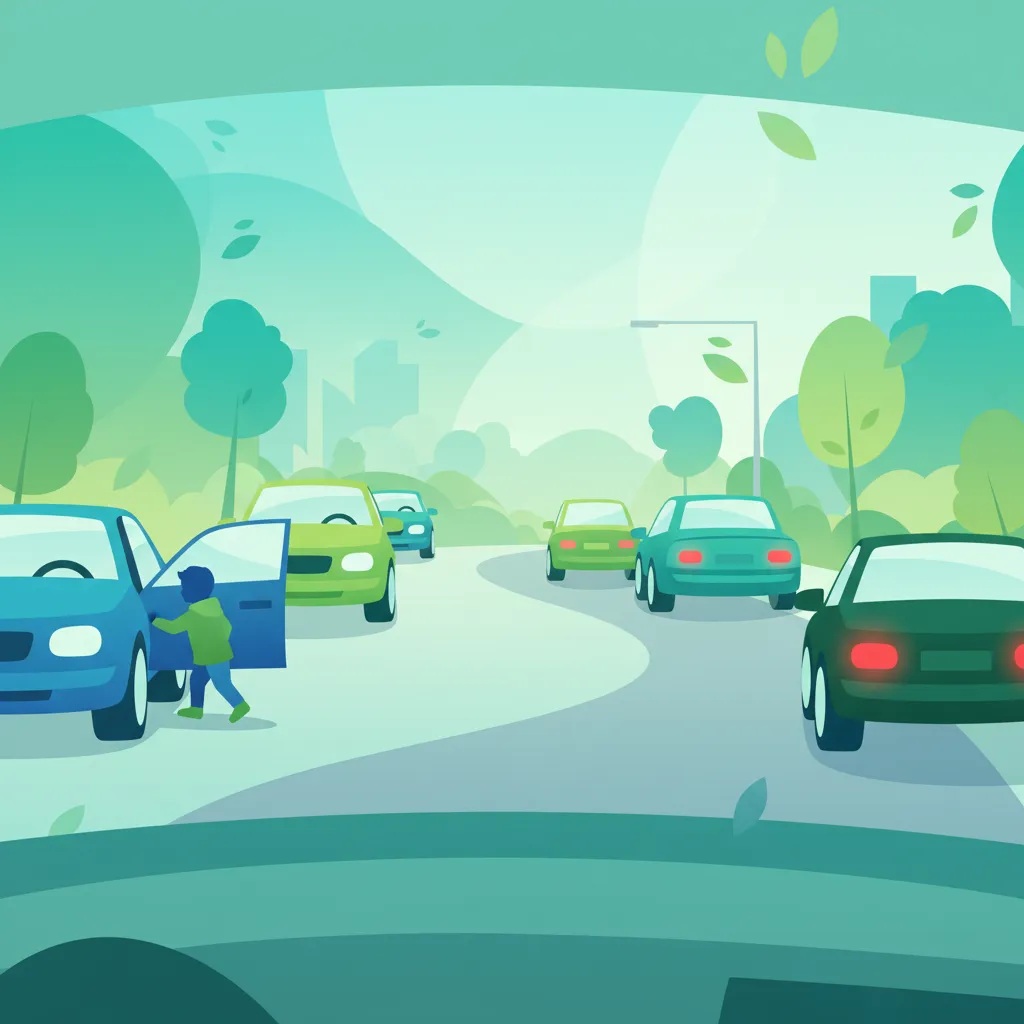
This lesson examines the specific hazards posed by vehicles parked along the roadside. It highlights the primary risk of a driver or passenger opening a door into the path of an approaching moped. Learners will understand the importance of maintaining a safe lateral distance and positioning themselves in the lane to avoid the 'door zone' while continuously scanning for signs of occupant activity.

This lesson analyzes the various intersection configurations found in Spanish cities, such as controlled and uncontrolled junctions. It explains the hierarchy of right-of-way, detailing when vehicles must yield, when pedestrians have priority, and how traffic signs dictate movement. Learners are guided through DGT signage conventions that determine priority at each intersection type.
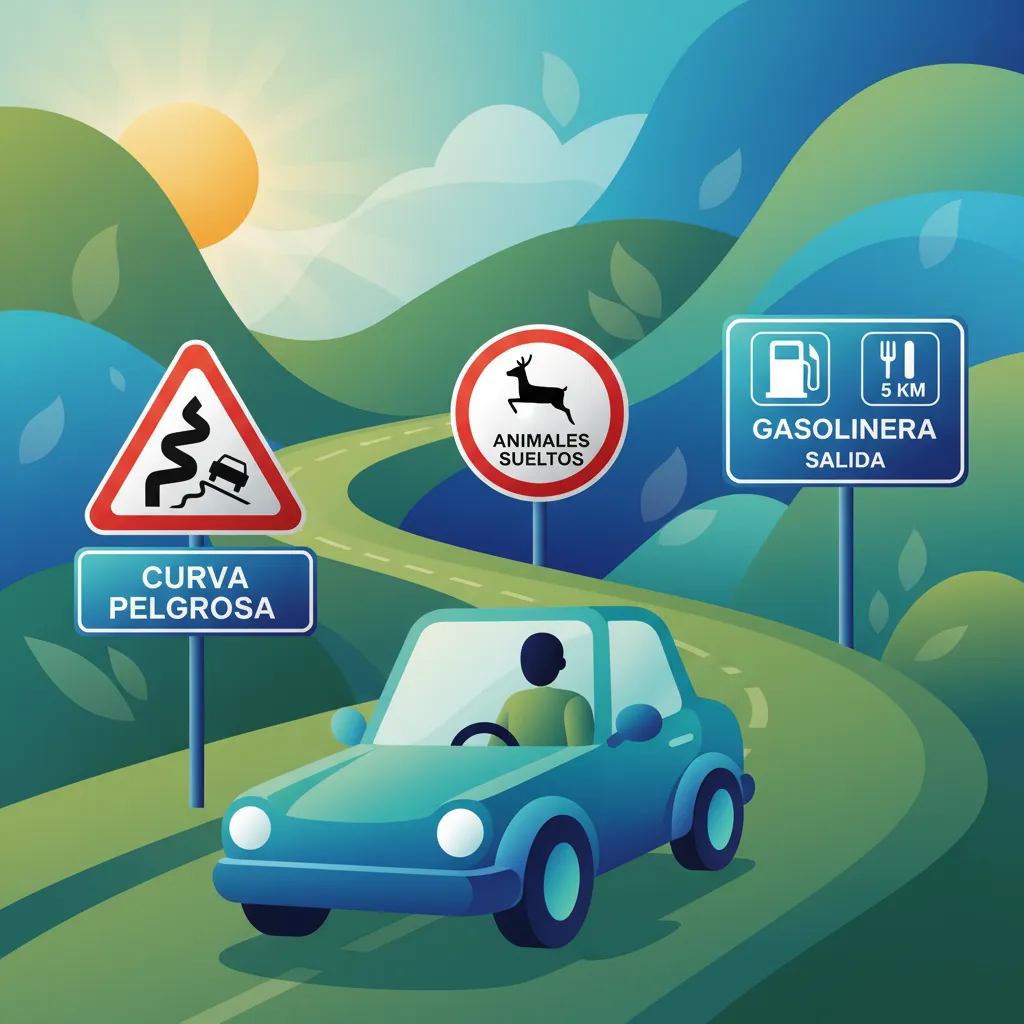
This lesson covers warning and informational signs, which are crucial for anticipating road conditions. It explains how triangular warning signs alert riders to upcoming hazards like sharp curves, slippery surfaces, or pedestrian crossings. The content also describes rectangular informational signs that provide directions, distances, and other useful guidance, helping riders to plan their route and adjust their driving in advance.
This lesson outlines the proper techniques for negotiating roundabouts and signal-controlled intersections in Spain. It explains priority rules at entry, lane selection based on the intended exit, and yielding to circulating traffic. The content also covers compliance with traffic signals and DGT regulations, including handling cyclist crossings.

This lesson examines the principles of maintaining a safe following distance, including the 'two-second rule' and its adjustments for speed and weather. It focuses on effective blind-spot management, teaching drivers how to use mirrors and head checks. The content integrates DGT guidelines on creating a safety buffer around the vehicle to allow time to react to unexpected events.
Understand the absolute priority of pedestrians at marked and signalized crossings in Spain. This lesson details rider obligations, yielding rules, and safe approaches according to DGT regulations for Category AM licenses.
This lesson addresses the crucial 'priority to the right' rule that governs traffic at intersections without signs or signals. It explains that drivers must yield to any vehicle approaching from their right-hand side. The content provides practical examples of how to assess traffic, determine the correct order of passage, and proceed with caution to safely navigate these common but potentially confusing intersections.
This lesson introduces the regulatory signs that impose obligations or prohibitions on road users, with a focus on those pertinent to mopeds. It covers common signs such as speed limits, 'no entry', and mandatory turn directions, explaining how their shape and color indicate their function. Learners will be able to identify and correctly interpret these signs to navigate urban road networks legally and safely, avoiding potential fines.

This lesson clarifies the technical classification of mopeds under Spanish law, differentiating them from motorcycles based on engine displacement not exceeding 50cc and specific power limits. It explains how these specifications impact vehicle categorization, registration, and permissible road speed. The content also covers how electric mopeds fit within the same legal framework and the implications for their use on public roads.

This lesson focuses on the optimal position for a moped within a traffic lane to maximize visibility and safety. It discusses the importance of maintaining a safety buffer from other vehicles and hazards, particularly the risk posed by the doors of parked cars. The content explains how to use lane positioning strategically to discourage unsafe overtaking and to be clearly seen by drivers in front and behind, especially when approaching intersections.
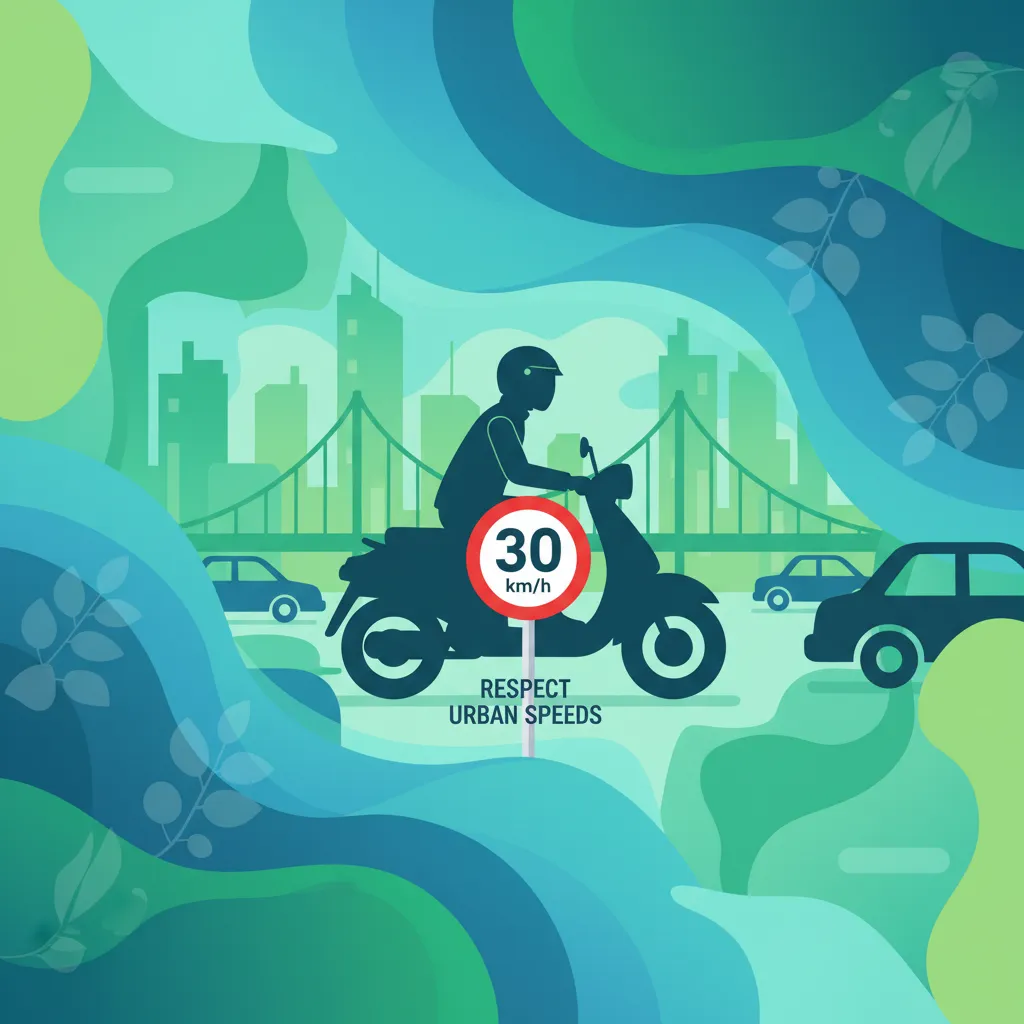
This lesson details the specific speed limits applicable to mopeds within Spanish urban areas, such as the 30 km/h limit on single-lane roads and the 50 km/h limit on roads with two or more lanes per direction. It teaches learners to identify speed zone signage and understand the legal rationale behind these restrictions. Adhering to these DGT-mandated limits is crucial for safety and avoiding penalties.
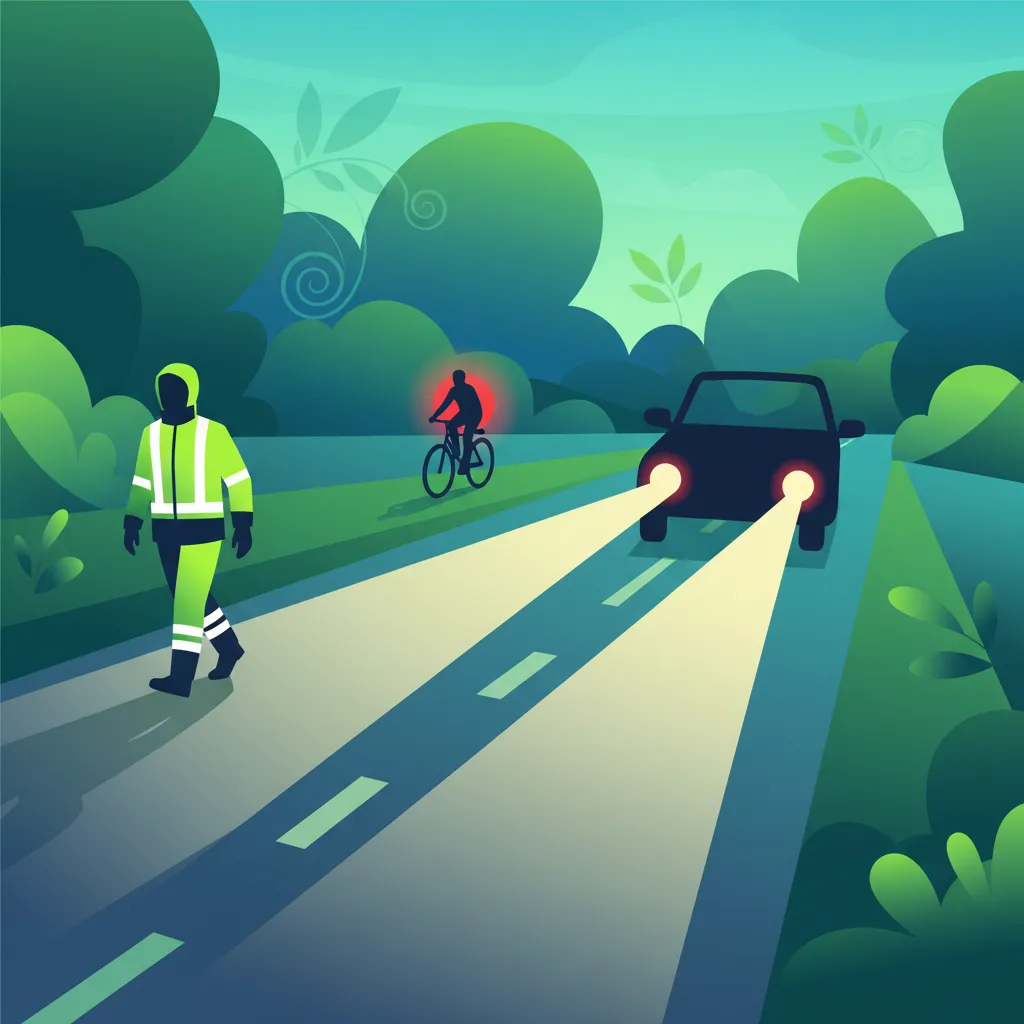
This lesson outlines the mandatory lighting and visibility equipment as per DGT regulations. It covers the correct use of headlights (low and high beams), taillights, and turn signals, ensuring the moped is visible to others, especially at night or in poor weather. The importance of wearing high-visibility or reflective clothing is also emphasized as a critical measure to enhance personal safety by making the rider more conspicuous.

This lesson teaches riders the critical importance of maintaining a safe following distance to allow for adequate reaction and braking time. It explains practical methods for judging this distance, such as the 'two-second rule,' and how this gap must be increased in adverse weather or poor visibility. Understanding this principle is fundamental to preventing rear-end collisions, one of the most common types of traffic accidents.
This lesson clarifies the primary rule for roundabouts: all vehicles entering must yield to traffic already on the circular roadway. It explains how to approach a roundabout, select the appropriate lane based on the intended exit, and merge safely into the flow of traffic. Proper signaling before exiting is also covered, ensuring other drivers can anticipate the rider's movements for a smooth and safe negotiation of the junction.

This lesson provides a detailed guide to safely starting a moped, from the ignition sequence to the coordinated use of the throttle and brakes. It explains the importance of a pre-ride checklist to verify lights and controls are functional. The content also covers techniques for achieving smooth acceleration from a standstill and performing controlled stops, which is crucial for managing stop-and-go urban traffic conditions.
This lesson addresses the critical skill of safely sharing the road with other vulnerable users like pedestrians, cyclists, and other motorcyclists. It emphasizes the need for increased awareness, speed adaptation, and providing ample space when passing. The content covers DGT regulations regarding minimum passing distances and highlights the importance of making eye contact to ensure mutual awareness and prevent common urban accidents.
Find clear answers to common questions learners have about Pedestrian Crossings and Right-of-Way. Learn how the lesson is structured, which driving theory objectives it supports, and how it fits into the overall learning path of units and curriculum progression in Spain. These explanations help you understand key concepts, lesson flow, and exam focused study goals.
Pedestrians generally have priority at marked crosswalks (zebra crossings) and when traffic signals indicate it. However, they do not have absolute priority if they cross outside of designated areas or against a red signal. As an AM moped rider, you must always be prepared to stop for pedestrians at marked crossings.
Marked pedestrian crossings, or zebra crossings, typically require you to yield to pedestrians waiting or already crossing without a specific traffic light. Signaled crossings have traffic lights for both vehicles and pedestrians, and you must obey the signal. For AM moped riders, failing to follow these rules is a serious infraction.
Even if a pedestrian crosses illegally, as an AM moped rider, you must always take all reasonable steps to avoid an accident. This means slowing down, being prepared to stop, and sounding your horn if necessary to alert them. Defensive riding is key to preventing incidents.
Yes, failing to yield to pedestrians at marked or signaled crossings when they have priority is a serious traffic infraction in Spain. This can result in significant fines and, depending on the severity, potentially the loss of points from your driving licence, impacting your AM licence status.
Use our powerful search functionality to pinpoint specific Spanish DGT driving theory practice sets. Filter by road sign categories, traffic law topics, or question difficulty to build custom study sessions and reinforce your knowledge precisely where it matters for your official exam.