
This lesson teaches you how to anticipate hazards and apply defensive driving techniques in various Swiss traffic scenarios. By mastering these skills, you will improve your safety on the road and better prepare for situational questions in your Category B theory exam.

Lesson content overview
This lesson, part of your Comprehensive Swiss Driving Theory Course for Category B License, introduces you to the fundamental principles of defensive driving. You will learn essential techniques for anticipating hazards, continuously scanning your environment, and proactively positioning your vehicle to mitigate risks. Mastering these skills is crucial for safe navigation on Swiss roads, enabling you to make informed decisions and react effectively to dynamic traffic situations.
Defensive driving is a mindset and a set of techniques aimed at minimizing driving risks by anticipating dangerous situations, regardless of the conditions or the actions of other road users. It transforms driving from a reactive task into a proactive one, focusing on accident avoidance and continuous risk assessment. This approach is fundamental to ensuring your safety and the safety of others in complex Swiss traffic environments.
The core of defensive driving lies in understanding human factors, such as reaction time and perception limits, combined with the physics of vehicle movement, including stopping distance and traction. It builds upon foundational knowledge of traffic rules, speed limits, and stopping distances, forming a critical bridge to advanced driving concepts like safe overtaking and navigating adverse weather.
Proactive vs. Reactive Driving: A proactive driver constantly looks for potential problems and takes action before they become dangerous. A reactive driver waits for a hazard to become immediate before responding, often with less time and fewer options.
Defensive driving is built upon several interconnected principles, each contributing to a holistic approach to road safety. These principles guide your decisions and actions behind the wheel, helping you stay ahead of potential dangers.
Hazard anticipation is the ability to foresee potential dangers based on current traffic conditions, road layout, and the likely behavior of other road users. This proactive prediction allows you to take preemptive actions, such as adjusting your speed or changing your lane position, to reduce your exposure to risk. It requires constant environmental assessment and the mental projection of future events.
Continuous scanning is the systematic and regular movement of your eyes and head to gather a complete picture of your driving environment. This includes monitoring the road far ahead, the immediate area around your vehicle, your peripheral vision, and the rear zones using your mirrors. Effective scanning helps you detect emerging hazards early, providing more time for decision-making and reducing the need for sudden, emergency reactions.
Proactive positioning involves strategically choosing your lane and your vehicle's placement within that lane to maximize visibility and provide adequate space for maneuvering. Proper positioning helps you spot hazards earlier, allows other drivers to see you clearly, and gives you more options for evasion if an unexpected event occurs. It significantly influences both your safety and the safety of those around you.
Safe speed management means selecting a speed that is appropriate for the prevailing road conditions, traffic flow, visibility, your vehicle's performance, and your personal capabilities. This speed may often be lower than the legal maximum limit. The primary purpose is to ensure that you can stop or avoid hazards safely within the distance you can see ahead, accounting for your perception and reaction time.
Situational awareness is the continuous perception and comprehension of all relevant elements in your driving environment, along with the ability to project their future states. It means not just seeing what is around you, but understanding what it means, how elements might interact, and what might happen next. This mental model is essential for effective hazard anticipation and proactive decision-making.
To fully grasp defensive driving, it's essential to delve deeper into its core components and their practical implications on the road.
The process of predicting potential dangers or critical events on the road before they become immediate threats, based on observations and knowledge of traffic patterns.
Hazard anticipation involves actively looking for clues that suggest a future problem. These clues can range from a child playing near the road to a vehicle ahead braking repeatedly. By identifying these signs, you gain valuable time to prepare for and avoid dangerous situations.
Swiss law reinforces this principle. According to the Road Traffic Act (SVG) Art. 33, drivers must maintain a safe distance to be able to stop safely. Furthermore, SVG Art. 45 mandates adapting speed to conditions, implicitly requiring drivers to anticipate how conditions might affect their ability to stop or react.
The systematic and frequent shifting of visual attention to monitor all areas of the driving environment, including the road ahead, to the sides, and behind the vehicle.
Effective scanning prevents "tunnel vision," where a driver fixates only on the vehicle directly in front. It involves a structured approach to observation:
The strategic choice of a lane and the placement of the vehicle within that lane to optimize visibility, create escape routes, and provide adequate maneuvering space.
Your position on the road significantly impacts your ability to see and be seen, and to react to hazards.
The maximum speed at which a driver can maintain full control of the vehicle and stop within the visible distance ahead, considering all prevailing conditions.
The legal speed limit is the maximum allowed under ideal conditions. A safe speed, however, is dynamic and must be adjusted based on real-time factors like weather, visibility, road surface, traffic density, and vehicle load.
Confusing the legal maximum with a safe speed is a common and dangerous misunderstanding. For instance, driving at 80 km/h on a motorway may be legal, but it is certainly not safe during a whiteout blizzard.
The continuous perception of environmental elements, coupled with the comprehension of their meaning and the projection of their future status, particularly concerning time and space.
Situational awareness integrates all other defensive driving principles. It's about building a mental model of the entire traffic scene.
This holistic understanding allows for truly proactive driving, where potential conflicts are identified and resolved long before they become emergencies. SVG Art. 5 (due care) and Art. 38 (yielding) implicitly demand high situational awareness from drivers.
Defensive driving principles are not merely suggestions; many are enshrined in Swiss traffic law. Adhering to these regulations is crucial for preventing accidents and avoiding penalties.
| Regulation (Swiss Road Traffic Act) | Rule Statement | Applicability | Rationale for Defensive Driving | Example of Correct Application |
|---|---|---|---|---|
| Art. 5 (General Duty of Care) | Drivers must exercise due care to ensure road safety. | All driving situations | This overarching article mandates a proactive and responsible driving style. | Constantly scanning for hazards and adjusting driving behavior accordingly. |
| Art. 33 (Safe Following Distance) | The driver must maintain a sufficient distance to stop safely without colliding with the vehicle ahead. | All driving situations; distance varies depending on speed and conditions. | Ensures adequate time for perception, reaction, and braking. | Maintaining at least a two-second gap (four seconds in adverse weather) behind the vehicle in front. |
| Art. 38 (Yielding) | Drivers must yield to traffic already on the right of way. | Intersections, roundabouts, when overtaking. | Prevents conflicts and ensures orderly traffic flow, relying on anticipation. | Slowing down and stopping if necessary before entering a roundabout when traffic is present. |
| Art. 45 (Visibility and Speed) | Drivers must adapt speed according to visibility conditions such as fog, rain, or at night. | Conditions with reduced visibility. | Directly supports safe speed management, ensuring stopping within visible distance. | Reducing speed significantly and using low beam headlights in dense fog. |
| Art. 71 (Lane Usage) | Vehicles must keep to the lane most suitable for the direction and speed of travel. | Multi-lane roads, motorways. | Promotes proactive positioning and smooth traffic flow, reducing unexpected maneuvers. | On a motorway, using the rightmost lane for cruising unless overtaking. |
| Art. 73 (Overtaking) | Overtaking is only allowed when it does not endanger other road users or impede traffic flow. | Wherever permitted by signs or markings. | Requires continuous scanning and hazard anticipation to ensure sufficient space and time for the maneuver. | Carefully checking mirrors and blind spots, signaling, and accelerating smoothly only when the path is clear. |
Defensive driving skills must be adaptable to a wide range of real-world scenarios, from different weather conditions to varying road types and interactions with vulnerable road users.
Weather significantly impacts road conditions and visibility, demanding a proactive adjustment of your driving techniques.
Visibility can change dramatically between day and night, and even at dusk or dawn.
Different roads present unique challenges that require specific defensive driving adaptations.
Your vehicle's condition and load significantly affect its performance, especially braking and handling.
Pedestrians, cyclists, and motorcyclists are particularly vulnerable due to their lack of protection. Defensive driving demands extra caution and anticipation when interacting with them.
Here are practical examples demonstrating the application of defensive driving principles.
Setting: You are driving on a single-lane mountain road in Switzerland. The road is dry but features numerous winding, blind curves with limited visibility. Defensive Driving in Action:
Setting: You are driving on a Swiss motorway, and heavy rain begins to fall, reducing visibility and creating wet road conditions. Traffic is moderate. Defensive Driving in Action:
Setting: You are approaching a busy urban intersection in a Swiss city. The traffic light turns green, but several pedestrians are still crossing the crosswalk from the opposing side. Defensive Driving in Action:
Setting: You are driving on a rural road in the Swiss countryside at night. There are no streetlights, and your only illumination comes from your vehicle's headlights. Defensive Driving in Action:
Defensive driving is the cornerstone of safe and responsible driving, especially within the context of the Comprehensive Swiss Driving Theory Course for Category B License. It is an active, continuous process that integrates hazard anticipation, continuous scanning, proactive positioning, safe speed management, and comprehensive situational awareness.
Drivers must consistently adapt their speed to prevailing visibility and road conditions, maintain sufficient following distances, and strategically position their vehicles to maximize sightlines and escape routes. Continuous scanning, particularly using mirrors and peripheral vision, ensures early detection of potential hazards. The legal framework of the Swiss Road Traffic Act (SVG), with articles on safe following distance, appropriate speed, and yielding, reinforces these defensive principles.
Mastery of defensive driving principles empowers you to navigate diverse contexts—from bustling urban intersections to high-speed motorways and challenging weather conditions—with confidence and safety. These skills are fundamental, directly supporting advanced maneuvers like safe lane changes and overtaking, and fostering harmonious interaction with vulnerable road users. By embedding these practices into your driving habits, you significantly reduce collision risks and contribute to overall road safety.
This lesson establishes defensive driving as a proactive mindset that minimizes risk by anticipating hazards, continuously scanning the environment, positioning the vehicle strategically, managing speed appropriately, and maintaining situational awareness. Swiss law reinforces these skills through regulations requiring safe following distances (SVG Art. 33), speed adaptation to conditions (SVG Art. 45), and proper mirror use before lane changes (SVG Art. 53). The lesson applies these principles across diverse Swiss driving contexts including mountain roads, motorways, urban intersections, and adverse weather conditions, directly preparing learners for both real-world safety and theory exam questions.
A short set of high-value points that capture the most important learning from this lesson.
Defensive driving transforms driving from a reactive task into a proactive one focused on accident avoidance through continuous risk assessment
The five core principles are hazard anticipation, continuous scanning, proactive positioning, safe speed management, and situational awareness
Your safe speed must always allow you to stop within the distance you can see ahead, regardless of posted limits
Position your vehicle strategically to maximize visibility, create escape routes, and ensure other road users can see you
Situational awareness means not just seeing your environment but understanding how elements interact and predicting what happens next
Explore all units and lessons included in this driving theory course.
SVG Art. 33 requires maintaining sufficient distance to stop safely behind the vehicle ahead; increase gaps in adverse conditions
Scan your mirrors every 5-8 seconds and use far scan (10-15 seconds ahead) to detect hazards early
The legal maximum speed is not automatically a safe speed; conditions often require driving well below the limit
On Swiss motorways, keep right unless overtaking and position slightly toward the outer edge on blind curves to widen your sightline
Dynamic hazards (moving vehicles, cyclists, pedestrians) require ongoing anticipation as their behavior can change unpredictably
Confusing the legal maximum speed limit with a safe speed, leading to driving too fast for conditions like fog, rain, or snow
Developing tunnel vision by focusing only on the vehicle directly ahead instead of scanning the full environment
Failing to increase following distance appropriately in adverse weather, risking rear-end collisions when stopping distances increase
Not checking mirrors frequently enough before changing lanes or speed, violating SVG Art. 53 mirror-use requirements
Assuming a green light or right of way means it is safe to proceed without anticipating pedestrians or other road users who may still be in the intersection
Lesson content overview
A short set of high-value points that capture the most important learning from this lesson.
Defensive driving transforms driving from a reactive task into a proactive one focused on accident avoidance through continuous risk assessment
The five core principles are hazard anticipation, continuous scanning, proactive positioning, safe speed management, and situational awareness
Your safe speed must always allow you to stop within the distance you can see ahead, regardless of posted limits
Position your vehicle strategically to maximize visibility, create escape routes, and ensure other road users can see you
Situational awareness means not just seeing your environment but understanding how elements interact and predicting what happens next
Explore all units and lessons included in this driving theory course.
SVG Art. 33 requires maintaining sufficient distance to stop safely behind the vehicle ahead; increase gaps in adverse conditions
Scan your mirrors every 5-8 seconds and use far scan (10-15 seconds ahead) to detect hazards early
The legal maximum speed is not automatically a safe speed; conditions often require driving well below the limit
On Swiss motorways, keep right unless overtaking and position slightly toward the outer edge on blind curves to widen your sightline
Dynamic hazards (moving vehicles, cyclists, pedestrians) require ongoing anticipation as their behavior can change unpredictably
Confusing the legal maximum speed limit with a safe speed, leading to driving too fast for conditions like fog, rain, or snow
Developing tunnel vision by focusing only on the vehicle directly ahead instead of scanning the full environment
Failing to increase following distance appropriately in adverse weather, risking rear-end collisions when stopping distances increase
Not checking mirrors frequently enough before changing lanes or speed, violating SVG Art. 53 mirror-use requirements
Assuming a green light or right of way means it is safe to proceed without anticipating pedestrians or other road users who may still be in the intersection
Explore search topics learners often look for when studying Defensive Driving Techniques and Hazard Anticipation. These topics reflect common questions about road rules, driving situations, safety guidance, and lesson level theory preparation for learners in Switzerland.
Browse additional driving theory lessons that cover connected traffic rules, road signs, and common driving situations related to this topic. Improve your understanding of how different rules interact across everyday traffic scenarios.
Go beyond basic defensive driving to master advanced hazard anticipation and risk management techniques. Learn to identify subtle cues and predict complex traffic scenarios on Swiss roads for enhanced safety and confident driving.

This lesson focuses on warning signs that alert drivers to potential hazards ahead, such as curves, steep descents, and roadwork zones. You will understand how these signs prompt anticipatory driving behavior, allowing for adjustments in speed and position. The content also discusses the typical placement of warning signs to help you react safely to changing conditions.

This lesson trains drivers to look beyond other vehicles and actively search for pedestrians, cyclists, and motorcyclists, especially those who may be distracted or unaware. It covers common behavioral patterns of different VRU groups. The goal is to see potential hazards developing early and create time and space to react safely.

This lesson focuses on general driving safety in areas with a high concentration of children. It stresses the importance of significantly reducing speed, being prepared for unexpected events, and scanning for children between parked cars. The driver must exhibit maximum vigilance in these high-risk environments at all times.

This lesson focuses on driving on mountain roads, addressing steep gradients, hairpin bends, and altitude-related challenges. You will learn proper techniques for climbing ascents and using engine braking on descents. The content also covers the use of snow chains, recognizing avalanche risks, and interpreting mountain road signs for safe alpine navigation.

This lesson examines the impact of various weather conditions on driving safety. It explains how to adjust speed in low visibility and the risks of aquaplaning in heavy rain. The content also covers using snow chains in snowy conditions, handling icy surfaces, and dealing with strong winds, particularly on bridges and open roads.

Driving a large vehicle on mountain passes is a demanding skill. This lesson covers selecting the correct gear for both ascents and descents to maintain control and avoid overheating the brakes. It also explains the specific priority rules that apply on mountain roads and the importance of being aware of sudden weather changes.

This lesson focuses on identifying and managing specific road surface hazards that can compromise traction. It provides techniques for safely crossing slippery tram rails and painted markings, navigating uneven cobblestones, and maintaining control on loose gravel. The core skill is learning to scan the road ahead and adjust riding style proactively.

This lesson covers the systematic use of rearview and side mirrors, combined with head checks, to maintain full awareness of surrounding traffic. It emphasizes frequent observation to detect vehicles in blind spots, especially during lane changes and turns. The content also details the proper timing for head checks and the role of scanning techniques in preventing collisions.

This lesson focuses on safe reversing techniques, emphasizing the use of mirrors, rearview cameras, and checking rear visibility. You will learn to control reversing speed and safely reverse around corners or in narrow spaces. The content also outlines the necessary safety checks to perform before and during any reversing maneuver to prevent accidents.

This lesson explores the typical features of rural and alpine roads, such as narrow lanes, sharp bends, and significant elevation changes. It discusses the need for heightened awareness due to limited sight distances and the potential for unexpected hazards like wildlife or agricultural vehicles. Riders will learn to adapt their speed and positioning for these challenging conditions.
Develop a deeper understanding of situational awareness through practical examples and real-world scenarios encountered on Swiss roads. Learn to connect defensive driving principles to diverse traffic situations and improve your ability to anticipate and react safely.

This lesson contrasts the interaction dynamics between road users in urban and rural environments, highlighting differing challenges. It discusses the higher density of pedestrians and cyclists in cities versus the presence of agricultural vehicles and wildlife in rural areas. You will learn how speed limits, visibility, and road layout impact safe interactions.
This lesson focuses on general driving safety in areas with a high concentration of children. It stresses the importance of significantly reducing speed, being prepared for unexpected events, and scanning for children between parked cars. The driver must exhibit maximum vigilance in these high-risk environments at all times.

This lesson explores the complexities of riding in busy urban areas with a mix of traffic types. It covers strategies for safely navigating alongside buses, trams, cyclists, and pedestrians. Key topics include respecting designated lanes, anticipating the movements of vulnerable road users, and maintaining heightened situational awareness.
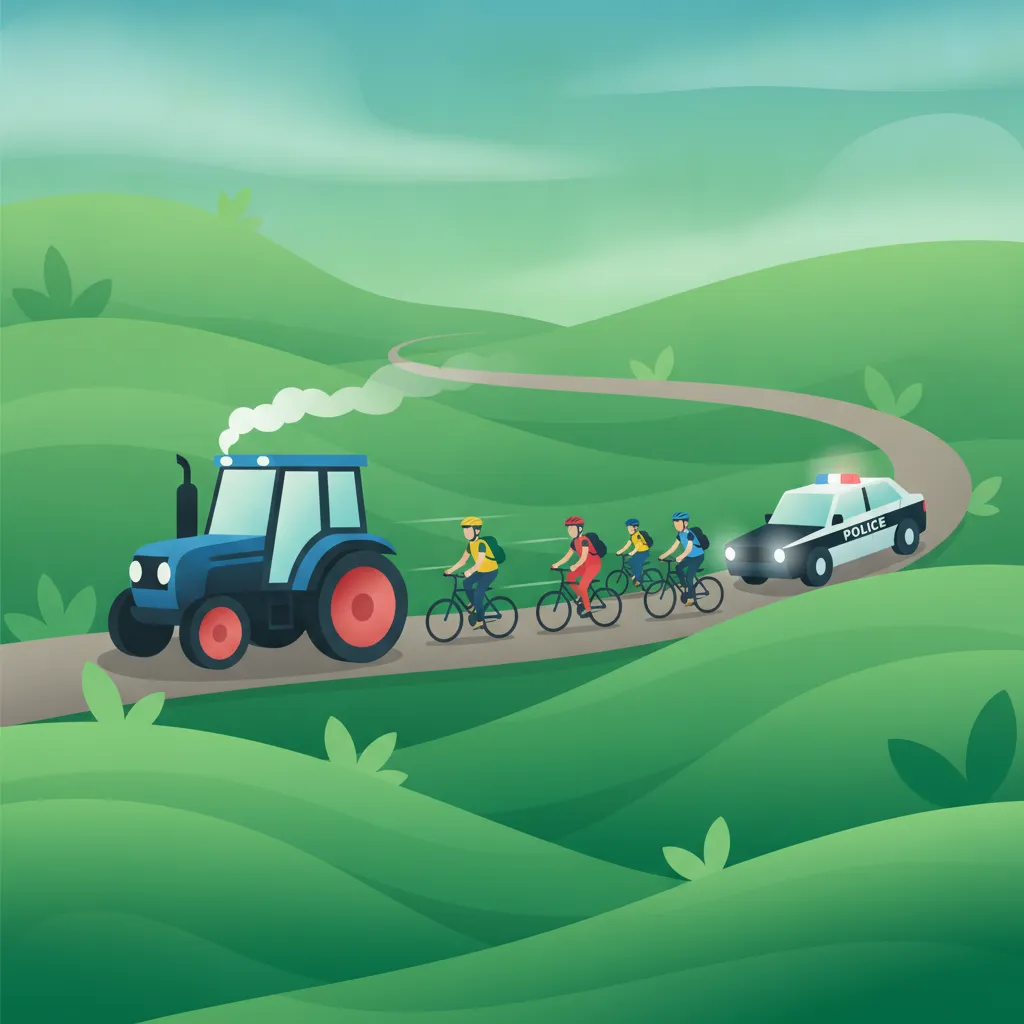
This lesson focuses on strategies for safely interacting with non-standard traffic common on rural roads. It covers how to anticipate the behaviour of slow-moving farm equipment and tourist vehicles, and the legal requirement to yield to emergency services. The importance of patience and safe passing opportunities is stressed.
This lesson trains drivers to look beyond other vehicles and actively search for pedestrians, cyclists, and motorcyclists, especially those who may be distracted or unaware. It covers common behavioral patterns of different VRU groups. The goal is to see potential hazards developing early and create time and space to react safely.
This lesson focuses on warning signs that alert drivers to potential hazards ahead, such as curves, steep descents, and roadwork zones. You will understand how these signs prompt anticipatory driving behavior, allowing for adjustments in speed and position. The content also discusses the typical placement of warning signs to help you react safely to changing conditions.

Urban driving requires heightened awareness and careful planning. This lesson covers the challenges of narrow streets, heavy traffic, and the need to identify designated loading and unloading zones. It emphasizes the importance of planning routes in advance to account for time-based access restrictions and to avoid unsuitable roads.

Rural roads present challenges like narrow lanes, poor surfaces, sharp bends, and limited visibility. This lesson teaches drivers how to position their large vehicle to maximize space and visibility, anticipate oncoming traffic at blind corners, and be aware of specific rural hazards. These hazards include slow-moving agricultural vehicles, animals on the road, and concealed farm entrances.
This lesson covers the systematic use of rearview and side mirrors, combined with head checks, to maintain full awareness of surrounding traffic. It emphasizes frequent observation to detect vehicles in blind spots, especially during lane changes and turns. The content also details the proper timing for head checks and the role of scanning techniques in preventing collisions.

This lesson introduces the core behaviour rules governing safe communication, focusing on the use of signals, mirrors, and eye contact. It emphasizes the importance of timely indicator usage and the correct procedure for checking mirrors and blind spots. The content also covers non-verbal communication cues that help convey intent and foster predictable traffic flow.
Find clear answers to common questions learners have about Defensive Driving Techniques and Hazard Anticipation. Learn how the lesson is structured, which driving theory objectives it supports, and how it fits into the overall learning path of units and curriculum progression in Switzerland. These explanations help you understand key concepts, lesson flow, and exam focused study goals.
The exam tests your ability to spot potential dangers before they become accidents. Mastering defensive driving helps you choose the safest answer in scenario-based questions.
The key is continuous scanning. By constantly checking your mirrors, blind spots, and the road ahead, you can identify patterns and potential risks early, allowing you more time to react.
Proactive speed management means slowing down when you spot potential hazards, such as children near the road or limited visibility. It provides the buffer needed to avoid collisions.
Yes, especially in urban areas. Defensive driving is crucial when navigating intersections, public transport interactions, and busy crossings to anticipate unpredictable actions by pedestrians or cyclists.
Pinpoint specific Swiss traffic rules, road signs, or driving situations you need to master. Use the practice search to start a focused revision session now and build confidence for your official driving theory exam.