
This lesson explores the vital role of Anti-lock Braking Systems (ABS) and Electronic Stability Control (ESC) in modern vehicles. You will learn how these automated safety systems intervene during emergency braking and traction loss, which is a core component of vehicle technology knowledge for your Swiss Category B licence.
Lesson content overview
Driving safely requires not only skill and attentiveness but also a thorough understanding of your vehicle's safety features. Modern vehicles are equipped with sophisticated systems designed to assist drivers in maintaining control, especially during critical situations. Among the most crucial are the Anti-lock Braking System (ABS) and Electronic Stability Control (ESC). These technologies fundamentally change how a vehicle responds to emergency braking and evasive maneuvers, significantly reducing the risk of accidents.
This lesson will delve into the mechanics, benefits, and proper driver interaction with ABS and ESC. Gaining a comprehensive understanding of these systems is essential for every driver undergoing the Comprehensive Swiss Driving Theory Course for Category B License, as it equips you with the knowledge to react appropriately in emergencies and leverage your vehicle's full safety potential.
The primary goal of ABS and ESC is to enhance vehicle control and stability, particularly in situations where traction is compromised or rapid driver input is required. During sudden, hard braking, ABS prevents the wheels from locking up, allowing the driver to maintain steering ability and potentially steer around an obstacle. ESC, on the other hand, monitors the vehicle's trajectory and actively intervenes to prevent skids or spin-outs, guiding the vehicle back onto its intended path.
Understanding these systems is not just about knowing their names; it's about appreciating how they operate and how your actions as a driver can complement or hinder their effectiveness. This knowledge empowers you to make safer decisions and respond more effectively in challenging driving conditions, from sudden stops on a wet road to navigating unexpected curves.
The development of ABS and ESC represents significant milestones in automotive safety. Early braking systems were purely mechanical, requiring drivers to manually modulate brake pressure to prevent wheel lock-up – a technique known as "cadence braking." The introduction of ABS automated this process, making advanced braking accessible to all drivers. ESC further built upon this foundation by integrating more sensors and processing capabilities to manage not just braking, but overall vehicle stability. These innovations have drastically improved road safety statistics, leading to their mandatory inclusion in new vehicles in many jurisdictions, including Switzerland.
The Anti-lock Braking System (ABS) is a pivotal safety feature designed to prevent the wheels of a vehicle from locking up during hard braking. This prevention is critical because locked wheels cease to roll, reducing friction and causing the vehicle to skid uncontrollably, making it impossible to steer.
When a driver applies the brakes forcefully, especially on slippery surfaces such as wet, icy, or gravel roads, there's a high risk that the wheels will stop rotating and begin to slide. ABS actively counters this by detecting when a wheel is about to lock. It then rapidly releases and reapplies brake pressure to that specific wheel, often several times per second. This modulation ensures that the wheels continue to rotate, even if slowly, maintaining their grip on the road and allowing the driver to steer the vehicle.
The core principle behind ABS is managing wheel slip.
An optimal amount of wheel slip (typically between 10-30%) provides the maximum braking force while still allowing for steering. If a wheel completely locks, the slip is 100%. ABS uses wheel speed sensors on each wheel to continuously measure their rotational speed. This data is fed to an Electronic Control Unit (ECU). The ECU compares the speed of each wheel to the overall vehicle speed. If one wheel is slowing down significantly faster than the others, or if its speed suddenly drops to zero, the ECU identifies an impending lock-up. It then signals the brake modulator to reduce hydraulic pressure to that particular brake caliper, momentarily releasing the brake. As the wheel speeds up again, pressure is reapplied, repeating this cycle very quickly. This constant adjustment ensures that maximum braking force is applied without sacrificing steering capability.
ABS systems can vary in complexity, primarily concerning how many wheels they control independently:
One of the most distinctive indicators that ABS is active is the brake pedal pulsation.
When ABS activates during hard braking, you will feel a rapid pulsing or vibrating sensation through the brake pedal, often accompanied by a rattling sound. This is a normal operation of the system, not a malfunction. It's the hydraulic valves rapidly opening and closing to release and reapply brake pressure. It is crucial not to release pressure from the brake pedal when this occurs. Instead, maintain firm and steady pressure on the pedal, allowing the ABS to do its job. Releasing pressure prematurely will extend your stopping distance and negate the benefits of the system.
While ABS is an invaluable safety feature, it's often misunderstood:
Electronic Stability Control (ESC) is an advanced active safety system designed to help drivers maintain control of their vehicle during extreme maneuvers or when traction is lost. It intervenes automatically to prevent skids or loss of control, significantly reducing the risk of single-vehicle accidents and rollovers.
ESC goes beyond ABS by not just preventing wheel lock-up during braking, but by actively managing the vehicle's directional stability. It continuously compares the driver's intended path (derived from steering wheel angle and accelerator pedal position) with the vehicle's actual path (measured by sensors such as yaw rate and lateral acceleration). If a discrepancy is detected – indicating the vehicle is starting to skid, understeer, or oversteer – ESC intervenes.
ESC relies on an array of sensors to gather real-time data about the vehicle's motion:
The Electronic Control Unit (ECU) processes this information thousands of times per second. If the ECU detects that the vehicle is not following the driver's intended path (e.g., the yaw rate indicates a skid), it instantly reacts. Its primary method of intervention is selective braking.
For example, if the vehicle begins to oversteer (the rear end slides out), ESC might apply the brake to the outer front wheel, creating a yaw moment that helps bring the rear end back in line. If the vehicle understeers (plows straight ahead despite steering input), ESC might brake the inner rear wheel to help turn the vehicle. In some cases, ESC may also reduce engine power to help regain control. This intervention happens so rapidly that many drivers might only notice the vehicle correcting itself without realizing ESC has activated.
Understanding understeer and oversteer is key to appreciating ESC:
ESC often incorporates other safety systems, such as ABS and Traction Control (TC).
TC ensures that driving wheels maintain grip during acceleration, especially on slippery surfaces. If a wheel starts spinning, TC reduces power to that wheel or applies its brake until traction is restored. ABS provides the foundational technology for both TC and ESC by allowing individual wheel braking. These systems work in concert to provide comprehensive vehicle stability and control.
Most vehicles equipped with ESC have a button to temporarily disable it, usually marked "ESC OFF" or similar. While there are very specific, rare situations where disabling ESC might be beneficial (e.g., trying to rock a vehicle free from deep snow or mud), it should almost always remain enabled during normal driving. Disabling ESC removes a critical layer of safety, significantly increasing the risk of losing control, especially in emergency maneuvers or adverse weather conditions. For general road use, and especially for novice drivers, ESC should always be active. Swiss regulations typically require ESC to be functional.
The seamless operation of ABS and ESC relies on a sophisticated network of sensors, a powerful central processing unit, and precise hydraulic mechanisms. Each component plays a vital role in ensuring these systems can respond instantaneously to maintain vehicle control.
These sensors are fundamental to both ABS and ESC. They constantly feed real-time data about each wheel's rotational speed to the Electronic Control Unit (ECU). By comparing the speeds of all four wheels, and against the vehicle's overall speed, the ECU can detect when a wheel is decelerating too rapidly (indicating impending lock-up for ABS) or when there's a discrepancy in wheel speeds that suggests a loss of stability (for ESC). A faulty wheel speed sensor can disable both ABS and ESC, triggering a warning light on the dashboard.
The Electronic Control Unit (ECU), often referred to as the brain of the vehicle's safety systems, is a microcomputer that receives and processes data from all the various sensors. For ABS and ESC, the ECU takes input from wheel speed sensors, the steering wheel angle sensor, yaw rate sensor, and lateral acceleration sensor. Using complex algorithms, it analyzes this data to determine if the vehicle's actual movement matches the driver's intended input. If a deviation is detected, the ECU sends commands to the hydraulic brake modulator to intervene. The speed and precision of the ECU's calculations are critical for the instantaneous responses required by these safety systems.
The brake modulator, often integrated with the master cylinder or as a separate hydraulic control unit, is the component that physically executes the commands from the ECU. It contains a series of solenoid valves and a pump. When the ECU detects a wheel lock-up or a loss of stability, it signals the modulator:
This rapid, independent modulation of brake pressure to each wheel is what allows ABS to prevent lock-up and ESC to apply selective braking to correct vehicle trajectory. The driver feels this as the brake pedal pulsation during ABS activation.
Vehicle safety systems, including ABS and ESC, are not merely optional extras but are increasingly becoming legal requirements in many countries, including Switzerland. These regulations aim to enhance road safety for all users.
In Switzerland, legislative measures have made Electronic Stability Control (ESC) a mandatory feature for new passenger cars (Category B vehicles) registered after a certain cutoff date. This aligns with broader European regulations that recognize the significant life-saving potential of ESC.
This means that any new Category B vehicle sold and registered in Switzerland today must be equipped with a functional ESC system. While ABS was not initially mandatory for all vehicles, its functionality is typically integrated into ESC, and it is a standard safety feature across virtually all modern cars. Drivers must be aware that these systems are critical for vehicle roadworthiness.
According to Swiss Road Traffic Act (RTA) § 86, every driver has a responsibility to ensure their vehicle's safety equipment is functional before operating it. This explicitly includes systems like ABS and ESC. Driving with known faults in these systems is not only unsafe but can also lead to legal penalties and invalidate insurance claims in the event of an accident.
Before starting a journey, especially if you notice a warning light on your dashboard, it's essential to check your vehicle's condition. A quick visual check of the dashboard for warning lights is a good habit.
Ignoring warning lights for ABS or ESC can have serious repercussions:
It is paramount for drivers to take any ABS or ESC warning lights seriously and arrange for professional inspection and repair immediately.
Understanding how ABS and ESC work is only half the battle; knowing how to properly interact with these systems during an emergency is equally important. Your actions as a driver can significantly impact the effectiveness of these advanced safety features.
When an emergency braking situation arises and your vehicle is equipped with ABS, the correct technique is straightforward:
Stomp: Press the brake pedal firmly and decisively with maximum force. Do not hesitate.
Stay: Maintain this firm, steady pressure on the brake pedal throughout the entire braking process, even if you feel pulsations or hear noises. Do not "pump" the brakes.
Steer: While maintaining firm brake pressure, steer around any obstacles if necessary. ABS preserves your steering ability, so use it.
The natural instinct for many drivers, particularly those trained on older vehicles without ABS, is to pump the brakes. However, with ABS, this is counterproductive. Pumping the brakes actually reduces braking force and extends stopping distances. Trust the system to modulate the brakes for you while you focus on steering and avoiding obstacles.
When ESC activates, it often works subtly and automatically. You might feel a slight vibration, hear a whirring sound, or notice a dashboard warning light flash. The key driver response is:
ESC is designed to assist you, not take over completely. Your calm and appropriate steering inputs are still vital for the system to guide the vehicle effectively.
While ABS and ESC are incredibly effective, they are not infallible and operate within the laws of physics. Their capabilities are directly limited by:
Let's consider some real-world driving situations where ABS and ESC come into play, and how a driver should react.
Imagine you are driving in an urban area on a wet road. Suddenly, a child runs into the street from behind a parked car.
You are driving on a motorway during winter, and unbeknownst to you, there's a patch of black ice on a gentle curve. Your vehicle begins to oversteer, and the rear end starts to slide outwards.
One morning, you start your car, and the ABS warning light (often a circle with "ABS" inside) and/or the ESC warning light (often a car icon with wavy lines underneath) illuminate and stay on.
Maximizing the benefits of ABS and ESC involves avoiding common pitfalls and misunderstandings. Being aware of these errors can significantly enhance your safety on the road.
One of the most frequent mistakes drivers make during an emergency stop with ABS is to release the brake pedal prematurely. This happens because the pulsation and noise from the ABS activation can feel alarming, leading drivers to believe something is wrong with the brakes.
Releasing the pedal, even for a moment, disengages ABS and re-engages it only when the pedal is pressed again. This intermittent braking significantly extends your stopping distance and compromises steering control, potentially turning a near-miss into a collision.
While ABS and ESC are remarkable safety systems, they are not a substitute for attentive, responsible driving. A common psychological trap is over-reliance on technology, where drivers might unconsciously take greater risks or drive less cautiously, assuming the systems will always save them.
Always drive defensively, anticipate hazards, maintain safe speeds and distances, and ensure your tires are in excellent condition. These fundamental driving principles remain paramount, regardless of the advanced technology in your vehicle.
Ignoring an illuminated ABS or ESC warning light is a critical error. These lights are not mere suggestions; they indicate that a vital safety system is either malfunctioning or completely disabled. Driving with a known fault means:
Always take warning lights seriously. Consult a professional mechanic immediately if an ABS or ESC light stays on after starting your vehicle. Your safety, and the safety of others on the road, depends on it.
Anti-lock Braking Systems (ABS) and Electronic Stability Control (ESC) are cornerstone technologies in modern vehicle safety. ABS empowers drivers to maintain steering control during emergency braking by preventing wheel lock-up, while ESC proactively intervenes to correct vehicle trajectory and prevent skids and spin-outs. Both systems work in harmony, leveraging sophisticated sensors and electronic control units to make split-second adjustments to brake pressure and engine power.
For drivers preparing for their Swiss Category B License, understanding these systems is not just theoretical knowledge but a practical necessity. Knowing how to react to brake pedal pulsation, maintaining steady brake pressure, making smooth steering inputs during ESC activation, and never ignoring warning lights are critical skills. These systems greatly enhance safety by reducing the risk of collisions, but they are not a license to drive recklessly. They are aids, not replacements, for vigilant and responsible driving. By respecting their capabilities and limitations, you can fully leverage the safety benefits of ABS and ESC, ensuring safer journeys on Swiss roads.
ABS and ESC are complementary safety systems that enhance vehicle control during emergencies. ABS prevents wheels from locking during hard braking by modulating brake pressure independently at each wheel, allowing the driver to steer while stopping - recognized by a pulsating brake pedal. ESC goes further by monitoring vehicle stability through multiple sensors (yaw rate, steering angle, lateral acceleration) and applying selective braking to correct understeer or oversteer, preventing skids. Both systems require functional tires and cannot overcome physics on low-traction surfaces. Swiss regulations mandate ESC on new vehicles, and drivers are legally responsible for addressing any warning lights, as operating with faulty systems risks accident, penalties, and insurance issues.
A short set of high-value points that capture the most important learning from this lesson.
ABS prevents wheel lock-up during hard braking by rapidly modulating brake pressure, allowing the driver to maintain steering control while stopping
ESC monitors vehicle trajectory against driver steering input and applies selective braking to individual wheels to prevent skids and maintain the intended path
Both ABS and ESC rely on wheel speed sensors, an Electronic Control Unit (ECU), and hydraulic brake modulation to function
ABS primarily assists during braking, while ESC manages overall vehicle stability during steering and acceleration scenarios
Swiss law mandates functional ESC on new Category B vehicles and requires drivers to address any ABS/ESC warning lights promptly
Explore all units and lessons included in this driving theory course.
During ABS activation, maintain firm continuous brake pressure - the pulsating pedal is normal and indicates the system is working
ESC corrects understeer by braking the inside rear wheel and oversteer by braking the outside front wheel
ABS and ESC cannot create traction - they maximize available grip but cannot overcome physics on surfaces like black ice
A flashing ABS or ESC warning light means the system is actively intervening; a persistent light means a fault requires immediate professional inspection
ABS and ESC are aids, not replacements, for attentive driving, safe speeds, and proper tire maintenance
Releasing the brake pedal when ABS pulsation begins, which defeats the system and extends stopping distance
Pumping the brakes instead of maintaining firm steady pressure, reducing ABS effectiveness and steering control
Assuming ABS always shortens stopping distance - its main benefit is preserving steering ability during emergency braking
Ignoring persistent ABS/ESC warning lights, driving with compromised safety systems increases accident risk significantly
Over-relying on technology by driving too fast for conditions, believing ESC will always correct excessive speed or poor technique
Lesson content overview
A short set of high-value points that capture the most important learning from this lesson.
ABS prevents wheel lock-up during hard braking by rapidly modulating brake pressure, allowing the driver to maintain steering control while stopping
ESC monitors vehicle trajectory against driver steering input and applies selective braking to individual wheels to prevent skids and maintain the intended path
Both ABS and ESC rely on wheel speed sensors, an Electronic Control Unit (ECU), and hydraulic brake modulation to function
ABS primarily assists during braking, while ESC manages overall vehicle stability during steering and acceleration scenarios
Swiss law mandates functional ESC on new Category B vehicles and requires drivers to address any ABS/ESC warning lights promptly
Explore all units and lessons included in this driving theory course.
During ABS activation, maintain firm continuous brake pressure - the pulsating pedal is normal and indicates the system is working
ESC corrects understeer by braking the inside rear wheel and oversteer by braking the outside front wheel
ABS and ESC cannot create traction - they maximize available grip but cannot overcome physics on surfaces like black ice
A flashing ABS or ESC warning light means the system is actively intervening; a persistent light means a fault requires immediate professional inspection
ABS and ESC are aids, not replacements, for attentive driving, safe speeds, and proper tire maintenance
Releasing the brake pedal when ABS pulsation begins, which defeats the system and extends stopping distance
Pumping the brakes instead of maintaining firm steady pressure, reducing ABS effectiveness and steering control
Assuming ABS always shortens stopping distance - its main benefit is preserving steering ability during emergency braking
Ignoring persistent ABS/ESC warning lights, driving with compromised safety systems increases accident risk significantly
Over-relying on technology by driving too fast for conditions, believing ESC will always correct excessive speed or poor technique
Explore search topics learners often look for when studying Braking Systems: ABS and ESC. These topics reflect common questions about road rules, driving situations, safety guidance, and lesson level theory preparation for learners in Switzerland.
Browse additional driving theory lessons that cover connected traffic rules, road signs, and common driving situations related to this topic. Improve your understanding of how different rules interact across everyday traffic scenarios.
Explore the advanced operational nuances and real-world limitations of ABS and ESC systems. Understand how driver actions interact with these safety technologies in critical Swiss driving scenarios, and learn common mistakes to avoid for safer journeys.

This lesson introduces defensive driving principles, focusing on hazard anticipation, continuous scanning, and proactive positioning. You will learn how to anticipate potential hazards by observing traffic patterns and maintaining situational awareness. Emphasis is placed on proactive speed management to avoid dangerous situations before they arise.
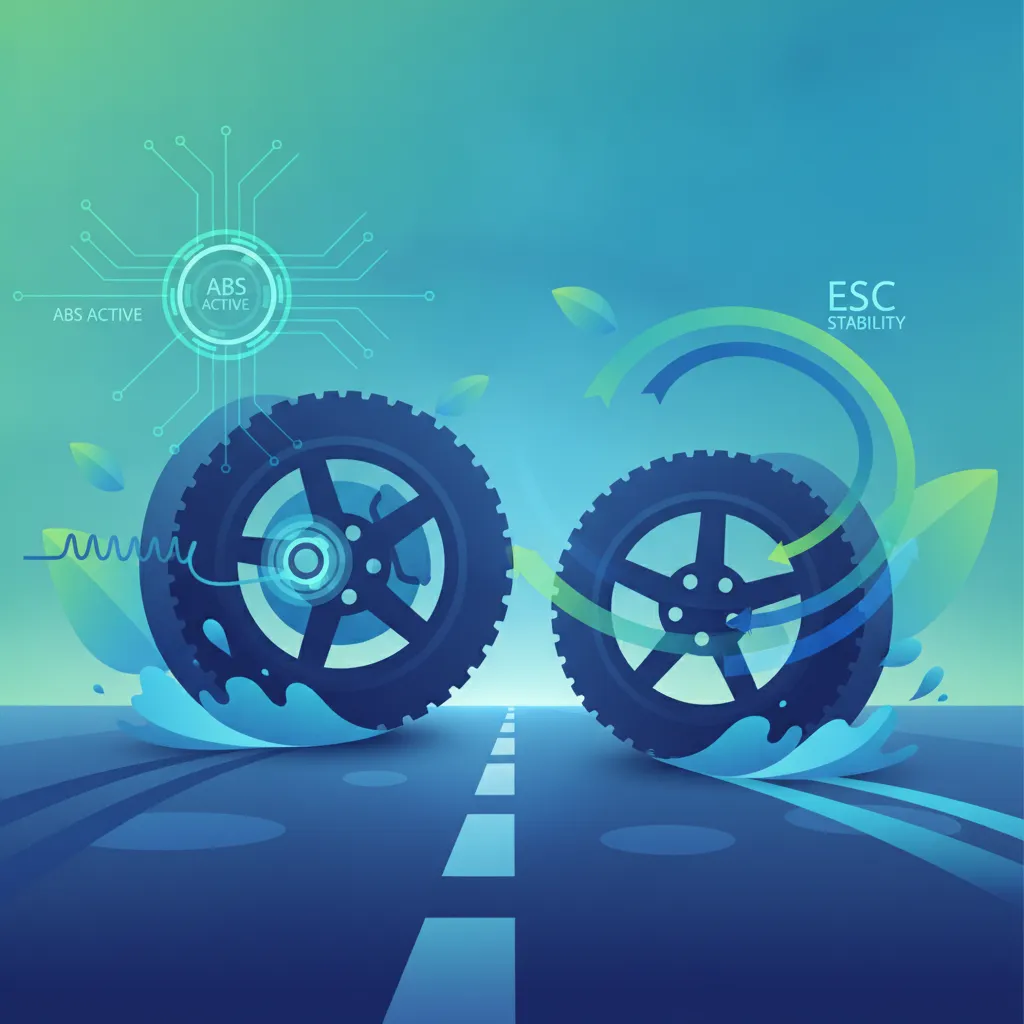
Modern lorries are equipped with advanced electronic safety systems. This lesson explains how the Anti-lock Braking System (ABS) prevents wheels from locking up during hard braking, allowing the driver to maintain steering control. It also covers Electronic Stability Control (ESC), which can detect and mitigate skids or potential rollovers by automatically applying individual brakes and reducing engine power.

This lesson focuses on the rules governing when and how to stop a vehicle safely. You will learn to calculate the required stopping distance, considering reaction time and braking distance. The content also covers how to adjust stopping behavior for different road conditions and safe stopping techniques on inclines to ensure the vehicle remains under control.
This lesson provides instruction on how to perform an emergency stop safely and effectively. It covers techniques for applying maximum braking force without losing control, both in a straight line and while in a lean. Understanding how to manage traction and stability during a sudden stop is a vital skill for avoiding hazards.

Driving in the Alps requires a high level of skill and vehicle sympathy. This lesson covers techniques for climbing steep gradients by selecting the correct gear to maintain momentum without straining the engine. It reiterates the critical importance of using low gears and auxiliary brakes for descending, to ensure the service brakes remain cool and effective for the entire descent.

Large passenger vehicles rely on powerful air brake systems. This lesson explains how these systems work, including the importance of monitoring air pressure. It also details the function and proper use of auxiliary braking systems (retarders) to control speed on long descents and reduce wear on the service brakes.

This lesson focuses on driving on mountain roads, addressing steep gradients, hairpin bends, and altitude-related challenges. You will learn proper techniques for climbing ascents and using engine braking on descents. The content also covers the use of snow chains, recognizing avalanche risks, and interpreting mountain road signs for safe alpine navigation.

This lesson focuses on safe reversing techniques, emphasizing the use of mirrors, rearview cameras, and checking rear visibility. You will learn to control reversing speed and safely reverse around corners or in narrow spaces. The content also outlines the necessary safety checks to perform before and during any reversing maneuver to prevent accidents.

Wet or icy roads drastically reduce tyre grip and can double or triple braking distances. This lesson stresses the importance of significantly reducing overall speed and increasing following distances in such conditions. It advises on using brakes with extreme care to avoid skidding and explains how the vehicle's retarder should be used with caution as it can cause the drive wheels to lock up on slippery surfaces.

This lesson focuses on calculating total stopping distance, incorporating perception-reaction distance and the vehicle's braking distance. You will also learn to determine an appropriate following gap based on speed, visibility, and road conditions. The content emphasizes maintaining a safe distance to avoid collisions, especially in adverse weather.
Learn the correct driver responses during emergency braking situations where ABS and ESC systems activate. Understand how to maintain vehicle control and leverage these safety features effectively according to Swiss road law.
Modern lorries are equipped with advanced electronic safety systems. This lesson explains how the Anti-lock Braking System (ABS) prevents wheels from locking up during hard braking, allowing the driver to maintain steering control. It also covers Electronic Stability Control (ESC), which can detect and mitigate skids or potential rollovers by automatically applying individual brakes and reducing engine power.

This lesson covers essential first aid skills and the procedures for reporting accidents in Switzerland. It details the use of emergency numbers 112 and 144, the correct placement of warning triangles, and the use of high-visibility vests. The content outlines the steps for securing an accident scene, providing assistance, and coordinating with emergency services.
This lesson provides instruction on how to perform an emergency stop safely and effectively. It covers techniques for applying maximum braking force without losing control, both in a straight line and while in a lean. Understanding how to manage traction and stability during a sudden stop is a vital skill for avoiding hazards.
This lesson equips riders with essential knowledge for responding to an accident. It covers how to secure the scene to prevent further incidents, assess any casualties, and provide basic first aid. Crucially, it explains the difference between the general emergency number (112) and the medical emergency number (144) and what information to give the operator.

A tyre blowout or engine failure can be a frightening experience. This lesson provides a clear action plan: maintain a firm grip on the steering wheel, avoid harsh braking, signal, and move the vehicle to a safe location like the hard shoulder if possible. It then covers the essential safety steps of activating hazard lights, placing the warning triangle, and waiting in a safe place away from the vehicle.

After stopping for an emergency, making the scene safe is the top priority. This lesson details the procedure: activate hazard warning lights, put on high-visibility clothing before exiting the cab, and place the warning triangle at the correct distance behind the vehicle (at least 100m on motorways). This warns approaching traffic and creates a safer environment for the driver and emergency responders.
Find clear answers to common questions learners have about Braking Systems: ABS and ESC. Learn how the lesson is structured, which driving theory objectives it supports, and how it fits into the overall learning path of units and curriculum progression in Switzerland. These explanations help you understand key concepts, lesson flow, and exam focused study goals.
Not necessarily. While ABS prevents wheel lock-up, allowing you to maintain steering control during emergency braking, the actual stopping distance depends largely on tyre condition and road surface. ABS is designed primarily for steerability, not just distance reduction.
ESC or Electronic Stability Control is designed to prevent skidding and loss of control by automatically applying brakes to individual wheels. It helps the car follow the direction the driver is steering, particularly in corners or on slippery surfaces.
Yes, you may encounter questions about vehicle safety systems, including the function and dashboard warning lights for ABS and ESC. Understanding these systems is part of the requirement for being a knowledgeable and safe driver.
If the ABS light stays on, it indicates a fault in the system. You should have the vehicle inspected by a professional immediately, as your emergency braking performance will be compromised, though the standard hydraulic brakes will generally still function.
Pinpoint specific Swiss traffic rules, road signs, or driving situations you need to master. Use the practice search to start a focused revision session now and build confidence for your official driving theory exam.