
This lesson explores the essential endurance braking systems required for safe heavy goods vehicle operation in Switzerland. By mastering engine brakes and retarders, you will understand how to manage speed on challenging mountain gradients while protecting your primary service brakes from overheating.
Lesson content overview
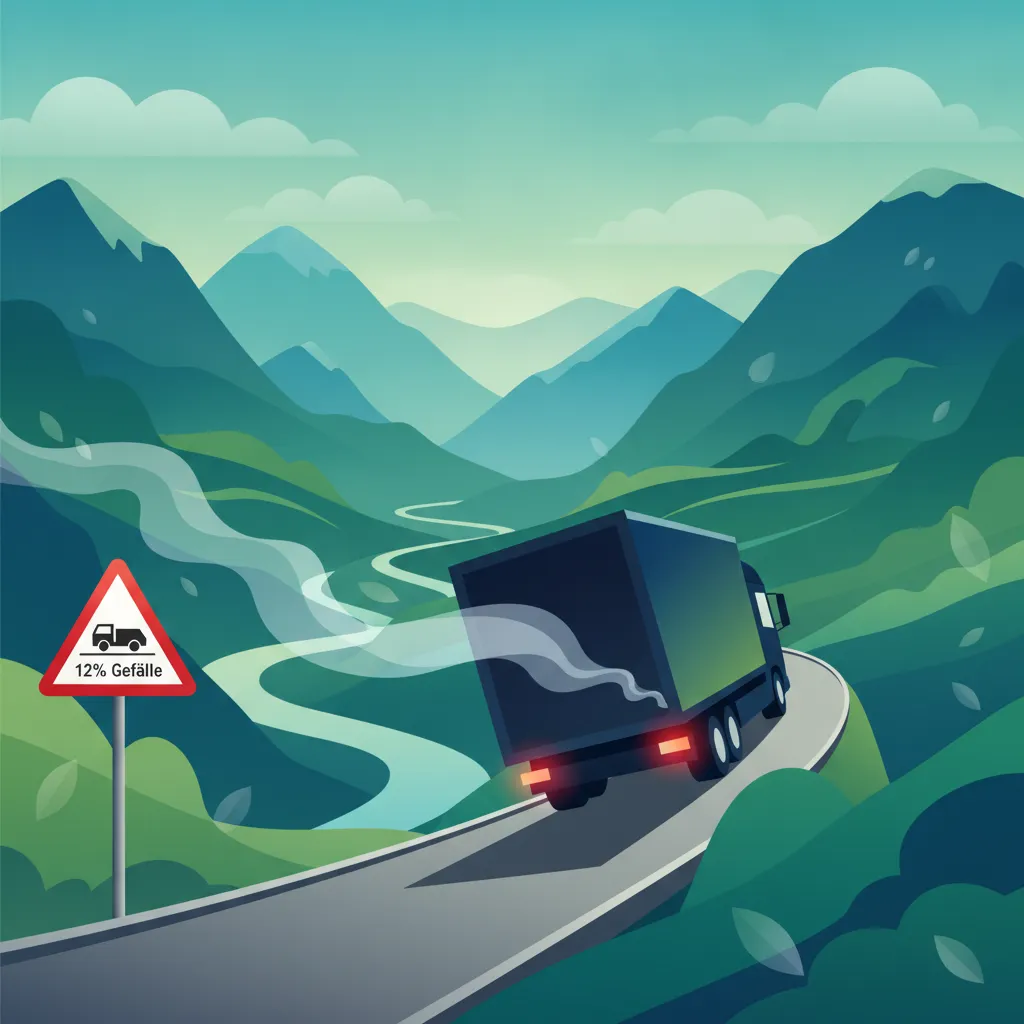
Operating heavy goods vehicles, such as those in Category C and C1, demands a deep understanding of their specialized braking systems. Unlike passenger cars, these large vehicles possess immense kinetic energy, especially when fully loaded and descending long, steep gradients. Relying solely on the primary friction brakes (service brakes) in such conditions can lead to dangerous overheating and a significant reduction in braking effectiveness, a phenomenon known as brake fade. To counteract this, heavy goods vehicles are equipped with advanced auxiliary or endurance braking systems.
This lesson explores the essential role of endurance braking, focusing specifically on engine brakes and retarders. These systems are crucial for maintaining safe, controlled speeds on prolonged descents, protecting the service brakes, and enhancing overall road safety, particularly in challenging terrains like the Swiss Alps. Understanding their function, proper application, and regulatory requirements is fundamental for every professional heavy vehicle driver.
Heavy vehicles, due to their substantial mass, build up enormous kinetic energy when moving, especially on downhill sections. Converting this energy into heat through friction, as the service brakes (Betriebsbremse) do, places immense thermal stress on the brake components. On long descents, continuous use of the service brakes can cause their temperature to rise beyond safe operating limits.
Brake fade is the reduction in braking effectiveness caused by the excessive overheating of friction materials in the service brakes. As temperatures soar, the friction coefficient between the brake pads/linings and discs/drums decreases significantly, leading to a loss of braking power and increased stopping distances.
Brake fade not only compromises safety by making it harder to slow down or stop the vehicle but also accelerates wear on brake components, leading to higher maintenance costs. Endurance braking systems are designed to supplement the service brakes by providing continuous deceleration without relying on friction, thereby preventing overheating and maintaining the readiness of the primary braking system for critical situations.
Engine brakes, often referred to as compression release brakes, are auxiliary braking systems that utilize the vehicle's engine to create a retarding force. They work by converting the engine from a power-producing unit into a power-absorbing compressor, thereby slowing the vehicle down. This system is highly effective when correctly used, especially on long downhill gradients, as it harnesses the engine's natural resistance.
A standard internal combustion engine converts fuel into mechanical energy. During its normal operation, the engine compresses air, injects fuel, ignites it, and expels exhaust gases. An engine brake modifies this process. When activated, the engine brake alters the timing of the exhaust valves.
Instead of the exhaust valve opening after the power stroke, it opens briefly near the top of the compression stroke. This action releases the highly compressed air in the cylinder, preventing it from expanding and pushing the piston back down. Effectively, the engine expends energy compressing air that is then immediately released, creating a resistance or braking effect on the drivetrain. This continuous cycle of compressing and releasing air absorbs kinetic energy from the vehicle, converting it into heat that is dissipated through the engine's cooling system.
While often used interchangeably, there are typically two main categories of engine brakes:
Exhaust Brakes (Auspuffbremse): This simpler system works by creating back-pressure in the exhaust manifold. A valve closes in the exhaust pipe, restricting the flow of exhaust gases. This increased pressure pushes back against the engine's pistons during their exhaust stroke, creating a braking effect. Exhaust brakes are generally less powerful than compression release brakes.
Compression Release Brakes (often called 'Jake Brakes'): This is the more sophisticated and powerful type. The term "Jake Brake" is a brand name (Jacobs Vehicle Systems) that has become synonymous with compression release brakes. As described above, these systems modify the engine's valve timing to release compressed air from the cylinders. This method significantly increases the engine's resistance, providing substantial deceleration. The distinctive "barking" sound often associated with heavy trucks descending a grade is characteristic of a Jake Brake in operation.
The effectiveness of an engine brake is highly dependent on the engine's rotational speed (RPM). For the engine brake to provide maximum retarding force, the engine must operate within its optimal RPM range, typically between 1,500 and 2,500 revolutions per minute for most diesel engines.
To achieve this, the driver must select an appropriate lower gear before beginning a descent. A lower gear ratio means that the engine will turn more revolutions for every rotation of the wheels, keeping the engine RPM high. If the gear selected is too high, the engine RPM will be too low for the engine brake to be effective, forcing the driver to rely more on the service brakes. Conversely, selecting too low a gear can cause the engine to over-rev, potentially leading to damage.
Before starting a descent, shift to a gear that would be necessary to climb the same gradient. This ensures the engine is in the optimal RPM range for the engine brake to work effectively, allowing it to maintain speed without over-revving.
Retarders are another class of auxiliary braking systems specifically designed to provide continuous, friction-free deceleration. Unlike engine brakes, retarders operate independently of the engine's power delivery, meaning they can provide braking force even when the engine is idling or disengaged. They are highly effective, offering smooth, sustained braking and significantly contributing to the safety and longevity of the service brakes.
A hydrodynamic retarder, also known as a fluid retarder, utilizes a viscous fluid (typically oil or water) to create resistance. It consists of two main components: a rotor and a stator, housed within a sealed casing filled with fluid.
The rotor is directly connected to the vehicle's drivetrain (e.g., integrated into the transmission or mounted as a separate unit on the driveshaft), spinning as the vehicle moves. When the retarder is activated, fluid is pumped into the casing. As the rotor spins through this fluid, the fluid is accelerated and directed into the stationary stator. The stator's vanes then redirect the fluid back towards the rotor, creating a powerful resistance to the rotor's motion. This conversion of kinetic energy into heat significantly slows the vehicle. The generated heat is then dissipated via the vehicle's cooling system, often using a dedicated heat exchanger.
Hydrodynamic retarders offer several advantages, including very smooth and controllable braking force across a wide speed range, and they are generally quiet in operation. They are often integrated into the transmission for optimal packaging and efficiency.
Electromagnetic retarders, sometimes called eddy current retarders, employ magnetic forces to generate braking resistance. This system also consists of two primary components: a rotating disc (or discs) attached to the vehicle's drivetrain and stationary electromagnets positioned on either side of the disc.
When activated by the driver, electric current flows through the electromagnets, creating powerful magnetic fields. As the rotating metal disc passes through these magnetic fields, eddy currents are induced within the disc material. According to Lenz's Law, these eddy currents generate their own magnetic fields that oppose the motion of the disc, thereby creating a resistive torque that slows the vehicle. The kinetic energy is converted into heat within the rotating disc, which is then dissipated into the surrounding air through cooling fins or a fan system.
Electromagnetic retarders are typically compact and can be mounted in various locations along the drivetrain, such as on the driveshaft or integrated with the transmission. They provide consistent braking performance, largely independent of external factors like temperature or fluid levels, and are particularly effective even at relatively low speeds.
Endurance braking systems operate on fundamental principles to ensure safe and efficient speed control for heavy goods vehicles.
In Switzerland, specific regulations govern the use of auxiliary braking systems for heavy goods vehicles to ensure safety on its varied terrain, including challenging mountain passes. Adherence to these rules is mandatory for all Category C and C1 drivers.
Swiss road traffic legislation emphasizes the proactive use of auxiliary brakes to prevent accidents caused by brake fade.
Directive 59.58 mandates the use of auxiliary brakes (engine brakes or retarders) on long downhill gradients for heavy goods vehicles to prevent service-brake overheating and maintain vehicle control.
This directive is critical for mountain roads and prolonged descents. Drivers must engage appropriate auxiliary systems before commencing a long or steep descent, not waiting until the vehicle has gained excessive speed. The specific thresholds for what constitutes a "long" or "steep" gradient can vary, requiring careful attention to road signage and local regulations.
While engine brakes are excellent for continuous deceleration, they are not designed to bring a vehicle to a complete halt.
Directive 60.44 requires that engine brakes must be disengaged before the vehicle comes to a complete stop, at which point the service brakes take over for the final deceleration and halt.
Attempting to use an engine brake to stop completely can put undue stress on the engine and drivetrain, and it will not provide the necessary stopping power at very low speeds. The service brakes (Betriebsbremse) are essential for the final phase of stopping.
The use of auxiliary braking systems does not exempt drivers from adhering to posted speed limits.
Regulation 61.30 stipulates that drivers must not exceed maximum permissible speed limits, even when utilizing auxiliary brakes to assist in speed control. Auxiliary brakes support safe driving but do not override legal speed requirements.
Drivers must select a combination of gear and auxiliary brake setting that allows them to remain within the speed limit for the given road conditions and gradient.
The functionality of auxiliary braking systems is paramount for safety.
Regulation 62.00 mandates that drivers must ensure engine brakes and retarders are fully functional as part of their pre-trip vehicle operation checks.
Any fault or malfunction in these systems must be addressed before commencing a journey, especially if the route involves significant descents. Regular maintenance according to manufacturer specifications is also crucial for their reliable operation.
Misusing or neglecting auxiliary braking systems can have severe consequences. Understanding common errors and adopting best practices is key to safe heavy vehicle operation.
One of the most frequent and dangerous mistakes is over-reliance on the service brakes (Betriebsbremse) during long descents.
Proper handling of auxiliary systems is crucial for their effectiveness and longevity.
The effectiveness and safe application of auxiliary brakes can be influenced by environmental factors.
The strategic use of engine brakes and retarders significantly enhances the safety and control of heavy goods vehicles.
Mastering the use of endurance braking systems is a hallmark of a skilled and responsible heavy vehicle driver, contributing significantly to road safety for all.
Endurance braking systems—engine brakes and retarders—are essential for heavy goods vehicles to prevent brake fade on long descents by providing friction-free deceleration. Engine brakes work by modifying valve timing to release compressed air from cylinders, while hydrodynamic retarders use fluid resistance and electromagnetic retarders use eddy current technology. Proper operation requires selecting the correct gear to maintain optimal engine RPM and engaging these systems before commencing a descent. Swiss regulations mandate auxiliary brake use on steep gradients and require disengagement before stopping, while drivers must still observe posted speed limits. The strategic use of these systems preserves service brakes, reduces maintenance costs, and enhances vehicle stability and driver safety on challenging terrain.
A short set of high-value points that capture the most important learning from this lesson.
Engine brakes convert the engine into a power-absorbing compressor by releasing compressed air through modified valve timing, creating resistance without friction
Hydrodynamic retarders use fluid-filled turbines to create resistance, while electromagnetic retarders generate eddy currents in rotating discs to produce braking torque
Retarders operate independently of the engine and can provide braking force even when the engine is idling
Auxiliary braking systems protect service brakes from overheating by handling most deceleration on long descents, keeping them ready for emergency stops
Swiss regulations mandate auxiliary brake use on long downhill gradients before excessive speed builds up
Explore all units and lessons included in this driving theory course.
Engine brake effectiveness depends on engine RPM; select a gear that keeps RPM in the 1500–2500 range for optimal retarding force
Engage auxiliary brakes before starting a descent, not after the vehicle has gained excessive speed
Disengage engine brakes before coming to a complete stop; the service brakes take over for the final deceleration
Hydrodynamic retarders dissipate heat through the cooling system, while electromagnetic retarders cool through fins or fans on the rotating disc
Speed limits must still be observed when using auxiliary brakes—they support safe driving but do not override legal requirements
Relying exclusively on service brakes during long descents, leading to dangerous brake fade and loss of braking effectiveness
Activating the engine brake at too-low RPM (below 1000 rpm), which provides minimal braking effect and can cause engine lugging
Keeping engine brakes engaged when coming to a complete stop, placing undue stress on the engine and drivetrain
Using aggressive auxiliary braking on wet or icy surfaces, which can cause wheel lock-up or loss of traction
Disabling the retarder on long declines to save fuel, risking overheating and temporary loss of braking function
Lesson content overview
A short set of high-value points that capture the most important learning from this lesson.
Engine brakes convert the engine into a power-absorbing compressor by releasing compressed air through modified valve timing, creating resistance without friction
Hydrodynamic retarders use fluid-filled turbines to create resistance, while electromagnetic retarders generate eddy currents in rotating discs to produce braking torque
Retarders operate independently of the engine and can provide braking force even when the engine is idling
Auxiliary braking systems protect service brakes from overheating by handling most deceleration on long descents, keeping them ready for emergency stops
Swiss regulations mandate auxiliary brake use on long downhill gradients before excessive speed builds up
Explore all units and lessons included in this driving theory course.
Engine brake effectiveness depends on engine RPM; select a gear that keeps RPM in the 1500–2500 range for optimal retarding force
Engage auxiliary brakes before starting a descent, not after the vehicle has gained excessive speed
Disengage engine brakes before coming to a complete stop; the service brakes take over for the final deceleration
Hydrodynamic retarders dissipate heat through the cooling system, while electromagnetic retarders cool through fins or fans on the rotating disc
Speed limits must still be observed when using auxiliary brakes—they support safe driving but do not override legal requirements
Relying exclusively on service brakes during long descents, leading to dangerous brake fade and loss of braking effectiveness
Activating the engine brake at too-low RPM (below 1000 rpm), which provides minimal braking effect and can cause engine lugging
Keeping engine brakes engaged when coming to a complete stop, placing undue stress on the engine and drivetrain
Using aggressive auxiliary braking on wet or icy surfaces, which can cause wheel lock-up or loss of traction
Disabling the retarder on long declines to save fuel, risking overheating and temporary loss of braking function
Explore search topics learners often look for when studying Endurance Braking: Engine Brakes and Retarders. These topics reflect common questions about road rules, driving situations, safety guidance, and lesson level theory preparation for learners in Switzerland.
Browse additional driving theory lessons that cover connected traffic rules, road signs, and common driving situations related to this topic. Improve your understanding of how different rules interact across everyday traffic scenarios.
Understand the fundamental differences and operational principles of hydrodynamic and electromagnetic retarders versus engine brakes (compression release and exhaust brakes). Essential Swiss driving theory for heavy vehicle drivers.
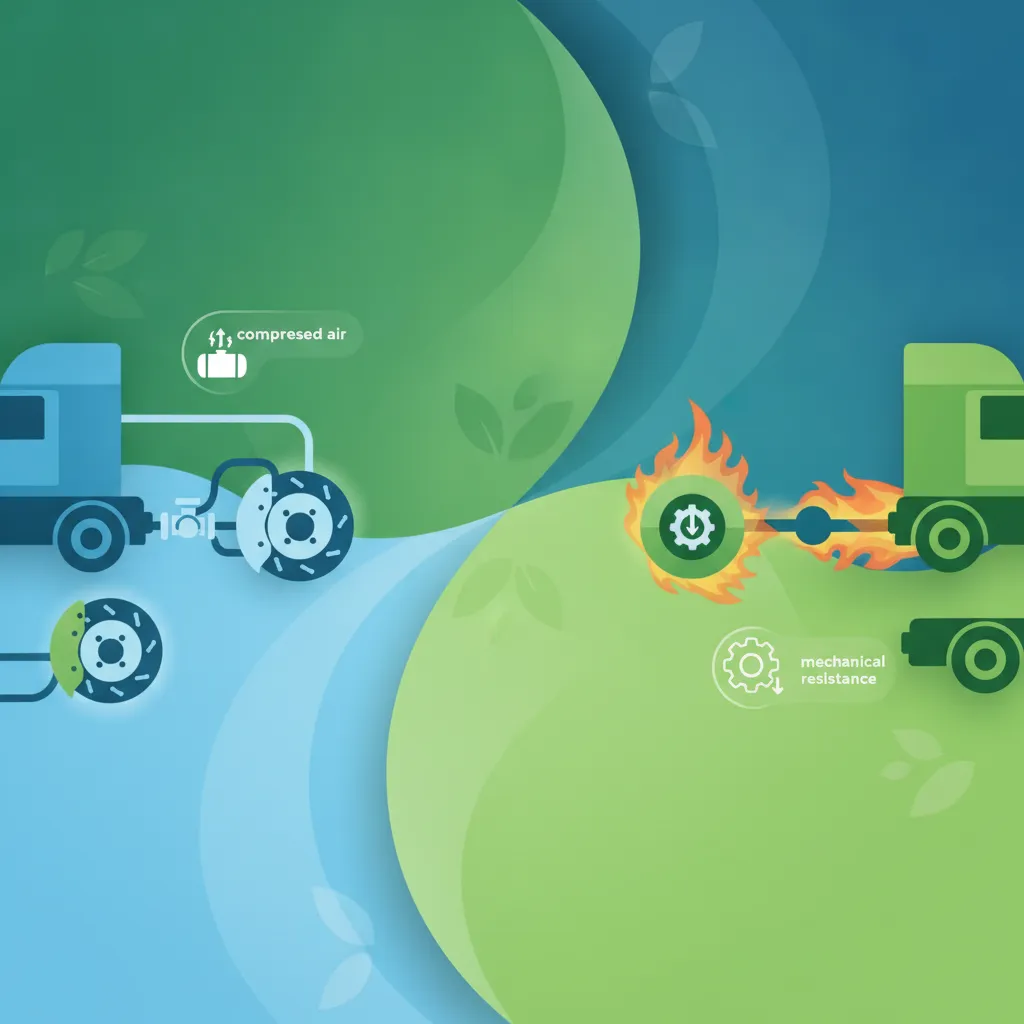
Large passenger vehicles rely on powerful air brake systems. This lesson explains how these systems work, including the importance of monitoring air pressure. It also details the function and proper use of auxiliary braking systems (retarders) to control speed on long descents and reduce wear on the service brakes.
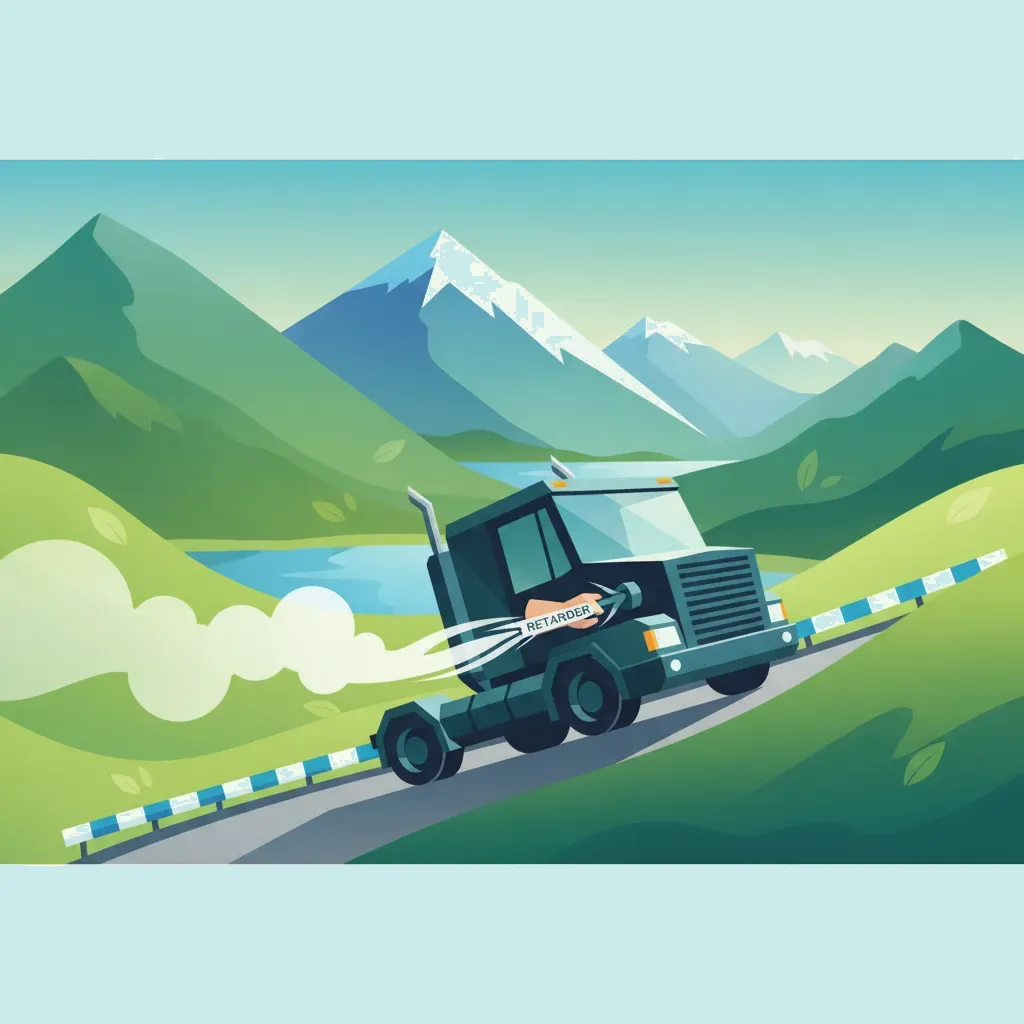
Relying solely on the service brakes on a long downhill stretch can lead to overheating and complete brake failure (brake fade). This lesson explains the function of auxiliary brakes like retarders. You will learn how and when to engage them to maintain a safe, controlled speed, preserving the main brakes for when they are truly needed.
Wet or icy roads drastically reduce tyre grip and can double or triple braking distances. This lesson stresses the importance of significantly reducing overall speed and increasing following distances in such conditions. It advises on using brakes with extreme care to avoid skidding and explains how the vehicle's retarder should be used with caution as it can cause the drive wheels to lock up on slippery surfaces.
Two critical issues can affect air brake performance. This lesson explains brake lag, the slight delay between pressing the pedal and the brakes applying, and brake fade, a dangerous loss of braking power caused by overheating from prolonged or heavy use. It emphasizes that using endurance brakes and selecting the correct gear on descents are key techniques to prevent brake fade.
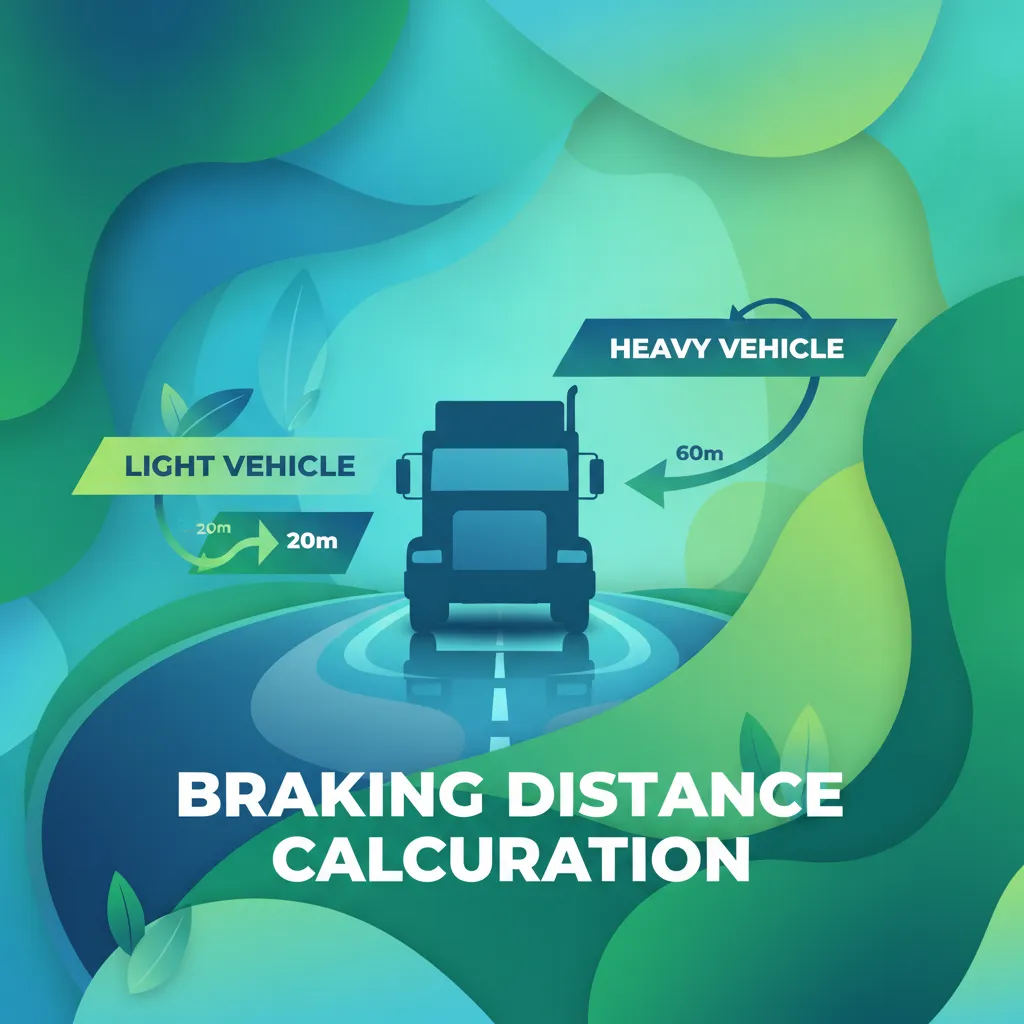
The immense mass of a loaded truck means its braking distance is far greater than that of a car. This lesson breaks down total stopping distance into reaction distance and braking distance, explaining how speed, weight, and road conditions have an exponential effect. It reinforces the necessity of maintaining a significantly larger following distance to ensure enough space to stop safely in an emergency.

This lesson details the function of the two primary braking circuits. The service brake (Betriebsbremse) is the main system operated by the foot pedal for slowing and stopping the vehicle. The parking brake (Feststellbremse) is a powerful spring-applied system that is held off by air pressure, meaning it engages automatically if a major air leak occurs, serving as a critical fail-safe.

Driving in the Alps requires a high level of skill and vehicle sympathy. This lesson covers techniques for climbing steep gradients by selecting the correct gear to maintain momentum without straining the engine. It reiterates the critical importance of using low gears and auxiliary brakes for descending, to ensure the service brakes remain cool and effective for the entire descent.
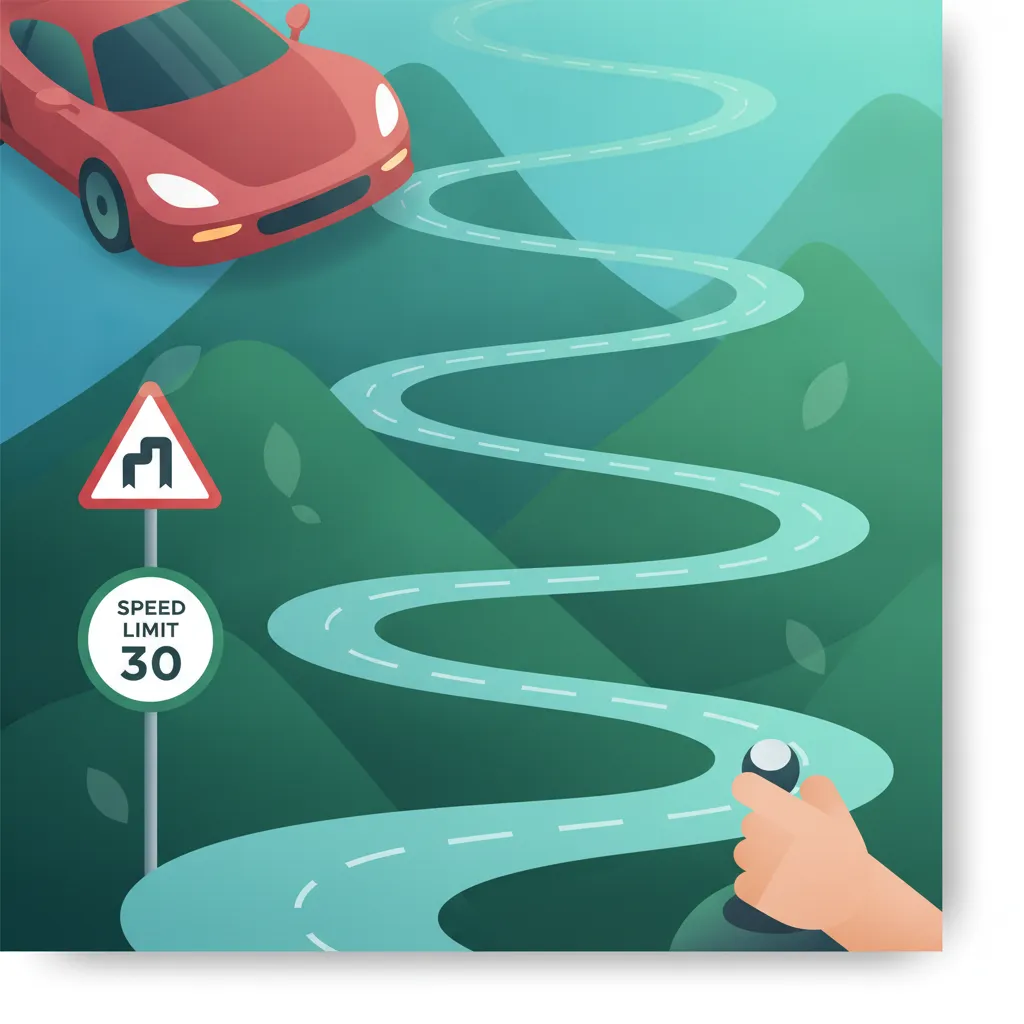
Controlling a heavy vehicle on a steep downhill grade requires a specific technique to avoid disaster. This lesson teaches the golden rule: select a low gear before starting the descent, one that is low enough to control the speed with minimal use of the service brakes. It explains how to effectively combine this with the engine brake or retarder to maintain a safe, steady speed and keep the service brakes cool and ready for an emergency.

Driving a large vehicle on mountain passes is a demanding skill. This lesson covers selecting the correct gear for both ascents and descents to maintain control and avoid overheating the brakes. It also explains the specific priority rules that apply on mountain roads and the importance of being aware of sudden weather changes.
Learn about the specific risks associated with long downhill gradients for heavy vehicles in Switzerland, including brake fade, and the essential techniques for maintaining control using auxiliary braking systems.
Controlling a heavy vehicle on a steep downhill grade requires a specific technique to avoid disaster. This lesson teaches the golden rule: select a low gear before starting the descent, one that is low enough to control the speed with minimal use of the service brakes. It explains how to effectively combine this with the engine brake or retarder to maintain a safe, steady speed and keep the service brakes cool and ready for an emergency.
Driving in the Alps requires a high level of skill and vehicle sympathy. This lesson covers techniques for climbing steep gradients by selecting the correct gear to maintain momentum without straining the engine. It reiterates the critical importance of using low gears and auxiliary brakes for descending, to ensure the service brakes remain cool and effective for the entire descent.

Rural roads present challenges like narrow lanes, poor surfaces, sharp bends, and limited visibility. This lesson teaches drivers how to position their large vehicle to maximize space and visibility, anticipate oncoming traffic at blind corners, and be aware of specific rural hazards. These hazards include slow-moving agricultural vehicles, animals on the road, and concealed farm entrances.
Driving a large vehicle on mountain passes is a demanding skill. This lesson covers selecting the correct gear for both ascents and descents to maintain control and avoid overheating the brakes. It also explains the specific priority rules that apply on mountain roads and the importance of being aware of sudden weather changes.
Motorway driving requires constant concentration due to high speeds. This lesson emphasizes the importance of staying in the right-hand lane unless overtaking and the specific restrictions on lorry overtaking in Switzerland. It reinforces the need for a following distance of at least four seconds to compensate for the vehicle's long stopping distance and provides guidance on safely merging and exiting.

This lesson focuses on driving on mountain roads, addressing steep gradients, hairpin bends, and altitude-related challenges. You will learn proper techniques for climbing ascents and using engine braking on descents. The content also covers the use of snow chains, recognizing avalanche risks, and interpreting mountain road signs for safe alpine navigation.
Wet or icy roads drastically reduce tyre grip and can double or triple braking distances. This lesson stresses the importance of significantly reducing overall speed and increasing following distances in such conditions. It advises on using brakes with extreme care to avoid skidding and explains how the vehicle's retarder should be used with caution as it can cause the drive wheels to lock up on slippery surfaces.
Motorway driving involves high speeds and requires constant concentration. This lesson covers correct lane discipline, safe procedures for joining and leaving the motorway, and techniques for overtaking other large vehicles. Maintaining appropriate speed and a safe following distance is emphasized throughout.

This lesson focuses on general driving safety in areas with a high concentration of children. It stresses the importance of significantly reducing speed, being prepared for unexpected events, and scanning for children between parked cars. The driver must exhibit maximum vigilance in these high-risk environments at all times.
Rural driving requires a different mindset from urban driving. This lesson covers how to position your vehicle on narrow roads, how to use passing places effectively, and how to anticipate hazards like slow-moving farm machinery, animals, and concealed junctions. Managing vehicle width and height is a key focus.
Find clear answers to common questions learners have about Endurance Braking: Engine Brakes and Retarders. Learn how the lesson is structured, which driving theory objectives it supports, and how it fits into the overall learning path of units and curriculum progression in Switzerland. These explanations help you understand key concepts, lesson flow, and exam focused study goals.
On long or steep descents, continuous use of the service brake causes friction heat to build up rapidly, leading to 'brake fade' where the braking effect decreases significantly. Endurance brakes dissipate this energy without relying on the friction of the wheel brakes.
An engine brake alters the valve timing to turn the engine into a compressor that slows the vehicle. A retarder, which can be hydrodynamic or electromagnetic, uses fluid or magnetic resistance to provide smooth, continuous braking force independently of the engine's rotation speed.
No, the retarder is an auxiliary system. You must always maintain appropriate gear selection to provide engine braking as well, and be ready to use the service brake for emergency stops. The retarder is a supplement, not a total replacement.
Yes, however, most modern heavy vehicle systems are designed to automatically disable the retarder if the ABS sensors detect a risk of wheel lock to maintain directional stability on slippery surfaces.
Pinpoint specific Swiss traffic rules, road signs, or driving situations you need to master. Use the practice search to start a focused revision session now and build confidence for your official driving theory exam.