
This lesson provides specialized instruction on navigating Swiss mountain passes safely while operating a large passenger vehicle. You will learn critical techniques for managing heavy vehicles on steep gradients and complex terrain, ensuring you are prepared for both the theory exam and real-world professional driving duties.
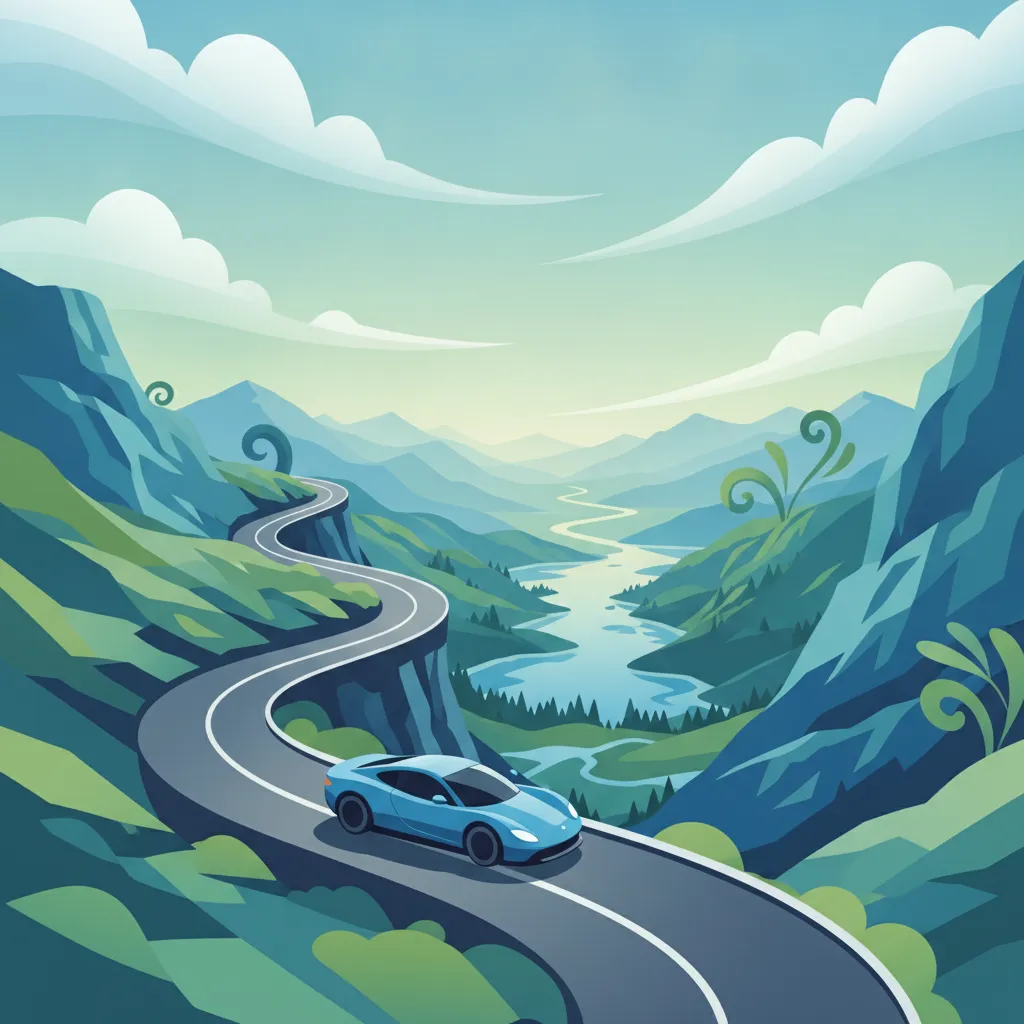
Lesson content overview
Driving a large passenger vehicle, such as a bus or coach, through the challenging terrain of Swiss mountain passes demands exceptional skill, foresight, and a thorough understanding of specialized driving techniques and regulations. These demanding routes feature steep gradients, sharp curves known as switchbacks, and often unpredictable weather conditions. Mastering these techniques is crucial for ensuring passenger safety, maintaining vehicle control, and preventing mechanical issues like brake overheating.
This lesson provides an in-depth exploration of the strategies and rules essential for safely navigating Swiss mountain passes, focusing on aspects critical for a Swiss Category D Driving License Theory Course. We will cover correct gear selection for both ascents and descents, advanced braking techniques, specific priority rules unique to mountain roads, and how to adapt your driving to sudden environmental changes.
Swiss mountain passes are renowned for their breathtaking scenery but also present significant driving challenges, especially for heavy passenger vehicles. The inherent physics of larger, heavier vehicles means they accumulate greater kinetic energy, requiring more effective and sustained braking power on descents and significant torque on ascents.
The unique topography of mountain roads — with their dramatic elevation changes, narrow sections, and often poor visibility — creates an environment where standard driving techniques are insufficient. Professional bus and coach drivers must possess an advanced skill set to manage vehicle dynamics under these extreme conditions. This includes precise control over speed, steering, and most critically, braking and gear selection. Ignoring these specialized demands can lead to serious consequences, from mechanical failure to loss of control.
Heavy vehicles face amplified risks on mountain passes. The primary concerns include:
Appropriate gear selection is arguably the single most important technique for maintaining control of a heavy vehicle on mountain roads. It directly impacts engine performance, fuel efficiency, and, crucially, the strain on your braking system.
When climbing steep mountain gradients, the objective is to maintain sufficient engine torque to prevent stalling and ensure a smooth, consistent ascent. This typically means selecting a lower gear than you would on flat terrain.
Before beginning a steep ascent, you should anticipate the incline and proactively downshift into a gear that allows the engine to operate within its optimal power band. For many heavy passenger vehicles, this might be 2nd or 3rd gear for very steep sections, or 4th or 5th gear for more moderate inclines. The aim is to achieve a steady climb without over-revving the engine or, conversely, letting the engine "lug" (struggle in too high a gear). Relying on clutch slipping to maintain momentum on an incline is strictly prohibited and can cause rapid clutch wear and overheating. Early downshifting prevents loss of momentum and the need for excessive acceleration, which can cause wheel spin on loose or wet surfaces.
Descending a mountain pass requires an equally strategic approach to gear selection, but for a different purpose: to harness engine braking. This technique uses the compression resistance within the engine to slow the vehicle, thereby reducing the reliance on the service brakes and preventing them from overheating.
Before you begin a descent, it is critical to downshift into a low gear, typically the same or one gear lower than you would use to climb the same gradient. This proactive downshifting should occur before the steep section begins, allowing the engine to provide significant resistance and control your speed. For instance, on a 12% grade, you might select 3rd gear. This strategy is complemented by the use of auxiliary braking systems (retarders), which we will discuss next. The goal is to maintain a safe, controlled speed without needing to continuously press the service brake pedal, thus averting brake fade.
On long and steep descents, a multi-pronged approach to braking is essential for heavy vehicles. Relying solely on service brakes is dangerous due to the risk of overheating. Instead, drivers must combine engine braking with auxiliary braking systems and judicious use of the service brakes.
Modern buses and coaches are equipped with powerful auxiliary brakes, often called retarders. These non-friction braking systems (hydraulic or electromagnetic) significantly aid in controlling vehicle speed on descents without generating heat in the service brakes. The retarder works by creating resistance within the drivetrain, effectively slowing the vehicle.
Retarders are mandatory for use on prolonged descents. They distribute the braking effort across different systems, dramatically reducing the thermal load on the service brakes. For descents longer than approximately 3 kilometers with gradients exceeding 6%, the use of auxiliary brakes is legally required. Drivers must learn to engage the retarder smoothly and at an appropriate level to maintain a steady, safe speed. This allows the service brakes to remain cool and fully effective for emergency stops or when additional braking power is momentarily needed.
Even with engine braking and retarders engaged, there will be times when service brakes are necessary to reduce speed further or bring the vehicle to a complete stop. However, their use on descents must be strategic and intermittent.
Instead of continuous pressure, service brakes should be applied with short, firm applications followed by periods of release, allowing the brakes to cool. This technique, often called "stab braking" or "snub braking," is crucial for thermal management. The rule of thumb is that service brakes should generally not be applied continuously for more than 30 seconds on steep descents. By using them intermittently, you reduce speed in controlled increments while allowing airflow to cool the brake components, preventing the buildup of excessive heat that leads to brake fade. Regularly monitoring brake temperature through dashboard indicators, if available, can also guide your braking strategy.
Swiss mountain roads have specific priority rules designed to ensure safety and prevent stalemates on narrow sections. These rules often supersede general right-of-way principles and are critical for bus and coach drivers.
On narrow mountain roads where two vehicles cannot pass each other simultaneously, vehicles traveling uphill generally have priority over those traveling downhill. This rule is particularly important for heavy vehicles like buses and coaches, as they have significantly more difficulty restarting after stopping on a steep incline and require more effort to regain momentum.
When you encounter this situation, especially at blind curves or constricted passages, if you are driving downhill, you must be prepared to stop and yield, allowing the uphill vehicle to proceed. Anticipation and early detection of oncoming traffic are key to making a safe decision.
Many narrow mountain roads are equipped with designated passing places (Ausweichstellen). These are widened sections or pull-outs where a vehicle can safely wait to allow oncoming traffic to pass.
When two large vehicles approach each other on a single-lane stretch, the driver who is closest to a passing place, or who can reach one safely, should pull in and wait. If both are equally distant, or if the situation is ambiguous, the downhill driver usually takes precedence in finding a safe spot to yield due to the uphill priority rule. It is imperative to use these areas correctly to prevent traffic blockages and dangerous maneuvers.
Overtaking on mountain roads is generally discouraged and often prohibited due to limited visibility, sharp curves, and narrow passages. For a bus or coach, overtaking another vehicle, especially an uphill one, requires significant clear space and is extremely risky.
You should only attempt to overtake if the road signs explicitly allow it, there is ample clear visibility, and you can complete the maneuver safely without impeding oncoming traffic or forcing other drivers to take evasive action. Always assume that conditions around blind curves or over crests could change rapidly. If in doubt, do not overtake. Patience is a virtue on mountain roads.
Mountain weather is notoriously fickle and can change dramatically within a short period, transforming safe driving conditions into hazardous ones. Professional drivers must be prepared to adjust their driving style instantly.
Fog, heavy rain, or even thick clouds can descend rapidly on mountain passes, drastically reducing visibility to just a few meters. In such conditions, your speed must be immediately and significantly reduced.
When visibility drops below 100 meters due to fog, heavy rain, or dusk, it is mandatory to switch on your low beam headlights (Abblendlicht). These headlights are designed to illuminate the road ahead without blinding oncoming drivers, and they make your vehicle much more visible to others. In very dense fog, some vehicles are equipped with fog lights, which can also be used, but they are not a substitute for low beams. Maintaining normal speed in reduced visibility is a common and dangerous mistake. Speed limits are typically reduced by 30 km/h in such adverse conditions, unless otherwise indicated by signage. Always increase your following distance to provide more reaction time.
Snow and ice present the most challenging conditions on mountain passes, severely reducing tire traction. If you encounter these conditions, your driving must become extremely cautious and smooth.
A crucial aspect of mountain driving is continuous awareness and anticipation. Monitor weather forecasts before and during your journey. Observe changes in temperature, cloud formations, and local road signs warning of potential hazards. The road surface can change quickly from dry to wet, or even icy, especially in shaded areas or tunnels. Be vigilant for dark, damp patches that might conceal black ice. Proactive adjustment is always safer than reactive panic.
Understanding common pitfalls is as important as knowing the correct procedures. Many incidents on mountain roads occur due to preventable errors.
Mastering mountain pass driving techniques is not an isolated skill; it builds upon and reinforces many foundational driving principles covered elsewhere in the Swiss Category D Driving License Theory Course.
This lesson on mountain passes directly leverages your understanding of vehicle dynamics (Lesson 4), particularly concepts related to braking, speed control, and the mechanical function of gears. It also expands on general priority rules (Lesson 6) by introducing specific mountain road variations and deepens your knowledge of auxiliary brakes (Lesson 9.3). The emphasis on adapting to weather directly applies principles from weather conditions (Lesson 9.6).
A solid grasp of basic vehicle dynamics, general Swiss road signs, and the specifications of Category D vehicles (weight, passenger capacity, braking system) are prerequisites for this lesson. The skills developed here, especially concerning vehicle control in challenging environments, will serve as a crucial foundation for future lessons on advanced maneuvering (Lesson 8), which will explore tight turns and blind spots further, and fatigue and emergency management (Lesson 10), where mountain scenarios often present complex emergency situations.
Let's apply these concepts to common situations encountered on Swiss mountain passes.
Navigating Swiss mountain passes in a bus or coach is a highly specialized skill that combines a deep understanding of vehicle dynamics, adherence to specific traffic regulations, and a proactive approach to ever-changing environmental conditions. By diligently applying the techniques discussed – mastering gear selection for both ascents and descents, utilizing advanced braking strategies including retarders, respecting unique mountain priority rules, and adapting swiftly to adverse weather – professional drivers can ensure the safety and comfort of their passengers. This commitment to safe driving not only protects lives but also upholds the high standards expected of a Category D license holder in Switzerland.
This lesson covers the specialized techniques required for safely operating a Category D vehicle on Swiss mountain passes, focusing on gear selection strategy, auxiliary braking systems, and mountain-specific traffic rules. Learners must understand that engine braking and retarders are essential for controlling heavy vehicles on descents, while uphill priority governs right-of-way on narrow roads. The content also emphasizes adapting driving to rapidly changing weather conditions including fog, rain, and snow, with specific guidance on speed reduction and headlight usage. Key exam-relevant concepts include brake fade prevention, correct gear ratios for various gradients, and the proper use of passing places to prevent traffic blockages.
A short set of high-value points that capture the most important learning from this lesson.
Engine braking through appropriate gear selection is the primary method for controlling speed on mountain descents, not continuous service brake application.
Auxiliary brakes (retarders) are legally required on descents longer than approximately 3 km with gradients exceeding 6% to prevent brake fade.
On narrow mountain roads, vehicles traveling uphill have priority over downhill traffic, requiring the downhill driver to yield and potentially use a passing place.
Retarders, engine braking, and intermittent service brake applications must be used in combination to manage thermal load and maintain braking effectiveness.
Weather on mountain passes can change rapidly, and speed must be reduced significantly in fog, heavy rain, or snow, with low beam headlights activated when visibility drops below 100 metres.
Explore all units and lessons included in this driving theory course.
For steep descents, downshift to a lower gear than you would use to climb the same gradient, engaging engine braking before the steep section begins.
Service brakes should not be applied continuously for more than 30 seconds on steep descents; use short, firm intermittent applications instead.
When two large vehicles meet on a single-lane mountain road, the downhill driver typically yields to allow the uphill vehicle to proceed.
In dense fog or heavy rain on mountain passes, reduce speed by approximately 30 km/h below the posted limit and increase following distance substantially.
On icy or snowy surfaces, use even lower gears than on dry conditions and apply retarders with extreme caution to avoid drive-wheel skidding.
Riding the service brakes continuously on a long descent causes overheating and brake fade, potentially leading to complete loss of braking ability.
Failing to downshift early enough before a steep section, which forces reliance on service brakes and risks being unable to select the correct gear without over-revving.
Ignoring the uphill priority rule on narrow roads and attempting to maintain momentum, forcing the uphill vehicle to stop on a steep grade where restarting is difficult.
Driving at normal speeds in reduced visibility conditions such as fog or heavy rain, without activating low beam headlights or increasing following distance.
Using the retarder aggressively on icy surfaces, which can induce drive-wheel skidding due to sudden engine braking resistance.
Lesson content overview
A short set of high-value points that capture the most important learning from this lesson.
Engine braking through appropriate gear selection is the primary method for controlling speed on mountain descents, not continuous service brake application.
Auxiliary brakes (retarders) are legally required on descents longer than approximately 3 km with gradients exceeding 6% to prevent brake fade.
On narrow mountain roads, vehicles traveling uphill have priority over downhill traffic, requiring the downhill driver to yield and potentially use a passing place.
Retarders, engine braking, and intermittent service brake applications must be used in combination to manage thermal load and maintain braking effectiveness.
Weather on mountain passes can change rapidly, and speed must be reduced significantly in fog, heavy rain, or snow, with low beam headlights activated when visibility drops below 100 metres.
Explore all units and lessons included in this driving theory course.
For steep descents, downshift to a lower gear than you would use to climb the same gradient, engaging engine braking before the steep section begins.
Service brakes should not be applied continuously for more than 30 seconds on steep descents; use short, firm intermittent applications instead.
When two large vehicles meet on a single-lane mountain road, the downhill driver typically yields to allow the uphill vehicle to proceed.
In dense fog or heavy rain on mountain passes, reduce speed by approximately 30 km/h below the posted limit and increase following distance substantially.
On icy or snowy surfaces, use even lower gears than on dry conditions and apply retarders with extreme caution to avoid drive-wheel skidding.
Riding the service brakes continuously on a long descent causes overheating and brake fade, potentially leading to complete loss of braking ability.
Failing to downshift early enough before a steep section, which forces reliance on service brakes and risks being unable to select the correct gear without over-revving.
Ignoring the uphill priority rule on narrow roads and attempting to maintain momentum, forcing the uphill vehicle to stop on a steep grade where restarting is difficult.
Driving at normal speeds in reduced visibility conditions such as fog or heavy rain, without activating low beam headlights or increasing following distance.
Using the retarder aggressively on icy surfaces, which can induce drive-wheel skidding due to sudden engine braking resistance.
Explore search topics learners often look for when studying Safe Driving Techniques for Swiss Mountain Passes. These topics reflect common questions about road rules, driving situations, safety guidance, and lesson level theory preparation for learners in Switzerland.
Browse additional driving theory lessons that cover connected traffic rules, road signs, and common driving situations related to this topic. Improve your understanding of how different rules interact across everyday traffic scenarios.
Learn to manage heat and prevent brake fade on steep Swiss mountain passes. This lesson details the combined use of engine braking, retarders, and intermittent service brake application for safe heavy vehicle control during descents.
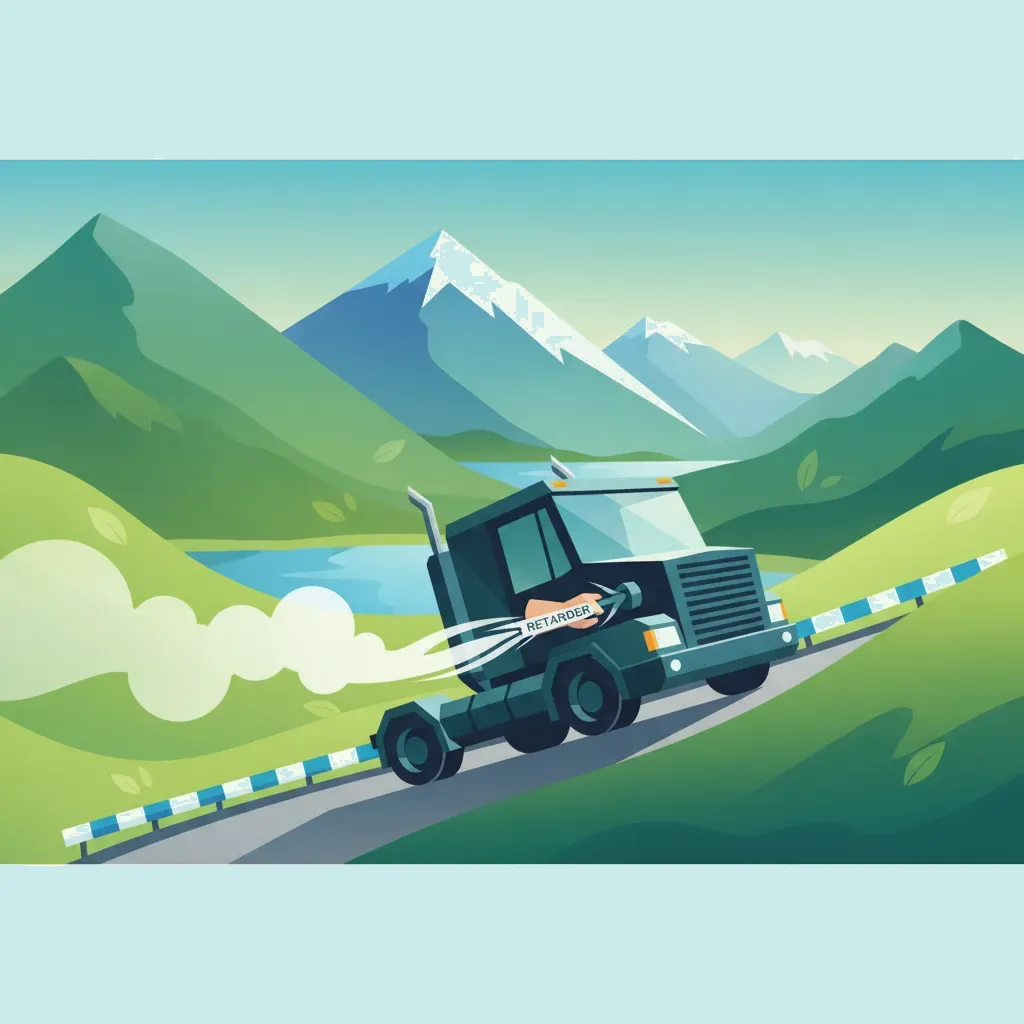
Relying solely on the service brakes on a long downhill stretch can lead to overheating and complete brake failure (brake fade). This lesson explains the function of auxiliary brakes like retarders. You will learn how and when to engage them to maintain a safe, controlled speed, preserving the main brakes for when they are truly needed.
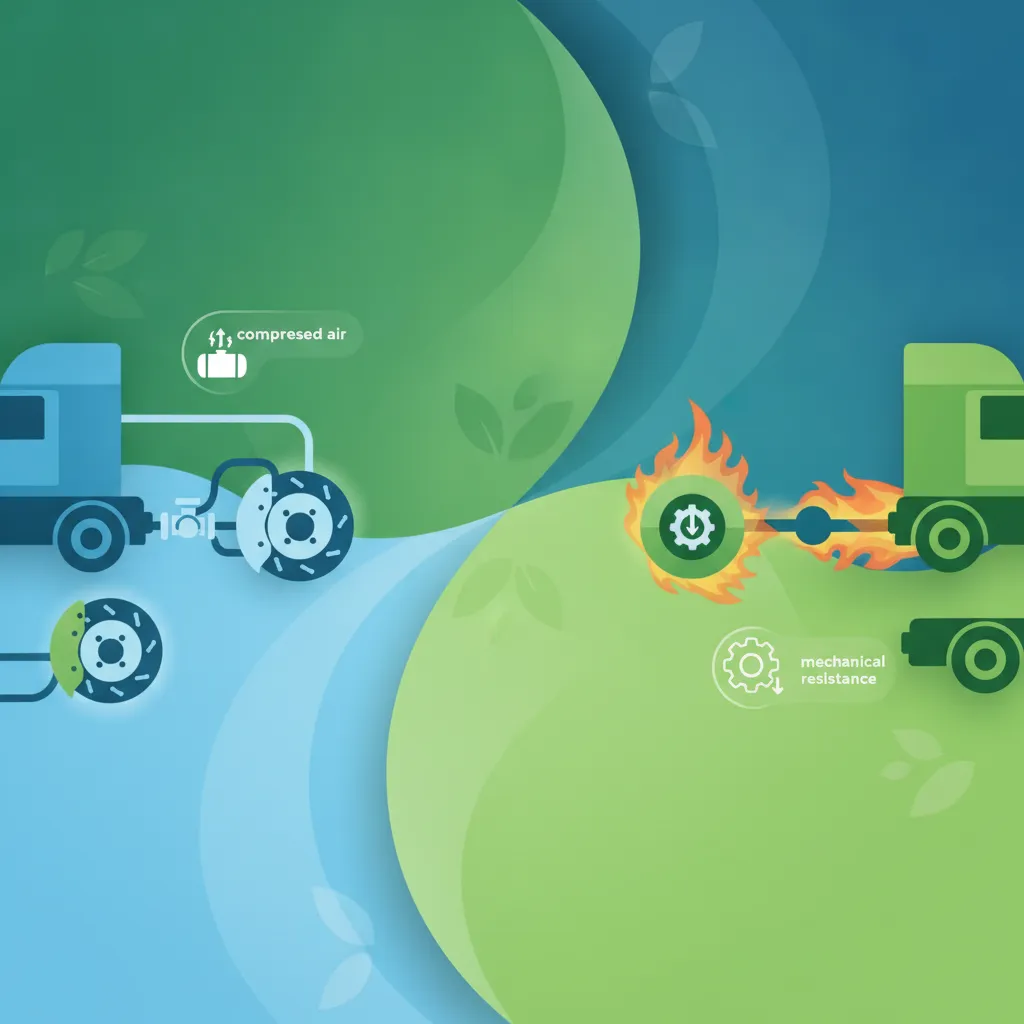
Large passenger vehicles rely on powerful air brake systems. This lesson explains how these systems work, including the importance of monitoring air pressure. It also details the function and proper use of auxiliary braking systems (retarders) to control speed on long descents and reduce wear on the service brakes.
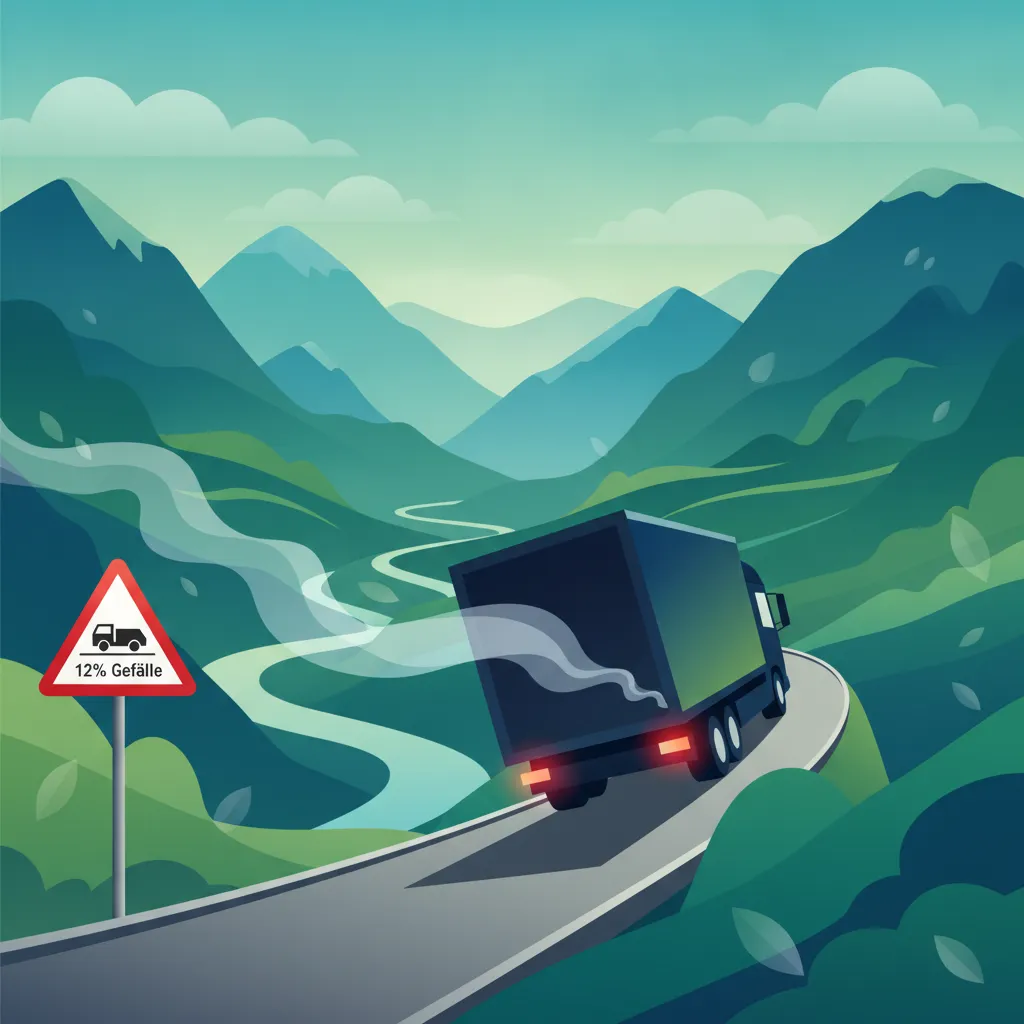
To prevent the service brakes from overheating and failing on long downhill gradients, heavy vehicles are equipped with endurance (or auxiliary) braking systems. This lesson explains the function of engine brakes (which alter valve timing) and retarders (which use hydrodynamic or electromagnetic force). These systems allow the driver to maintain a safe, controlled speed without relying solely on the service brakes.

This lesson focuses entirely on the technique of applying brakes smoothly and gradually. You will learn how to anticipate stops far in advance, applying gentle initial pressure and increasing it progressively. This method avoids sudden jolts, enhancing comfort and preventing falls, especially for standing passengers.
Wet or icy roads drastically reduce tyre grip and can double or triple braking distances. This lesson stresses the importance of significantly reducing overall speed and increasing following distances in such conditions. It advises on using brakes with extreme care to avoid skidding and explains how the vehicle's retarder should be used with caution as it can cause the drive wheels to lock up on slippery surfaces.
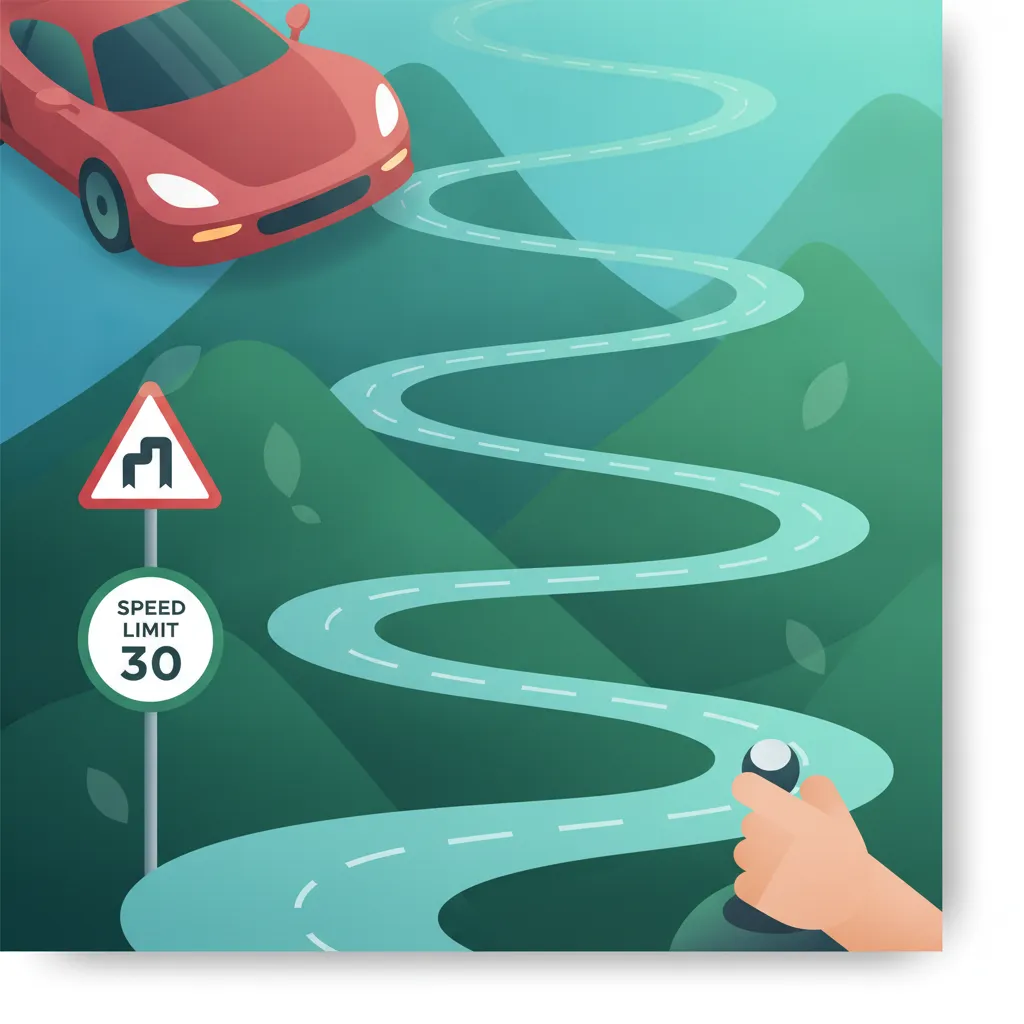
Controlling a heavy vehicle on a steep downhill grade requires a specific technique to avoid disaster. This lesson teaches the golden rule: select a low gear before starting the descent, one that is low enough to control the speed with minimal use of the service brakes. It explains how to effectively combine this with the engine brake or retarder to maintain a safe, steady speed and keep the service brakes cool and ready for an emergency.
Driving in the Alps requires a high level of skill and vehicle sympathy. This lesson covers techniques for climbing steep gradients by selecting the correct gear to maintain momentum without straining the engine. It reiterates the critical importance of using low gears and auxiliary brakes for descending, to ensure the service brakes remain cool and effective for the entire descent.
Two critical issues can affect air brake performance. This lesson explains brake lag, the slight delay between pressing the pedal and the brakes applying, and brake fade, a dangerous loss of braking power caused by overheating from prolonged or heavy use. It emphasizes that using endurance brakes and selecting the correct gear on descents are key techniques to prevent brake fade.
A key aspect of professionalism is the ability to provide a smooth ride. This lesson explains how harsh inputs to the accelerator, brakes, and steering can affect passenger comfort and safety. You will learn anticipation and vehicle control techniques to minimize G-forces and ensure a stable, pleasant journey for everyone on board.
Understand the specific priority rules for uphill traffic on narrow Swiss mountain roads and learn to anticipate sudden weather changes like fog and ice. Essential knowledge for safe bus operation in alpine environments.
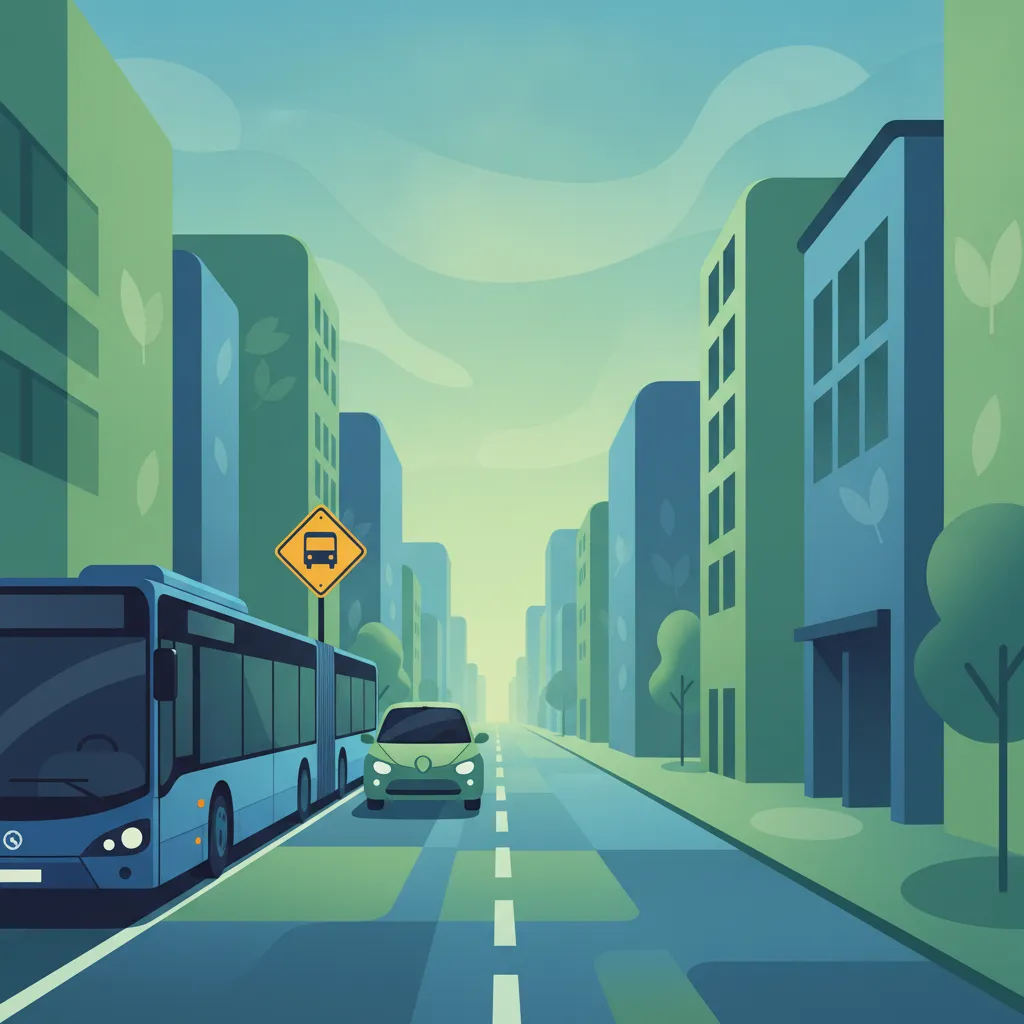
Bus lanes are a key tool for improving service reliability, but they come with specific rules. This lesson covers how to correctly interpret bus lane signs and markings. It also explains the regulations for entering and leaving the lane to make turns or avoid obstructions, and the priority rules associated with them.
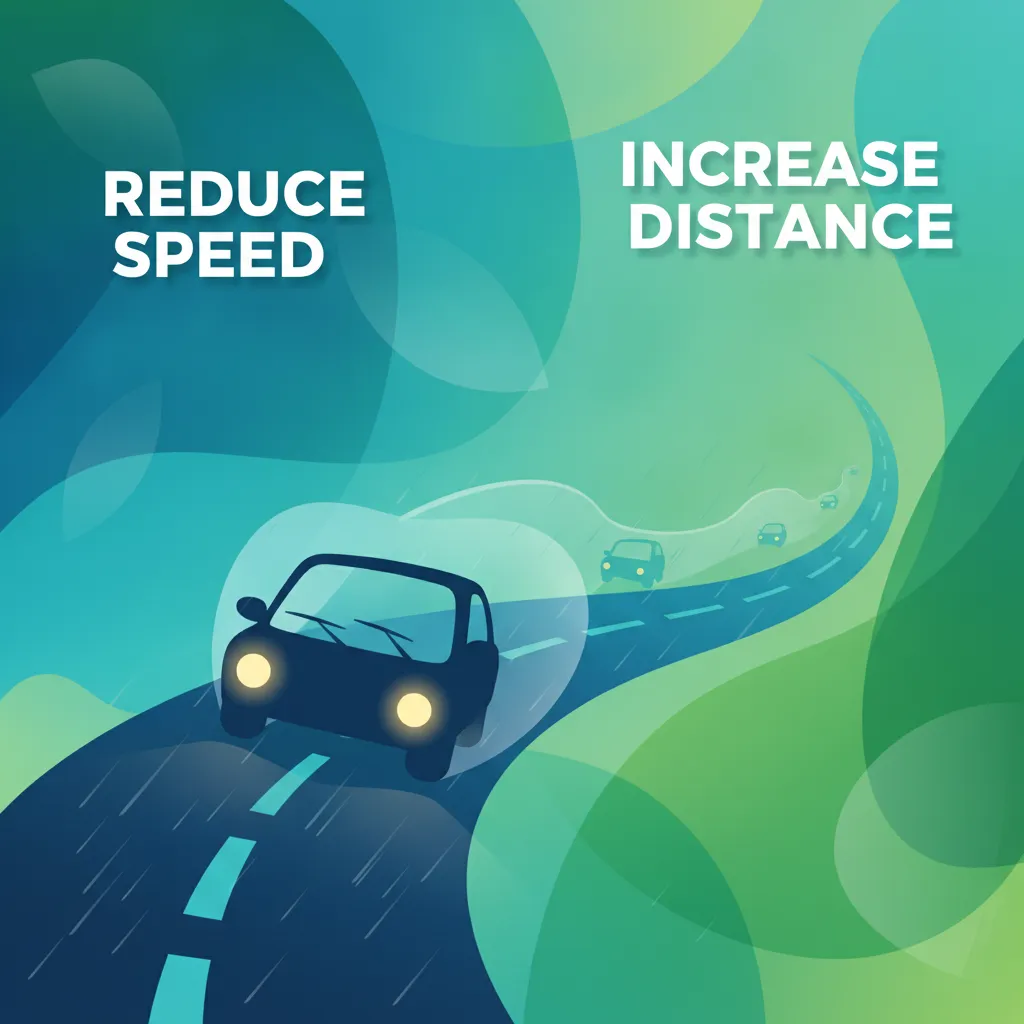
Weather has a profound impact on vehicle handling and visibility. This lesson teaches you how to reduce speed, increase following distances, and use controls smoothly to maintain traction in poor conditions. It also covers the legal requirements and practical application of snow chains in winter.
Rural driving requires a different mindset from urban driving. This lesson covers how to position your vehicle on narrow roads, how to use passing places effectively, and how to anticipate hazards like slow-moving farm machinery, animals, and concealed junctions. Managing vehicle width and height is a key focus.
Motorway driving involves high speeds and requires constant concentration. This lesson covers correct lane discipline, safe procedures for joining and leaving the motorway, and techniques for overtaking other large vehicles. Maintaining appropriate speed and a safe following distance is emphasized throughout.

This lesson focuses on general driving safety in areas with a high concentration of children. It stresses the importance of significantly reducing speed, being prepared for unexpected events, and scanning for children between parked cars. The driver must exhibit maximum vigilance in these high-risk environments at all times.
Departing from a bus stop is a high-risk manoeuvre. This lesson details the critical sequence of actions: checking all passengers are clear of the doors, performing a comprehensive mirror and blind spot check, signalling, and waiting for a safe gap in traffic. This systematic approach is essential for preventing collisions with overtaking vehicles, cyclists, or pedestrians.
Driving in the Alps requires a high level of skill and vehicle sympathy. This lesson covers techniques for climbing steep gradients by selecting the correct gear to maintain momentum without straining the engine. It reiterates the critical importance of using low gears and auxiliary brakes for descending, to ensure the service brakes remain cool and effective for the entire descent.
A stopped bus creates a significant visual obstruction for other road users. This lesson focuses on the risk of pedestrians stepping out from in front of the bus and cyclists passing unexpectedly on either side. It reinforces the need for exhaustive mirror and blind spot checks before moving off to prevent tragic 'pull-away' accidents.
Relying solely on the service brakes on a long downhill stretch can lead to overheating and complete brake failure (brake fade). This lesson explains the function of auxiliary brakes like retarders. You will learn how and when to engage them to maintain a safe, controlled speed, preserving the main brakes for when they are truly needed.
Many Swiss cities use systems that give buses priority at traffic lights to improve punctuality. This lesson explains how these systems detect an approaching bus and alter the signal phasing. You will learn to recognize and correctly respond to the special white light signals that grant this priority.
Find clear answers to common questions learners have about Safe Driving Techniques for Swiss Mountain Passes. Learn how the lesson is structured, which driving theory objectives it supports, and how it fits into the overall learning path of units and curriculum progression in Switzerland. These explanations help you understand key concepts, lesson flow, and exam focused study goals.
Using a low gear allows the engine's compression to assist in slowing the vehicle, which significantly reduces the reliance on your foundation brakes. This prevents the brakes from overheating and failing, which is critical for heavy Category D vehicles on long, steep descents.
On narrow mountain roads, vehicles travelling uphill generally have priority over those travelling downhill. If a vehicle must reverse to allow another to pass, the smaller or more manoeuvrable vehicle is usually expected to do so, but safety always comes first.
The retarder should be your primary tool for speed control on long descents to keep the main service brakes cool for emergency stops. Use it progressively as needed, but always be aware of road surface conditions like snow or ice, where excessive retarder use could cause wheel lock-up.
Immediately reduce your speed and increase your following distance. Weather in the Swiss mountains can change in minutes; always be prepared to pull over safely if visibility drops or the road surface becomes compromised by snow, ice, or thick fog.
Pinpoint specific Swiss traffic rules, road signs, or driving situations you need to master. Use the practice search to start a focused revision session now and build confidence for your official driving theory exam.