
This lesson explains the critical physics behind articulated heavy goods vehicles, specifically how trailers follow a different path than the tractor. Mastering the principles of off-tracking and cut-in is essential for safely navigating junctions and roundabouts with large vehicles in Switzerland. This knowledge forms the foundation for the practical safe maneuvering skills required in your professional driving career.

Lesson content overview
Operating an articulated heavy goods vehicle (HGV) or combination vehicle requires a deep understanding of its unique dynamics, especially during turning maneuvers. Unlike rigid vehicles, an articulated combination, consisting of a tractor unit and a semi-trailer or trailer, behaves differently when changing direction. This lesson delves into the crucial concept of off-tracking, also known as "cut-in," and explains why it is a fundamental aspect of safe and efficient driving for Category C and C1 license holders in Switzerland.
The phenomenon of off-tracking occurs because the wheels of the trailer do not follow the exact same path as the front wheels of the tractor unit. Instead, they take a shorter, inward path, effectively "cutting in" on the inside of the turn. Failing to account for this can lead to collisions with kerbs, street furniture, parked vehicles, or even other road users, making it a common cause of incidents involving articulated vehicles.
To master the operation of heavy goods vehicles, it is essential to grasp the core terminology and principles that govern their movement. Articulated vehicles, common on Swiss roads for goods transport, present specific challenges due to their length and the pivot point between the tractor and trailer.
An articulated vehicle is a vehicle combination comprising two or more rigid sections connected by a pivot joint. In the context of heavy goods transport, this typically refers to a tractor unit (Zugfahrzeug) coupled with a semi-trailer (Sattelanhänger) or a truck (Lastwagen) towing a full trailer (Anhänger). The pivot point, often a fifth wheel (Sattelkupplung) for semi-trailers, allows for angular movement between the sections, which is crucial for steering but also introduces complex dynamics like off-tracking.
The geometric phenomenon where the trailer’s rear wheels follow a path that cuts inside the tractor’s wheel path during a turn, due to the articulation joint.
Off-tracking, often referred to as cut-in, describes the inward deviation of the trailer's axle path relative to the tractor's axle path during a turn. This means that when an articulated vehicle makes a turn, the trailer wheels will follow a shorter radius towards the inside of the curve compared to the front wheels of the tractor. For example, during a left turn, the trailer's wheels will sweep closer to the left-hand kerb than the tractor's front wheels.
This fundamental principle arises from the geometric constraints of the hinge joint. As the tractor unit turns, it pulls the trailer, but the pivot point causes the trailer to swing around a different center of rotation. Understanding this inward sweep is paramount for professional drivers to prevent accidents, particularly in urban settings or when navigating tight junctions.
For drivers operating heavy goods vehicles under Category C and C1 licenses, anticipating and managing off-tracking is not just a matter of convenience, but a critical safety requirement. Failure to properly account for off-tracking can lead to serious consequences, including:
Mastery of off-tracking directly contributes to safe manoeuvring, load distribution, and informs advanced topics like avoiding jack-knifing, which will be covered later in your Official Swiss Driving Theory Course for Category C & C1 Goods Vehicles.
The movement of an articulated vehicle is governed by several interconnected dynamic principles. Understanding these principles is essential for predicting and controlling the trailer's path during any turn.
The angle formed between the longitudinal axes of the tractor and the trailer when the combination is turning.
The articulation angle is the angular displacement between the longitudinal centerlines of the tractor unit and its trailer. This angle continuously changes with the driver's steering input and the vehicle's movement. A larger articulation angle signifies a sharper turn and, consequently, a greater degree of off-tracking. Drivers must learn to control this angle through smooth and precise steering to manage the trailer's path effectively, especially in confined spaces or during challenging turns.
The turning radius of a combination refers to the radius of the path described by the outermost wheel of the vehicle combination, typically the front wheels of the tractor unit, during a turn. This radius provides a fundamental reference for the amount of lane width and space required to execute a turn safely.
Heavy goods vehicles have a significantly larger turning radius compared to passenger cars. This means they require earlier lane positioning and a wider sweep to complete turns without encroaching on obstacles or other lanes.
Off-tracking can be categorized into two main types, both crucial for driver awareness:
Understanding this distinction highlights why reducing speed before a turn is not just a recommendation but a mandatory safety measure for articulated vehicles.
While off-tracking refers to the inward sweep of the trailer's wheels, another related phenomenon is rear swing. This is the outward movement of the rear end of the trailer during a turn.
The outward movement of a trailer's rear-most point, relative to its initial straight-line path, during a turn.
For a semi-trailer, as the tractor turns, the rear of the trailer will initially swing outwards before the main off-tracking takes hold. In a right turn, for example, the front of the tractor moves right, the pivot point moves right, the trailer's rear initially swings left, and then the trailer wheels cut in sharply to the right. While distinct, rear swing and off-tracking both contribute to the overall challenge of maneuvering large combinations and demand careful spatial awareness from the driver.
The extent to which a trailer off-tracks is not constant; it varies based on several key factors. Professional drivers must understand these variables to accurately predict and compensate for the trailer's path.
The most significant factor influencing off-tracking is the length of the trailer and its configuration.
Always be aware of the specific dimensions of the vehicle combination you are operating. A longer semi-trailer will require a much wider approach to a turn than a shorter one.
Vehicle speed plays a critical role in dynamic off-tracking. As an articulated vehicle enters a turn at higher speeds, centrifugal forces acting on the trailer become more significant. These forces push the trailer outwards, intensifying the swing and increasing the effective off-tracking distance. This makes the trailer's path less predictable and harder to control.
Conversely, reducing speed before a turn minimizes these dynamic forces, allowing the vehicle's geometry to primarily dictate the off-tracking, making the trailer's path more predictable and manageable. This is why Swiss traffic regulations mandate speed reduction for articulated vehicles before turns.
The driver's steering input directly affects the articulation angle and, consequently, the off-tracking.
Avoid abrupt steering inputs, especially at higher speeds or on slippery surfaces. Such actions can quickly destabilize the vehicle combination and lead to dangerous situations.
The way a load is distributed across the axles of both the tractor and the trailer significantly impacts the vehicle's overall stability and its off-tracking characteristics.
It is crucial to ensure that loads are always secured correctly and distributed evenly, as mandated by Swiss load security regulations. Improper load distribution can lead to unpredictable off-tracking, making maneuvers significantly more hazardous.
Understanding the theory of off-tracking is one thing; applying it safely on the road is another. Professional drivers must develop keen spatial awareness and adopt specific maneuvering techniques to compensate for the trailer's cut-in.
The most fundamental technique for managing off-tracking is to initiate turns from a wider position than you would in a rigid vehicle or passenger car.
Always check your mirrors, especially the wide-angle and kerb-side mirrors, throughout the entire turning maneuver to monitor the trailer's path and ensure clearance from obstacles.
Roundabouts and tight corners present particular challenges for articulated vehicles due to their confined spaces and often sharp turning radii.
Urban areas are dense with challenges: parked vehicles, narrow streets, street furniture, and high pedestrian traffic.
Pedestrians and cyclists are particularly at risk during articulated vehicle turns. They often occupy the space close to the kerb or pavement where the trailer's cut-in occurs.
Adherence to Swiss traffic laws (Strassenverkehrsordnung – StVO) is paramount for all drivers, but heavy goods vehicle operators have specific responsibilities regarding vehicle dynamics and safety.
Rule 42.1 – Lateral Clearance for Articulated Vehicles: Drivers must maintain a sufficient lateral clearance from roadside obstacles during turning maneuvers. This clearance must accommodate the widest part of the trailer as it cuts in.
Article 6.5 – Articulation Control: Drivers are legally required to avoid abrupt or excessive steering inputs that could lead to extreme articulation angles and unsafe trailer swing.
Regulation 22.3 – Speed Reduction Before Turns: Articulated vehicles must reduce their speed to a level that allows for the safe negotiation of any turn without excessive off-tracking or loss of control.
Even experienced drivers can face challenges with off-tracking. Recognizing common pitfalls is the first step towards preventing accidents.
Challenge: Initiating a turn too close to the kerb, causing the trailer's inner wheels to scrape or mount it. Avoidance: Always start your turn from a wider position, allowing ample lateral clearance. Use your mirrors continuously to monitor the trailer's proximity to the kerb.
Challenge: Failing to position the tractor unit correctly or early enough, leading to the trailer swinging into an adjacent lane and potentially colliding with other vehicles. Avoidance: Assess the space needed well in advance. If a turn requires temporary use of an adjacent lane, ensure it is completely clear, signal clearly, and make eye contact with other drivers if possible. Prioritize safety over strict lane adherence if it means avoiding a collision.
Challenge: Entering a turn at excessive speed, especially on a slippery surface, or applying harsh braking mid-turn, which can lead to the trailer pushing the tractor, resulting in jack-knifing or even rollover. Avoidance: Significantly reduce speed before entering any curve. Apply smooth, gradual steering inputs. Avoid heavy braking while turning; if braking is necessary, do so gently and progressively, preferably before initiating the turn. Maintain proper load distribution.
Challenge: Underestimating the actual turning radius and off-tracking in complex scenarios such as tight urban intersections, multi-lane roundabouts, or constricted delivery zones. Avoidance: When in doubt, always choose the widest possible approach. If a maneuver seems too tight, consider an alternative route or a multiple-point turn if safe and legally permissible. Never force the vehicle through a space it clearly cannot clear.
Off-tracking is not just a static geometric principle; its effects are magnified or altered by various environmental and operational conditions.
The principles and regulations surrounding off-tracking are rooted in a combination of physics, human psychology, and accident analysis.
Drivers of articulated vehicles often struggle to accurately judge the exact position of the trailer's rear wheels, especially on the inner side of a turn, due to limited direct visibility. The long length of the combination creates significant blind spots. Understanding off-tracking intellectually helps compensate for these inherent visual limitations, forcing the driver to mentally visualize the trailer's path.
The articulation joint acts as a pivot. As the tractor turns, the trailer does not simply follow; its inherent inertia and the pivot point cause it to swing. At speed, centrifugal forces push the trailer outwards from the center of the turn. This outward push, combined with the inward pivot, complicates the trailer's path, necessitating proactive speed reduction to maintain control and predictability.
When a vehicle brakes, accelerates, or turns, the weight (load) shifts. During braking, weight transfers forward; during acceleration, it shifts backward. In a turn, weight shifts to the outside wheels. These load transfers can significantly alter the traction available at different axles and change how the trailer responds, potentially increasing off-tracking or making it less stable. Proper load distribution mitigates these adverse effects.
Accident statistics consistently highlight that a disproportionate number of collisions involving articulated vehicles occur during turning maneuvers, particularly in urban settings. These incidents often involve striking static objects (kerbs, poles) or vulnerable road users. The principles and practices related to off-tracking are specifically designed to address these high-risk scenarios, thereby enhancing overall road safety and reducing the frequency and severity of such accidents.
Mastering the dynamics of articulated vehicles is fundamental for obtaining and maintaining a Category C or C1 driving license. The concepts of off-tracking, articulation angle, turning radius, and the influence of speed and load are not merely theoretical; they are critical for safe, compliant, and efficient operation in all traffic conditions.
Final Concept Summary for Category C & C1 Drivers:
These principles, when diligently applied, ensure safe, compliant, and efficient operation of articulated vehicles in all traffic conditions, safeguarding both the driver and other road users.
Articulated vehicles exhibit off-tracking, where trailer wheels cut inside the tractor's path during turns, creating a collision risk with kerbs, parked vehicles, and vulnerable road users. This lesson explains the geometry and physics behind this phenomenon, distinguishing between static off-tracking (vehicle dimensions at low speed) and dynamic off-tracking (amplified by speed and centrifugal forces). Key factors influencing off-tracking include trailer length, speed, steering smoothness, and load distribution. Swiss regulations mandate proper lateral clearance, controlled steering inputs, and speed reduction before turns. Successful maneuvering requires wider positioning, mirror monitoring, and anticipation of rear swing alongside cut-in.
A short set of high-value points that capture the most important learning from this lesson.
Trailer wheels always cut inside the tractor's wheel path during turns, requiring drivers to position wider to avoid kerbs and obstacles
Off-tracking is amplified by higher speeds due to centrifugal forces acting on the trailer, making speed reduction mandatory before turns
The articulation angle directly controls off-tracking severity; larger steering angles create tighter cut-in and greater risk
Static off-tracking is geometry-based at low speed, while dynamic off-tracking includes motion effects and is significantly larger
Rear swing (the trailer's initial outward movement) must be anticipated alongside off-tracking for complete spatial awareness during turns
Explore all units and lessons included in this driving theory course.
Always position the tractor unit away from the curb on right turns to create clearance for the trailer's inward cut-in
Reduce speed before entering any turn to minimize dynamic off-tracking and maintain predictable trailer behavior
Smooth, gradual steering inputs prevent sudden articulation angle changes that destabilize the vehicle combination
Longer trailers create greater off-tracking distances; short trailers require less approach width
Brake before the turn, not during it, to avoid load transfer that amplifies trailer swing and off-tracking
Initiating a right turn too close to the kerb, assuming the trailer follows the tractor's path directly, causing kerb strikes
Entering tight corners at speeds that create excessive dynamic off-tracking and unpredictable trailer behavior
Making abrupt or full-lock steering inputs that rapidly increase the articulation angle and risk jack-knifing
Failing to monitor mirrors during turns, leaving the driver unaware of the trailer's actual path relative to obstacles
Not adjusting approach width for different trailer lengths; a longer semi-trailer needs significantly more space than a short one
Lesson content overview
A short set of high-value points that capture the most important learning from this lesson.
Trailer wheels always cut inside the tractor's wheel path during turns, requiring drivers to position wider to avoid kerbs and obstacles
Off-tracking is amplified by higher speeds due to centrifugal forces acting on the trailer, making speed reduction mandatory before turns
The articulation angle directly controls off-tracking severity; larger steering angles create tighter cut-in and greater risk
Static off-tracking is geometry-based at low speed, while dynamic off-tracking includes motion effects and is significantly larger
Rear swing (the trailer's initial outward movement) must be anticipated alongside off-tracking for complete spatial awareness during turns
Explore all units and lessons included in this driving theory course.
Always position the tractor unit away from the curb on right turns to create clearance for the trailer's inward cut-in
Reduce speed before entering any turn to minimize dynamic off-tracking and maintain predictable trailer behavior
Smooth, gradual steering inputs prevent sudden articulation angle changes that destabilize the vehicle combination
Longer trailers create greater off-tracking distances; short trailers require less approach width
Brake before the turn, not during it, to avoid load transfer that amplifies trailer swing and off-tracking
Initiating a right turn too close to the kerb, assuming the trailer follows the tractor's path directly, causing kerb strikes
Entering tight corners at speeds that create excessive dynamic off-tracking and unpredictable trailer behavior
Making abrupt or full-lock steering inputs that rapidly increase the articulation angle and risk jack-knifing
Failing to monitor mirrors during turns, leaving the driver unaware of the trailer's actual path relative to obstacles
Not adjusting approach width for different trailer lengths; a longer semi-trailer needs significantly more space than a short one
Explore search topics learners often look for when studying Understanding Articulation and Off-Tracking (Cut-in). These topics reflect common questions about road rules, driving situations, safety guidance, and lesson level theory preparation for learners in Switzerland.
Browse additional driving theory lessons that cover connected traffic rules, road signs, and common driving situations related to this topic. Improve your understanding of how different rules interact across everyday traffic scenarios.
Learn how to safely navigate articulated trucks through complex urban environments in Switzerland. This lesson focuses on managing trailer off-tracking, tight turns, and potential hazards in city streets, crucial for Category C and C1 drivers.

Urban driving requires heightened awareness and careful planning. This lesson covers the challenges of narrow streets, heavy traffic, and the need to identify designated loading and unloading zones. It emphasizes the importance of planning routes in advance to account for time-based access restrictions and to avoid unsuitable roads.

This lesson provides a more detailed look at managing off-tracking in challenging situations like sharp urban corners or tight industrial estate roads. It explains the technique of moving towards the centre line before a right turn (in a right-hand drive context) to create space for the trailer to follow. This requires careful judgement and observation to ensure it is safe to do so.

Turning a long vehicle requires careful planning and execution. This lesson covers the correct procedure: approach, observation, signalling, and positioning the vehicle correctly to allow for the trailer's off-tracking without mounting the kerb. It also highlights the need for constant mirror checks throughout the turn to monitor for cyclists or other vulnerable road users who may enter the danger zone.

Despite the complex mirror systems, large areas around a truck remain hidden from the driver's view. This lesson maps out these significant blind spots: directly in front, behind, and along both sides of the vehicle. It teaches drivers to be constantly aware of these 'no-zones' and to anticipate that smaller vehicles, cyclists, or pedestrians may be hidden within them, especially before changing lanes or turning.

Driving a bus in older parts of a city requires exceptional spatial awareness and precise control. This lesson focuses on assessing clearances, managing front and rear overhang, and negotiating tight turns around parked cars and buildings. A key theme is slow, careful, and deliberate manoeuvring to avoid contact.

Rural roads present challenges like narrow lanes, poor surfaces, sharp bends, and limited visibility. This lesson teaches drivers how to position their large vehicle to maximize space and visibility, anticipate oncoming traffic at blind corners, and be aware of specific rural hazards. These hazards include slow-moving agricultural vehicles, animals on the road, and concealed farm entrances.

Depots and loading bays present unique challenges with tight spaces, other moving vehicles, and pedestrians. This lesson focuses on the principles of safe manoeuvring in these environments, stressing the need for extremely low speeds, constant observation, and patience. It covers techniques for aligning with loading docks and navigating around fixed obstacles and other site traffic.

Unlike cars, heavy vehicles cannot travel on every road. This lesson stresses the importance of using HGV-specific satellite navigation systems or carefully checking maps to plan routes that avoid low bridges, weak bridges, and roads with weight or width restrictions. Proper planning saves time, fuel, and prevents dangerous situations or costly damage.

The left-hand turn (in Switzerland) is a moment of high risk, as a cyclist can easily be hidden in the vehicle's nearside blind spot. This lesson provides a detailed analysis of this scenario, mandating a slow approach and meticulous, repeated mirror checks before and during the turn. It emphasizes that the driver must assume a cyclist could be there, even if one isn't immediately visible.

Motorway driving requires constant concentration due to high speeds. This lesson emphasizes the importance of staying in the right-hand lane unless overtaking and the specific restrictions on lorry overtaking in Switzerland. It reinforces the need for a following distance of at least four seconds to compensate for the vehicle's long stopping distance and provides guidance on safely merging and exiting.
Explore the key factors that influence how articulated vehicles behave during turns. This lesson details the impact of speed, vehicle length, load distribution, and steering inputs on trailer off-tracking and overall stability for Swiss HGV theory.
Turning a long vehicle requires careful planning and execution. This lesson covers the correct procedure: approach, observation, signalling, and positioning the vehicle correctly to allow for the trailer's off-tracking without mounting the kerb. It also highlights the need for constant mirror checks throughout the turn to monitor for cyclists or other vulnerable road users who may enter the danger zone.

Heavy vehicles, especially those with a high centre ofgravity, are susceptible to rolling over. This lesson examines the primary causes, including excessive speed on bends or roundabouts, sudden steering manoeuvres, and the 'sloshing' effect of liquid loads in tankers. It reinforces that maintaining a sensible speed and driving smoothly are the best ways to mitigate this serious risk.
This lesson provides a more detailed look at managing off-tracking in challenging situations like sharp urban corners or tight industrial estate roads. It explains the technique of moving towards the centre line before a right turn (in a right-hand drive context) to create space for the trailer to follow. This requires careful judgement and observation to ensure it is safe to do so.

Adding a trailer (D1E) or driving an articulated bus (DE) changes the vehicle's dynamics significantly. This lesson covers the key differences in handling, braking, and reversing. It explains the concept of the pivot point and how to manage the increased length and swept path when turning and manoeuvring.

When a long vehicle turns, the rear wheels follow a shorter path than the front wheels (swept path), and the rear of the vehicle swings outwards (tail swing). This lesson explains these critical concepts. You will learn how to position the vehicle before a turn to avoid mounting the kerb or striking objects like signs and pedestrians with the rear corner.

When a long vehicle makes a sharp turn, the rear overhang swings out in a wide arc. This lesson illustrates the danger of rear swing, particularly when pulling away from a kerb or turning in confined spaces. Drivers must be aware of this effect and use their mirrors to check for pedestrians, cyclists, or obstacles in the path of the swinging rear of the vehicle or trailer.
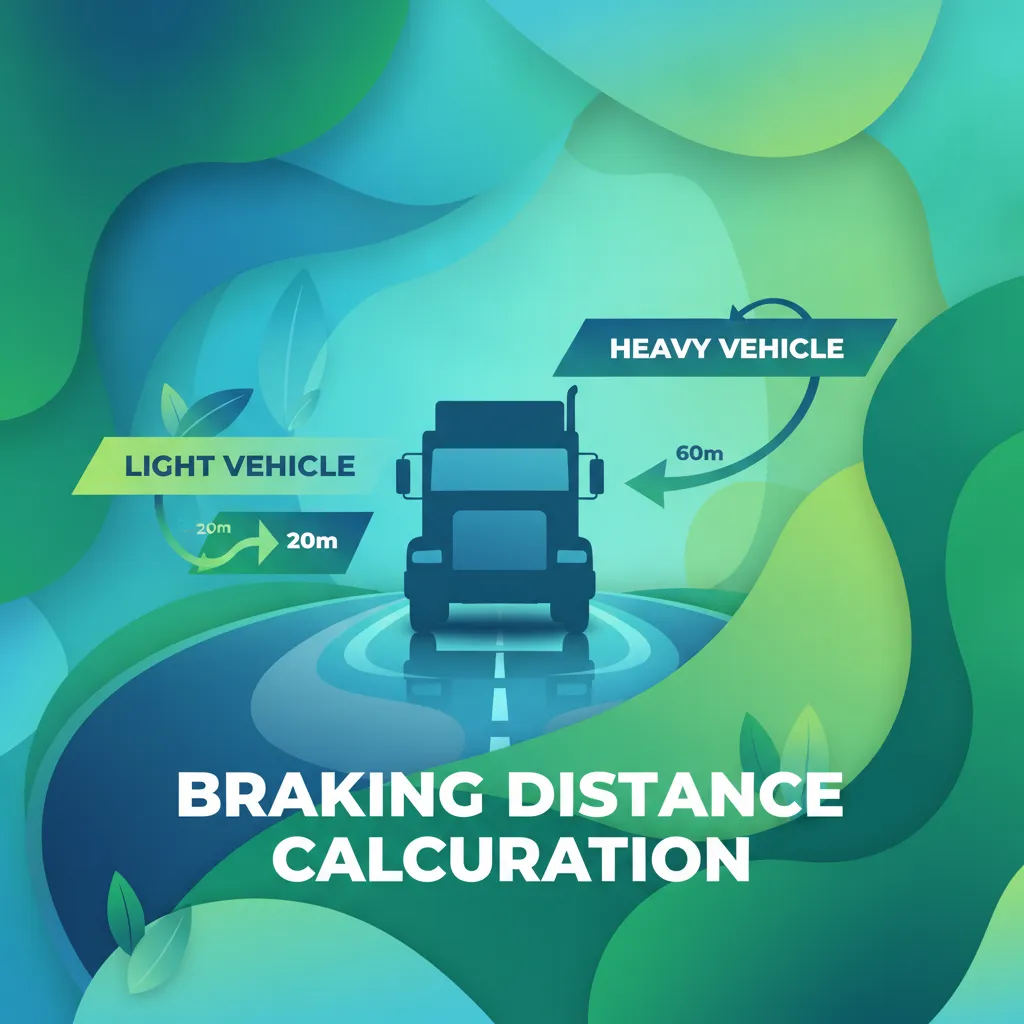
The immense mass of a loaded truck means its braking distance is far greater than that of a car. This lesson breaks down total stopping distance into reaction distance and braking distance, explaining how speed, weight, and road conditions have an exponential effect. It reinforces the necessity of maintaining a significantly larger following distance to ensure enough space to stop safely in an emergency.
Despite the complex mirror systems, large areas around a truck remain hidden from the driver's view. This lesson maps out these significant blind spots: directly in front, behind, and along both sides of the vehicle. It teaches drivers to be constantly aware of these 'no-zones' and to anticipate that smaller vehicles, cyclists, or pedestrians may be hidden within them, especially before changing lanes or turning.

Coupling and uncoupling are high-risk manoeuvres if not performed correctly. This lesson provides a theoretical, sequential guide to the process, covering aligning the tractor unit, raising the trailer's landing gear, locking the fifth-wheel mechanism onto the kingpin, and performing a 'tug test' to confirm a secure connection. The uncoupling process is also detailed, emphasizing the importance of a firm, level surface.
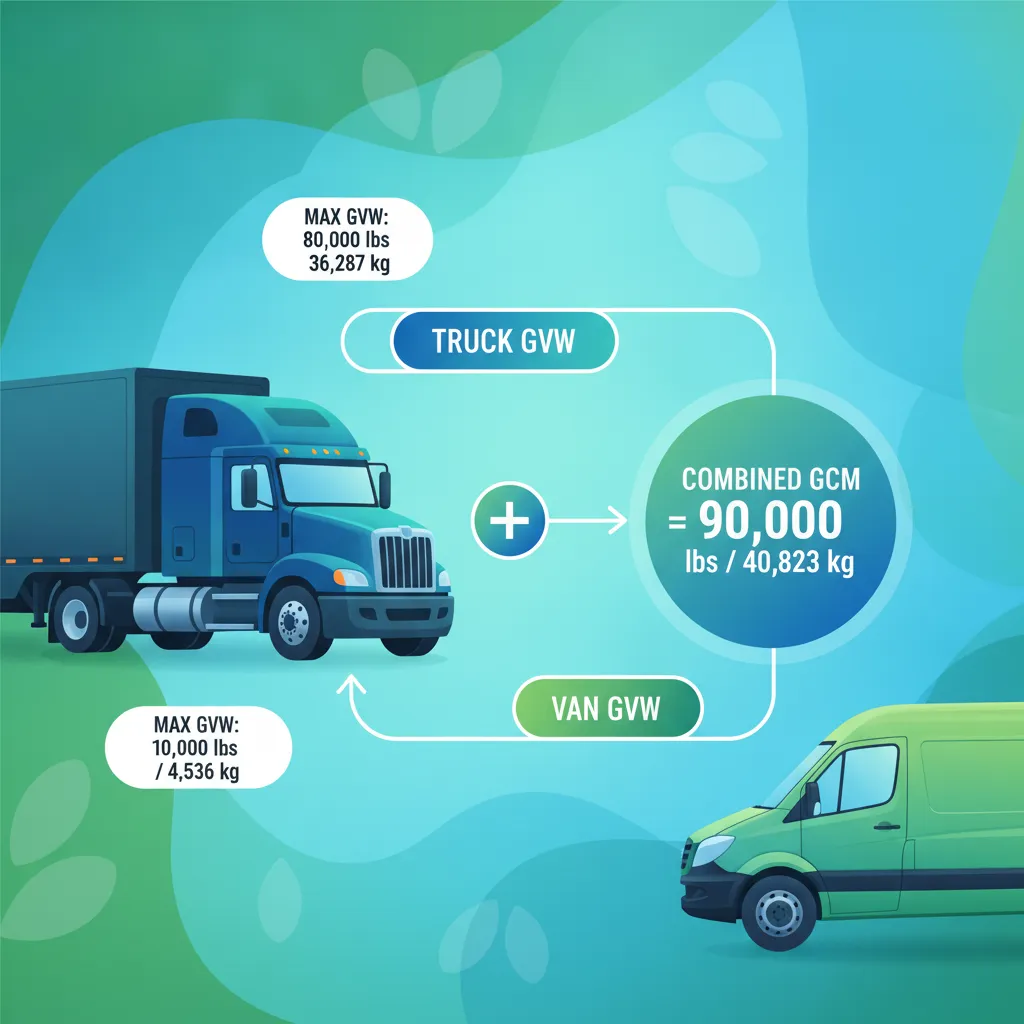
When a lorry tows a trailer, the total weight of the entire combination must not exceed the gross combination mass limit. This lesson explains how to find this value and why it is critical for ensuring the vehicle's engine, transmission, and brakes can safely handle the entire load. Exceeding the GCM compromises braking effectiveness, acceleration, and the ability to climb gradients, creating a significant safety risk.
Find clear answers to common questions learners have about Understanding Articulation and Off-Tracking (Cut-in). Learn how the lesson is structured, which driving theory objectives it supports, and how it fits into the overall learning path of units and curriculum progression in Switzerland. These explanations help you understand key concepts, lesson flow, and exam focused study goals.
Because the trailer wheels are fixed and follow a shorter path across the turn, the trailer 'cuts' the corner. The longer the distance between the coupling point and the trailer wheels, the more pronounced this effect becomes.
You must position your vehicle correctly before the turn by swinging slightly wide into the junction, ensuring the tractor’s front wheels provide enough clearance for the trailer’s inner wheels to clear the corner without mounting the kerb.
Yes, Swiss road laws require drivers of large vehicles to account for their size and weight. Failure to navigate a turn safely, leading to an obstruction or damage to public property, is considered a failure to maintain control of the vehicle.
Absolutely. On roundabouts, you must often straddle lanes or take a wider path to ensure your trailer does not hit the central island or sweep across adjacent lanes, which could endanger other vehicles.
Pinpoint specific Swiss traffic rules, road signs, or driving situations you need to master. Use the practice search to start a focused revision session now and build confidence for your official driving theory exam.