
This lesson focuses on the critical manoeuvres of off-tracking and vehicle positioning for large Category C and C1 vehicles. By understanding how to manage the trailer path and create space, you will gain the confidence needed for both complex urban navigation and your official Swiss theory test.

Lesson content overview
Operating heavy goods vehicles, especially those with trailers, presents unique challenges when navigating turns. Unlike single-unit vehicles, articulated combinations do not follow a simple path; their trailers "off-track," requiring drivers to master specific positioning techniques. This lesson, part of the Official Swiss Driving Theory Course for Category C & C1 Goods Vehicles, delves into the essential principles of off-tracking and provides a systematic approach to safely execute tight turns, particularly right-hand turns in a right-hand drive context.
Mastery of these techniques is crucial for safe urban navigation, preventing collisions with static obstacles, avoiding encroachment onto adjacent lanes, and ensuring the trailer accurately follows the intended path. It directly enhances a driver's ability to manoeuvre through confined spaces such as narrow streets, industrial estates, loading bays, and sharp junctions. This lesson builds upon foundational knowledge of vehicle dimensions, articulation geometry, effective mirror usage, blind spot identification, and general turning principles covered in earlier units, specifically those related to trailers and mirrors.
When an articulated vehicle, such as a truck with a trailer, performs a turn, its various axles do not follow the same path. This phenomenon is known as off-tracking, where the rear axle(s) and trailer describe a larger radius than the front steering axle. Understanding this fundamental concept is the cornerstone of safe heavy vehicle maneuvering.
The lateral deviation between the path of the steering axle (front axle) and the path of the trailing axle(s) when an articulated vehicle navigates a curve.
In essence, the rear wheels of a combination vehicle will always cut inside the path of the front wheels during a turn. The longer the wheelbase of the towing vehicle and the trailer, and the sharper the turn, the greater this deviation. This means the trailer will sweep a wider area on the outside of the turn, and a narrower area on the inside, compared to the tractor unit.
The trailing axle path is the geometric route taken by the rear axle(s) of the trailer during a turn. This path is critical because it determines whether the trailer will clear curbs, parked vehicles, or other stationary obstacles on the inside of the turn, or encroach onto adjacent lanes or sidewalks on the outside. Drivers must anticipate this path and adjust their initial vehicle trajectory accordingly, rather than simply following the front wheels. For instance, on a 30-meter radius turn, a semi-trailer might exhibit an off-tracking radius of 5-7 meters, meaning its rear wheels could sweep significantly wider than anticipated if not properly managed.
The angle formed between the longitudinal axis of the towing vehicle and that of the trailer during a turn.
The articulation angle is the angle created at the coupling point between the towing vehicle (tractor) and the trailer. This angle dynamically changes as the vehicle turns and is a direct indicator of the degree of off-tracking. A larger articulation angle implies a greater swing-out of the trailer. This swing-out refers to the lateral movement of the trailer beyond the path of the towing vehicle, particularly pronounced on the outside of a turn.
Drivers must constantly monitor this angle, typically through their driver's side mirror, to ensure it does not become excessive, which could lead to unsafe trailer swing. Excessive angles, especially when combined with speed, can destabilise the trailer or cause it to impact objects. During a tight right-hand turn, the articulation angle may reach 30-45°, causing the trailer to swing significantly outward from the path of the tractor unit. Ignoring this angle, even at low speeds, can lead to serious incidents.
To counteract off-tracking and safely complete a tight turn, heavy goods vehicle drivers must employ a deliberate technique called positioning for tight turns. This involves adjusting the initial trajectory of the tractor unit before entering the curve, rather than simply turning from the far side of the lane.
In a right-hand drive context, when preparing for a tight right-hand turn, the core technique is to position the vehicle's front wheels slightly towards the centre line of the lane. This does not mean crossing the centre line, but rather using the full width of the available lane, moving slightly to the left (in a right-hand drive system) to create a larger turning radius for the tractor unit. By doing so, the driver effectively 'opens up' the turn, providing crucial lateral clearance for the trailer's inevitable swing-out.
This early positioning manoeuvre is vital. If a driver delays the adjustment or attempts to turn from the far right side of the lane, the trailer will cut too sharply towards the inside curb or swing widely into adjacent lanes or onto the sidewalk. By starting further left, the overall path of the combination vehicle is widened, allowing the trailer to follow a safer trajectory within the intended lane or road boundaries.
Effective positioning for tight turns is impossible without keen observational judgment and proper mirror usage. These skills allow the driver to monitor the trailer's path, assess surrounding traffic, and make real-time adjustments.
Real-time assessment of traffic, road geometry, and trailer swing zone using mirrors, vehicle position, and surrounding cues to safely execute a maneuver.
Observational judgment involves more than just a quick glance. It's a continuous, integrated process of scanning and interpreting visual information:
Mirrors are the driver's primary tool for managing off-tracking. Proper adjustment and regular, systematic scanning are mandatory.
Adjust Driver's Side Mirror: Before starting any manoeuvre, adjust the driver’s side mirror to clearly view the side of the trailer, ideally showing the tip of the trailer. This mirror is crucial for monitoring the articulation angle and the inner swing of the trailer.
Passenger Side Mirror: Use the passenger side mirror to check for any oncoming traffic, lane position, and the outer swing of the trailer, especially in situations where it might encroach on another lane or shoulder.
Rearview Mirror (if applicable): For combination vehicles, the rearview mirror primarily provides general awareness of traffic behind the tractor unit, but its direct utility for trailer swing monitoring is limited.
Regular Scanning: Do not just set mirrors and forget them. Continuously scan all relevant mirrors (driver's side, passenger side, and rearview) before, during, and after the turn. This helps detect any unexpected movements or hazards.
Over-reliance on mirrors alone is a common mistake. Drivers must also use direct observation and peripheral vision to understand the vehicle's position and the surrounding environment, especially to check blind spots that mirrors might not cover.
Operating heavy goods vehicles in Switzerland requires strict adherence to specific traffic regulations, which are designed to ensure safety given the unique dynamics of these vehicles. The proper management of off-tracking and turning positioning is explicitly covered by these rules.
Rule Statement: A driver must keep the vehicle within the lane marking that corresponds to its intended direction of travel unless otherwise indicated by road signs or markings.
This rule is fundamental. While positioning towards the centre line for a tight right turn, the driver must generally remain within their designated lane. Crossing a solid centre line is prohibited as it puts you in the path of oncoming traffic. Exceptions may exist where road markings are dashed, allowing for temporary crossing if safe, or in specific cases where signs or specific road geometries (e.g., designated turning bays for long vehicles) explicitly permit it.
Rule Statement: When turning, a driver must ensure that the trailer does not cross the curb or road edge line.
This regulation directly addresses the inner off-tracking of the trailer. Failing to position correctly can cause the trailer's inner wheels to mount or strike the curb, potentially damaging the vehicle, the curb, or endangering pedestrians on the sidewalk. This is particularly relevant in urban areas and industrial estates where tight turns are common and road edges are clearly defined.
Rule Statement: For right-hand turns, the driver must position the vehicle such that the trailer’s off-tracking does not obstruct other road users.
This specific rule in the Swiss Road Traffic Act (SVG) acknowledges the inherent challenge of trailer swing. It mandates that drivers of articulated vehicles must account for the outward swing of their trailer, positioning their vehicle proactively to prevent it from encroaching upon adjacent lanes, cycle paths, or pedestrian areas. This means adjusting your approach early, using the centre line as a reference, and continuously verifying through mirrors that the trailer's path remains within safe and legal limits. Turning from the far right side of the lane, which might seem intuitive, is often incorrect for heavy vehicles as it forces the trailer to swing wide, potentially into the lane of oncoming traffic or into vulnerable road users.
Rule Statement: Heavy vehicle drivers must adjust and use mirrors to ensure complete visibility of the trailer’s swing zone.
Mirrors are not merely optional aids; their correct adjustment and continuous use are legal requirements for heavy vehicle drivers. They are indispensable for detecting off-tracking, monitoring the articulation angle, and identifying potential hazards in blind spots. Before every manoeuvre, especially turning, mirrors must be set to provide the clearest possible view of the trailer's path.
Rule Statement: The driver must reduce speed appropriately when performing turns, ensuring that the trailer’s path can be controlled safely.
While no explicit numerical speed limit applies solely to turns, the principle of driving at a safe and appropriate speed is fundamental in Swiss traffic law. For heavy vehicles, reducing speed significantly before and during a turn is crucial for several reasons: it provides more time for observational judgment, allows for finer control over the articulation angle, and minimises the forces that can cause excessive trailer swing or instability, especially with heavy loads. Entering a tight turn at high speed can lead to the trailer overshooting its intended path and potentially losing control.
Even experienced drivers can fall prey to common mistakes when managing off-tracking. Awareness of these pitfalls is the first step toward safer driving.
Late Positioning Leading to Trailer Encroachment:
Crossing the Centre Line Improperly:
Insufficient Mirror Adjustment or Use:
Entering a Turn at Excessive Speed:
Misjudging Road Width:
Over-reliance on Only One Mirror:
Ignoring Weather and Road Surface Influences:
Blind Spot Collision with Vulnerable Road Users:
The principles of off-tracking and positioning remain constant, but their application must be adapted to various driving conditions and environments.
Understanding the direct links between driver actions and outcomes reinforces the importance of correct turning techniques.
Let's look at practical examples of how these principles are applied in real-world driving situations for a Category C or C1 goods vehicle driver.
Successfully managing off-tracking and positioning for tight turns is a critical skill for any Category C or C1 goods vehicle driver.
This lesson explains how articulated heavy goods vehicles behave differently from cars during turns, with trailers following a wider path than the front wheels. Safe turning requires deliberately positioning the tractor unit toward the centre line before entering tight right-hand turns while remaining within lane boundaries, then using mirrors to monitor the articulation angle throughout. Speed must be reduced before turning to maintain control, and special attention must be given to cyclists and pedestrians who occupy the blind spots created by trailer swing. Swiss traffic law explicitly requires drivers to prevent trailers from crossing kerbs or encroaching on adjacent lanes, making correct positioning a legal obligation rather than merely a driving preference.
A short set of high-value points that capture the most important learning from this lesson.
Off-tracking means the trailer's rear wheels always follow a wider radius than the front steering axle during a turn
For tight right-hand turns in a right-hand drive vehicle, move slightly toward the centre line before turning to create space for the trailer's swing
The articulation angle between tractor and trailer must be continuously monitored through mirrors during any turn
Reducing speed before entering a turn is essential for maintaining control over the trailer's path
Vulnerable road users including cyclists and pedestrians are at extreme risk from trailer swing during tight turns
Explore all units and lessons included in this driving theory course.
Trailers cut inside the front wheels on tight turns, but swing wider on the outside, so the trailer's outer edge can encroach on adjacent lanes or sidewalks
Position toward the centre line early and stay within lane boundaries without crossing solid centre lines
Adjust the driver's side mirror to clearly view the trailer's articulation point and swing path before any manoeuvre
Heavier loads and longer trailers increase the required turning space and articulation angle
Adverse weather conditions demand greater safety margins, slower speeds, and gentler steering inputs
Late positioning: waiting until reaching the turn point instead of adjusting toward the centre line well in advance
Crossing the centre line illegally to gain extra space rather than finding an alternative route when the road is too narrow
Insufficient mirror adjustment or failing to scan mirrors continuously before, during, and after a turn
Entering tight turns at excessive speed, which reduces control and increases trailer swing
Relying on only one mirror instead of systematically checking both side mirrors and using peripheral vision
Lesson content overview
A short set of high-value points that capture the most important learning from this lesson.
Off-tracking means the trailer's rear wheels always follow a wider radius than the front steering axle during a turn
For tight right-hand turns in a right-hand drive vehicle, move slightly toward the centre line before turning to create space for the trailer's swing
The articulation angle between tractor and trailer must be continuously monitored through mirrors during any turn
Reducing speed before entering a turn is essential for maintaining control over the trailer's path
Vulnerable road users including cyclists and pedestrians are at extreme risk from trailer swing during tight turns
Explore all units and lessons included in this driving theory course.
Trailers cut inside the front wheels on tight turns, but swing wider on the outside, so the trailer's outer edge can encroach on adjacent lanes or sidewalks
Position toward the centre line early and stay within lane boundaries without crossing solid centre lines
Adjust the driver's side mirror to clearly view the trailer's articulation point and swing path before any manoeuvre
Heavier loads and longer trailers increase the required turning space and articulation angle
Adverse weather conditions demand greater safety margins, slower speeds, and gentler steering inputs
Late positioning: waiting until reaching the turn point instead of adjusting toward the centre line well in advance
Crossing the centre line illegally to gain extra space rather than finding an alternative route when the road is too narrow
Insufficient mirror adjustment or failing to scan mirrors continuously before, during, and after a turn
Entering tight turns at excessive speed, which reduces control and increases trailer swing
Relying on only one mirror instead of systematically checking both side mirrors and using peripheral vision
Explore search topics learners often look for when studying Off-tracking and Positioning for Tight Turns. These topics reflect common questions about road rules, driving situations, safety guidance, and lesson level theory preparation for learners in Switzerland.
Browse additional driving theory lessons that cover connected traffic rules, road signs, and common driving situations related to this topic. Improve your understanding of how different rules interact across everyday traffic scenarios.
Explore practical scenarios for heavy goods vehicles in confined urban streets and industrial estates. Learn how to apply off-tracking principles and positioning techniques effectively in challenging real-world Swiss driving environments.

Urban driving requires heightened awareness and careful planning. This lesson covers the challenges of narrow streets, heavy traffic, and the need to identify designated loading and unloading zones. It emphasizes the importance of planning routes in advance to account for time-based access restrictions and to avoid unsuitable roads.

Rural roads present challenges like narrow lanes, poor surfaces, sharp bends, and limited visibility. This lesson teaches drivers how to position their large vehicle to maximize space and visibility, anticipate oncoming traffic at blind corners, and be aware of specific rural hazards. These hazards include slow-moving agricultural vehicles, animals on the road, and concealed farm entrances.

Construction sites and industrial areas are non-public roads with their own set of rules and hazards. This lesson covers the need to follow site-specific safety instructions, be aware of moving plant machinery and personnel on the ground, and assess ground conditions. It highlights that reversing is often required and should be done with a signaller wherever possible.

Depots and loading bays present unique challenges with tight spaces, other moving vehicles, and pedestrians. This lesson focuses on the principles of safe manoeuvring in these environments, stressing the need for extremely low speeds, constant observation, and patience. It covers techniques for aligning with loading docks and navigating around fixed obstacles and other site traffic.

Turning a long vehicle requires careful planning and execution. This lesson covers the correct procedure: approach, observation, signalling, and positioning the vehicle correctly to allow for the trailer's off-tracking without mounting the kerb. It also highlights the need for constant mirror checks throughout the turn to monitor for cyclists or other vulnerable road users who may enter the danger zone.

Unlike cars, heavy vehicles cannot travel on every road. This lesson stresses the importance of using HGV-specific satellite navigation systems or carefully checking maps to plan routes that avoid low bridges, weak bridges, and roads with weight or width restrictions. Proper planning saves time, fuel, and prevents dangerous situations or costly damage.

Despite the complex mirror systems, large areas around a truck remain hidden from the driver's view. This lesson maps out these significant blind spots: directly in front, behind, and along both sides of the vehicle. It teaches drivers to be constantly aware of these 'no-zones' and to anticipate that smaller vehicles, cyclists, or pedestrians may be hidden within them, especially before changing lanes or turning.

Motorway driving requires constant concentration due to high speeds. This lesson emphasizes the importance of staying in the right-hand lane unless overtaking and the specific restrictions on lorry overtaking in Switzerland. It reinforces the need for a following distance of at least four seconds to compensate for the vehicle's long stopping distance and provides guidance on safely merging and exiting.

Tunnels are enclosed environments where incidents can quickly escalate. This lesson outlines the specific rules for tunnel driving: remove sunglasses, turn on dipped headlights, maintain a safe following distance, and tune the radio to the indicated frequency. It also covers the critical emergency procedures to follow in the event of a fire or breakdown inside a tunnel.
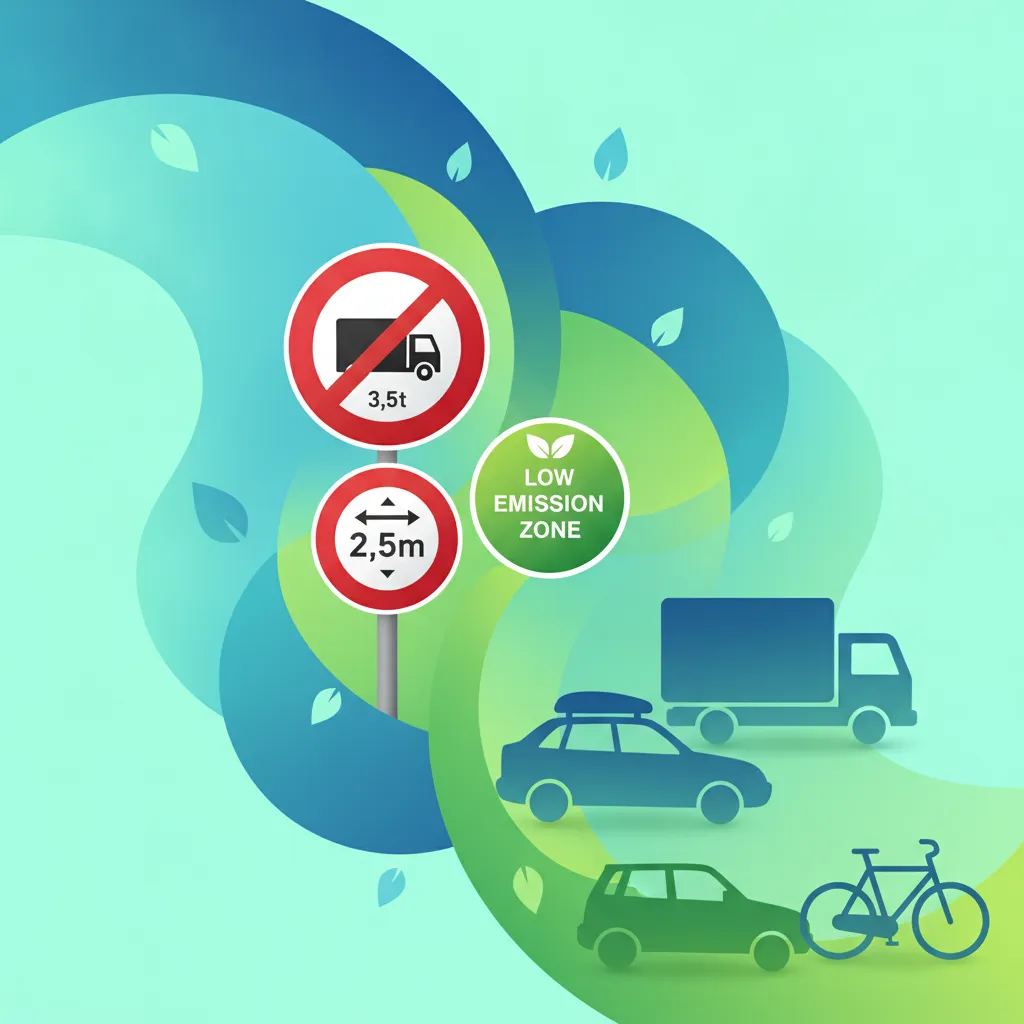
Many urban areas have restrictions to manage traffic and protect infrastructure. This lesson teaches drivers to identify and interpret traffic signs that prohibit access based on gross vehicle weight, axle load, height, or width. It also covers the growing prevalence of environmental or low-emission zones, which may restrict entry for older, more polluting vehicles.
Learn about frequent mistakes drivers make when performing tight turns with articulated vehicles in Switzerland. Understand the risks and consequences of poor positioning, speed, and mirror usage to enhance your road safety knowledge for the theory exam.
Turning a long vehicle requires careful planning and execution. This lesson covers the correct procedure: approach, observation, signalling, and positioning the vehicle correctly to allow for the trailer's off-tracking without mounting the kerb. It also highlights the need for constant mirror checks throughout the turn to monitor for cyclists or other vulnerable road users who may enter the danger zone.

The left-hand turn (in Switzerland) is a moment of high risk, as a cyclist can easily be hidden in the vehicle's nearside blind spot. This lesson provides a detailed analysis of this scenario, mandating a slow approach and meticulous, repeated mirror checks before and during the turn. It emphasizes that the driver must assume a cyclist could be there, even if one isn't immediately visible.

This lesson explores the correct procedures for turning at intersections and navigating roundabouts, focusing on lane selection and signaling. It covers the right-of-way rules for right and left turns and the importance of positioning the vehicle correctly before the turn. In roundabouts, the content emphasizes yielding to circulating traffic and selecting the correct exit lane.
Despite the complex mirror systems, large areas around a truck remain hidden from the driver's view. This lesson maps out these significant blind spots: directly in front, behind, and along both sides of the vehicle. It teaches drivers to be constantly aware of these 'no-zones' and to anticipate that smaller vehicles, cyclists, or pedestrians may be hidden within them, especially before changing lanes or turning.

When an articulated vehicle turns, the trailer wheels do not follow the same path as the tractor's front wheels; they take a shortcut, or 'cut-in'. This lesson explains this principle of off-tracking and why the driver must take a wider path when initiating a turn. Failing to account for off-tracking is a common cause of striking kerbs, street furniture, or other vehicles.

This lesson covers complex manoeuvres such as three-point turns, U-turns, and parking in tight spaces. You will learn the step-by-step process for performing a three-point turn and the legal requirements for a U-turn. The content also provides guidance for parking in confined areas, ensuring proper lane usage and positioning during these manoeuvres.
Motorway driving requires constant concentration due to high speeds. This lesson emphasizes the importance of staying in the right-hand lane unless overtaking and the specific restrictions on lorry overtaking in Switzerland. It reinforces the need for a following distance of at least four seconds to compensate for the vehicle's long stopping distance and provides guidance on safely merging and exiting.
Rural roads present challenges like narrow lanes, poor surfaces, sharp bends, and limited visibility. This lesson teaches drivers how to position their large vehicle to maximize space and visibility, anticipate oncoming traffic at blind corners, and be aware of specific rural hazards. These hazards include slow-moving agricultural vehicles, animals on the road, and concealed farm entrances.

This lesson focuses on mitigating the risk of collisions at intersections, particularly from vehicles turning across the rider's path. It teaches defensive strategies such as positioning for visibility, anticipating driver actions, and using head checks to be aware of surrounding traffic. Managing your own and others' blind spots is presented as a crucial survival skill.

When a long vehicle turns, the rear wheels follow a shorter path than the front wheels (swept path), and the rear of the vehicle swings outwards (tail swing). This lesson explains these critical concepts. You will learn how to position the vehicle before a turn to avoid mounting the kerb or striking objects like signs and pedestrians with the rear corner.
Find clear answers to common questions learners have about Off-tracking and Positioning for Tight Turns. Learn how the lesson is structured, which driving theory objectives it supports, and how it fits into the overall learning path of units and curriculum progression in Switzerland. These explanations help you understand key concepts, lesson flow, and exam focused study goals.
Off-tracking occurs because the rear wheels follow a shorter path than the front wheels. With a trailer, this effect is multiplied, meaning the rear of the vehicle can swing over sidewalks or hit street furniture, creating significant blind spot hazards.
Not necessarily. You must balance the need for space with the risk of allowing a cyclist or motorcyclist to slip into the gap between your lorry and the kerb. You must signal your intention clearly and monitor mirrors constantly.
The longer the wheelbase and the greater the distance to the rear axles, the more extreme the off-tracking. You must account for this by starting your turn later and potentially swinging wider to ensure the rear wheels clear the corner.
Yes, you may encounter questions regarding intersection management, safe positioning, and hazard perception involving large vehicles. Understanding these forces is essential for identifying correct and incorrect driving behaviour in official exam images.
Pinpoint specific Swiss traffic rules, road signs, or driving situations you need to master. Use the practice search to start a focused revision session now and build confidence for your official driving theory exam.