
This lesson guides you through the specific road rules governing interactions with public transport, including trams and buses in Switzerland. You will learn how to identify priority scenarios, navigate around tram tracks, and safely approach stops to avoid common exam pitfalls. Understanding these rules is essential for safe driving and passing the Category B theoretical examination.

Lesson content overview
Driving safely and efficiently within Switzerland requires a thorough understanding of how to interact with public transport vehicles, specifically buses, coaches, and trams. These vehicles operate under distinct rules to ensure passenger safety and maintain the efficiency of public services. This lesson, part of your Comprehensive Swiss Driving Theory Course for Category B License, will equip you with the essential knowledge to navigate these interactions safely and lawfully.
Public transport vehicles frequently stop to pick up or drop off passengers, which creates dynamic and sometimes unpredictable situations on the road. Understanding their unique right-of-way and adhering to specific lane regulations are crucial for preventing collisions, reducing traffic delays, and contributing to a smooth traffic flow in urban and suburban environments. This chapter delves into the specific legal and safety-oriented rules governing these interactions, from understanding priority at stops to the correct use of dedicated lanes and safe tram track crossing procedures.
One of the most critical aspects of interacting with public transport is recognizing and respecting their special priority. This priority is not merely a courtesy; it is a fundamental safety regulation designed to protect passengers and ensure the smooth operation of public services.
In Switzerland, buses, coaches, and trams are granted absolute priority when they are stopped at designated points for passenger boarding and alighting. This means that private vehicle drivers must yield, stop, or give way, regardless of other general priority rules that might otherwise apply. The purpose of this rule is to safeguard passengers who are in a vulnerable position as they enter or exit the vehicle and may be crossing the road.
This absolute priority means you must stop and wait, even if it appears the public transport vehicle is ready to move or if no passengers are immediately visible. The safety of passengers is paramount.
The rationale behind giving public transport special priority stems from several factors:
When you encounter a bus, coach, or tram stopped at a designated stop for passenger exchange, your immediate action must be to stop behind it. You must maintain a safe distance to allow passengers to alight or board without obstruction or danger.
A specific, marked location where public transport vehicles are authorized to stop to pick up or drop off passengers. These are often indicated by road markings, signs, and shelters.
The general rule is to stop at least 5 meters behind a public transport vehicle that is loading or unloading passengers. This distance ensures that:
Overtaking a public transport vehicle that is halted at a stop for passenger exchange is strictly prohibited. You must wait until the vehicle has completed its passenger operations and has either started to move, or it is clear that all passengers have safely cleared the roadway and the vehicle itself is no longer an immediate obstruction.
Always anticipate stops in urban areas. Look for bus stops, tram lines, and public transport vehicles ahead, and be prepared to slow down and stop well in advance.
Dedicated lanes, often referred to as "Busspuren" in Switzerland, are a critical component of urban transport infrastructure, designed to prioritize public transport and ensure its smooth, uninterrupted movement. Understanding the rules governing these lanes is essential for all drivers.
Dedicated bus and tram lanes are clearly identifiable by specific road markings and, sometimes, signage. They are typically marked by a solid white line separating them from general traffic lanes. Within the lane itself, the word "BUS" or a tram symbol is often painted on the road surface.
These markings signify that the lane is reserved for the exclusive use of public transport vehicles (buses and coaches) and often trams. In some cases, specific other vehicles such as taxis, bicycles, or electric cars may also be permitted, but this will always be explicitly indicated by supplementary signs.
For private vehicle drivers, the general rule is clear: you may not enter or drive in a dedicated bus lane unless explicitly permitted.
Prohibited Actions:
Permitted Actions (Only when explicitly indicated):
Violating dedicated lane usage rules can lead to significant fines and potential penalties, as it directly impedes public transport operations and compromises traffic flow.
It is important to distinguish between different types of dedicated lanes:
Always check supplementary signs when encountering a dedicated lane. If no specific times are shown, assume the lane is continuously reserved for public transport.
Trams present a unique set of challenges and require particular attention from drivers due to their fixed routes and limited braking capabilities. Safe interaction with trams is crucial to prevent serious accidents.
Trams generally have the right-of-way when crossing your path at intersections or where tram tracks intersect with roadways. This is because trams cannot easily deviate from their tracks and have significantly longer stopping distances compared to cars.
You must yield to an approaching tram unless:
Always make eye contact with the tram driver if possible, or at least be certain of their intentions. Never assume a tram will stop for you.
One of the most critical rules when driving near tram tracks is never to stop, park, or wait on the tracks themselves unless it is absolutely unavoidable (e.g., in a severe traffic jam where you cannot move forward or backward safely).
Stopping on tram tracks, even momentarily while waiting for a traffic light, is extremely dangerous and strictly prohibited. Trams require a clear path.
If you are waiting at a traffic light or in a queue, always ensure that your vehicle comes to a halt before the tram tracks. If the space beyond the tracks is insufficient to accommodate your vehicle without obstructing the tracks, you must wait before crossing, even if the traffic light for your direction is green. This applies even if it means missing a light cycle.
Proper positioning of your vehicle near public transport stops is not just about avoiding fines; it's a fundamental aspect of ensuring safety for passengers and maintaining traffic flow.
As mentioned earlier, maintaining a safe distance is crucial. When a bus, coach, or tram is stopped at a designated stop to allow passengers to board or alight, you must stop behind it at a minimum distance. This distance, typically 5 meters in Switzerland, serves several purposes:
Public transport stops are often delineated by specific road markings, known as stop lines or clear zones. These markings define the space that must be kept clear for public transport operations.
A solid white line painted across a lane, indicating the point where vehicles must stop when required (e.g., at a stop sign, traffic light, or when a public transport vehicle is loading passengers).
You must respect these delineated zones. Stopping or parking within a marked public transport stop zone is strictly prohibited, even if the vehicle is only left for a short period. These areas must remain entirely clear for the public transport vehicle itself and for the safe movement of passengers.
To ensure safety and efficiency, certain actions are explicitly prohibited in the vicinity of public transport stops:
Understanding the rules is one thing; consistently applying them on the road is another. Many common violations stem from either misunderstanding the regulations or simply impatience.
Here are some of the most frequent errors drivers make when interacting with public transport:
Violating rules related to public transport interaction carries significant consequences:
Always err on the side of caution. If in doubt about a tram's intention or a bus's status at a stop, assume they have priority and yield.
Safe interaction with public transport also requires drivers to adapt their behavior to different environmental conditions and unusual circumstances.
Adverse weather conditions significantly increase the risks associated with public transport interactions:
Construction zones can temporarily alter standard traffic rules, including those pertaining to public transport:
Public transport stops are often hotspots for vulnerable road users, especially pedestrians and cyclists.
The presence of vulnerable road users near public transport stops amplifies the need for vigilance and adherence to priority rules. Your primary goal is to ensure their safety.
To summarize, safe and lawful interaction with public transport revolves around a few core principles:
Let's consider a few practical scenarios to solidify your understanding of these rules.
Setting: You are driving in an urban area during peak hours. Ahead, a city bus is stopped at a clearly marked bus stop, with its hazard lights flashing, and passengers are actively boarding. Rule: Priority of public transport at stops and maintaining a safe distance. Correct Behavior: You must slow down and stop your vehicle at least 5 meters behind the bus. You wait patiently until all passengers have safely boarded or alighted, and the bus signals its intention to move and begins to pull away. Only then can you proceed. Incorrect Behavior: You attempt to overtake the bus, believing you can squeeze past before it moves. This places alighting passengers at severe risk.
Setting: You are approaching an intersection with tram tracks. You intend to make a left turn, which requires crossing the tram tracks. As you approach, you see a tram approaching the intersection from your right, about to cross your path. Rule: Yielding to trams at crossings. Correct Behavior: You slow down and stop before the tram tracks, allowing the tram to pass through the intersection unimpeded. Once the tram has cleared your path and it is safe, you proceed with your left turn. Incorrect Behavior: You attempt to quickly cross the tracks before the tram reaches the intersection, misjudging its speed and stopping distance. This creates a high risk of a collision.
Setting: You are driving on a multi-lane city street. One lane to your right is marked with a solid white line and the word "BUS" painted on the asphalt. There are no supplementary signs indicating time restrictions. Rule: Prohibition of private vehicles entering bus lanes. Correct Behavior: You remain in the general traffic lane, ensuring you do not cross the solid white line into the dedicated bus lane. You understand that this lane is for public transport only. Incorrect Behavior: You cross the solid white line and drive in the bus lane to avoid traffic congestion, even for a short distance. This is a violation and could result in a fine.
Setting: You need to quickly stop to drop off a passenger in a busy shopping district. You spot what appears to be an empty space near a tram stop, which is marked with a yellow zigzag line on the curb and a specific sign indicating it is a tram stop. Rule: No stopping or parking within designated stop zones. Correct Behavior: You identify the marked tram stop as a prohibited area. You continue driving to find a legal parking or stopping spot further away from the tram stop, even if it means a slightly longer walk for your passenger. Incorrect Behavior: You momentarily stop your vehicle within the yellow zigzag line of the tram stop to drop off your passenger. This obstructs the tram's access and endangers passengers using the stop.
Mastering the rules for interacting with public transport is a cornerstone of safe driving in Switzerland. These rules not only protect you and other road users but also contribute to the efficiency and reliability of public transport systems, which benefit everyone. Consistent awareness, patience, and adherence to regulations are key.
This lesson covers Swiss traffic rules for interacting safely with buses and trams, emphasizing the absolute priority granted to public transport vehicles at designated stops. Key rules include maintaining a minimum 5-meter stopping distance behind loading vehicles, never obstructing tram tracks, and respecting dedicated bus lanes marked with solid white lines. Trams have priority at crossings due to their fixed routes and limited maneuverability, requiring drivers to yield and never assume a tram will stop. Understanding these rules is essential for passing the Category B theory exam and ensuring real-world safety in urban Swiss traffic.
A short set of high-value points that capture the most important learning from this lesson.
Buses, coaches, and trams have absolute priority when stopped at designated stops for passenger exchange; you must yield regardless of other priority rules.
Always stop at least 5 meters behind a public transport vehicle loading or unloading passengers to ensure their safety.
Never enter a dedicated bus lane marked with a solid white line unless explicitly permitted by supplementary signs.
Trams have priority at crossings and intersections because they cannot deviate from their tracks and have longer stopping distances.
Never stop, park, or wait on tram tracks, even momentarily at a red light.
Explore all units and lessons included in this driving theory course.
Continuous bus lanes operate 24/7; time-restricted lanes only apply during specified hours shown on supplementary signs.
Overtaking a bus or tram that is loading passengers is strictly prohibited regardless of how stationary it appears.
Yellow zigzag lines or specific signs indicate prohibited stopping zones at public transport stops.
If a bus lane is ending with a broken white line, you may merge into it to rejoin general traffic.
Trams cannot swerve or stop quickly; always yield to approaching trams unless you have a specific green light or sign granting you priority.
Stopping on tram tracks while waiting at a red light, creating a collision hazard with approaching trams.
Driving in a dedicated bus lane to bypass traffic congestion, ignoring the solid white line and BUS markings.
Failing to maintain the 5-meter distance behind a loading bus or tram, reducing safety margins for passengers.
Attempting to overtake a tram that is stopped to allow passengers to alight directly onto the road.
Parking momentarily in a marked bus or tram stop zone, even for quick passenger drop-off.
Lesson content overview
A short set of high-value points that capture the most important learning from this lesson.
Buses, coaches, and trams have absolute priority when stopped at designated stops for passenger exchange; you must yield regardless of other priority rules.
Always stop at least 5 meters behind a public transport vehicle loading or unloading passengers to ensure their safety.
Never enter a dedicated bus lane marked with a solid white line unless explicitly permitted by supplementary signs.
Trams have priority at crossings and intersections because they cannot deviate from their tracks and have longer stopping distances.
Never stop, park, or wait on tram tracks, even momentarily at a red light.
Explore all units and lessons included in this driving theory course.
Continuous bus lanes operate 24/7; time-restricted lanes only apply during specified hours shown on supplementary signs.
Overtaking a bus or tram that is loading passengers is strictly prohibited regardless of how stationary it appears.
Yellow zigzag lines or specific signs indicate prohibited stopping zones at public transport stops.
If a bus lane is ending with a broken white line, you may merge into it to rejoin general traffic.
Trams cannot swerve or stop quickly; always yield to approaching trams unless you have a specific green light or sign granting you priority.
Stopping on tram tracks while waiting at a red light, creating a collision hazard with approaching trams.
Driving in a dedicated bus lane to bypass traffic congestion, ignoring the solid white line and BUS markings.
Failing to maintain the 5-meter distance behind a loading bus or tram, reducing safety margins for passengers.
Attempting to overtake a tram that is stopped to allow passengers to alight directly onto the road.
Parking momentarily in a marked bus or tram stop zone, even for quick passenger drop-off.
Explore search topics learners often look for when studying Interaction with Public Transport and Trams. These topics reflect common questions about road rules, driving situations, safety guidance, and lesson level theory preparation for learners in Switzerland.
Browse additional driving theory lessons that cover connected traffic rules, road signs, and common driving situations related to this topic. Improve your understanding of how different rules interact across everyday traffic scenarios.
Explore specific Swiss traffic regulations for interacting with buses and trams, including priority rules at stops, dedicated lanes, and crossing tram tracks. Essential theory for safe urban driving.
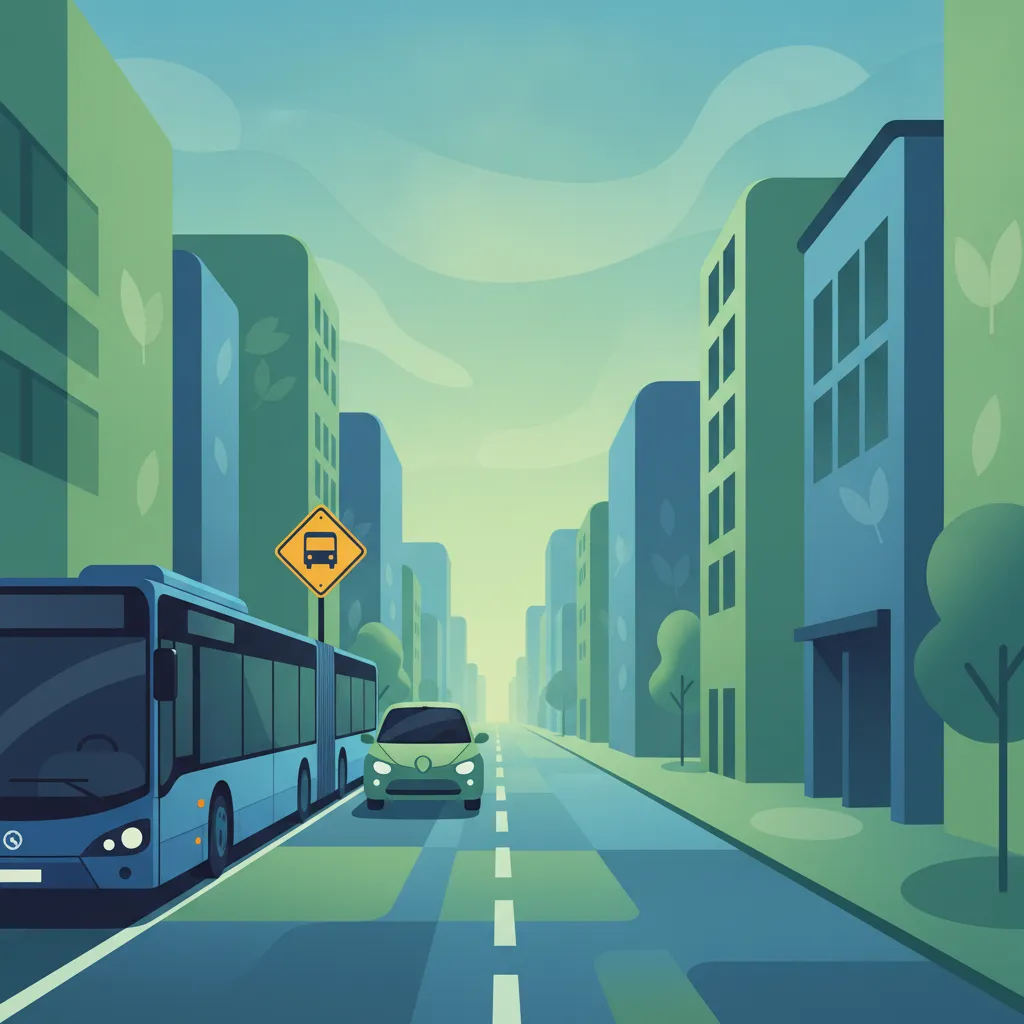
Bus lanes are a key tool for improving service reliability, but they come with specific rules. This lesson covers how to correctly interpret bus lane signs and markings. It also explains the regulations for entering and leaving the lane to make turns or avoid obstructions, and the priority rules associated with them.
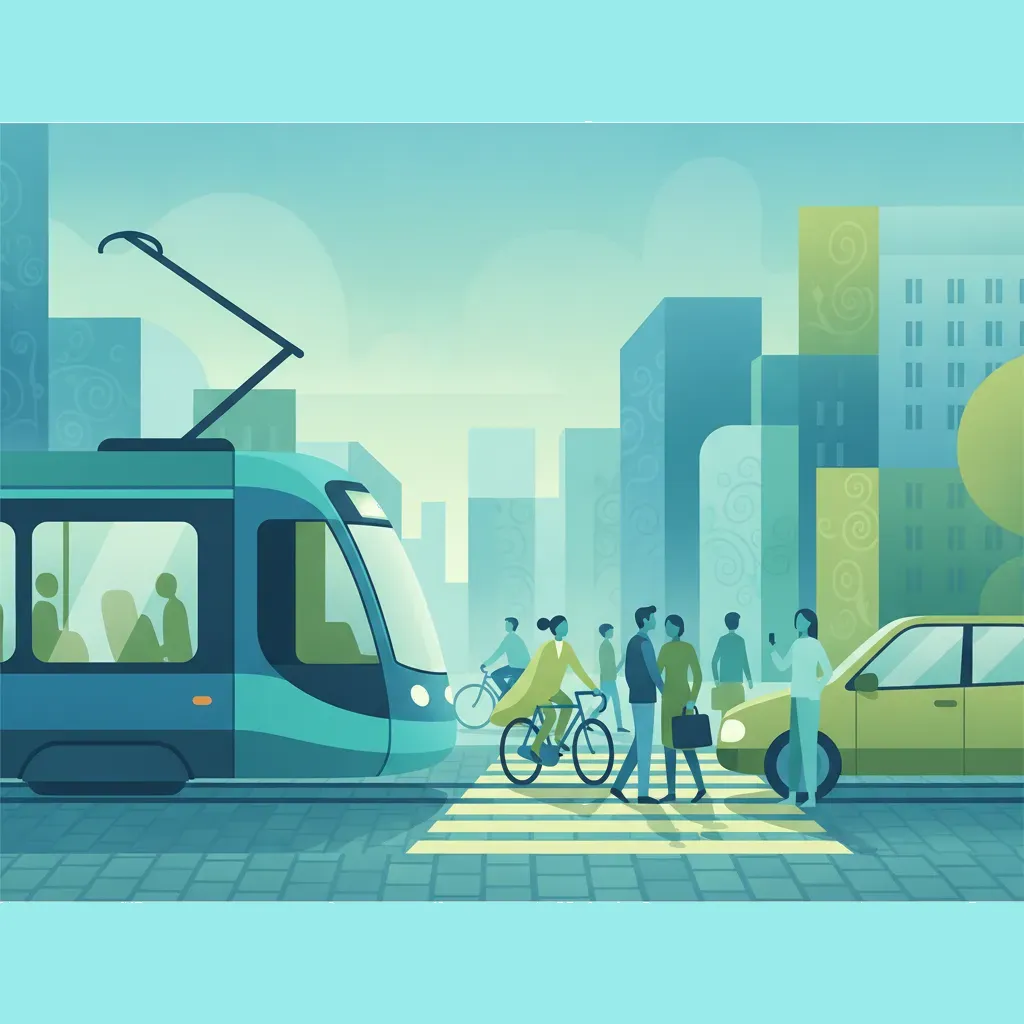
This lesson explores the priority given to public transport vehicles, especially trams and buses, in Swiss traffic. It explains how to recognize dedicated public transport lanes and the requirement to yield to trams at intersections. The content also covers procedures when a bus is stopping for passengers and how to ensure safe interactions.
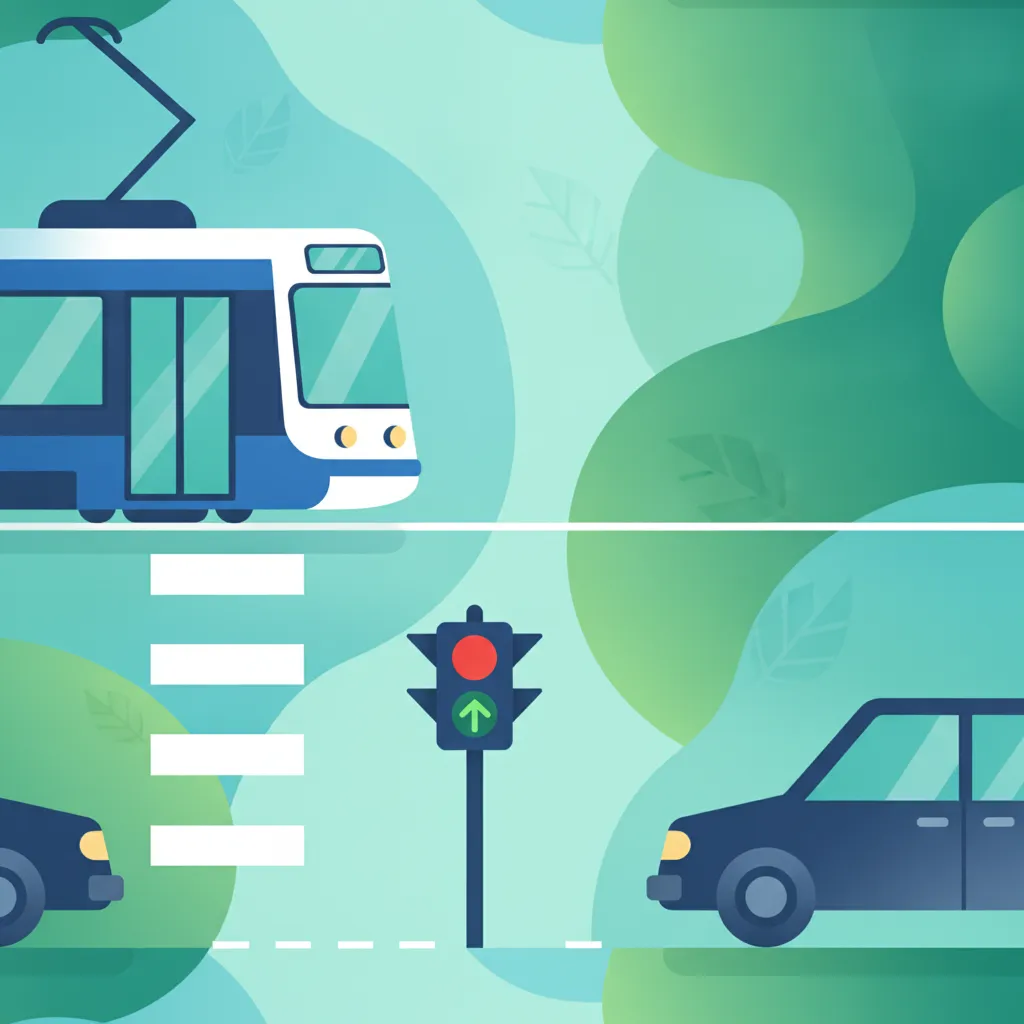
Many Swiss cities use systems that give buses priority at traffic lights to improve punctuality. This lesson explains how these systems detect an approaching bus and alter the signal phasing. You will learn to recognize and correctly respond to the special white light signals that grant this priority.
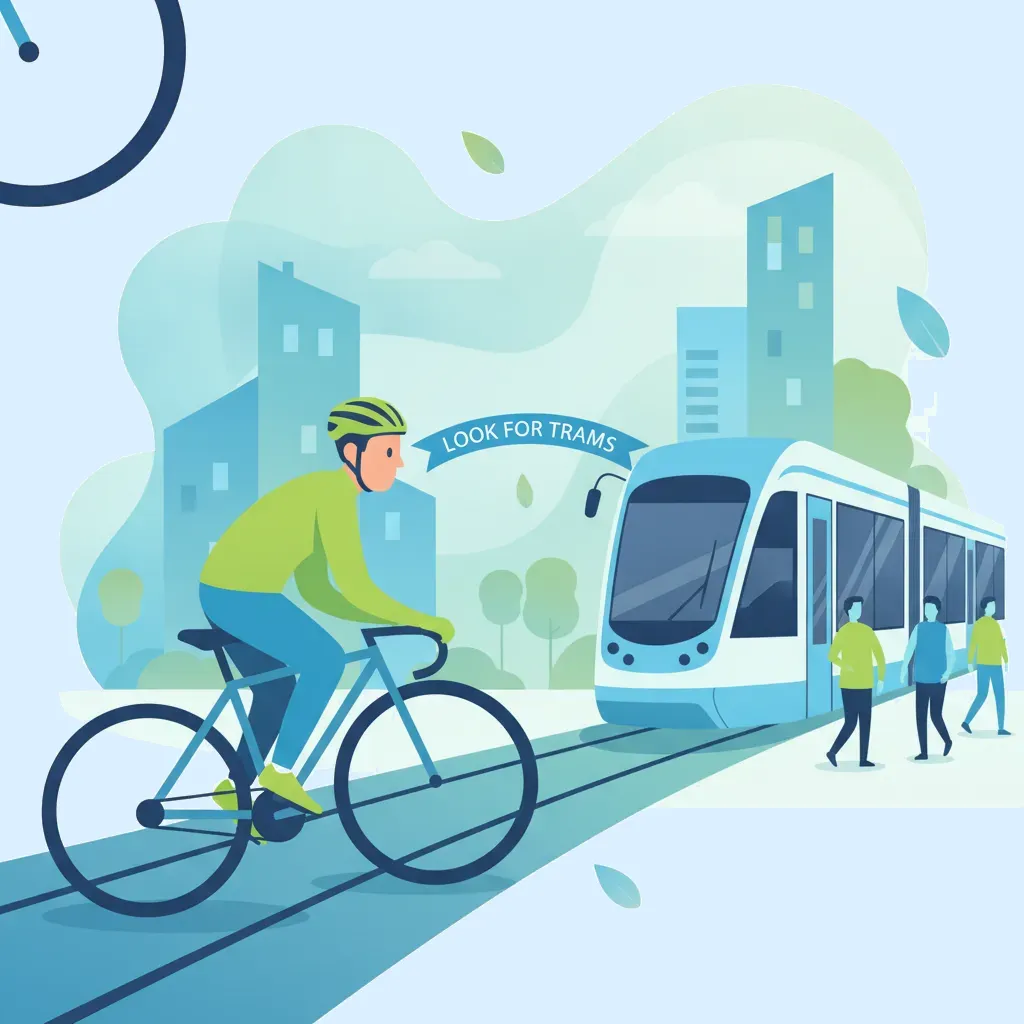
Sharing road space with trams presents unique challenges, including different priority rules and physical hazards like tracks. This lesson covers the Swiss regulations regarding tram priority at junctions and stops. It also provides practical advice on crossing tram tracks safely and maintaining awareness of tram movements.
Motorway driving involves high speeds and requires constant concentration. This lesson covers correct lane discipline, safe procedures for joining and leaving the motorway, and techniques for overtaking other large vehicles. Maintaining appropriate speed and a safe following distance is emphasized throughout.
This lesson provides guidance on safely navigating roundabouts and tram lanes, common features in Swiss cities. It covers the rules for yielding, lane positioning within the roundabout, and signaling intentions upon exiting. Special attention is given to the hazards of crossing slippery tram tracks and sharing the road with public transport.
This lesson focuses on safe interaction with large vehicles. It highlights the significant blind spots (or 'no-zones') around trucks and buses and teaches riders how to position themselves to remain visible. The content also provides guidance on overtaking large vehicles safely and anticipating their wide turning radius at intersections.
Driving a bus in older parts of a city requires exceptional spatial awareness and precise control. This lesson focuses on assessing clearances, managing front and rear overhang, and negotiating tight turns around parked cars and buildings. A key theme is slow, careful, and deliberate manoeuvring to avoid contact.
The size of a bus requires careful planning when negotiating complex intersections. This lesson teaches the importance of early lane selection, clear signalling, and comprehensive observation. It provides specific techniques for managing the vehicle's swept path through multi-lane roundabouts and other challenging urban junctions.
Motorway driving requires constant concentration due to high speeds. This lesson emphasizes the importance of staying in the right-hand lane unless overtaking and the specific restrictions on lorry overtaking in Switzerland. It reinforces the need for a following distance of at least four seconds to compensate for the vehicle's long stopping distance and provides guidance on safely merging and exiting.
Understand common driving mistakes and real-world scenarios when interacting with buses and trams in Switzerland. Learn how to apply theory rules correctly to ensure safety and avoid penalties.
This lesson explores the priority given to public transport vehicles, especially trams and buses, in Swiss traffic. It explains how to recognize dedicated public transport lanes and the requirement to yield to trams at intersections. The content also covers procedures when a bus is stopping for passengers and how to ensure safe interactions.
Sharing road space with trams presents unique challenges, including different priority rules and physical hazards like tracks. This lesson covers the Swiss regulations regarding tram priority at junctions and stops. It also provides practical advice on crossing tram tracks safely and maintaining awareness of tram movements.
This lesson focuses on safe interaction with large vehicles. It highlights the significant blind spots (or 'no-zones') around trucks and buses and teaches riders how to position themselves to remain visible. The content also provides guidance on overtaking large vehicles safely and anticipating their wide turning radius at intersections.
Many Swiss cities use systems that give buses priority at traffic lights to improve punctuality. This lesson explains how these systems detect an approaching bus and alter the signal phasing. You will learn to recognize and correctly respond to the special white light signals that grant this priority.
Driving a bus in older parts of a city requires exceptional spatial awareness and precise control. This lesson focuses on assessing clearances, managing front and rear overhang, and negotiating tight turns around parked cars and buildings. A key theme is slow, careful, and deliberate manoeuvring to avoid contact.

This lesson focuses on general driving safety in areas with a high concentration of children. It stresses the importance of significantly reducing speed, being prepared for unexpected events, and scanning for children between parked cars. The driver must exhibit maximum vigilance in these high-risk environments at all times.
The approach to a stop sets the stage for a safe passenger exchange. This lesson covers signalling in good time, decelerating smoothly, and aiming for a final position that is close and parallel to the kerb. Proper positioning minimizes the step for passengers and prevents them from having to step into traffic.
Transporting children carries the highest level of responsibility. This lesson covers the specific legal requirements for school buses in Switzerland, including the use of special signs and warning lights. It details the safe procedures for stopping, boarding, and alighting, and the driver's role in supervising children.
Departing from a bus stop is a high-risk manoeuvre. This lesson details the critical sequence of actions: checking all passengers are clear of the doors, performing a comprehensive mirror and blind spot check, signalling, and waiting for a safe gap in traffic. This systematic approach is essential for preventing collisions with overtaking vehicles, cyclists, or pedestrians.
Bus lanes are a key tool for improving service reliability, but they come with specific rules. This lesson covers how to correctly interpret bus lane signs and markings. It also explains the regulations for entering and leaving the lane to make turns or avoid obstructions, and the priority rules associated with them.
Find clear answers to common questions learners have about Interaction with Public Transport and Trams. Learn how the lesson is structured, which driving theory objectives it supports, and how it fits into the overall learning path of units and curriculum progression in Switzerland. These explanations help you understand key concepts, lesson flow, and exam focused study goals.
Generally, yes, trams have priority in many situations, especially when moving on their own tracks. However, you must always look for signs and signals at intersections that specifically govern right-of-way.
In built-up areas, if a bus indicates its intention to leave a designated bus stop, you are required to slow down and, if necessary, stop to allow the bus to enter the flow of traffic.
You may use tram tracks for driving or turning if they are integrated into the roadway, provided you do not obstruct the tram. Always check for signs indicating exclusive tram lanes.
While there isn't a single numerical distance, you must position your vehicle to avoid any part of the tram or its overhang, especially when turning or navigating tight curves.
Pinpoint specific Swiss traffic rules, road signs, or driving situations you need to master. Use the practice search to start a focused revision session now and build confidence for your official driving theory exam.