
Logo
Swiss Driving Theory Courses

Lesson 1 of the Road Users, Core Behaviour Rules and Safe Communication unit

Swiss Driving Theory B: Road Users and Their Rights

This lesson introduces the diverse categories of road users you will encounter on Swiss streets and the legal framework that defines their rights. Understanding these interactions is essential for passing your Category B theory exam and ensuring safety for all, especially vulnerable individuals. You will learn to identify the hierarchy of road users and apply the correct etiquette and safety protocols.
road userspriority rulesvulnerable road usersCategory B theorySwiss traffic law
Swiss Driving Theory B: Road Users and Their Rights

Lesson content overview

Swiss Driving Theory B

Understanding Road Users and Their Rights on Swiss Roads

Navigating the roads safely and confidently requires a thorough understanding of the various road users, their legal rights, and their corresponding responsibilities. This lesson is designed for those preparing for their Swiss Category B License, providing essential knowledge to interpret traffic situations, particularly concerning priority and safe interaction. By understanding the established hierarchy and specific regulations, drivers can anticipate actions, reduce risks, and contribute to a predictable and safe traffic flow for everyone on Swiss roads.

The legal system in Switzerland establishes clear guidelines to determine which road users have priority in different contexts. This framework is crucial for ensuring predictability and safety, especially at intersections, roundabouts, and shared spaces. All road users, from pedestrians to public transport operators, are bound by these regulations, though their specific rights and duties may vary.

A fundamental principle of Swiss road traffic law is the legal hierarchy of road users. This is a tiered structure designed to protect the most vulnerable participants, thereby reducing the risk of collisions and severe injuries. The general order, from highest to lowest priority in terms of vulnerability, is:

  1. Pedestrians: As the most vulnerable, pedestrians generally receive the highest priority, especially at designated crossings.
  2. Cyclists: While more protected than pedestrians, cyclists are significantly more exposed than those in motor vehicles and are afforded special consideration.
  3. Motorcyclists: Sharing many rights with motor vehicles, motorcyclists are still considered vulnerable due to their lack of protective structure.
  4. Motor Vehicle Drivers: This category includes cars, trucks, and vans. They generally have less inherent priority over the above categories but still follow specific right-of-way rules among themselves.
  5. Public Transport Operators: While public transport vehicles often have dedicated lanes and certain priority privileges in specific situations, they are also part of the overall traffic flow and must adhere to signals and general rules.

This hierarchy implies that drivers of larger, more powerful vehicles must constantly adjust their speed and behaviour to ensure the safety of those with less protection. It's not just about who has the "right" to proceed, but about who has the obligation to yield to prevent an accident.

Equality of Road Users: Shared Responsibilities

Despite the legal hierarchy, all road users in Switzerland are subject to the same fundamental traffic rules. This principle of equality means that regardless of whether you are walking, cycling, or driving a motor vehicle, you must observe traffic signs, signals, and speed limits. The purpose is to prevent arbitrary advantages and ensure predictable interactions. For instance, a pedestrian must still wait for a red light at a signalised crossing, just as a cyclist must follow stop signs. Understanding this balance between hierarchy and equality is vital for safe and responsible road use.

Categories of Road Users and Their Specific Responsibilities

Each category of road user has distinct characteristics and specific rules governing their interaction with others.

Pedestrians: The Most Vulnerable Road Users

Definition

Pedestrian

Any person traveling on foot, including those using mobility aids, walking, or standing on or near the roadway.

Pedestrians are the most vulnerable group, with no external protection against impact. This category includes children, the elderly, and persons with disabilities, all of whom may require even greater caution from other road users.

  • Practical Meaning: Pedestrians primarily use sidewalks, footpaths, and designated crosswalks. Where no sidewalks exist, they may use the road shoulder or the road itself, typically walking against the flow of traffic to maintain visibility of oncoming vehicles.
  • Associated Rules: Pedestrians must use designated crossings (zebra crossings, pedestrian bridges, underpasses) whenever available and reasonably accessible. At marked crosswalks without traffic lights, drivers must stop if pedestrians are clearly indicating their intention to cross or are already on the crossing. Even at unmarked crossings, drivers should be prepared to yield if a pedestrian has already entered the flow of traffic.
  • Common Misunderstandings: A common misconception is that pedestrians always have absolute priority, even when crossing outside marked zones or against traffic signals. While drivers should always be vigilant, pedestrians also bear responsibility for their safety. Another misunderstanding is assuming drivers will always stop at marked crosswalks without observing the surroundings; pedestrians should make eye contact and ensure they are seen before crossing.
  • Examples: A child stepping onto a zebra crossing requires immediate cessation of movement from all approaching vehicles. Conversely, a pedestrian attempting to cross a multi-lane highway where no crossing exists must wait for a safe gap in traffic, as they do not have automatic right-of-way in such a situation.

Cyclists: Navigating Shared and Dedicated Spaces

Definition

Cyclist

A road user operating a bicycle, e-bike, or other human-powered two-wheeled vehicle.

Cyclists bridge the gap between pedestrians and motor vehicles, often sharing road space but with greater vulnerability than those in cars.

  • Practical Meaning: Cyclists are generally expected to follow the same traffic signals and road markings as motorized traffic. They are encouraged to use dedicated bike lanes or paths where provided, but may use public roads where these are absent.
  • Associated Rules: Cyclists must use bike lanes or cycle paths when available, unless it is unsafe to do so (e.g., blocked by debris). They must obey all traffic signals and signs. When turning, especially left turns on busy roads, cyclists must signal their intentions clearly and may need to wait for a safe gap or even dismount and cross as a pedestrian if the situation is too complex. At roundabouts, cyclists typically have the same priority as cars unless otherwise indicated by signs or markings.
  • Common Misunderstandings: Some cyclists mistakenly believe they can ignore traffic lights on bike paths, or that they always have equal or superior priority to cars on shared roads. Conversely, some drivers underestimate cyclists' speed or assume they will always stick to dedicated paths, leading to dangerous encounters.
  • Examples: A cyclist approaching an intersection with a red light must stop, just like a car. If a bike lane merges with a car lane, the cyclist must follow the merging rules, potentially yielding to vehicles already in the lane. When turning left across traffic, a cyclist should either use a dedicated left-turn lane for bikes, perform an indirect turn by first crossing to the right side of the intersection, or dismount and walk their bike across.

Motorcyclists: Vulnerable Motorized Transport

Definition

Motorcyclist

An individual operating a motorcycle, scooter, or moped.

Motorcyclists, while operating motorized vehicles, are significantly more exposed to injury than occupants of cars or trucks due to the lack of a protective shell.

  • Practical Meaning: Motorcyclists generally share the same rights and obligations as drivers of cars and other motor vehicles. They use the same lanes and follow the same speed limits and traffic signals.
  • Associated Rules: Motorcyclists must obey all standard traffic laws, including speed limits, traffic signals, and priority rules at intersections. Special attention is given to safe overtaking distances, particularly when passing cyclists or pedestrians.
  • Common Misunderstandings: Some drivers mistakenly believe motorcyclists can legally filter through stationary traffic at high speeds or always overtake on the right. Similarly, some motorcyclists might assume they have inherent priority over cyclists, which is not always the case; the general rules of yielding and safe distances still apply.
  • Examples: A motorcyclist approaching a junction with a stop sign must come to a complete stop, just like any other motorist. When overtaking a cyclist, a motorcyclist is legally required to maintain a safe lateral distance of at least 1.5 meters to prevent startling the cyclist or causing a collision if the cyclist swerves.

Motor Vehicles: Cars, Trucks, and Vans

Definition

Motor Vehicle

Any motorized vehicle not classified as public transport or an emergency vehicle, including cars, trucks, and vans.

This broad category encompasses the majority of vehicles on Swiss roads. Drivers of these vehicles bear significant responsibility due to the potential for causing harm to other road users.

  • Practical Meaning: Drivers of motor vehicles must adhere to standard road rules, obey all traffic signs and signals, and yield according to the legal hierarchy of road users.
  • Associated Rules: Motor vehicle drivers must yield to pedestrians and cyclists at marked crossings. They must also give way to public transport vehicles in specific situations, such as when a bus signals to pull out from a stop or when trams require a clear path. At uncontrolled intersections, the vehicle approaching from the right typically has priority.
  • Common Misunderstandings: A frequent misconception among motor vehicle drivers is that they always have priority on main roads or over less protected users. Another is misunderstanding the specific circumstances under which they must yield to public transport, especially trams.
  • Examples: A car approaching a zebra crossing must stop if a pedestrian is waiting to cross or has already stepped onto the crossing. When entering a roundabout, drivers must yield to traffic already circulating within the roundabout.

Public Transport: Buses, Trams, and Trolleybuses

Definition

Public Transport Vehicle

Vehicles operating as part of the public transportation system on scheduled routes, such as buses, trams, and trolleybuses.

Public transport vehicles play a crucial role in urban mobility and often have specific rights to ensure efficient service.

  • Practical Meaning: Trams and buses frequently operate in dedicated lanes or have exclusive right-of-way in certain areas. However, they are still part of the overall traffic system and must heed traffic signals and general road rules.
  • Associated Rules: Drivers of other vehicles must yield to trams and trolleybuses when they signal to turn or are pulling out from a designated stop. Motorists must also avoid entering dedicated tram lanes unless explicitly permitted (e.g., to make a turn where the lane is shared briefly). Buses pulling out from a designated bus stop often have priority over other traffic in their lane.
  • Common Misunderstandings: A common belief is that trams always have absolute priority in all urban settings, which isn't entirely true; they must still obey traffic signals. Another misunderstanding for drivers is failing to anticipate a bus pulling out from a stop, potentially leading to sudden braking or collisions.
  • Examples: A car driving alongside a tram lane must not enter that lane unless there's a clear road marking allowing it to do so for a turn. If a bus at a designated stop signals its intention to pull back into traffic, vehicles approaching from behind must yield, allowing the bus to merge safely.

Vulnerable Road Users (VRUs): Requiring Extra Care

Definition

Vulnerable Road User (VRU)

A category of road users including pedestrians, cyclists, motorcyclists, and especially children, who have limited protection and are at higher risk of severe injury in a collision.

The concept of VRUs highlights the need for heightened caution from all road users, particularly those in motor vehicles.

  • Practical Meaning: VRUs should be given extra consideration and space, especially at intersections, crossing points, and in shared road environments. This means anticipating their actions and being prepared to react defensively.
  • Associated Rules: Drivers must constantly anticipate the actions of VRUs, maintain larger safety distances when passing or following them, and avoid abrupt manoeuvres that could startle or endanger them. Special vigilance is required around children, who are prone to unpredictable movements.
  • Common Misunderstandings: Underestimating the speed of cyclists or believing that VRUs always have priority regardless of the context are common misunderstandings. Another is failing to account for the potential unpredictability of children or impaired individuals.
  • Examples: When approaching a school zone, drivers must reduce speed significantly and be prepared for children to unexpectedly enter the roadway. Overtaking a cyclist requires providing a substantial safety buffer, not just the legal minimum, especially in adverse conditions.

Key Rules and Regulations for Swiss Road Users

Adhering to specific regulations is non-negotiable for safe road use in Switzerland. These rules define clear expectations for interactions between different road user categories.

Pedestrians at Crosswalks: Mandatory Yielding

Drivers must yield to pedestrians who are on a marked zebra crossing or clearly indicating their intention to cross. This is a fundamental principle for pedestrian safety.

  • Applicability: Applies to any marked crosswalk (zebra crossing) where a pedestrian has stepped onto the roadway or is waiting directly at the edge, showing a clear intent to cross.
  • Rationale: Pedestrians are the most vulnerable; their visible intention to cross must be respected to prevent accidents.
  • Correct Example: A driver stops their vehicle well before the zebra crossing when a person is waiting to cross, allowing them to proceed safely.
  • Incorrect Example: A driver speeds up to "beat" a pedestrian to the crossing or proceeds without stopping when a pedestrian is halfway across.

Warning

Always anticipate pedestrians near crosswalks, even if they haven't explicitly indicated intent to cross. Be prepared to stop.

Cyclists Using Bike Lanes: Stay in Your Lane

Cyclists must use designated bike lanes or cycle paths when provided, unless it is unsafe or blocked. Drivers must not impede cyclists in these lanes.

  • Applicability: Roads with clearly marked and designated bike lanes or paths.
  • Exception: When the lane is blocked, damaged, or otherwise unsafe, cyclists may temporarily use the adjacent vehicle lane, exercising caution.
  • Correct Example: A cyclist rides within the painted lines of a dedicated bike lane. A driver keeps their vehicle out of the bike lane.
  • Incorrect Example: A driver parks in a bike lane or encroaches into it while driving, forcing cyclists into the main traffic flow.

Motorcyclists Overtaking Cyclists: Safe Distance Required

When a motorcyclist (or any motor vehicle) overtakes a cyclist, a minimum safe lateral distance of 1.5 meters must be maintained.

  • Applicability: Anytime a motorized vehicle passes a bicycle or e-bike.
  • Rationale: To prevent collisions caused by wind turbulence, sudden swerving by the cyclist, or loss of balance.
  • Correct Example: A motorcyclist waits for a clear, wide section of road to pass a cyclist, ensuring ample space.
  • Incorrect Example: A motorcyclist squeezes past a cyclist with only a few centimetres to spare, especially at high speed.

Drivers Yielding to Public Transport: Respecting Priority

Drivers must give way to trams and trolleybuses when they signal to turn or are exiting a designated stop. Buses also often have priority when pulling out from designated stops.

  • Applicability: In urban settings, especially near tram tracks and bus stops.
  • Rationale: To ensure the smooth and timely operation of public transport and prevent delays or accidents.
  • Correct Example: A car driver slows down and stops to allow a tram to complete its turn or a bus to pull out from its stop.
  • Incorrect Example: A driver attempts to overtake a tram that is signaling to turn, or forces their way past a bus pulling out.

Priority at Unmarked Intersections: The Right-Hand Rule

At uncontrolled intersections (those without traffic lights, signs, or road markings indicating priority), vehicles approaching from the right must be given priority.

  • Applicability: Any intersection without specific priority signage or signals.
  • Rationale: To provide a clear, universal rule for right-of-way, reducing confusion and potential collisions.
  • Correct Example: Two cars arrive at an unmarked crossroad; the car on the left yields to the car approaching from its right.
  • Incorrect Example: A driver assumes they have priority because they are on what they perceive as a "main" road, ignoring the right-hand rule.

Children as Vulnerable Users: Heightened Caution

Drivers must exercise heightened caution, especially near schools, playgrounds, and residential areas where children might be present. Special speed limits and signage often reinforce this.

  • Applicability: Always, but particularly in areas known for child activity.
  • Rationale: Children are unpredictable, have less developed road sense, and are less visible.
  • Correct Example: Reducing speed to walking pace when passing a group of children near the road, and being prepared to stop instantly.
  • Incorrect Example: Driving at the posted speed limit through a school zone during school hours, assuming children will always use sidewalks.

Common Violations and Their Safety Implications

Ignoring the rules governing road user rights can have severe consequences, ranging from fines to serious accidents.

  1. Failure to Yield at a Zebra Crossing: This is a leading cause of pedestrian accidents. A driver failing to stop for a pedestrian at a marked crossing risks a collision, resulting in severe injuries to the pedestrian and significant legal penalties (fines, points, license suspension) for the driver.
  2. Cyclist Riding Against the Direction of a Bike Lane or Traffic: This creates unpredictable situations for drivers who may not anticipate a cyclist coming from the "wrong" direction, leading to head-on collisions or dangerous evasive actions.
  3. Motorist Overtaking a Cyclist with Insufficient Distance: Passing too closely can cause the cyclist to lose balance due to wind turbulence or panic, leading to a fall under the wheels of the overtaking vehicle or into other traffic. This is a direct violation of the 1.5-meter minimum distance rule.
  4. Driver Ignoring a Tram Lane: Encroaching on a tram lane is not only illegal but extremely dangerous, as trams cannot swerve. It risks collisions with trams and can disrupt public transport schedules, leading to fines and safety hazards.
  5. Entering a Roundabout Without Yielding to Circulating Traffic: This is a frequent cause of collisions at roundabouts, leading to side-impact accidents and obstructing traffic flow.

Conditional Variations and Defensive Driving Strategies

Road conditions are rarely ideal, and adapting your driving behaviour is crucial for maintaining safety and respecting the rights of all users.

Weather Conditions

  • Rain, Snow, Fog: Reduce visibility for all users. Drivers must significantly increase following distances, decrease speed, and allow longer reaction times for pedestrians and cyclists, who become harder to see and may be less stable. Braking distances are also extended.

Light Conditions

  • Night Driving: Pedestrians and cyclists are much less visible, especially if they are not wearing reflective clothing or don't have adequate lighting. Drivers must use headlights appropriately (dipped beam in built-up areas, high beam on unlit roads when safe) and be extra cautious near crosswalks and bus stops.

Road Type Variation

  • Urban Areas: Characterised by dense pedestrian and cyclist traffic, numerous intersections, and public transport. Drivers must be constantly vigilant and prepared to yield frequently. Speed limits are typically lower.
  • Rural Roads: While pedestrian and cyclist traffic may be lower, speeds are generally higher. The sudden appearance of a pedestrian or cyclist can be more dangerous due to the speed differential. The same rules for yielding at crosswalks apply, but often with less warning.

Vehicle State

  • Heavy Load or Trailer: Significantly affects a vehicle's stopping distance and maneuverability. Drivers must account for these changes, allowing much more space and time before braking or executing turns, especially when interacting with vulnerable users.

Interaction with Vulnerable Users

  • Cyclists and Turns: If a cyclist signals a left turn, a motorist must give them sufficient space and time to complete the manoeuvre safely, particularly on shared lanes where the cyclist may need to position themselves towards the centre of the lane.
  • Children and Pets: Be prepared for sudden, unpredictable movements. Always assume they might step into the road without looking.

Special Scenarios

  • At Tram Stops: Even if a driver technically has priority, they must anticipate a tram pulling out or passengers disembarking and crossing the road. Proactive yielding enhances safety.
  • Emergency Vehicles: In urgent situations, emergency vehicles (ambulance, fire, police) with flashing blue lights and sirens override all standard priority rules. All road users must yield and make way safely.

Tip

Always practice defensive driving: anticipate potential hazards, assume other road users might make mistakes, and be prepared to react safely.

Cause-and-Effect: The Logic Behind Traffic Rules

Understanding the 'why' behind traffic rules reinforces their importance for safety and efficiency.

  • Following the Legal Hierarchy: When drivers consistently yield to higher-priority road users (pedestrians, cyclists, motorcyclists), the risk of severe collisions is drastically reduced. This creates a predictable environment where each user knows what to expect.
  • Ignoring Hierarchy: Disregarding priority rules is a primary cause of near-misses and serious accidents, especially involving vulnerable road users. This leads to increased legal liability, potential injury, and emotional distress.
  • Increased Visibility: Better lighting, reflective clothing, and proper use of vehicle lights improve mutual visibility among road users. This increases reaction time for everyone, significantly reducing accident potential, especially in low light or adverse weather.
  • Adequate Following and Overtaking Distances: Maintaining proper distances ensures sufficient braking time to prevent rear-end collisions and provides a safe buffer when passing cyclists or pedestrians, preventing side-swipe accidents and allowing for minor deviations.
  • Anticipating Human Factors: Recognizing that children, the elderly, or distracted individuals may act unpredictably allows drivers to adjust their behaviour (e.g., lower speed, increased vigilance) to compensate, thereby preventing accidents.

Conclusion and Further Learning

Mastering the rights and responsibilities of all road users is more than just passing your Swiss Category B License exam; it's about adopting a mindset of respect, caution, and predictability on the road. By consistently applying the legal hierarchy, yielding to vulnerable users, and adjusting your driving to various conditions, you contribute to a safer environment for everyone. This foundational knowledge will be built upon in future lessons, exploring more complex interactions and advanced driving techniques.

Learn more with these articles

Check out these practice sets

Lesson recap

Quick summary before you move on

Fast revision

This lesson establishes the legal hierarchy of Swiss road users, placing pedestrians at the top due to their vulnerability, followed by cyclists, motorcyclists, motor vehicle drivers, and public transport operators. Despite this hierarchy, all road users share equal responsibility to obey traffic signs, signals, and speed limits. Key regulations covered include mandatory yielding to pedestrians at zebra crossings, the 1.5-meter minimum overtaking distance for cyclists, the right-hand rule at unmarked intersections, and special yield obligations to public transport vehicles. The content emphasizes defensive driving strategies for interacting with vulnerable road users, particularly children and cyclists, and highlights how understanding the rationale behind these rules helps learners internalize safe driving practices for their Category B theory exam and real-world Swiss driving.


Core takeaways

Main ideas from this lesson

A short set of high-value points that capture the most important learning from this lesson.

Swiss traffic law establishes a legal hierarchy where pedestrians have the highest priority, followed by cyclists, motorcyclists, motor vehicle drivers, and public transport operators.

All road users are bound by the same fundamental traffic rules regardless of their position in the hierarchy, ensuring predictable interactions for everyone.

Drivers of larger vehicles bear the greatest responsibility to adjust speed and behaviour to protect more vulnerable road users.

At marked zebra crossings, drivers must yield to pedestrians who are on the crossing or clearly indicating intent to cross.

Vulnerable road users (VRUs) including children, elderly, and cyclists require heightened caution and larger safety buffers from all other road users.

Remember this

Details worth keeping in mind

Point 1

Pedestrians always have priority at marked zebra crossings, even if they haven't fully entered the road yet.

Point 2

When overtaking a cyclist, maintain a minimum lateral distance of 1.5 meters at all times.

Point 3

At uncontrolled intersections without signs or signals, vehicles approaching from the right have priority.

Point 4

Cyclists must use designated bike lanes when available, and drivers must not impede them in these lanes.

Point 5

Public transport vehicles (trams, buses) have priority when signalling to turn or pulling out from designated stops.

Watch for this

Frequent learner mistakes

Assuming pedestrians only have priority at zebra crossings when they are already fully on the road, rather than when they are clearly indicating intent to cross.

Passing cyclists with insufficient lateral distance, underestimating how wind turbulence or sudden swerving can cause a cyclist to lose balance.

Believing that being on a perceived 'main road' automatically grants priority at unmarked intersections, ignoring the right-hand rule.

Drivers encroaching on or parking in designated bike lanes, forcing cyclists into traffic unexpectedly.

Failing to yield to public transport vehicles (trams and buses) when they signal to pull out from stops, disrupting traffic flow and creating safety hazards.

Search topics related to Road Users and Their Rights

Explore search topics learners often look for when studying Road Users and Their Rights. These topics reflect common questions about road rules, driving situations, safety guidance, and lesson level theory preparation for learners in Switzerland.

road user rights Swiss theory exampriority rules pedestrians cyclists Switzerlandwho has right of way Switzerland Category BSwiss driving theory vulnerability rulesunderstanding road user hierarchy Switzerlanddefensive driving theory for Swiss Category B

Related driving theory lessons for Road Users and Their Rights

Browse additional driving theory lessons that cover connected traffic rules, road signs, and common driving situations related to this topic. Improve your understanding of how different rules interact across everyday traffic scenarios.

Swiss Road User Hierarchy and Vulnerability Explained

Understand the legal hierarchy of road users in Switzerland, focusing on the rights and responsibilities of pedestrians, cyclists, and motorcyclists. Learn how to identify and protect vulnerable road users (VRUs) in various traffic situations.
road user hierarchyvulnerable road userspriority rulesSwiss traffic lawdefensive driving
Identifying and Anticipating the Actions of Vulnerable Road Users lesson image

Identifying and Anticipating the Actions of Vulnerable Road Users

This lesson trains drivers to look beyond other vehicles and actively search for pedestrians, cyclists, and motorcyclists, especially those who may be distracted or unaware. It covers common behavioral patterns of different VRU groups. The goal is to see potential hazards developing early and create time and space to react safely.
Swiss Driving Theory DProtecting Vulnerable Road Users and Managing High-Risk Environments
View lesson
Protecting Vulnerable Road Users: Pedestrians and Cyclists lesson image

Protecting Vulnerable Road Users: Pedestrians and Cyclists

Pedestrians, cyclists, motorcyclists, and e-scooter riders are extremely vulnerable in any interaction with a heavy vehicle. This lesson instills a defensive mindset, teaching drivers to be hyper-aware of VRUs, especially near junctions, crossings, and cycle lanes. It focuses on anticipation and giving VRUs extra space, as they can be unpredictable and are often hidden in blind spots.
Swiss Truck Driving Theory (C/C1)Urban Deliveries, Vulnerable Road Users and Restricted Environments
View lesson
Vulnerable Road Users: Cyclists and Pedestrians lesson image

Vulnerable Road Users: Cyclists and Pedestrians

This lesson explores the specific considerations for cyclists and pedestrians, who are among the most vulnerable road users. It covers the proper use of bicycle lanes, the minimum safe overtaking distance for cyclists, and the legal requirements for yielding at pedestrian crossings. The content reinforces the need for heightened vigilance around these users.
Swiss Driving Theory BRoad Users, Core Behaviour Rules and Safe Communication
View lesson
Safe Procedures Around Schools, Playgrounds, and Residential Areas lesson image

Safe Procedures Around Schools, Playgrounds, and Residential Areas

This lesson focuses on general driving safety in areas with a high concentration of children. It stresses the importance of significantly reducing speed, being prepared for unexpected events, and scanning for children between parked cars. The driver must exhibit maximum vigilance in these high-risk environments at all times.
Swiss Driving Theory DProtecting Vulnerable Road Users and Managing High-Risk Environments
View lesson
Road User Interaction in Urban vs Rural Settings lesson image

Road User Interaction in Urban vs Rural Settings

This lesson contrasts the interaction dynamics between road users in urban and rural environments, highlighting differing challenges. It discusses the higher density of pedestrians and cyclists in cities versus the presence of agricultural vehicles and wildlife in rural areas. You will learn how speed limits, visibility, and road layout impact safe interactions.
Swiss Driving Theory BRoad Users, Core Behaviour Rules and Safe Communication
View lesson
Pedestrian Safety and Right-of-Way Rules lesson image

Pedestrian Safety and Right-of-Way Rules

This lesson explores pedestrian right-of-way at various crossings, including zebra crossings and pedestrian islands. It emphasizes the need for drivers to reduce speed, anticipate pedestrian movement, and stop safely when required. The content also covers special regulations that apply in school zones, such as reduced speed limits and heightened vigilance.
Swiss Driving Theory BVulnerable Road Users, Public Transport, Trams and Special Traffic Situations
View lesson
Defensive Driving Techniques and Hazard Anticipation lesson image

Defensive Driving Techniques and Hazard Anticipation

This lesson introduces defensive driving principles, focusing on hazard anticipation, continuous scanning, and proactive positioning. You will learn how to anticipate potential hazards by observing traffic patterns and maintaining situational awareness. Emphasis is placed on proactive speed management to avoid dangerous situations before they arise.
Swiss Driving Theory BSpeed, Distance, Stopping, Visibility and Defensive Driving
View lesson
Securing the Scene of an Accident lesson image

Securing the Scene of an Accident

This lesson covers the immediate actions to take following a collision. The priorities are to prevent further incidents by securing the scene, to assess the situation for injuries, and to alert the emergency services. You will learn the correct procedures for making the area safe for yourself, your passengers, and other road users.
Swiss Driving Theory DManaging Fatigue, Incidents, and On-Board Emergencies
View lesson
School Zones and Child Safety Rules lesson image

School Zones and Child Safety Rules

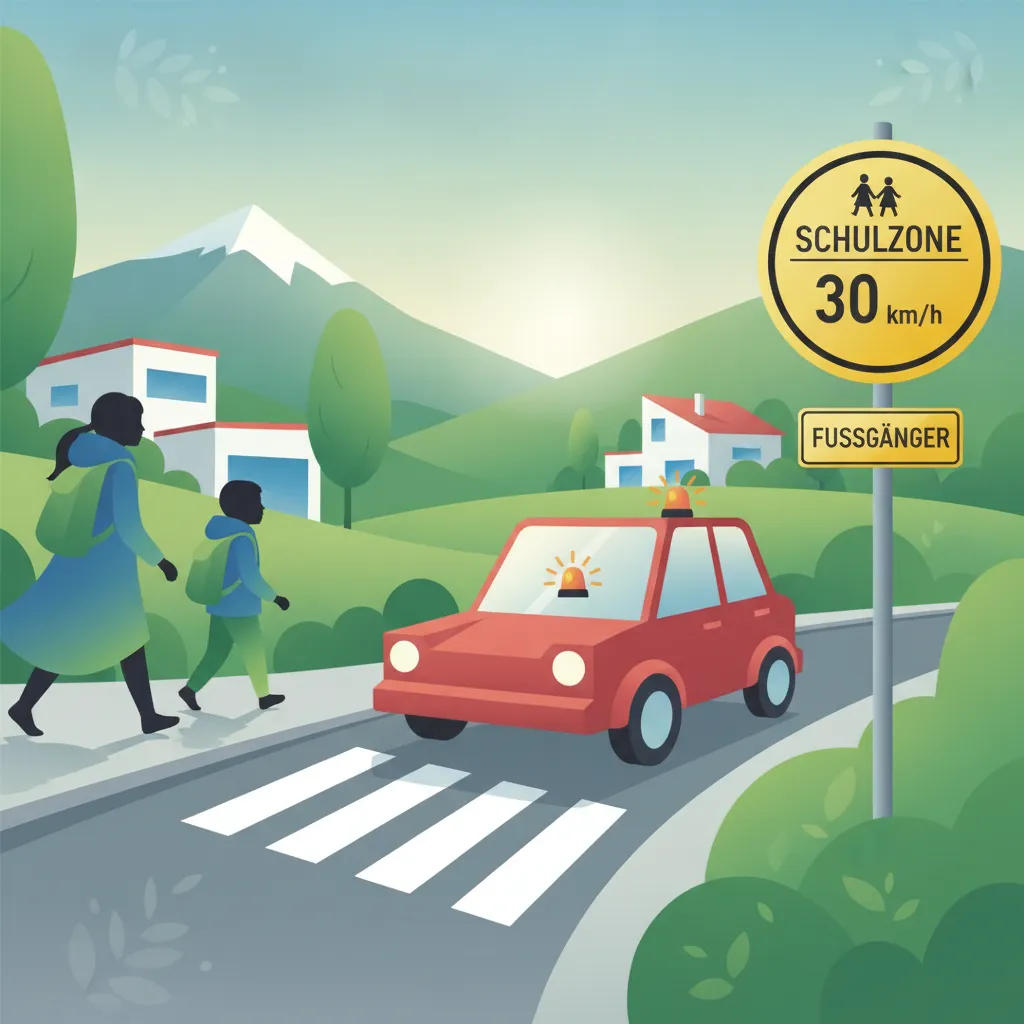
This lesson focuses on school zones, where special speed limits and cautionary measures are required. You will learn to recognize school zone signs, understand reduced speed limits, and be aware of designated child crossing zones. The content also emphasizes the need for heightened vigilance when school buses stop for students to ensure child safety.
Swiss Driving Theory BVulnerable Road Users, Public Transport, Trams and Special Traffic Situations
View lesson
Warning Signs and Hazard Awareness lesson image

Warning Signs and Hazard Awareness

This lesson focuses on warning signs that alert drivers to potential hazards ahead, such as curves, steep descents, and roadwork zones. You will understand how these signs prompt anticipatory driving behavior, allowing for adjustments in speed and position. The content also discusses the typical placement of warning signs to help you react safely to changing conditions.

Swiss Driving Theory BSwiss Signs, Supplementary Signs, Signals and Road Markings
View lesson

Interactions Between Road Users: Rules and Scenarios

Explore practical scenarios and essential rules for safe interaction between different road users in Switzerland, including yielding at crosswalks, cyclist lane usage, and public transport priority. Crucial for understanding real-world traffic situations.

road user interactionpriority rulespedestrianscyclistspublic transportSwiss driving theory
Pedestrian Safety and Right-of-Way Rules lesson image

Pedestrian Safety and Right-of-Way Rules

This lesson explores pedestrian right-of-way at various crossings, including zebra crossings and pedestrian islands. It emphasizes the need for drivers to reduce speed, anticipate pedestrian movement, and stop safely when required. The content also covers special regulations that apply in school zones, such as reduced speed limits and heightened vigilance.
Swiss Driving Theory BVulnerable Road Users, Public Transport, Trams and Special Traffic Situations
View lesson
Traffic Lights, Pedestrian Signals, and Tram Signals lesson image

Traffic Lights, Pedestrian Signals, and Tram Signals

This lesson details the operation of traffic light systems in Switzerland. It explains the sequence and meaning of red, amber, and green lights, including flashing amber signals. The content also covers specific signals for pedestrians and the priority rules associated with tram signals to ensure safe interaction at controlled intersections.

Swiss Driving Theory MSwiss Signs, Signals, Markings, and Priority Rules
View lesson
Interaction with Public Transport and Trams lesson image

Interaction with Public Transport and Trams

This lesson focuses on the rules governing interactions with public transport vehicles like buses and trams. It explains the priority given to these vehicles at stops and the use of dedicated lanes. Additionally, the content covers tram track crossing procedures and correct vehicle positioning near public transport stops to ensure safety.

Swiss Driving Theory BRoad Users, Core Behaviour Rules and Safe Communication
View lesson
Vulnerable Road Users: Cyclists and Pedestrians lesson image

Vulnerable Road Users: Cyclists and Pedestrians

This lesson explores the specific considerations for cyclists and pedestrians, who are among the most vulnerable road users. It covers the proper use of bicycle lanes, the minimum safe overtaking distance for cyclists, and the legal requirements for yielding at pedestrian crossings. The content reinforces the need for heightened vigilance around these users.
Swiss Driving Theory BRoad Users, Core Behaviour Rules and Safe Communication
View lesson
Cyclist and E‑Bike Interaction Rules lesson image

Cyclist and E‑Bike Interaction Rules

This lesson focuses on the interaction between motor vehicles and cyclists, including e-bikes. You will learn the importance of respecting cyclist priority and maintaining a safe overtaking distance. The content also addresses specific Swiss regulations concerning e-bike speed limits, cyclist lane markings, and appropriate behavior when passing cyclists.

Swiss Driving Theory BVulnerable Road Users, Public Transport, Trams and Special Traffic Situations
View lesson
Protecting Vulnerable Road Users: Pedestrians and Cyclists lesson image

Protecting Vulnerable Road Users: Pedestrians and Cyclists

Pedestrians, cyclists, motorcyclists, and e-scooter riders are extremely vulnerable in any interaction with a heavy vehicle. This lesson instills a defensive mindset, teaching drivers to be hyper-aware of VRUs, especially near junctions, crossings, and cycle lanes. It focuses on anticipation and giving VRUs extra space, as they can be unpredictable and are often hidden in blind spots.
Swiss Truck Driving Theory (C/C1)Urban Deliveries, Vulnerable Road Users and Restricted Environments
View lesson
Public Transport Priority and Tram Interactions lesson image

Public Transport Priority and Tram Interactions

This lesson explores the priority given to public transport vehicles, especially trams and buses, in Swiss traffic. It explains how to recognize dedicated public transport lanes and the requirement to yield to trams at intersections. The content also covers procedures when a bus is stopping for passengers and how to ensure safe interactions.
Swiss Driving Theory BVulnerable Road Users, Public Transport, Trams and Special Traffic Situations
View lesson
Special Traffic Situations: Railway Crossings and Shared Zones lesson image

Special Traffic Situations: Railway Crossings and Shared Zones

This lesson examines special traffic situations such as railway level crossings and shared zones where different road users coexist. It explains the specific safety procedures required at railway crossings and how to behave in shared zones with mixed traffic. The content also addresses the need to yield to oncoming trains and follow special signage in these unique zones.
Swiss Driving Theory BVulnerable Road Users, Public Transport, Trams and Special Traffic Situations
View lesson
Safe Interaction with Trams and Shared Road Spaces lesson image

Safe Interaction with Trams and Shared Road Spaces

Sharing road space with trams presents unique challenges, including different priority rules and physical hazards like tracks. This lesson covers the Swiss regulations regarding tram priority at junctions and stops. It also provides practical advice on crossing tram tracks safely and maintaining awareness of tram movements.

Swiss Driving Theory DNavigating Urban Traffic, Bus Priority, and Public Transport Systems
View lesson
Safe Procedures Around Schools, Playgrounds, and Residential Areas lesson image

Safe Procedures Around Schools, Playgrounds, and Residential Areas

This lesson focuses on general driving safety in areas with a high concentration of children. It stresses the importance of significantly reducing speed, being prepared for unexpected events, and scanning for children between parked cars. The driver must exhibit maximum vigilance in these high-risk environments at all times.

Swiss Driving Theory DProtecting Vulnerable Road Users and Managing High-Risk Environments
View lesson

Frequently asked questions about Road Users and Their Rights

Find clear answers to common questions learners have about Road Users and Their Rights. Learn how the lesson is structured, which driving theory objectives it supports, and how it fits into the overall learning path of units and curriculum progression in Switzerland. These explanations help you understand key concepts, lesson flow, and exam focused study goals.

Do pedestrians always have the right of way in Switzerland?

Pedestrians have priority at marked pedestrian crossings, provided they are waiting to cross or are already on the crossing. However, they must exercise caution and not step out unexpectedly. In other locations, drivers must still exercise special care towards vulnerable users, but the strict right-of-way rules differ.

How should I treat cyclists on the road according to Swiss theory?

Cyclists are considered full road users. You must maintain a safe lateral distance when overtaking them and be aware of their vulnerability at intersections. Never cut off a cyclist when turning right.

Why is the hierarchy of road users important for the theory test?

The test often presents scenarios where you must decide the order of movement. Understanding the hierarchy—where vulnerable users or those with special signals are prioritized—is crucial for choosing the correct answer in priority situations.

What special caution is required for children on Swiss roads?

Children are unpredictable and may not perceive danger like adults. When you see children near the road, you are legally required to slow down, be prepared to brake immediately, and increase your observation range.

Ready to Target Specific Weaknesses in Your Swiss Driving Theory Knowledge?

Pinpoint specific Swiss traffic rules, road signs, or driving situations you need to master. Use the practice search to start a focused revision session now and build confidence for your official driving theory exam.

Search Practice Theory Questions

Continue your Swiss driving theory learning journey

Swiss road signsSwiss article topicsSearch Swiss road signsSwiss driving theory homeSwiss road sign categoriesSwiss driving theory topicsSearch Swiss theory articlesSwiss driving theory coursesSwiss Driving Theory B courseSwiss Driving Theory M courseSwiss Driving Theory D courseSwiss driving theory articlesSwiss driving theory practiceSwiss practice set categoriesSwiss driving licence proceduresSwiss Motorcycle Theory (A) courseSearch Swiss driving theory practiceSwiss driving theory terminology A–ZSwiss driving theory terms and glossarySwiss Truck Driving Theory (C/C1) courseSwiss Signs, Signals, Markings, and Priority Rules unit in Swiss Driving Theory MSwiss Category M Context and First-Rider Responsibility unit in Swiss Driving Theory MRoad Users, Core Behaviour Rules and Safe Communication unit in Swiss Driving Theory BSwiss D, D1, D1E & DE Scope and Professional Responsibility unit in Swiss Driving Theory DRoad Users and Their Rights lesson in Road Users, Core Behaviour Rules and Safe CommunicationSwiss C, C1, C1E & CE Scope and Professional Context unit in Swiss Truck Driving Theory (C/C1)Passenger Vehicle Construction, Controls, and Pre-Trip Inspections unit in Swiss Driving Theory DMotorcycle Construction, Controls, Equipment and Safety Checks unit in Swiss Motorcycle Theory (A)Swiss Category B, Learner Permit, Examination and Driver Responsibility unit in Swiss Driving Theory BSwiss Motorcycle Categories, Licence Scope and Rider Responsibility unit in Swiss Motorcycle Theory (A)Heavy-Vehicle Dimensions, Masses, Axle Loads and Operating Limits unit in Swiss Truck Driving Theory (C/C1)Core Behaviour Rules and Safe Communication lesson in Road Users, Core Behaviour Rules and Safe CommunicationInteraction with Public Transport and Trams lesson in Road Users, Core Behaviour Rules and Safe CommunicationVulnerable Road Users: Cyclists and Pedestrians lesson in Road Users, Core Behaviour Rules and Safe CommunicationRoad User Interaction in Urban vs Rural Settings lesson in Road Users, Core Behaviour Rules and Safe Communication