
Navigating urban streets requires careful interaction with a variety of road users. This lesson focuses on safely coexisting with cars and bicycles, a crucial topic for your Spanish AM category theory exam. Learn how to ensure your visibility and predict the movements of larger vehicles and cyclists.

Lesson content overview
Operating a moped (Category AM) in Spain's bustling urban environments requires a keen understanding of how to safely interact with all other road users, especially cars and bicycles. This lesson focuses on the dynamic relationship between these vehicle types, emphasizing strategies for visibility, predictable behavior, and legal compliance. Mastering these interactions is fundamental not only for your safety but also for ensuring a harmonious flow of traffic for everyone on the road.
The urban landscape is a complex mix of vehicle sizes, speeds, and vulnerabilities. As a moped rider, you sit in an intermediate position: more vulnerable than a car, but generally less vulnerable than a cyclist or pedestrian. This lesson is crucial because collisions often stem from misunderstandings about priority, lack of visibility, or unexpected maneuvers. By understanding the specific challenges and rules governing interactions with cars and bicycles, you can proactively prevent accidents and navigate Spanish roads with confidence.
Effective interaction relies on anticipating the actions of others, making your own intentions clear, and consistently adhering to traffic regulations. This knowledge builds upon your understanding of basic vehicle controls, urban traffic signs, and the general hierarchy of road users in Spain, where pedestrians and cyclists are considered more vulnerable and therefore often have priority.
To ensure safety and legal compliance when sharing the road with cars and bicycles, several core principles guide a moped rider's actions. These principles are interconnected and form the foundation of responsible urban riding.
Predictability is paramount for road safety. As a moped rider, every maneuver you make should be clear and anticipated by other road users, particularly cyclists and car drivers. This means consistently signaling your intentions well in advance, whether you are changing lanes, turning, or preparing to stop. Predictable behavior reduces uncertainty, gives others time to react, and significantly lowers the risk of sudden braking or collisions.
Visibility is your first line of defense. Given their smaller size, mopeds can easily be overlooked by drivers of larger vehicles. It is your responsibility to ensure you are seen and, conversely, to be aware of other vehicles' blind spots. These are areas around a vehicle that the driver cannot see, even with mirrors. Positioning yourself strategically in your lane, using appropriate lighting, and wearing high-visibility gear are essential for preventing blind-spot incidents.
In the Spanish traffic hierarchy, cyclists are considered vulnerable road users and are often granted priority in various situations. Understanding and respecting these right-of-way rules is not just a legal obligation but a moral one, designed to protect those who are most exposed. This means yielding to cyclists at intersections, respecting their dedicated lanes, and never assuming you have priority simply because you are faster or in a motor vehicle.
Overtaking bicycles requires extreme caution and a specific legal minimum distance. Providing ample lateral clearance – the horizontal space between your moped and the cyclist – is critical. This buffer zone accounts for sudden movements a cyclist might make, such as swerving to avoid an obstacle, or the "bow wave effect" caused by your moped's passage. Insufficient clearance is a common cause of accidents and is strictly prohibited under Spanish traffic law.
Proper lane discipline involves using the correct lanes for your vehicle type and positioning yourself appropriately within them. Dedicated cycling infrastructure, such as bike lanes, is designed to separate cyclists from motorized traffic, enhancing safety for everyone. As a moped rider, you must understand when and how you may interact with these lanes, which are generally reserved exclusively for bicycles. Using them incorrectly can create dangerous conflicts and result in legal penalties.
Understanding specific concepts related to visibility, overtaking, and lane usage is vital for safe moped operation in mixed traffic.
A blind spot is an area around a vehicle that cannot be seen by the driver using mirrors or direct vision. All vehicles, including mopeds, have blind spots. For cars, these are typically the areas to the rear-side, often not fully covered by the side mirrors. For mopeds, side-rear blind spots can also exist, making shoulder checks (glancing over your shoulder) essential before changing lanes.
As a moped rider, your primary concern is to avoid lingering in a car's blind spots. If you ride directly alongside a car's rear-side window for an extended period, the driver may not see you, especially if they are preparing to change lanes or turn. Always assume that if you cannot see the driver's face in their mirror, they likely cannot see you. Instead, position yourself to be visible in their mirrors or maintain a safe distance either ahead or behind the vehicle. When traveling parallel to a car, maintain a lateral distance of at least 1 meter to provide a buffer.
Overtaking a cyclist means passing them while traveling in the same direction. This maneuver requires careful planning and execution to ensure the safety of both parties.
Assess the Situation: Before attempting to overtake, check your mirrors and perform a shoulder check to ensure there is no traffic approaching from behind or in an adjacent lane that would make overtaking unsafe.
Signal Your Intentions: Clearly signal your intention to move left (or right, if applicable) using your turn indicators or hand signals at least 5 seconds before the maneuver.
Maintain Minimum Lateral Distance: Under Article 101 of the Spanish Traffic Regulations (Reglamento General de Circulación, RGC), when overtaking a cyclist in urban settings, you must maintain a minimum lateral clearance of 1.5 metres. If the lane is not wide enough to provide this distance safely, you must wait until it is, even if it means slowing down considerably or temporarily stopping.
Adjust Speed: Reduce your speed slightly before overtaking, then accelerate smoothly as you pass to minimize the time spent alongside the cyclist.
Overtaking on the Right: Overtaking on the right is generally prohibited in Spain unless specific road markings or lane configurations permit it, such as when there is a dedicated bike lane to your left, and you are in a lane clearly marked for traffic proceeding straight. Always prioritize left-side overtaking when safe.
Return to Lane: Once you have safely passed the cyclist and can see them clearly in your right mirror, signal your intention to return to your original lane and do so smoothly.
Never overtake on blind curves, at intersections where visibility is limited, or if there is insufficient space to maintain the legal 1.5-metre clearance.
Dedicated cycling infrastructure, such as bike lanes, is designed specifically for cyclists. Under Article 96 of the RGC, mopeds generally may not use bike lanes for continuous travel.
Never treat bike lanes as an extension of the general traffic lanes for continuous moped travel. They are primarily for cyclists, and incorrect use by mopeds can lead to dangerous situations and fines.
Clear signaling intentions is a fundamental aspect of predictable driving. It involves communicating your planned maneuvers to other road users using both mechanical indicators and, where necessary, hand signals.
Always ensure your signals are visible and held for a sufficient duration to be understood by others. Canceling your signal once the maneuver is complete is equally important to avoid confusion.
The right-of-way defines who has legal priority in specific traffic situations. With cyclists, particular attention is required due to their vulnerability.
Never assume that because you are in a motorized vehicle, you automatically have priority. Always be prepared to yield to cyclists, especially when turning or crossing their path.
Blind corners and intersections are areas where your visibility, or the visibility of other road users, is severely limited due to buildings, parked vehicles, dense foliage, or the road's geometry (e.g., sharp curves). These present a heightened risk for moped riders, particularly concerning unseen cyclists or cars.
Always assume there's something you can't see around a blind corner or at an obstructed intersection. Your caution is your best defense.
Adherence to specific articles of the Reglamento General de Circulación (RGC) is essential for safe and legal moped operation in Spain.
When a moped overtakes a bicycle on urban streets or in mixed traffic, Spanish law (RGC Article 101) requires a minimum lateral clearance of 1.5 metres. This distance is non-negotiable and applies even if it means crossing a continuous white line or moving into an adjacent lane (if safe to do so) to provide the necessary space. Failure to maintain this distance is a serious violation that endangers cyclists.
As per RGC Article 96, bike lanes are generally reserved for cyclists. Mopeds are expressly prohibited from using them for continuous travel. The only exception is to briefly enter a bike lane to overtake a slower cyclist, provided the lane is not marked as exclusive for bicycles and it is safe to do so while maintaining proper lateral clearance, after which the moped must immediately return to the general traffic lane. Any other use constitutes a traffic violation.
RGC Article 71 mandates the proper use of signals for all vehicles. For mopeds, this means using turn indicators when present and functional, or mandatory hand signals when indicators are absent, broken, or not clearly visible. Failure to signal lane changes, turns, or other maneuvers is a serious offense that contributes to unpredictability and significantly increases accident risk.
RGC Article 28.6 clearly states that drivers of vehicles must yield to cyclists when turning into another road or changing direction and crossing the path of cyclists. This also applies when entering or exiting a roundabout where cyclists are present. Cyclists traversing a marked intersection have legal priority over turning vehicles.
Mopeds (Category AM) have a maximum legal speed limit of 45 km/h on all roads where they are permitted to travel. However, RGC Article 62 further requires drivers to reduce speed below the maximum limit in specific situations, such as:
Maintaining a safe and appropriate speed is crucial for allowing sufficient reaction time, especially when interacting with more vulnerable road users like cyclists.
Ignoring the rules and principles discussed can lead to dangerous situations and legal penalties. Be aware of these common violations:
Violation: Riding directly alongside a car's rear-side for extended periods, making yourself invisible to the driver. Consequence: High risk of collision if the car changes lanes or turns. Correct behavior: Adjust your position to be visible in the car's mirrors or maintain a safe distance ahead or behind.
Violation: Passing a cyclist with less than the mandatory 1.5 metres of lateral clearance. Consequence: Risk of side-impact, causing the cyclist to lose balance, or injuries from air turbulence. Legal fines. Correct behavior: Reduce speed, wait for a safe opportunity, and ensure ample clearance, even if it means momentarily crossing a solid line or using an adjacent lane (if safe).
Violation: Using bike lanes for continuous travel or without clear justification (e.g., not for overtaking). Consequence: Endangers cyclists, creates conflict, and results in legal penalties. Correct behavior: Use general traffic lanes, entering a bike lane only briefly and safely to overtake if permitted, then returning immediately.
Violation: Changing lanes or turning without using turn indicators or appropriate hand signals. Consequence: Unpredictability, forcing other drivers/cyclists to react abruptly, leading to potential collisions. Correct behavior: Signal clearly and well in advance (at least 5 seconds) for all maneuvers.
Violation: Proceeding into an intersection or turning across a bike lane without yielding to a cyclist who has priority. Consequence: Direct collision risk with a vulnerable road user, serious injuries, and legal liability. Correct behavior: Always stop and yield to cyclists when your path crosses theirs at intersections or when turning.
Violation: Traveling in the wrong direction within a dedicated bike lane or shared cycling path. Consequence: High risk of head-on collisions with oncoming cyclists. Correct behavior: Always ride in the direction indicated by lane markings and signs.
Violation: Exceeding the moped's 45 km/h speed limit or failing to reduce speed in areas with high cyclist or pedestrian density. Consequence: Reduced reaction time, increased braking distance, and higher severity of potential accidents. Correct behavior: Always adhere to the 45 km/h limit and actively reduce speed in urban areas, especially near schools, parks, or bike lanes.
Violation: Failing to regularly check mirrors, particularly when approaching intersections or before maneuvers, leading to missed cyclists approaching from blind spots. Consequence: Failure to anticipate other road users' actions, leading to dangerous surprises. Correct behavior: Continuously scan mirrors and perform shoulder checks before any change in direction or lane.
Safe interaction with cars and bicycles isn't static; it changes based on various external factors.
Here are some real-world situations and the correct actions for a moped rider:
Scenario – Overtaking a Cyclist on a Two-Lane Street
Scenario – Approaching an Intersection with a Cyclist Crossing
Scenario – Riding at Night Near a Bike Lane
Scenario – Blind Corner with a Parked Car
This lesson has equipped you with essential knowledge for safely interacting with cars and bicycles while riding your moped in urban Spanish traffic. To further enhance your skills and prepare for your Spanish Driving License Theory – AM Category exam, consider reviewing related topics and practicing scenario-based questions.
This lesson covers essential rules for AM moped riders sharing Spanish urban roads with cars and bicycles, focusing on visibility, blind spot avoidance, and cyclist interactions. Key legal requirements include the mandatory 1.5-metre lateral clearance when overtaking cyclists (RGC Article 101) and the prohibition on moped use of bike lanes except for brief overtaking (RGC Article 96). Cyclists have priority over turning vehicles at intersections and roundabouts (RGC Article 28.6). Riders must signal all maneuvers clearly, reduce speed in low-visibility zones, and always assume they may be unseen when positioned in a vehicle's blind spot. Mastering these interactions is vital for both the DGT theory exam and real-world defensive riding.
A short set of high-value points that capture the most important learning from this lesson.
Maintain a minimum 1.5-metre lateral clearance when overtaking cyclists in Spanish urban traffic, even if it requires crossing lane markings.
Mopeds are generally prohibited from using bike lanes for continuous travel; they may only briefly enter to overtake if the lane is not exclusive and space allows.
Cyclists have legal priority over turning vehicles at intersections and roundabouts under RGC Article 28.6.
Always position yourself to be visible in car mirrors; if you cannot see the driver's face, assume they cannot see you.
Signal all lane changes and turns at least 5 seconds in advance using indicators or mandatory hand signals when indicators are unavailable.
Explore all units and lessons included in this driving theory course.
The 1.5m lateral clearance rule (RGC Article 101) applies when overtaking cyclists; insufficient clearance is a serious violation.
RGC Article 96 reserves bike lanes exclusively for bicycles; mopeds may only enter momentarily to overtake, then must immediately return to traffic lanes.
RGC Article 28.6 requires drivers to yield to cyclists when turning across their path at intersections and roundabouts.
RGC Article 62 mandates reduced speed in areas with limited visibility, high pedestrian/cyclist density, and adverse conditions.
Hand signals are mandatory for mopeds without functional turn indicators: left arm straight (left turn), left arm up/bent (right turn), left arm down (stopping).
Riding alongside a car's rear-side window for extended periods, lingering in a blind spot where the driver cannot see the moped.
Attempting to overtake cyclists with less than the required 1.5 metres of lateral clearance, often to avoid slowing down.
Using bike lanes for continuous moped travel instead of general traffic lanes, creating dangerous conflicts with cyclists.
Failing to signal before lane changes or turns, making the rider unpredictable to other road users.
Proceeding with a right turn at an intersection without yielding to a cyclist proceeding straight through a bike lane.
Lesson content overview
A short set of high-value points that capture the most important learning from this lesson.
Maintain a minimum 1.5-metre lateral clearance when overtaking cyclists in Spanish urban traffic, even if it requires crossing lane markings.
Mopeds are generally prohibited from using bike lanes for continuous travel; they may only briefly enter to overtake if the lane is not exclusive and space allows.
Cyclists have legal priority over turning vehicles at intersections and roundabouts under RGC Article 28.6.
Always position yourself to be visible in car mirrors; if you cannot see the driver's face, assume they cannot see you.
Signal all lane changes and turns at least 5 seconds in advance using indicators or mandatory hand signals when indicators are unavailable.
Explore all units and lessons included in this driving theory course.
The 1.5m lateral clearance rule (RGC Article 101) applies when overtaking cyclists; insufficient clearance is a serious violation.
RGC Article 96 reserves bike lanes exclusively for bicycles; mopeds may only enter momentarily to overtake, then must immediately return to traffic lanes.
RGC Article 28.6 requires drivers to yield to cyclists when turning across their path at intersections and roundabouts.
RGC Article 62 mandates reduced speed in areas with limited visibility, high pedestrian/cyclist density, and adverse conditions.
Hand signals are mandatory for mopeds without functional turn indicators: left arm straight (left turn), left arm up/bent (right turn), left arm down (stopping).
Riding alongside a car's rear-side window for extended periods, lingering in a blind spot where the driver cannot see the moped.
Attempting to overtake cyclists with less than the required 1.5 metres of lateral clearance, often to avoid slowing down.
Using bike lanes for continuous moped travel instead of general traffic lanes, creating dangerous conflicts with cyclists.
Failing to signal before lane changes or turns, making the rider unpredictable to other road users.
Proceeding with a right turn at an intersection without yielding to a cyclist proceeding straight through a bike lane.
Explore search topics learners often look for when studying Interaction with Cars and Bicycles. These topics reflect common questions about road rules, driving situations, safety guidance, and lesson level theory preparation for learners in Spain.
Browse additional driving theory lessons that cover connected traffic rules, road signs, and common driving situations related to this topic. Improve your understanding of how different rules interact across everyday traffic scenarios.
Explore detailed Spanish driving theory on how mopeds interact with cars and bicycles in complex urban scenarios. Understand advanced rules for visibility, blind spots, and right-of-way beyond basic principles.
This lesson addresses the critical skill of safely sharing the road with other vulnerable users like pedestrians, cyclists, and other motorcyclists. It emphasizes the need for increased awareness, speed adaptation, and providing ample space when passing. The content covers DGT regulations regarding minimum passing distances and highlights the importance of making eye contact to ensure mutual awareness and prevent common urban accidents.

This lesson focuses on the optimal position for a moped within a traffic lane to maximize visibility and safety. It discusses the importance of maintaining a safety buffer from other vehicles and hazards, particularly the risk posed by the doors of parked cars. The content explains how to use lane positioning strategically to discourage unsafe overtaking and to be clearly seen by drivers in front and behind, especially when approaching intersections.

This lesson provides a detailed guide to safely starting a moped, from the ignition sequence to the coordinated use of the throttle and brakes. It explains the importance of a pre-ride checklist to verify lights and controls are functional. The content also covers techniques for achieving smooth acceleration from a standstill and performing controlled stops, which is crucial for managing stop-and-go urban traffic conditions.
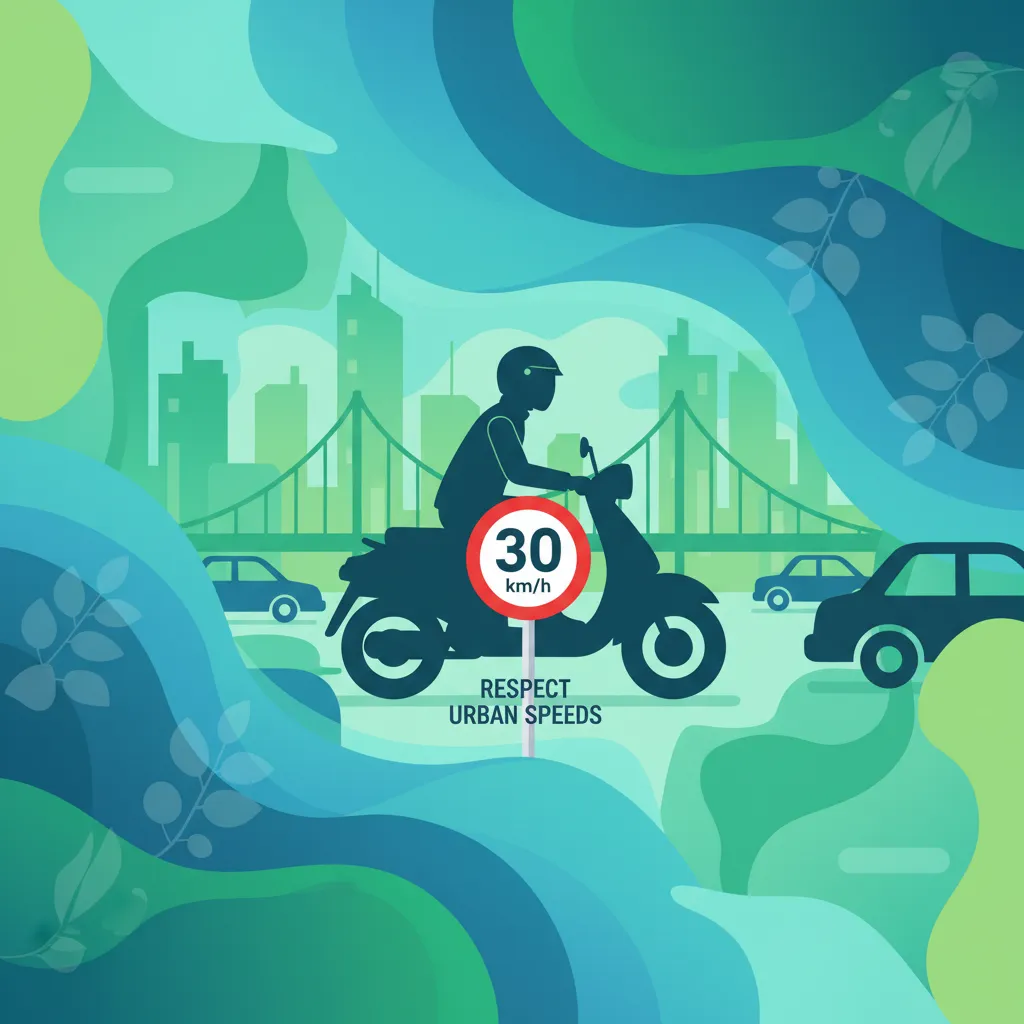
This lesson details the specific speed limits applicable to mopeds within Spanish urban areas, such as the 30 km/h limit on single-lane roads and the 50 km/h limit on roads with two or more lanes per direction. It teaches learners to identify speed zone signage and understand the legal rationale behind these restrictions. Adhering to these DGT-mandated limits is crucial for safety and avoiding penalties.

This lesson teaches riders the critical importance of maintaining a safe following distance to allow for adequate reaction and braking time. It explains practical methods for judging this distance, such as the 'two-second rule,' and how this gap must be increased in adverse weather or poor visibility. Understanding this principle is fundamental to preventing rear-end collisions, one of the most common types of traffic accidents.

This lesson teaches riders how to react effectively in a sudden, critical situation. It explains the technique for applying maximum braking force without locking the wheels, ensuring the shortest possible stopping distance while maintaining stability. The content also covers how to perform a swift and controlled swerve to avoid an obstacle when stopping is not possible, emphasizing the importance of looking where you want to go.

This lesson focuses on low-speed manoeuvres within congested urban traffic, detailing techniques for navigating tight corners and weaving through traffic. Learners analyze urban traffic flow, pedestrian zones, and cyclist interactions to anticipate hazards. The lesson also explains DGT regulations regarding slow-speed movement and lane positioning.

This lesson focuses on interaction dynamics with larger vehicles like cars, trucks, and buses, detailing their specific blind spot zones. Strategies for safely sharing lanes, overtaking etiquette, and proper approach when a bus stops are covered. The lesson also includes guidance on merging onto acceleration lanes following DGT policies.

This lesson discusses the infrastructure dedicated to cyclists, covering dedicated bike lanes and the rules governing interaction and overtaking. It explains DGT regulations on safe passing distances and how to navigate mixed-traffic scenarios where vehicles and bicycles share the road. The content emphasizes driver responsibilities to maintain a safe corridor and respect cyclist priority.

This lesson focuses on the absolute priority of pedestrians at marked crosswalks, often known as zebra crossings. It explains that riders must always be prepared to stop and yield the right-of-way to any pedestrian waiting to cross or already crossing. The content also covers signaled pedestrian crossings and general awareness in urban areas where pedestrians may cross unexpectedly, reinforcing safety and legal compliance.
Learn essential driving theory for moped riders on maximizing visibility to cars and understanding their blind spots. This lesson covers strategies for safe positioning and communication in mixed Spanish urban traffic.
This lesson focuses on the optimal position for a moped within a traffic lane to maximize visibility and safety. It discusses the importance of maintaining a safety buffer from other vehicles and hazards, particularly the risk posed by the doors of parked cars. The content explains how to use lane positioning strategically to discourage unsafe overtaking and to be clearly seen by drivers in front and behind, especially when approaching intersections.

This lesson outlines the proper use and legal requirements of vehicle lighting and mirror systems. It covers headlamps, fog lights, turn signals, and brake lights, clarifying when each must be used according to DGT regulations. The lesson also explains the correct adjustment of rearview and side mirrors and strategies for effective blind-spot monitoring.
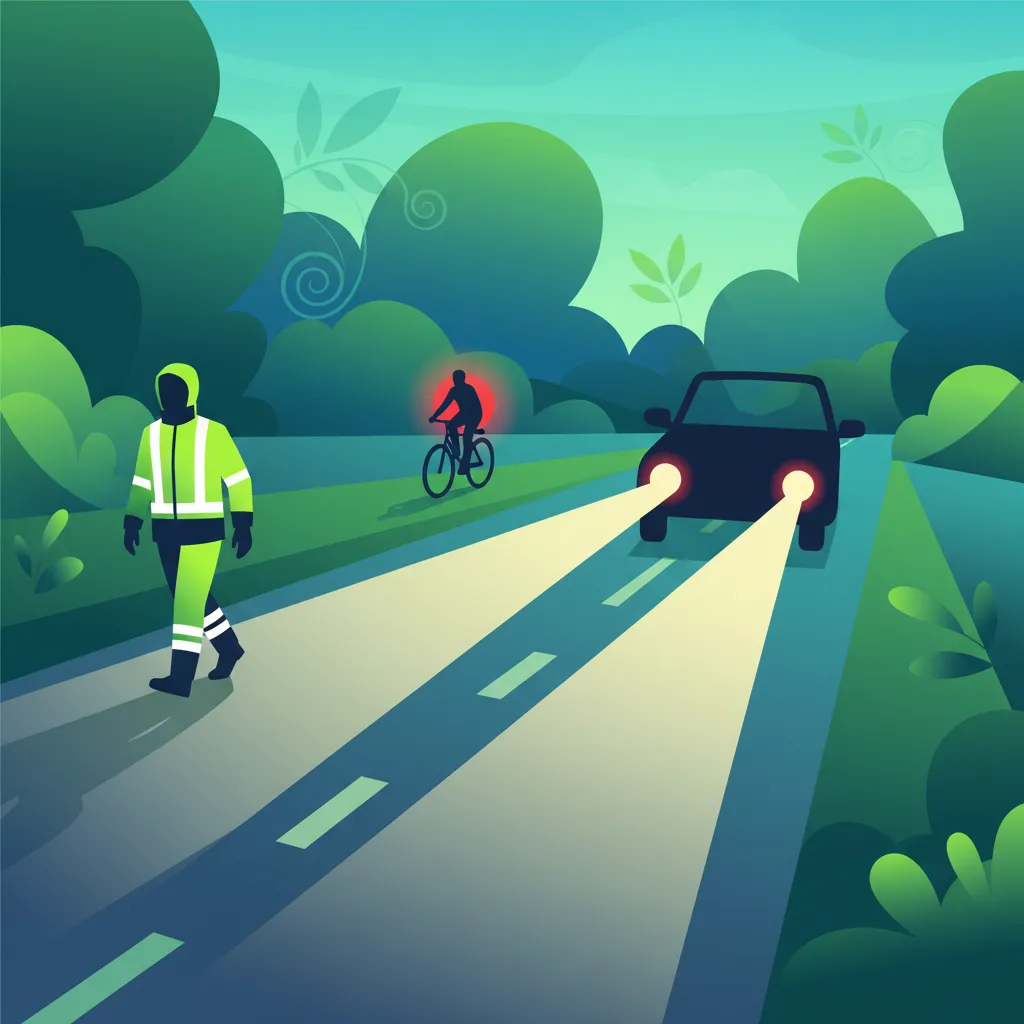
This lesson outlines the mandatory lighting and visibility equipment as per DGT regulations. It covers the correct use of headlights (low and high beams), taillights, and turn signals, ensuring the moped is visible to others, especially at night or in poor weather. The importance of wearing high-visibility or reflective clothing is also emphasized as a critical measure to enhance personal safety by making the rider more conspicuous.
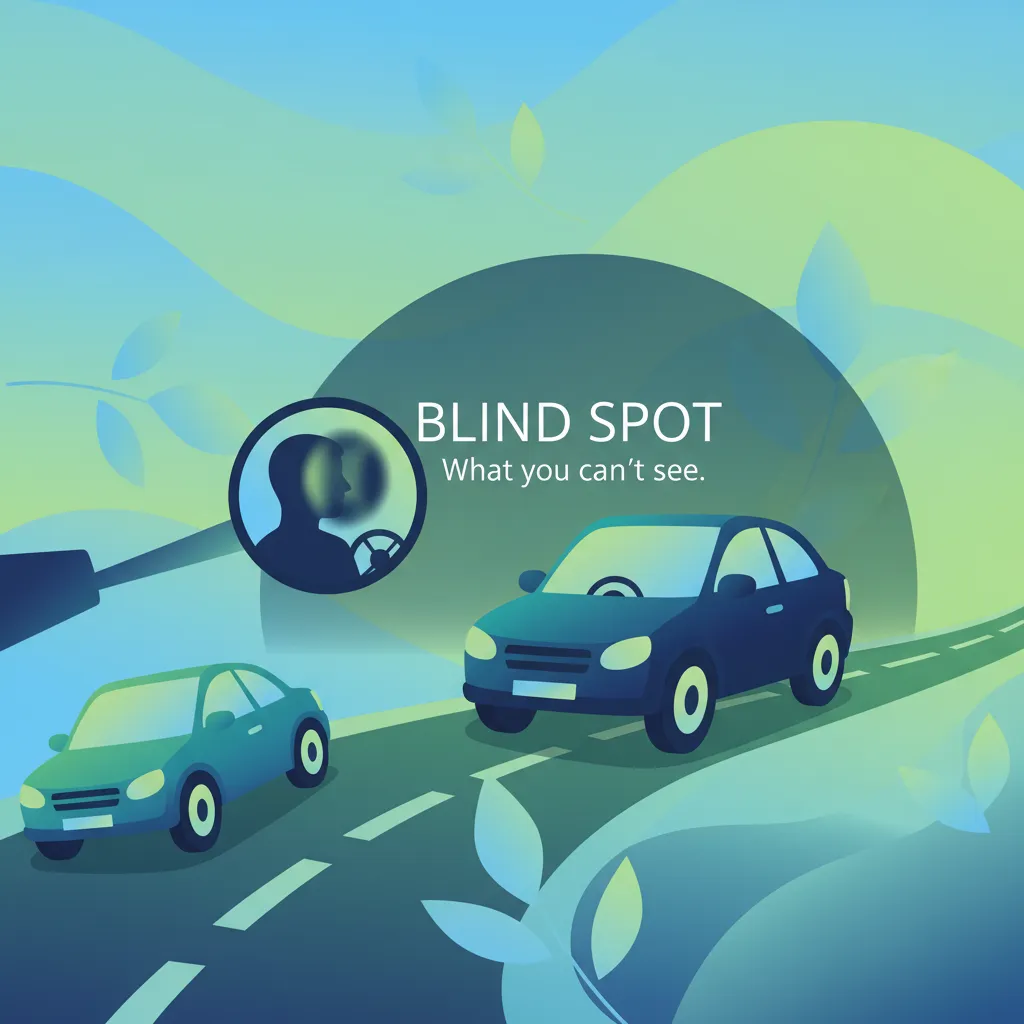
This lesson focuses on identifying blind spot zones created by larger vehicles and the rider’s own positioning. It covers effective mirror usage, lateral awareness techniques, and the importance of head checks before lane changes. DGT blind spot guidelines are referenced, emphasizing situational scanning to maintain safety in traffic.
This lesson details the specific speed limits applicable to mopeds within Spanish urban areas, such as the 30 km/h limit on single-lane roads and the 50 km/h limit on roads with two or more lanes per direction. It teaches learners to identify speed zone signage and understand the legal rationale behind these restrictions. Adhering to these DGT-mandated limits is crucial for safety and avoiding penalties.

This lesson teaches the crucial skill of adapting speed to match prevailing environmental conditions. It explains that the posted speed limit is a maximum for ideal conditions and that riders must slow down significantly in rain, fog, or darkness. The content emphasizes maintaining a larger safety margin to account for reduced visibility and longer stopping distances, ensuring the rider can always stop within the distance they can see clearly.
This lesson addresses the critical skill of safely sharing the road with other vulnerable users like pedestrians, cyclists, and other motorcyclists. It emphasizes the need for increased awareness, speed adaptation, and providing ample space when passing. The content covers DGT regulations regarding minimum passing distances and highlights the importance of making eye contact to ensure mutual awareness and prevent common urban accidents.
This lesson focuses on interaction dynamics with larger vehicles like cars, trucks, and buses, detailing their specific blind spot zones. Strategies for safely sharing lanes, overtaking etiquette, and proper approach when a bus stops are covered. The lesson also includes guidance on merging onto acceleration lanes following DGT policies.
This lesson provides a detailed guide to safely starting a moped, from the ignition sequence to the coordinated use of the throttle and brakes. It explains the importance of a pre-ride checklist to verify lights and controls are functional. The content also covers techniques for achieving smooth acceleration from a standstill and performing controlled stops, which is crucial for managing stop-and-go urban traffic conditions.
This lesson focuses on low-speed manoeuvres within congested urban traffic, detailing techniques for navigating tight corners and weaving through traffic. Learners analyze urban traffic flow, pedestrian zones, and cyclist interactions to anticipate hazards. The lesson also explains DGT regulations regarding slow-speed movement and lane positioning.
Find clear answers to common questions learners have about Interaction with Cars and Bicycles. Learn how the lesson is structured, which driving theory objectives it supports, and how it fits into the overall learning path of units and curriculum progression in Spain. These explanations help you understand key concepts, lesson flow, and exam focused study goals.
Always assume car drivers may not see you. Position your moped strategically within your lane to be seen, typically in the center or slightly to the right, avoiding the edges where they might not look. Maintain a clear line of sight and be ready to react if a driver initiates a maneuver without seeing you. Use your headlights at all times.
When overtaking a bicycle, you must ensure it is safe to do so and that you have sufficient space. Move into the adjacent lane if necessary and maintain a safe lateral distance from the cyclist, as stipulated by DGT regulations. Never overtake if it means crossing into oncoming traffic or if the cyclist is approaching a junction or narrow section. Give them plenty of room.
Yes, absolutely. Cars have significant blind spots, especially around the sides and rear. Avoid lingering in these areas. If you are in a car's blind spot, they may change lanes or turn without seeing you, leading to a collision. Always try to be in a position where the driver can see you in their mirrors.
Mopeds are generally not permitted to use dedicated bicycle lanes unless specifically indicated by signage allowing such access. You must respect these lanes and treat them as separate from the main carriageway, giving cyclists the space they need. Riding in a bike lane can be dangerous and may result in a fine.
Always use your turn signals well in advance of any maneuver, such as turning or changing lanes. Ensure your signals are clear and visible. For cyclists, a simple wave or nod to acknowledge them can sometimes help, but your primary communication should be through clear, timely signaling and predictable riding.
Use our powerful search functionality to pinpoint specific Spanish DGT driving theory practice sets. Filter by road sign categories, traffic law topics, or question difficulty to build custom study sessions and reinforce your knowledge precisely where it matters for your official exam.