
This lesson introduces you to identifying risk zones and anticipating potential hazards, a cornerstone of defensive driving according to DGT guidelines. It’s the first step in Unit 7, 'Hazard Perception & Defensive Driving,' building essential skills for safer road use for your B & BE license. Mastering these techniques will help you predict dangerous situations and react effectively, crucial for both the theory exam and real-world driving.
Lesson content overview
Successfully navigating Spain's roads requires more than just understanding traffic laws and controlling your vehicle. It demands a proactive mindset, an ability to foresee potential dangers, and the skill to react preemptively. This lesson, crucial for the Complete Spanish Driving License Theory Course for Categories B & BE (DGT), delves into the critical concepts of identifying risk zones and employing anticipation techniques. Mastering these skills is fundamental for preventing collisions, ensuring compliance with traffic regulations, and fostering safe interactions with all road users.
A risk zone is any area on the road environment where potential conflicts or hazards are statistically more likely to develop. These zones are defined by road geometry, traffic interactions, user behavior, and environmental factors. Recognizing these areas allows drivers to allocate their attention appropriately and adjust their driving behavior before a hazard fully materializes.
Drivers must develop a mental map of where hazards can appear. These common risk zones demand heightened vigilance:
Intersections and Junctions: Crossings, T-junctions, and roundabouts are prime locations for conflicts due to vehicles crossing paths, turning, or yielding. Here, a high volume of decisions must be made in a short time, increasing the risk of misjudgment.
This sign, P4, alerts drivers to an uncontrolled intersection where the general rule of giving way to traffic from the right applies, marking it as a significant risk zone.
Merging and Diverging Lanes: On-ramps, off-ramps, and lane drops on motorways or dual carriageways present challenges as vehicles accelerate, decelerate, or change lanes. These areas require precise speed and position adjustments to integrate smoothly into traffic flow.
Pedestrian and Vulnerable User Zones: Crosswalks (pasos de peatones), school zones, bus stops, and areas with high pedestrian or cyclist activity are critical risk zones. Vulnerable road users can be unpredictable, and their presence demands significantly reduced speeds and constant vigilance.
Blind Spots and Limited Visibility Areas: These include areas not visible in mirrors, particularly during lane changes or when passing large vehicles. Curves, hillcrests, and areas obstructed by parked vehicles or roadside vegetation also reduce the visible horizon, creating hidden risk zones.
Adverse Weather Zones: Areas affected by rain, snow, fog, or strong winds become risk zones as these conditions reduce visibility, traction, and overall control. Drivers must anticipate the impact of weather on stopping distances and handling.
Ignoring these zones or underestimating their potential for conflict is a common cause of accidents. Drivers must allocate their attention to these zones even when no immediate hazard is evident, preparing for sudden changes in the driving environment.
Scanning is the continuous, systematic observation of the entire driving environment. It's a fundamental defensive driving technique that dramatically increases situational awareness and allows for the early detection of emerging hazards. Instead of fixating on the vehicle directly ahead, effective scanning involves expanding your visual horizon and constantly moving your eyes.
Forward Scanning and the Visible Horizon: This involves looking far down the road, beyond the vehicle immediately in front, to identify potential hazards well in advance. On motorways, this could be hundreds of meters ahead, while in urban areas, it might be through an intersection. This allows drivers to anticipate traffic flow changes, road signs, and the actions of distant vehicles.
Mirror Scanning: Frequent and systematic checks of the rear-view mirror (retrovisor interior) and side-view mirrors (retrovisores exteriores) are crucial. These checks should occur every 5-8 seconds, before braking, before changing lanes, and when approaching an intersection or a hazard. This helps drivers monitor traffic behind and to the sides, preventing surprises from vehicles that may be in their blind spots.
Peripheral Scanning: Using peripheral vision allows drivers to monitor adjacent lanes, roadside activity, and potential hazards without directly looking at them. This wide-angle awareness is vital for detecting sudden movements from the sides, such as a pedestrian stepping off a curb or a vehicle drifting into your lane.
Road-Side and Immediate Surroundings Scanning: This involves actively observing sidewalks, bike lanes (carril bici), crosswalks, and parked vehicles for vulnerable users (pedestrians, cyclists) or unexpected vehicle movements (e.g., car doors opening, vehicles pulling out). In urban settings, this vigilance is paramount.
Develop a scanning habit: Aim for a systematic scanning pattern: check ahead, then left mirror, rear-view mirror, right mirror, and then back ahead. Repeat this cycle every few seconds, especially in dynamic traffic situations.
The human eye can only focus on a small area at a time. Systematic scanning overcomes this limitation by combining fixations (focused glances) with saccades (quick, jerky eye movements) to build a comprehensive picture of the environment. This constant movement prevents "tunnel vision" and ensures that emerging threats are detected early, giving the driver more time to react. The DGT's Article 2.2 emphasizes the driver's obligation to maintain proper attention to the driving environment.
Anticipation is the cognitive process of predicting the future behavior of traffic participants based on visual cues, vehicle dynamics, and contextual information. It’s about thinking "what if?" and preparing for various scenarios, rather than simply reacting to what happens. This proactive approach allows for smoother, safer driving adjustments, such as modifying speed or lane position.
Cue Recognition: Drivers learn to identify specific indicators that signal a potential action. These include:
intermitentes), reverse lights.Pattern Analysis: This involves understanding typical traffic flow, pedestrian movement, and common driving behaviors in different situations. For example, knowing that vehicles often accelerate rapidly on green lights or that a car turning right often needs to swing wide. Analyzing these patterns helps drivers predict likely actions.
Temporal Projection: Estimating the time it will take for a situation to develop or for a vehicle to reach a certain point. This allows drivers to judge whether they have enough time and space to execute a maneuver safely or if they need to yield. For example, estimating how long a vehicle takes to clear an intersection.
Consider a scenario where a car ahead signals a right turn onto a bus lane. An anticipating driver will not only notice the turn signal but also predict that the car will decelerate and likely move towards the right. This allows the driver behind to slow down earlier, increase their buffer zone, and adjust their lane position to give the turning vehicle ample space, preventing abrupt braking or a potential rear-end collision.
Always assume the worst-case scenario. Even if a driver signals, be prepared for them to change their mind, forget to turn, or make an unexpected maneuver. This defensive mindset is key to anticipation.
A buffer zone is the minimum safe space left ahead of your vehicle that provides sufficient time and distance to react and stop safely in response to an unexpected event. Maintaining an adequate buffer zone is a cornerstone of defensive driving, directly compensating for human perception-reaction time and the vehicle's braking distance. The DGT's Article 22 specifically mandates maintaining a minimum safe distance.
The most widely taught method for determining a safe following distance is the 2-second rule (regla de los 2 segundos).
Choose a fixed object ahead, such as a road sign, bridge, or tree, that the vehicle in front of you is about to pass.
As the rear of the vehicle in front passes your chosen object, start counting "one thousand one, one thousand two."
If your front bumper reaches the same object before you finish counting "one thousand two," you are following too closely. Increase your distance and repeat the check.
While the 2-second rule is a good baseline, it must be adjusted according to various factors:
autovías or autopistas), particularly at 120 km/h, a 3-second or even 4-second rule is safer.Perception-Reaction Time (Tiempo de Percepción-Reacción): This is the time it takes from when a driver first detects a hazard to when they actually start to react (e.g., applying brakes). For an alert driver, this is typically about 1 second. During this time, the vehicle continues to travel at its current speed. The buffer zone accounts for this delay, providing crucial milliseconds for the brain to process information and for the body to act.
Priority assessment is the process of determining which road user has the legal right-of-way at a given moment. Correctly assessing and respecting priority rules is absolutely essential for an orderly flow of traffic and, critically, for preventing collisions. The DGT's Article 26 outlines general priority rules at intersections.
ceder el paso a los vehículos que se aproximan por la derecha). This is indicated by the P4 sign discussed earlier.R1 (Stop) sign requires a complete stop before the stop line, or at the intersection itself if no line is present, and yielding to all traffic and pedestrians.
R2 (Yield) sign requires giving way to vehicles on the intersecting road, slowing down or stopping as necessary.Pasos de Peatones): At marked pedestrian crossings, drivers must yield to pedestrians who are on or about to step onto the crossing. The DGT's Article 101 strictly enforces this priority for vulnerable road users. Even at unmarked crossings, drivers have a duty of care to yield if pedestrians are clearly trying to cross.Glorietas): The general rule in Spain is that vehicles already circulating within the roundabout have priority over those wishing to enter it. Drivers entering a roundabout must yield to traffic already inside.vehículo de emergencia) with activated blue lights and/or siren approaches from any direction, drivers must immediately yield the right-of-way. This means safely pulling over to the right-hand side of the road and stopping, clearing the path for the emergency vehicle.Intermitentes)Communicating your intentions is a critical part of safe driving and priority assessment. The DGT's Article 21 mandates the use of turn signals.
Signal Early and Clearly: Always activate your turn signal at least 50 meters before a maneuver (turn, lane change, merge), and ensure it's visible to other road users. This allows others to anticipate your actions and adjust their speed and position accordingly.
Failure to signal, or signaling late, can confuse other drivers, negate your perceived priority, and contribute to accidents.
Safe driving is not static; it requires constant adaptation. Risk zones and anticipation techniques must be dynamically adjusted based on the prevailing conditions.
luces de cruce) or fog lights (luces antiniebla) as appropriate. Scanning needs to be more frequent and focused on potential standing water or icy patches.Zonas Urbanas): Frequent intersections, pedestrian activity, parked cars, and lower speed limits demand continuous, short-range scanning. Risk zones are dense and require immediate anticipation of sudden movements.Autopistas / Autovías): Higher speeds mean that hazards develop and close distances much faster. Anticipation must be focused further ahead, and buffer zones need to be much larger to accommodate longer stopping distances. Merging and diverging zones are critical risk areas.Carreteras Rurales): Sharp curves, limited lighting, narrow lanes, and potential for wildlife increase the size of visual risk zones. Drivers must anticipate blind corners, adjust speed well in advance, and scan for animals or unexpected obstacles.Ciclistas): Cyclists often have a smaller visual profile and can be in blind spots. Always perform a shoulder check (mirar por encima del hombro) before changing lanes or turning to ensure no cyclist is hidden. Give them ample space and anticipate their often less predictable movements.Motoristas): Their speed can be misjudged, and their smaller size makes them harder to see. Assume they might be in your blind spot and increase your scanning frequency.Even experienced drivers can make mistakes in risk zone identification and anticipation. Awareness of these common pitfalls can help in developing safer driving habits.
Spanish traffic law, primarily outlined in the Reglamento General de Circulación (General Traffic Regulations), explicitly supports the principles of risk zone identification and anticipation. Non-compliance can lead to severe penalties, including fines and license points.
Artículo 3.1): Establishes the driver's general duty of care and obligation to drive diligently and cautiously, avoiding any damage to themselves or others. This underlies the entire concept of defensive driving.Artículo 19): Mandates that speed must be adapted not only to road limits but also to prevailing conditions (weather, visibility, traffic, road layout). This directly relates to reducing speed in risk zones.Artículo 21): Details the correct use of turn signals and other indications to communicate maneuvers to other drivers.Artículo 22): Requires drivers to maintain a safe following distance that allows them to stop without colliding with the vehicle ahead, even in case of sudden braking.Artículo 26): Outlines general rules for priority at intersections, including yielding to the right at uncontrolled junctions.Artículo 101): Grants explicit priority to pedestrians at marked crosswalks, reinforcing the need to anticipate their presence and yield.Understanding and adhering to these regulations is not just about avoiding fines; it's about internalizing the principles of safe and responsible road use, which are the very foundations of risk mitigation.
The journey to obtaining a Spanish driving license for Categories B & BE involves much more than theoretical knowledge of signs and rules; it requires developing an intuitive understanding of road dynamics and human behavior. Identifying risk zones and mastering anticipation techniques are paramount to becoming a safe, confident, and responsible driver.
By consistently applying systematic scanning, actively identifying risk zones, accurately anticipating the actions of others, and maintaining appropriate buffer zones and following distances, you dramatically reduce the likelihood of accidents. Furthermore, a thorough understanding of priority assessment and strict adherence to DGT regulations ensures not only your safety but also compliance with Spanish traffic law. Remember that driving conditions are never constant, and successful navigation demands continuous adaptation based on weather, road type, vehicle state, and the presence of vulnerable road users. Embrace these principles, and you will be well-equipped to manage the complexities of Spanish roads safely and efficiently.
This lesson teaches core defensive driving skills essential for the Spanish B and BE theory exam, focusing on identifying risk zones where hazards commonly develop such as intersections, blind spots, and areas with vulnerable road users. It emphasizes proactive scanning techniques—systematically checking ahead, mirrors, and peripheral vision—to detect emerging dangers early rather than reacting to immediate threats. Key techniques include the 2-second following distance rule (extended for adverse conditions), cue recognition for anticipating other drivers' intentions, and understanding Spanish priority rules including yielding to the right at uncontrolled intersections and respecting pedestrian crossings. The content aligns with specific DGT articles governing safe driving behavior and provides practical guidance for adapting to weather, road type, and vehicle load conditions.
A short set of high-value points that capture the most important learning from this lesson.
A risk zone is any area where hazards are statistically more likely to develop due to road geometry, traffic interactions, or environmental factors.
Systematic scanning involves continuously checking ahead, mirrors, and peripheral vision in a repeating pattern every few seconds to build comprehensive situational awareness.
The 2-second rule provides a baseline for safe following distance, but must be extended in adverse weather, at higher speeds, or when driving heavier vehicles.
Anticipation involves predicting other road users' actions based on visual cues like turn signals, brake lights, vehicle movement, and behavioral patterns.
At uncontrolled intersections in Spain, the universal rule is to yield to traffic approaching from your right (ceder el paso a la derecha).
Explore all units and lessons included in this driving theory course.
Perform a shoulder check before changing lanes or turning, as mirrors alone cannot reveal blind spots where motorcycles and cyclists may be hidden.
Increase your buffer zone to 4-6 seconds or more in rain, fog, snow, when driving at high speeds on motorways, or when towing a trailer (Category BE).
Always activate turn signals at least 50 meters before a maneuver to allow other road users to anticipate your actions.
Pedestrians have priority at marked crossings; you must yield to them even if they have not yet fully stepped onto the crossing.
Vehicles already circulating within a roundabout in Spain have priority over vehicles wishing to enter.
Waiting until nearly at an intersection to check for cross-traffic or pedestrians, which drastically reduces reaction time.
Relying solely on mirrors without performing a shoulder check before changing lanes, especially failing to spot smaller vehicles like motorcycles.
Maintaining the posted speed limit in heavy fog, rain, or night conditions when conditions demand significantly slower speeds.
Proceeding at an intersection assuming you have priority without checking for signs, road markings, or applying the yield-to-right rule.
Becoming so focused on one hazard (such as a car turning ahead) that you fail to notice another developing danger (such as a pedestrian stepping out).
Lesson content overview
A short set of high-value points that capture the most important learning from this lesson.
A risk zone is any area where hazards are statistically more likely to develop due to road geometry, traffic interactions, or environmental factors.
Systematic scanning involves continuously checking ahead, mirrors, and peripheral vision in a repeating pattern every few seconds to build comprehensive situational awareness.
The 2-second rule provides a baseline for safe following distance, but must be extended in adverse weather, at higher speeds, or when driving heavier vehicles.
Anticipation involves predicting other road users' actions based on visual cues like turn signals, brake lights, vehicle movement, and behavioral patterns.
At uncontrolled intersections in Spain, the universal rule is to yield to traffic approaching from your right (ceder el paso a la derecha).
Explore all units and lessons included in this driving theory course.
Perform a shoulder check before changing lanes or turning, as mirrors alone cannot reveal blind spots where motorcycles and cyclists may be hidden.
Increase your buffer zone to 4-6 seconds or more in rain, fog, snow, when driving at high speeds on motorways, or when towing a trailer (Category BE).
Always activate turn signals at least 50 meters before a maneuver to allow other road users to anticipate your actions.
Pedestrians have priority at marked crossings; you must yield to them even if they have not yet fully stepped onto the crossing.
Vehicles already circulating within a roundabout in Spain have priority over vehicles wishing to enter.
Waiting until nearly at an intersection to check for cross-traffic or pedestrians, which drastically reduces reaction time.
Relying solely on mirrors without performing a shoulder check before changing lanes, especially failing to spot smaller vehicles like motorcycles.
Maintaining the posted speed limit in heavy fog, rain, or night conditions when conditions demand significantly slower speeds.
Proceeding at an intersection assuming you have priority without checking for signs, road markings, or applying the yield-to-right rule.
Becoming so focused on one hazard (such as a car turning ahead) that you fail to notice another developing danger (such as a pedestrian stepping out).
Explore search topics learners often look for when studying Risk Zones Identification and Anticipation Techniques. These topics reflect common questions about road rules, driving situations, safety guidance, and lesson level theory preparation for learners in Spain.
Browse additional driving theory lessons that cover connected traffic rules, road signs, and common driving situations related to this topic. Improve your understanding of how different rules interact across everyday traffic scenarios.
Learn to anticipate complex driving scenarios and identify high-risk areas beyond basic intersections. This lesson deepens your understanding of proactive observation and predictive driving for enhanced road safety in Spain.
This lesson examines the principles of maintaining a safe following distance, including the 'two-second rule' and its adjustments for speed and weather. It focuses on effective blind-spot management, teaching drivers how to use mirrors and head checks. The content integrates DGT guidelines on creating a safety buffer around the vehicle to allow time to react to unexpected events.
This lesson introduces anticipation techniques that improve a rider’s ability to predict potential hazards before they manifest. It covers scanning ahead, evaluating traffic patterns, and applying DGT risk assessment criteria. Emphasis is placed on developing a defensive riding mindset and maintaining safety margins to reduce accident likelihood.
This lesson focuses on interaction dynamics with larger vehicles like cars, trucks, and buses, detailing their specific blind spot zones. Strategies for safely sharing lanes, overtaking etiquette, and proper approach when a bus stops are covered. The lesson also includes guidance on merging onto acceleration lanes following DGT policies.
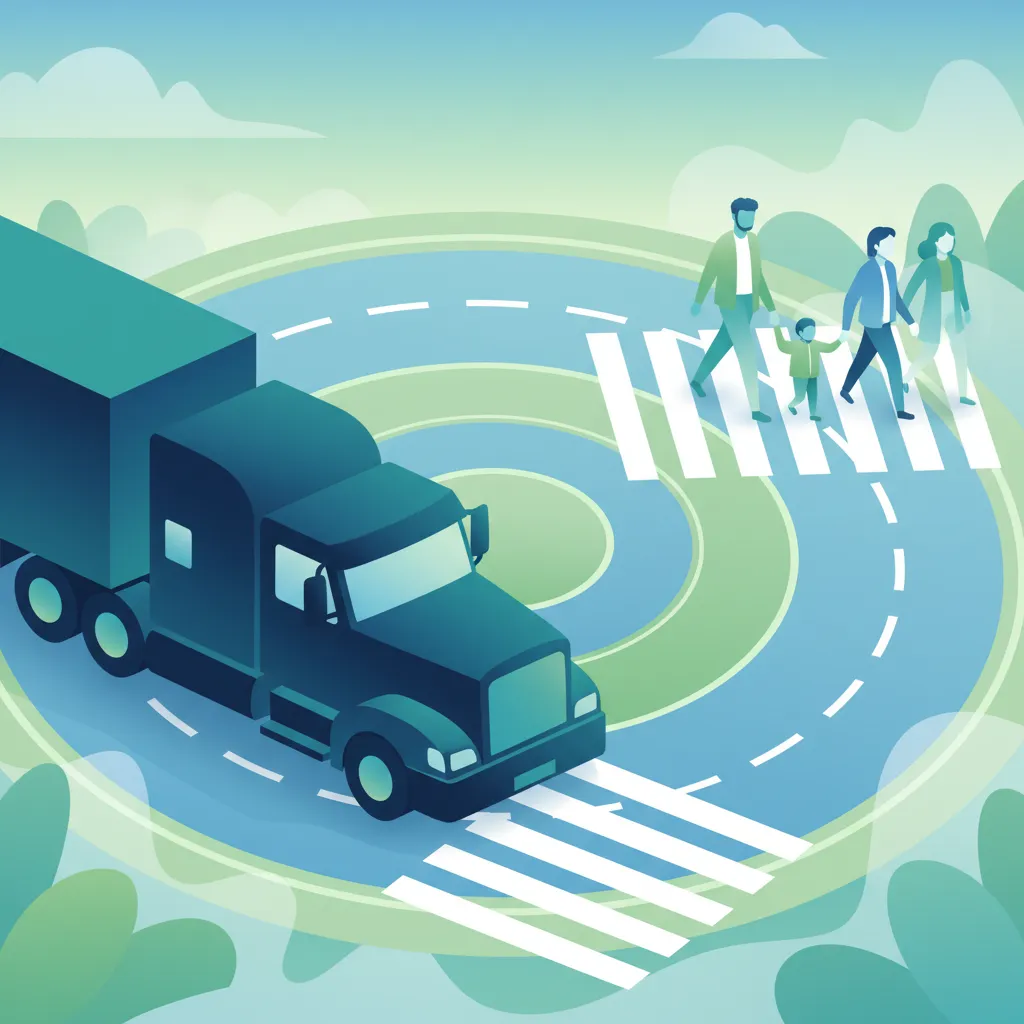
This lesson examines the interaction between large vehicles, such as trucks, and vulnerable road users within roundabouts. It addresses the wide turning radius of heavy vehicles, the importance of checking blind spots, and the correct yielding behavior toward pedestrians and cyclists. Learners will understand how to maintain safe distances and anticipate the movements of different road users.

This lesson presents advanced cornering scenarios common on Spanish roads, such as mountain hairpins and high-speed autovía exits. It outlines specific techniques for descent control, ascent maneuvers, and safely merging into traffic after cornering. Interaction with cyclists and emergency cornering strategies are also covered in accordance with DGT regulations.

This lesson is focused on the early identification of road hazards through the application of effective scanning techniques and the use of peripheral vision. Learners will practice recognizing visual cues that signal potential dangers, such as erratic vehicle movements, unexpected obstacles, or pedestrian behavior. The module also teaches proactive response strategies designed to mitigate these risks before they can escalate into dangerous situations.

This lesson explores the design and legal requirements of pedestrian crossings in Spanish urban areas. It clarifies the rules at zebra crossings, signal-controlled crossings, and areas where cyclists or other vulnerable users share space. The content explains the required safety distances and signage indicating crossing zones to ensure drivers respect all road users.
This lesson outlines the core principles of defensive driving, focusing on maintaining a safe following distance, creating a protective space cushion around the vehicle, and anticipating potential hazards. Learners will be taught how to develop contingency plans for unexpected events and employ risk mitigation techniques to actively avoid accidents. The content reinforces the vital importance of remaining vigilant and proactive at all times when driving.
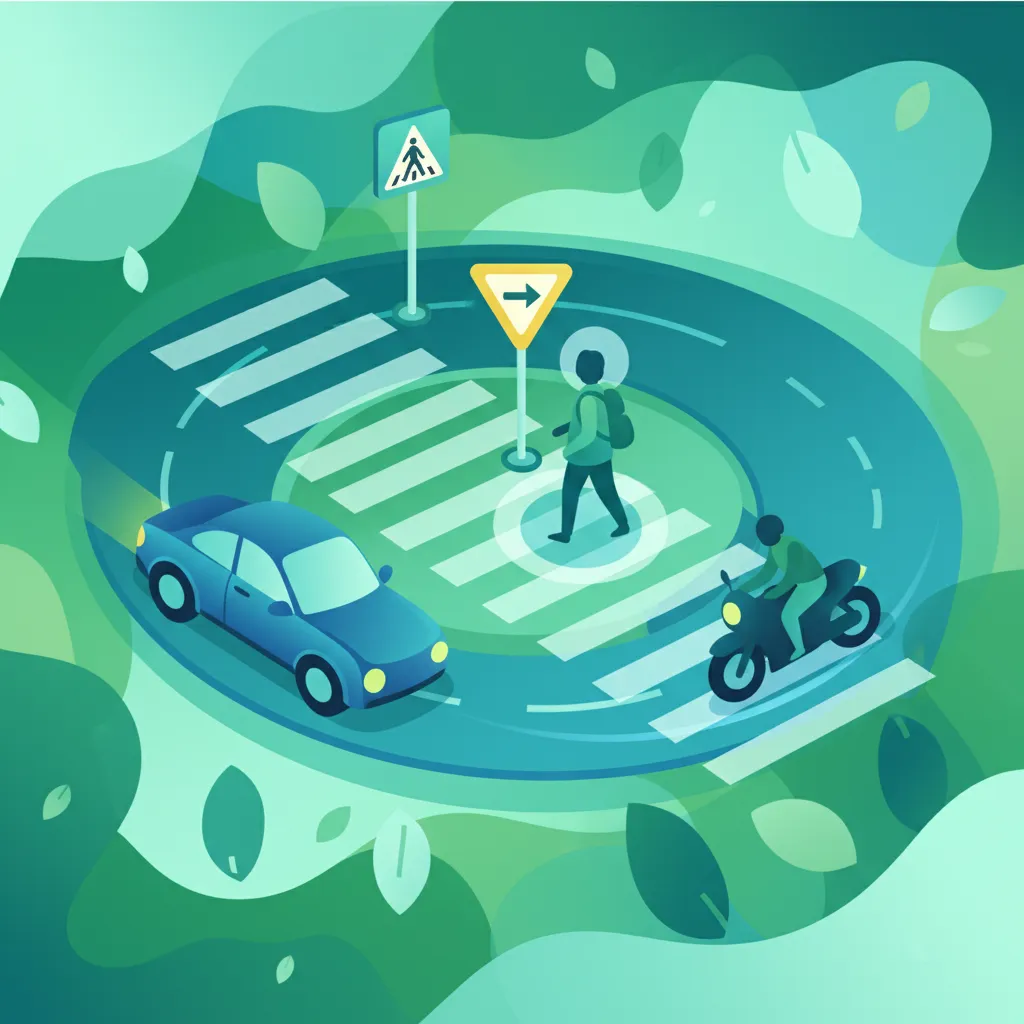
This lesson outlines the proper techniques for negotiating roundabouts and signal-controlled intersections in Spain. It explains priority rules at entry, lane selection based on the intended exit, and yielding to circulating traffic. The content also covers compliance with traffic signals and DGT regulations, including handling cyclist crossings.
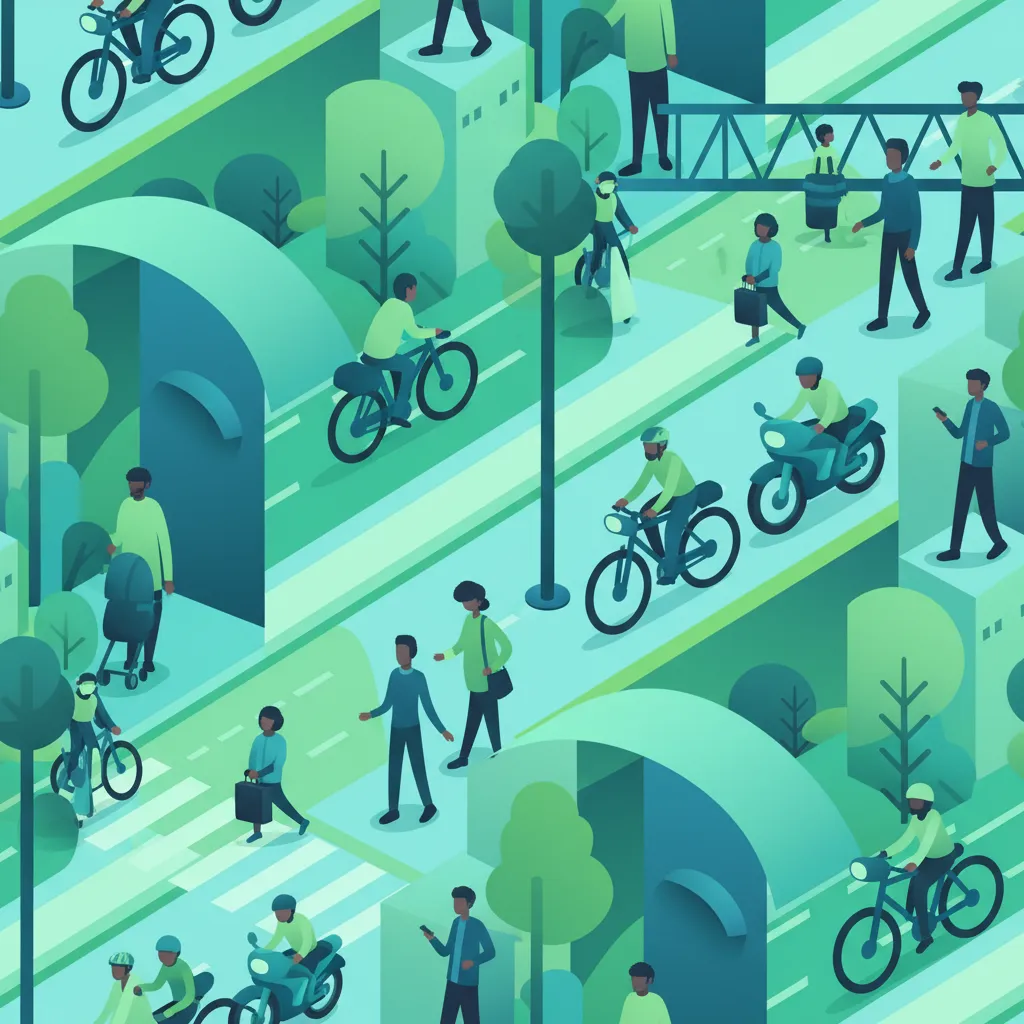
This lesson addresses the critical skill of safely sharing the road with other vulnerable users like pedestrians, cyclists, and other motorcyclists. It emphasizes the need for increased awareness, speed adaptation, and providing ample space when passing. The content covers DGT regulations regarding minimum passing distances and highlights the importance of making eye contact to ensure mutual awareness and prevent common urban accidents.
Master the DGT rules for priority at intersections, roundabouts, and pedestrian crossings. This lesson clarifies common mistakes and explains how to safely yield and proceed in various traffic situations.
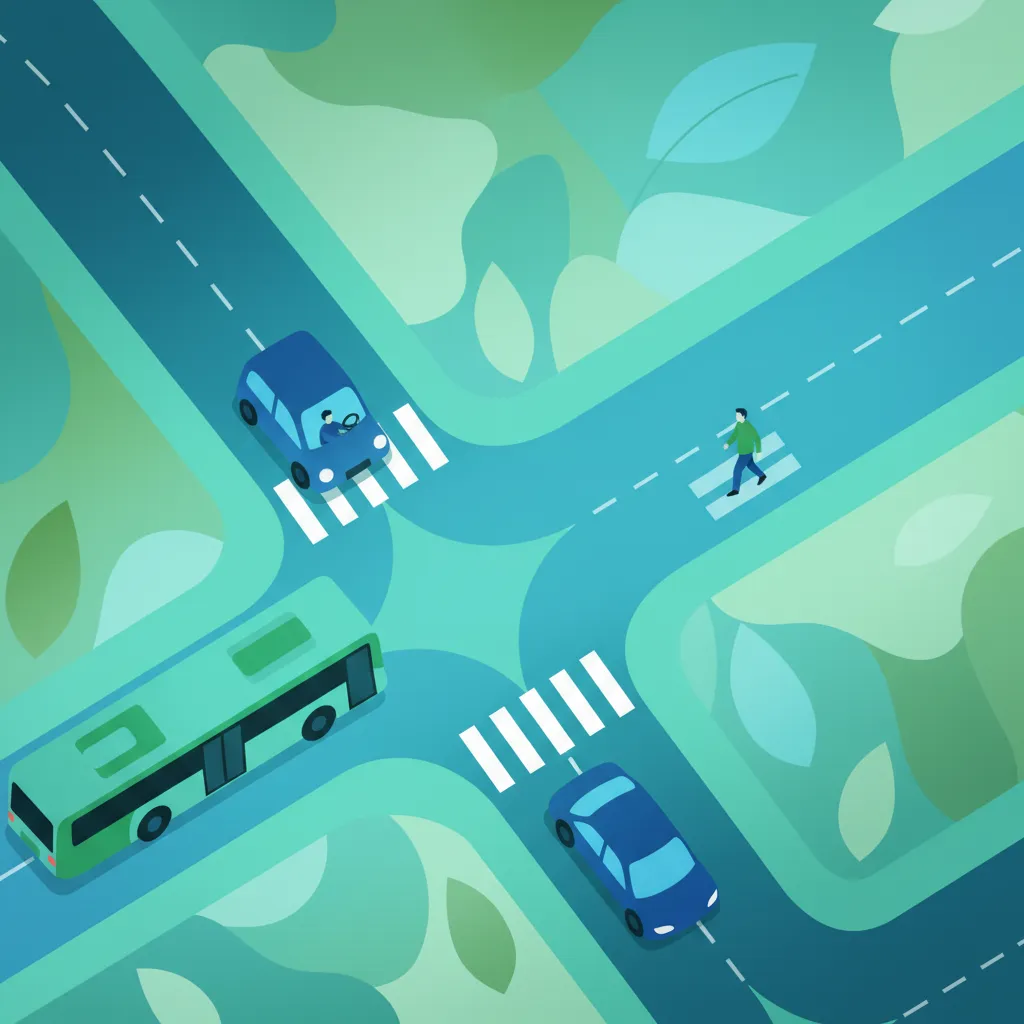
This lesson addresses the crucial 'priority to the right' rule that governs traffic at intersections without signs or signals. It explains that drivers must yield to any vehicle approaching from their right-hand side. The content provides practical examples of how to assess traffic, determine the correct order of passage, and proceed with caution to safely navigate these common but potentially confusing intersections.

This lesson analyzes the various intersection configurations found in Spanish cities, such as controlled and uncontrolled junctions. It explains the hierarchy of right-of-way, detailing when vehicles must yield, when pedestrians have priority, and how traffic signs dictate movement. Learners are guided through DGT signage conventions that determine priority at each intersection type.
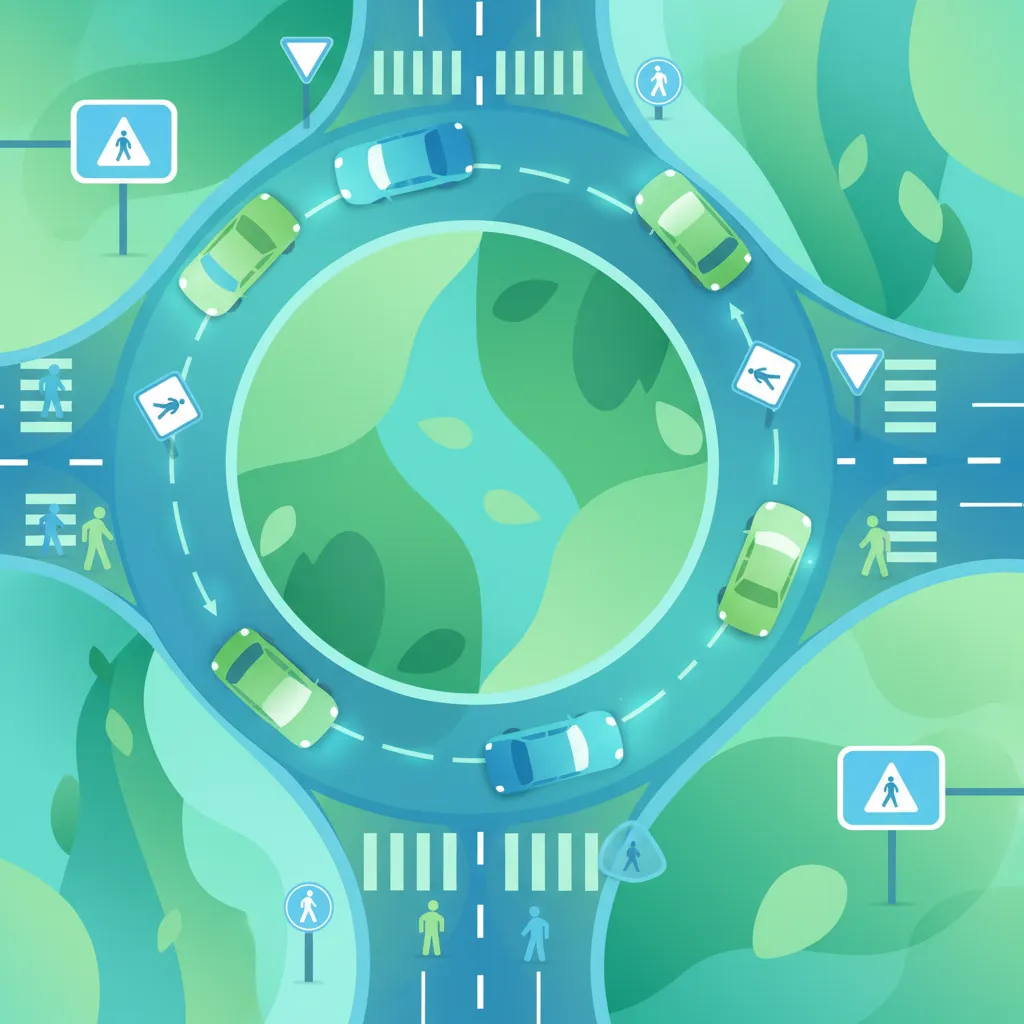
This lesson offers a comprehensive guide to navigating roundabouts in urban settings, explaining the correct protocols for entry, yielding, and circulation. Learners will be taught how to interpret lane markings and signage on multi-lane roundabouts and determine the correct vehicle positioning for safe entry and exit. The content emphasizes full compliance with Spanish city regulations that govern priority and right-of-way at these intersections.

This lesson focuses on the absolute priority of pedestrians at marked crosswalks, often known as zebra crossings. It explains that riders must always be prepared to stop and yield the right-of-way to any pedestrian waiting to cross or already crossing. The content also covers signaled pedestrian crossings and general awareness in urban areas where pedestrians may cross unexpectedly, reinforcing safety and legal compliance.
This lesson explores the design and legal requirements of pedestrian crossings in Spanish urban areas. It clarifies the rules at zebra crossings, signal-controlled crossings, and areas where cyclists or other vulnerable users share space. The content explains the required safety distances and signage indicating crossing zones to ensure drivers respect all road users.
This lesson focuses on the yielding hierarchy that governs roundabout usage in Spain. It clarifies that vehicles already circulating have priority over those entering and explains the proper lane positioning based on the intended exit. The content includes the correct use of signals for changing lanes and exiting, and safe merging techniques.
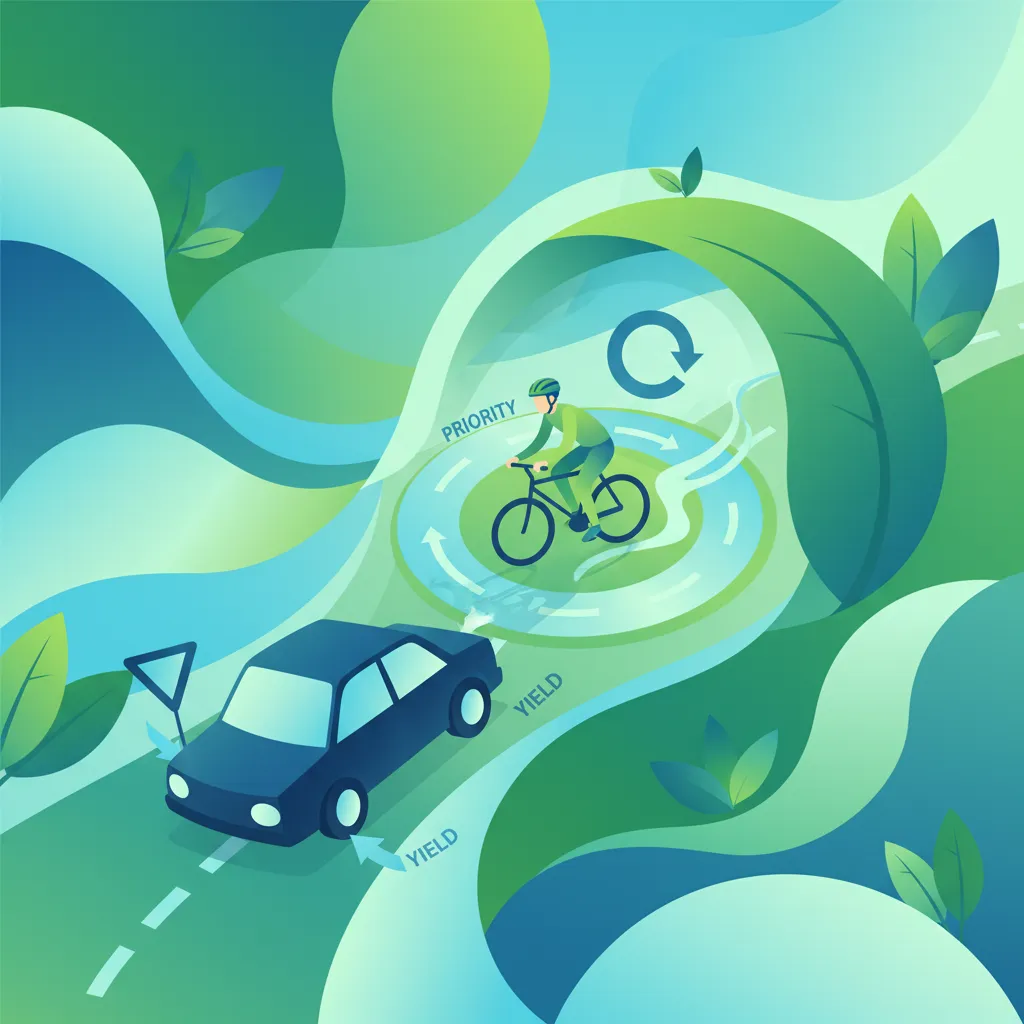
This lesson clarifies the primary rule for roundabouts: all vehicles entering must yield to traffic already on the circular roadway. It explains how to approach a roundabout, select the appropriate lane based on the intended exit, and merge safely into the flow of traffic. Proper signaling before exiting is also covered, ensuring other drivers can anticipate the rider's movements for a smooth and safe negotiation of the junction.
This lesson outlines the proper techniques for negotiating roundabouts and signal-controlled intersections in Spain. It explains priority rules at entry, lane selection based on the intended exit, and yielding to circulating traffic. The content also covers compliance with traffic signals and DGT regulations, including handling cyclist crossings.
This lesson addresses common errors made by drivers when using roundabouts and presents corrective strategies. It covers issues such as entering from the wrong lane, failing to yield to circulating traffic, exceeding the recommended speed, and not signaling an exit correctly. By understanding these mistakes, drivers can improve their roundabout proficiency and reduce accident risk.
Find clear answers to common questions learners have about Risk Zones Identification and Anticipation Techniques. Learn how the lesson is structured, which driving theory objectives it supports, and how it fits into the overall learning path of units and curriculum progression in Spain. These explanations help you understand key concepts, lesson flow, and exam focused study goals.
A risk zone is any area or situation on the road where a potential hazard is likely to develop, requiring extra caution. Examples include intersections, pedestrian crossings, parked cars with people nearby, or areas with limited visibility. Identifying these zones early allows you to prepare for unexpected events and adjust your driving according to DGT safety standards for categories B & BE.
Reaction is responding to a hazard after it has occurred, while anticipation involves foreseeing a potential hazard before it fully develops. The DGT theory exam emphasizes anticipation, as it's a key element of defensive driving, allowing you more time to plan and execute a safe response, reducing the risk of accidents.
Common mistakes include focusing too narrowly ahead, not checking mirrors regularly, assuming other drivers will act predictably, or failing to consider environmental factors like weather. Over-reliance on intuition rather than systematic observation also leads to errors, which can be costly in the B & BE driving exam and real traffic.
Practice scanning your surroundings constantly, using your central vision for the immediate path and peripheral vision for the sides. Regularly check your mirrors (interior and side) every 5-8 seconds and before changing speed or direction. This systematic approach enhances your perception of risk zones and helps you gather crucial information for safe decision-making on Spanish roads for categories B & BE.
No, anticipation applies to all road users and environmental factors. This includes pedestrians, cyclists, motorcyclists, animals, road conditions (potholes, slippery surfaces), and even potential vehicle malfunctions. Comprehensive anticipation, as taught for the DGT exam, considers every variable that could become a hazard.
Use our powerful search functionality to pinpoint specific Spanish DGT driving theory practice sets. Filter by road sign categories, traffic law topics, or question difficulty to build custom study sessions and reinforce your knowledge precisely where it matters for your official exam.