
This lesson provides a comprehensive overview of the legal maximum length, width, and height for heavy goods vehicles in Spain, as mandated by DGT and EU regulations for Category C and C1 licences. Understanding these dimensions is fundamental for safe driving, effective route planning, and successfully passing your professional truck driving theory exam. It sets the groundwork for avoiding common pitfalls related to vehicle limitations.

Lesson content overview
Understanding the physical dimensions of your commercial vehicle is not merely a bureaucratic requirement; it is a fundamental aspect of safe and legal professional driving in Spain and across the European Union. This lesson will provide a detailed breakdown of the maximum permissible length, width, and height for heavy vehicles, specifically those requiring a Category C or C1 licence. We will explore how these dimensions are measured, the specific regulations that govern them, and their critical impact on vehicle classification, route planning, and, most importantly, road safety.
For any professional truck driver operating under a Spanish Category C or C1 licence, a precise understanding of vehicle dimensions is paramount. These regulations exist to ensure that heavy vehicles can safely navigate existing infrastructure, such as bridges, tunnels, and urban streets, without causing damage to the vehicle, infrastructure, or other road users. Ignoring these limits can lead to severe consequences, including costly fines, vehicle damage, serious accidents, and even infrastructure collapse.
Proper dimensional knowledge directly impacts your daily operations. It influences your choice of routes, dictating which roads you can safely take and which you must avoid. It also guides your loading practices, as the cargo itself contributes to the vehicle's overall dimensions. Mastering these concepts is essential not only for passing your official DGT theory exam for the Spanish truck licence but also for a successful and safe career as a professional driver.
The dimensional limits for commercial vehicles in Spain are established by a combination of European Union (EU) directives and national Spanish legislation. This dual regulatory approach ensures harmonisation across member states while allowing for specific national adaptations and enforcement mechanisms.
The bedrock of vehicle dimension regulations across the EU is Directive 96/53/EC, which sets common maximum dimensions and weights for certain road vehicles. This directive aims to facilitate the free movement of goods within the EU by standardising vehicle characteristics, preventing technical barriers to trade, and ensuring infrastructure compatibility across borders. For professional truck drivers, this means that the core dimensional limits you adhere to in Spain are largely consistent with those in other EU countries.
Spain implements the EU directive through its own national laws, primarily the Royal Decree 2822/1998, which approves the General Regulations for Vehicles (Reglamento General de Vehículos), and the General Regulations for Circulation (Reglamento General de Circulación). The Directorate-General for Traffic (DGT) further issues circulars and ordinances, such as DGT Circular 1/2006, to provide specific interpretations and enforcement guidelines. These Spanish regulations detail the exact numerical limits, measurement procedures, and the legal implications of non-compliance for vehicles registered and operating within Spain.
The overall length of a commercial vehicle is a critical dimension, impacting turning radii, maneuvering space, and the ability to navigate complex road geometries. Exceeding legal length limits can make a vehicle unmanageable in tight spaces and unsafe on certain road segments.
For rigid trucks, which are single vehicles without a trailer, the maximum permissible overall length is 12.00 metres. This limit applies to vehicles requiring a Category C licence. This measurement includes all fixed parts of the vehicle, such as the front bumper, rear bumper, and any permanently attached equipment. It also encompasses any load that protrudes from the vehicle's structure within legal limits.
Vehicles requiring a Category C1 licence are generally lighter and smaller rigid trucks. For these vehicles, the maximum permissible overall length is 7.50 metres. This shorter limit reflects the intended use of C1 vehicles in environments that might be less forgiving for larger trucks, such as urban delivery routes or narrower country roads.
Articulated vehicles, which consist of a tractor unit and a semi-trailer, fall under the Category C+E licence. For these combinations, the maximum permissible overall length is 18.75 metres. This total length is measured from the foremost point of the tractor unit to the rearmost point of the semi-trailer, including the coupling device and any load overhang. The length of articulated vehicles is crucial for determining safe turning radii and ensuring they do not obstruct traffic during maneuvers.
When determining overall length, it is important to include any protruding elements that are part of the vehicle or its load. This can include:
Common misunderstandings include only measuring the chassis length or ignoring the additional length contributed by a trailer's overhang or rear-mounted equipment. Always consider the vehicle's full envelope, including any legally permitted load protrusion. Longer vehicles may face prohibitions on certain urban roads or require special permits for specific routes.
Vehicle width is another critical dimension, particularly when navigating narrow lanes, urban streets, or when passing other vehicles. An over-width vehicle poses a significant risk of side-swipe collisions with other traffic, parked cars, or roadside obstacles.
For all heavy vehicle categories (C and C1), the standard maximum permissible overall width is 2.55 metres. This measurement must include all permanent parts of the vehicle, as well as any external attachments such as mudguards, steps, and indicators.
Certain specialized vehicles, such as refrigerated transport units, may have specific exemptions allowing a width of up to 2.60 metres due to the insulation thickness required for their operation. It is essential to verify if your vehicle qualifies for such an exemption and to carry the necessary documentation.
Side mirrors are particularly important when measuring vehicle width. Generally, side mirrors are included in the overall width measurement. However, there is a specific rule regarding retractable mirrors: if mirrors are designed to be retracted and the vehicle's width falls within the legal limit when they are folded in, they are considered compliant. If they are extended, and the vehicle exceeds the 2.55-metre limit, it will be considered over-width. Drivers must be vigilant about the position of their mirrors, especially when navigating tight spaces.
The overall height of a commercial vehicle is arguably the most critical dimension for preventing collisions with overhead structures. Bridges, tunnels, overhead gantries, and power lines all have specific clearance limits that must be respected.
For both Category C and C1 vehicles, the maximum permissible overall height is 4.00 metres. This limit is strictly enforced and is a common source of accidents if ignored. The height is measured from the ground or road surface to the highest point of the vehicle, encompassing everything from the tyres to the highest structural element, including any load.
A frequent cause of height-related incidents is the failure to account for the height added by cargo or roof-mounted equipment. Stacked pallets, containers, tarpaulins, air conditioning units, GPS masts, or even a raised exhaust stack must all be included in the overall height calculation. The height of the vehicle can change significantly when loaded compared to when it is empty. It is the driver's responsibility to know the precise height of their vehicle, especially when loaded, before embarking on a journey.
To ensure compliance with dimension regulations, it is crucial to use standard and accurate measurement procedures. These procedures provide a uniform method for verifying a vehicle's dimensions during inspections and for day-to-day operation.
Preparation: Ensure the vehicle is on a flat, level surface, with tyres correctly inflated and the suspension at its normal operating height. If measuring with a load, ensure the load is securely fastened and reflects typical operating conditions.
Length Measurement: Place a measuring device (e.g., a long tape measure or laser distance meter) from the absolute foremost point of the vehicle (typically the front bumper) to the absolute rearmost point. This includes any fixed parts, coupling devices, and legally protruding loads.
Width Measurement: Measure horizontally across the widest points of the vehicle. This must include side mirrors in their extended position, unless they are designed to be retractable and the vehicle fits within limits when retracted. Any side-mounted equipment or load overhangs must also be included.
Height Measurement: Measure vertically from the ground surface to the absolute highest point of the vehicle. This includes any roof-mounted equipment (antennas, air deflectors), and crucially, the highest point of any loaded cargo. Remember that tyre deflection and suspension compression/extension can slightly alter this measurement.
Consider having your vehicle officially measured and dimension-certified, especially if it has custom modifications or carries varied loads. This provides an authoritative reference for compliance.
Road signs indicating maximum permissible vehicle dimensions are not merely advisory; they are mandatory limits that drivers must obey. Failing to respect these signs is a primary cause of accidents involving heavy vehicles.
Throughout the road network, you will encounter specific signs indicating height, width, and sometimes length restrictions.
These signs are typically placed before bridges, tunnels, underpasses, and narrow sections of road. It is paramount to know your vehicle's exact dimensions and to respect these posted limits. If your vehicle exceeds the indicated dimension, you must take an alternative route. Attempting to proceed will inevitably lead to a collision, causing potentially severe damage to your vehicle, the infrastructure, and risking injury or worse.
Modern technology plays a crucial role in helping professional drivers comply with dimensional limits. Specialized GPS navigation systems designed for heavy vehicles allow you to input your truck's exact dimensions (length, width, height, weight, and axle loads). These systems then calculate routes that avoid known restrictions and provide real-time warnings for upcoming clearances.
Many transport companies also use DGT-approved route planning tools that integrate detailed infrastructure data. These tools are indispensable for planning journeys that ensure safe passage, especially when transporting unusual or over-sized loads (which would require special permits). Always cross-reference your planned route with current road conditions, as temporary construction or maintenance can alter clearances without immediate GPS updates.
Several key legal instruments underpin vehicle dimension regulations in Spain. Adherence to these is not optional but legally binding for all professional drivers.
| Regulation | Rule Statement | Applicability | Rationale | Correct Example | Incorrect Example |
|---|---|---|---|---|---|
| EU Directive 96/53/EC | Vehicles must not exceed the maximum dimensions for their category (e.g., rigid truck ≤ 12m, articulated ≤ 18.75m, width ≤ 2.55m, height ≤ 4m). | All Category C and C1 vehicles within EU, including Spain. | Harmonises dimensions, ensures infrastructure safety. | A rigid truck of 11.9m length, 2.5m width, 3.9m height. | A rigid truck of 12.1m length used on a highway without special permit. |
| Spanish Royal Decree 2822/1998 (Article 2) | Technical inspection (ITV) must verify dimensions against prescribed limits. | Vehicles undergoing periodic technical inspection. | Guarantees compliance before road use. | A truck passes inspection after official measurement confirms dimensions are within limits. | Inspection passes despite visible load overhang that exceeds length limit. |
| DGT Circular 1/2006 | Clearance signs (height/width limits) are binding for all vehicles; violation incurs fines. | All road users, specifically heavy vehicles. | Prevents collisions with infrastructure. | Driver sees 4.0m height sign, detours around a tunnel. | Driver proceeds under a bridge with a posted 3.5m limit, causing a collision. |
| Reglamento General de Circulación, Article 126 | Articulated vehicles must not exceed a total length of 18.75m. | Articulated combinations (C+E) on any road. | Ensures safe turning radii and lane occupancy. | Semi-tractor with trailer fully loaded measuring 18.5m total. | Semi-tractor exceeding 19m total attempting to enter a motorway. |
Local municipalities and autonomous communities may impose additional, stricter limits in specific urban zones or protected areas. Always check local regulations when planning routes in unfamiliar towns or cities.
Despite clear regulations, dimensional violations are unfortunately common. Many stem from oversight, miscalculation, or a lack of attention to detail.
Vehicle dimensions are static, but the environment in which you drive is dynamic. Professional drivers must consider how various factors can impact their ability to comply with dimension regulations.
The rationale behind strict dimension regulations is rooted in preventing severe consequences. Violations lead to a chain of negative outcomes, from immediate physical damage to long-term legal and financial repercussions.
The most immediate consequence of exceeding a dimensional limit is a collision.
Exceeding vehicle dimension limits carries substantial legal penalties:
Understanding vehicle dimensions is not an isolated concept; it is deeply interwoven with many other aspects of professional truck driving:
Mastering the regulations regarding vehicle length, width, and height is non-negotiable for any professional driver. It underpins safe operation, compliance with the law, and the efficient movement of goods. By diligently applying this knowledge, you contribute to your own safety, the integrity of the road infrastructure, and the overall efficiency of the transport industry. Always remember that prevention, through accurate measurement and careful route planning, is the best defense against dimensional incidents.
Understanding vehicle dimension regulations is essential for professional truck drivers holding Spanish Category C or C1 licences, as specific legal limits apply to each vehicle type: rigid trucks maximum 12.00m, C1 light rigid vehicles 7.50m, and articulated combinations 18.75m. Commercial vehicles must not exceed 2.55m in width (with a 2.60m exception for refrigerated units) or 4.00m in height, and these measurements must include all permanent attachments, mirrors, and cargo. Clearance signs are mandatory limits that drivers must respect by taking alternative routes if their vehicle exceeds posted dimensions, making accurate pre-journey dimension checks critical for preventing bridge strikes and avoiding serious legal consequences.
A short set of high-value points that capture the most important learning from this lesson.
Rigid trucks (Category C) are limited to 12.00m overall length, light rigid vehicles (Category C1) to 7.50m, and articulated combinations (Category C+E) to 18.75m
Maximum permissible width for commercial vehicles is 2.55m, with a specific exemption allowing 2.60m for refrigerated transport units
Maximum overall height for all heavy vehicle categories is 4.00m, measured from ground to the highest point including all cargo and equipment
All protruding elements must be included in dimension measurements, including side mirrors, coupling devices, and legally permitted load overhangs
Clearance signs (S-50 for height, S-51 for width) are legally binding limits that drivers must obey before entering any restricted route
Explore all units and lessons included in this driving theory course.
Any exceedance of dimensional limits, no matter how small, constitutes a legal violation regardless of intent or circumstances
Side mirrors are included in width measurements unless they are retractable and the vehicle fits within limits when retracted
A loaded vehicle's height can differ significantly from its empty height due to cargo stacking and roof-mounted equipment
Bridge strikes and tunnel collisions are among the most common and dangerous incidents caused by drivers ignoring height clearance limits
Drivers are legally responsible for knowing their vehicle's exact dimensions when loaded, not just when empty
Measuring only the empty vehicle dimensions and failing to account for the additional height contributed by stacked cargo or roof loads
Assuming side mirrors are excluded from the overall width measurement, leading to inadvertent over-width violations
Overlooking temporary road signs indicating reduced clearances due to construction, maintenance, or special events
Believing that small exceedances (10-20 cm) will be tolerated by authorities, when any violation can result in fines and penalties
Failing to include load overhang in overall length calculations, especially when cargo extends beyond the rear structure
Lesson content overview
A short set of high-value points that capture the most important learning from this lesson.
Rigid trucks (Category C) are limited to 12.00m overall length, light rigid vehicles (Category C1) to 7.50m, and articulated combinations (Category C+E) to 18.75m
Maximum permissible width for commercial vehicles is 2.55m, with a specific exemption allowing 2.60m for refrigerated transport units
Maximum overall height for all heavy vehicle categories is 4.00m, measured from ground to the highest point including all cargo and equipment
All protruding elements must be included in dimension measurements, including side mirrors, coupling devices, and legally permitted load overhangs
Clearance signs (S-50 for height, S-51 for width) are legally binding limits that drivers must obey before entering any restricted route
Explore all units and lessons included in this driving theory course.
Any exceedance of dimensional limits, no matter how small, constitutes a legal violation regardless of intent or circumstances
Side mirrors are included in width measurements unless they are retractable and the vehicle fits within limits when retracted
A loaded vehicle's height can differ significantly from its empty height due to cargo stacking and roof-mounted equipment
Bridge strikes and tunnel collisions are among the most common and dangerous incidents caused by drivers ignoring height clearance limits
Drivers are legally responsible for knowing their vehicle's exact dimensions when loaded, not just when empty
Measuring only the empty vehicle dimensions and failing to account for the additional height contributed by stacked cargo or roof loads
Assuming side mirrors are excluded from the overall width measurement, leading to inadvertent over-width violations
Overlooking temporary road signs indicating reduced clearances due to construction, maintenance, or special events
Believing that small exceedances (10-20 cm) will be tolerated by authorities, when any violation can result in fines and penalties
Failing to include load overhang in overall length calculations, especially when cargo extends beyond the rear structure
Explore search topics learners often look for when studying Vehicle Length, Width, and Height Regulations. These topics reflect common questions about road rules, driving situations, safety guidance, and lesson level theory preparation for learners in Spain.
Browse additional driving theory lessons that cover connected traffic rules, road signs, and common driving situations related to this topic. Improve your understanding of how different rules interact across everyday traffic scenarios.
Understand the legal limits for truck length, width, and height in Spain. This lesson explains DGT dimensional standards, measurement procedures, and clearance requirements for safe navigation and compliance.

This lesson addresses the special regulations that apply to transporting loads that exceed standard legal dimensions or weight. It explains the process for obtaining the necessary special permits from the DGT and other authorities. The content also covers the requirements for route planning, the use of escort vehicles (pilot cars), and the mandatory signage and lighting for the vehicle.

This lesson covers the critical regulations concerning vehicle weight, including Gross Vehicle Weight (GVW) and individual axle load limits. Learners will understand how to calculate tare weight and maximum payload to avoid overloading. The content also explains how proper weight distribution is essential for vehicle stability, braking efficiency, and minimizing road surface damage.

This lesson provides a broad overview of the key traffic regulations in Spain that directly impact professional truck drivers. It details the rules of priority at intersections, the interpretation of different road markings, and the principles of correct lane discipline. Furthermore, it explains the specific speed limits applicable to heavy vehicles and the legal protocols for safe overtaking and signaling.

This lesson explains the specific legal framework governing truck operations on Spain's high-speed road network. It details the different speed limits for trucks on autovías versus autopistas and the regulations regarding which lanes heavy vehicles are permitted to use. Learners will also understand how to interpret specific highway signage relevant to commercial vehicles and any applicable toll regulations.
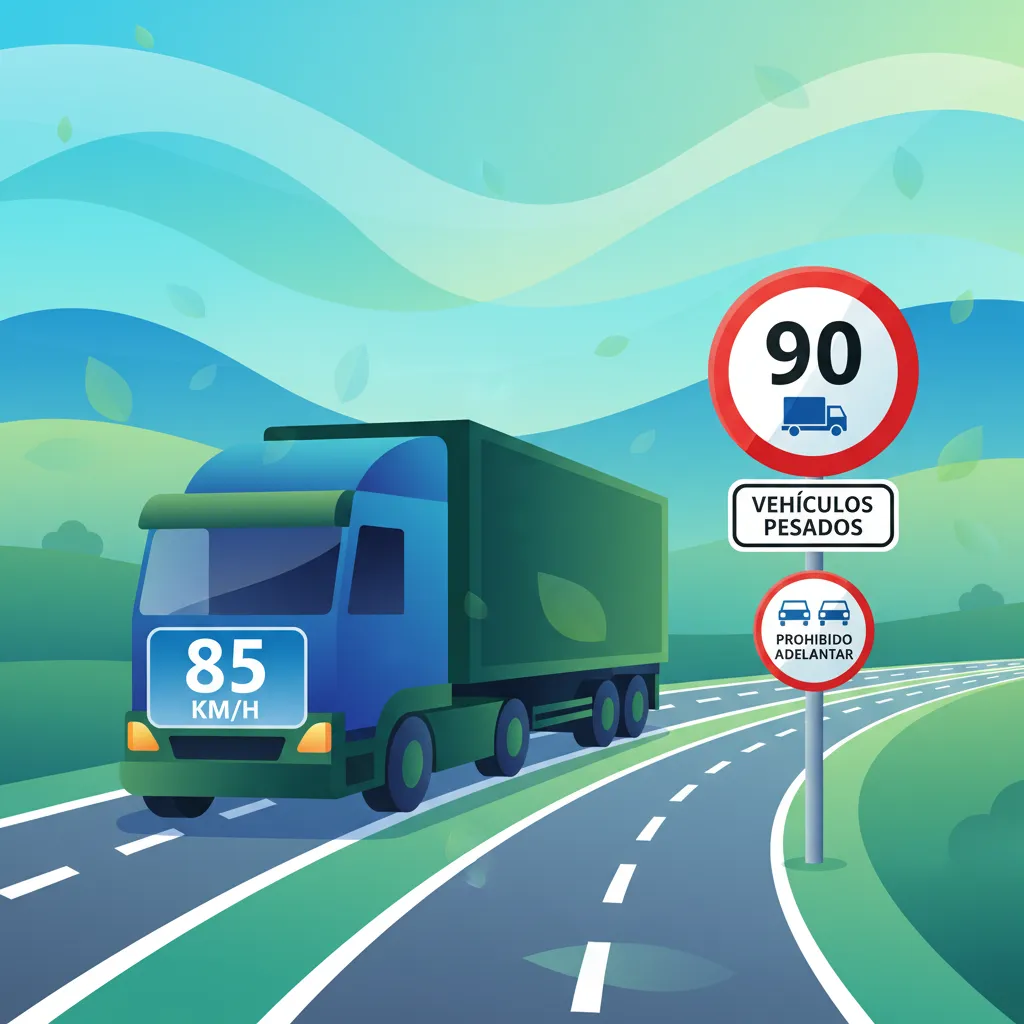
This lesson details the specific legal speed limits that apply to heavy passenger vehicles on Spanish highways, including variable speed zones that adjust based on traffic and weather conditions. Learners will understand the methods for speed monitoring, the function of speed control devices, and the legal consequences of non-compliance. The content also provides guidance on calculating a safe operating speed based on vehicle load and road conditions.
Learn to identify and understand truck clearance signage in Spain. This lesson details common violations, risks associated with exceeding dimensions, and essential route planning strategies for professional drivers.
This lesson addresses the special regulations that apply to transporting loads that exceed standard legal dimensions or weight. It explains the process for obtaining the necessary special permits from the DGT and other authorities. The content also covers the requirements for route planning, the use of escort vehicles (pilot cars), and the mandatory signage and lighting for the vehicle.
This lesson provides a broad overview of the key traffic regulations in Spain that directly impact professional truck drivers. It details the rules of priority at intersections, the interpretation of different road markings, and the principles of correct lane discipline. Furthermore, it explains the specific speed limits applicable to heavy vehicles and the legal protocols for safe overtaking and signaling.

This lesson provides specific instructions on how to safely navigate complex junctions such as roundabouts and intersections with a large vehicle. It explains the rules of priority, the correct lane to use based on the intended exit, and the importance of proper vehicle positioning to account for off-tracking. The content also covers clear signaling to communicate intentions to other road users for safe and efficient passage.

This lesson focuses on the specific restrictions that heavy vehicles face on public infrastructure and in urban centers. It covers how to interpret signs indicating weight limits for bridges and height restrictions for tunnels and overpasses. The content also explains the various municipal regulations that can restrict truck access to certain urban areas, such as low-emission zones or time-based delivery windows.
This lesson explains the specific legal framework governing truck operations on Spain's high-speed road network. It details the different speed limits for trucks on autovías versus autopistas and the regulations regarding which lanes heavy vehicles are permitted to use. Learners will also understand how to interpret specific highway signage relevant to commercial vehicles and any applicable toll regulations.

This lesson addresses the practical aspects of maneuvering a large vehicle in various environments. It explains concepts like turning radius, off-tracking, and the vehicle's total footprint, which determine the space needed for turns and other maneuvers. Learners will develop the spatial awareness required to navigate tight corners, loading bays, and urban streets while maintaining safe clearance from obstacles.

This lesson provides a detailed guide to performing safe and legal overtaking maneuvers on the highway. It places strong emphasis on the techniques for thoroughly checking the large blind spots around a truck before initiating a lane change. The content also covers judging the necessary speed differential and distance required to complete the pass and return to the lane safely.

This lesson focuses on the core principles of defensive driving as they apply to operating a large truck. It explains the importance of managing the space around the vehicle to create a safety buffer and always having an 'escape route' in mind. The content emphasizes anticipating the actions of other road users and being prepared to react calmly and safely to unexpected situations.

This lesson focuses on the principles of safe lane selection and overtaking on multi-lane roads and highways. It covers the importance of maintaining proper lane discipline and the legal protocols for executing a safe pass, including checking blind spots and ensuring sufficient speed differential. The content also stresses the need for clear signaling and judging adequate space before returning to the original lane.
Find clear answers to common questions learners have about Vehicle Length, Width, and Height Regulations. Learn how the lesson is structured, which driving theory objectives it supports, and how it fits into the overall learning path of units and curriculum progression in Spain. These explanations help you understand key concepts, lesson flow, and exam focused study goals.
According to DGT regulations, the standard maximum length for a rigid motor vehicle (camión rígido) is typically 12 meters. This applies to most Category C vehicles, though specific combinations or special vehicles may have different allowances. Always check the official DGT tables for exact figures relevant to your vehicle type and licence category.
DGT regulations stipulate that vehicle dimensions are measured from the outermost points, including any fixed or removable parts, such as mirrors, load securing devices, or tarpaulin frames. For height, this includes the load itself if it extends above the vehicle's structure. It's crucial to know your vehicle's actual height, especially when carrying diverse loads, to avoid clearance issues.
Exceeding legal dimension limits in Spain can result in significant fines, immobilization of the vehicle, and potential points deducted from your licence. In severe cases, especially if an accident occurs due to oversized dimensions, it can lead to more serious legal charges. It's vital for Category C and C1 drivers to always comply with DGT regulations to ensure safety and avoid penalties.
While the maximum legal dimensions (length, width, height) are generally consistent across all road types in Spain, urban areas often have additional specific restrictions. These can include lower clearance limits for bridges or tunnels, narrower streets, and designated access routes or time windows for larger vehicles. Professional drivers must pay close attention to local signage and municipal regulations in cities.
Spanish DGT regulations largely align with broader European Union directives on vehicle dimensions. The EU sets general maximum limits to facilitate international transport, and Spain, as a member state, incorporates these into its national legislation. However, there can be specific national adaptations or additional rules for certain vehicle types or operational contexts within Spain, which all Category C and C1 drivers must adhere to.
Use our powerful search functionality to pinpoint specific Spanish DGT driving theory practice sets. Filter by road sign categories, traffic law topics, or question difficulty to build custom study sessions and reinforce your knowledge precisely where it matters for your official exam.