
Welcome to the lesson on Defensive Driving Techniques for Trucks, a crucial part of your Official DGT Theory Course for Category C & C1 licences. This lesson builds on fundamental road safety principles, teaching you how to proactively manage space and anticipate potential risks on the road. Mastering these skills is key to passing your theory exam and ensuring your safety as a professional truck driver in Spain.

Lesson content overview
Operating a heavy goods vehicle (HGV) such as a truck for which a Category C or C1 licence is required demands a superior level of caution and skill. This is due to the inherent characteristics of large vehicles, including their significant mass, extended stopping distances, larger blind spots, and reduced maneuverability compared to passenger cars. Defensive driving is a proactive approach that equips professional drivers with the mindset and techniques to anticipate hazards, manage risks, and react safely to unexpected situations on the road.
Defensive driving for trucks is not merely about following traffic laws; it is about taking personal responsibility for safety and actively minimizing the potential for accidents. This philosophy is fundamental for protecting the driver, the vehicle, its cargo, and all other road users. For those preparing for their Official DGT Theory Course for Spanish Truck Licence, mastering these techniques is not just about passing an exam, but about developing a lifelong professional safety standard.
The physics of heavy vehicles dictate that their increased mass leads to significantly longer braking distances and greater momentum. A fully loaded truck requires substantially more time and space to stop or maneuver than a smaller vehicle. Consequently, a defensive driving strategy is indispensable to compensate for these physical realities and the potential actions or inactions of other drivers who may not fully appreciate a truck's limitations. It significantly reduces the likelihood of collisions, minimizes damage to valuable cargo, and ensures compliance with specific DGT (Dirección General de Tráfico) regulations designed for heavy vehicles.
Defensive driving is built upon several interconnected principles, each vital for safe truck operation:
Space management is a cornerstone of defensive driving, especially for heavy vehicles. It involves consciously creating and maintaining a safety cushion around your truck at all times. This protective bubble gives you the necessary time and space to react to unexpected events, significantly reducing the risk of collisions.
The distance maintained between your truck and the vehicle ahead is known as the longitudinal gap or following distance. For heavy vehicles, this gap must be substantially greater than for passenger cars due to longer braking distances. A common guideline for trucks is the 3-second rule, which should be extended under adverse conditions.
A method to estimate a safe following distance. Pick a fixed point ahead (e.g., a sign or tree). When the vehicle in front passes it, count "one thousand one, one thousand two, one thousand three." If your truck reaches the point before you finish counting, you are too close. For heavy vehicles or adverse conditions, extend this to 4 or more seconds.
DGT regulations, specifically Article 92-1, mandate that drivers maintain a minimum separation distance appropriate to the vehicle's size, speed, and prevailing conditions. For a truck traveling at 80 km/h on a motorway, a 3-second gap translates to approximately 100 metres. This extended distance is crucial for responding to sudden stops or swerving maneuvers by the vehicle ahead.
Lateral clearance refers to the side-to-side distance between your truck and other vehicles, road edges, or obstacles. Maintaining adequate lateral clearance is vital for preventing sideswipe collisions and for providing room to maneuver if necessary.
You should aim to maintain at least 1 metre of clearance from road edges and adjacent vehicles. This distance needs to be increased when driving through curves, where the trailer might cut inwards (off-tracking), or during adverse weather conditions like strong winds, which can push your vehicle. When passing cyclists or pedestrians, even greater lateral clearance is legally required and morally imperative.
Professional drivers must always be aware of their vehicle's total height, including any loaded cargo. Vertical clearance ensures sufficient headroom under bridges, overpasses, tunnels, and even tree limbs or overhead utility lines. Always check height warning signs carefully and be aware of your vehicle's specific dimensions, as listed in its technical documentation. Misjudging vertical clearance can lead to severe structural damage to the truck and infrastructure, as well as potential load shifting or even complete rollover.
While space management focuses on creating a buffer, escape route planning is about identifying where to go if that buffer is suddenly compromised. It's a proactive mental exercise of continuously identifying a clear, safe path to avoid imminent hazards. This skill is particularly critical for truck drivers, given their limited agility and stopping power.
An effective escape route plan involves mentally mapping out potential paths.
This continuous assessment requires constant scanning of your mirrors and ahead, anticipating potential actions of other drivers, and ensuring you always have enough maneuverability. You are essentially asking yourself: "If something goes wrong right now, where can I go safely?"
Overtaking is a maneuver that demands meticulous escape route planning, especially for trucks. DGT Article 192-3 obliges drivers of heavy vehicles to maintain an escape route when executing an overtaking maneuver. This means you must not only ensure the lane you are moving into is clear but also that the lane you are leaving, or the shoulder, remains a viable option until the maneuver is complete.
Before committing to an overtake, confirm that the entire length of the oncoming lane (if on a two-lane road) offers enough clear space for your truck's total length to pass safely and merge back without cutting off the overtaken vehicle. Rushing an overtake or failing to confirm a clear path ahead before merging back can lead to dangerous situations, including head-on collisions or forcing other vehicles to brake harshly.
Speed adaptation is the practice of adjusting your vehicle's speed not just to comply with posted limits, but also to suit the specific external conditions (road, weather, traffic) and internal factors (vehicle load, brake temperature). For truck drivers, this dynamic adjustment is critical for maintaining control and safety, as well as for maximizing fuel efficiency and reducing wear and tear.
The weight of your cargo dramatically influences your truck's dynamics, particularly its braking distance and acceleration capabilities. A fully loaded truck requires significantly more distance to stop and more power to accelerate. Therefore, reducing your speed proportionally to the cargo weight is essential. This compensates for altered handling characteristics and ensures you can react safely in an emergency. Ignoring the impact of a heavy load on speed adaptation is a common misunderstanding, as it can lead to situations where the vehicle cannot stop in time or struggles to maintain stability.
Weather conditions demand a significant reduction in speed.
DGT regulations set distinct maximum speeds for trucks (Category C & C1 vehicles) on different road categories, which are often lower than those for passenger cars. DGT Regulation 123-2 and Article 98-1 establish these limits.
As a general guideline:
It is crucial to be aware that simply adhering to the maximum speed limit is not always safe. The legal limit is the maximum permissible speed under ideal conditions; drivers must always adjust their speed downwards based on the actual conditions.
Understanding how cargo affects a truck's stability and dynamics is a critical aspect of defensive driving. Improper load management can lead to dangerous situations, including rollovers, loss of traction, and reduced braking efficiency.
The way cargo is distributed within the trailer significantly affects the truck's center of gravity (CoG). An improperly balanced load can:
Before any journey, drivers must verify that the load is balanced across all axles, adhering to maximum axle load limits dictated by DGT Decree 37/1992.
Cargo must be securely fastened to prevent it from shifting during transit. Sudden braking, acceleration, or turning can cause unsecured loads to move, drastically altering the truck's CoG and potentially leading to a loss of control. Methods such as straps, nets, dunnage bags, and bracing are used to achieve securement. Drivers must continuously monitor for any signs of load shift, especially after hard braking or bumpy road sections, and perform visual checks at rest stops.
An unsecured load is not only a danger to your truck but also a severe hazard to other road users, as falling debris or cargo can cause catastrophic accidents. DGT regulations strictly penalize improper load securement.
Hazard anticipation is the skill of predicting potential dangers before they materialize, allowing a driver to react proactively rather than reactively. This requires constant vigilance and an understanding of common risk patterns. DGT Article 140-1 requires drivers to exercise due caution, especially when operating vehicles with extended length.
Hazards can be categorized into several types:
Effective hazard anticipation demands a wide field of vision, continuously scanning ahead, using mirrors frequently, and being aware of the traffic patterns around you.
Scanning involves constantly moving your eyes, not just staring straight ahead. This includes:
Effective braking for trucks involves more than just pressing the brake pedal. It requires a sophisticated understanding and coordinated use of all available braking systems to maintain control, minimize wear, and prevent dangerous situations like jackknifing or brake fade.
The service brakes (foot brake) should be applied progressively – meaning gradually increasing pressure – rather than suddenly. Abrupt braking, especially with a heavy load, can cause the wheels to lock up, leading to a skid or, in articulated vehicles, a jackknife. Smooth, progressive braking allows the vehicle's weight to shift forward gradually, maintaining stability and maximizing braking efficiency.
Heavy vehicles are often equipped with auxiliary braking systems to assist the service brakes, particularly on long descents:
When descending a steep grade, select a gear that would be appropriate for ascending the same grade. Then, use your engine brake or retarder to maintain a safe, controlled speed, only lightly applying the service brakes intermittently if additional slowing is needed. This prevents brake fade, where brakes lose effectiveness due to excessive heat.
Professional truck drivers must always be aware of the inherent vulnerabilities of their vehicles and proactively take steps to mitigate the risks associated with them. These vulnerabilities stem from the truck's sheer size and mass.
As previously mentioned, trucks have significantly larger blind spots than passenger cars. These zones exist directly behind the trailer, along both sides, and sometimes even in front of the cab at close range due to the elevated driving position. DGT Article 123-4 specifically requires heavy vehicles to use rear-view mirrors and, when installed, blind-spot monitoring devices to compensate for these large blind zones. Drivers must always use auxiliary side mirrors, perform thorough mirror checks, and even glance over their shoulder if possible before changing lanes or turning. Never assume that if you can't see a vehicle, it isn't there.
Trucks require a much wider turning radius than smaller vehicles. This means they need significantly more space to execute turns, especially left turns at intersections or tight urban corners. This phenomenon, known as "off-tracking" or "cut-in," causes the rear wheels of a truck to follow a path inside the front wheels, potentially hitting curbs, parked cars, or even pedestrians.
When turning, drivers must signal early, approach the turn from a position that allows the necessary swing, and check all mirrors and blind spots carefully throughout the maneuver. Do not turn too sharply, and be mindful of vulnerable road users who might be in your blind spot.
Adherence to DGT regulations is not only a legal obligation but also a fundamental aspect of defensive driving. These rules are specifically designed to enhance safety when heavy vehicles share the road.
As discussed, DGT Article 92-1 mandates maintaining a minimum separation distance appropriate to the vehicle's size, speed, and conditions. For heavy vehicles, this generally translates to a significantly larger gap than for cars, typically at least a 3-second rule in good conditions, extended in adverse weather.
DGT Articles 98-1 and 123-2 establish distinct maximum speed limits for Category C and C1 trucks, which are generally lower than those for passenger cars. Drivers must always be aware of and adhere to these specific limits for different road types.
DGT Decree 37/1992 dictates maximum axle loads and overall vehicle weights, as well as standards for cargo securement. Proper load distribution is crucial for vehicle stability, braking, and legal compliance.
DGT Article 100-2 mandates the use of auxiliary braking systems, such as engine brakes (Jake brakes) or retarders, on long downgrades, especially when the vehicle is fully loaded. This regulation aims to prevent overheating and failure of the service brakes.
DGT Article 123-4 requires heavy vehicles to be equipped with and use specific rear-view mirrors and, where installed, blind-spot monitoring devices to compensate for their large blind zones.
DGT Article 192-3 sets specific rules for overtaking by heavy vehicles, emphasizing the need to ensure sufficient space and maintaining an escape route. Due to their length and acceleration limitations, trucks require more time and distance to overtake safely.
Ignoring defensive driving principles can lead to specific dangerous scenarios common in truck driving:
Defensive driving is not a fixed set of actions but a flexible approach that adapts to varying environmental and operational conditions.
Vulnerable road users (pedestrians, cyclists, motorcyclists) are at significantly higher risk in collisions with heavy vehicles.
Defensive driving principles are deeply rooted in the laws of physics, human perception, and statistical evidence.
Applying defensive driving techniques in real-world scenarios is key to internalizing these principles.
Setting: You are driving a fully loaded Category C truck on a two-lane motorway at 80 km/h. Traffic is moderate, and you approach a slower truck ahead traveling at 70 km/h. Correct Behavior:
Setting: You are driving an empty truck on a 50 km/h urban road. It's raining moderately, and pedestrians are present, some with umbrellas obscuring their view. You are approaching a marked pedestrian crossing. Correct Behavior:
Setting: You are driving a fully loaded truck down a mountain road with a 10% grade. Correct Behavior:
Setting: You are driving on a dual carriageway in moderate traffic. You need to change lanes to the left. Correct Behavior:
Setting: You are at a rest stop after several hours of driving. You perform a routine vehicle check and notice one of your trailer tires appears under increased strain, suggesting uneven weight distribution. Correct Behavior:
Defensive driving is the cornerstone of safe and responsible professional truck operation, especially for those holding a Spanish Truck Licence Category C & C1. It’s a proactive safety mindset that prioritizes hazard anticipation, meticulous space management (longitudinal, lateral, and vertical clearances), and continuous escape route planning.
Key elements include speed adaptation based on load, weather, and road type, strict load management to maintain stability, and controlled braking using all available systems. Truck drivers must also be acutely aware of their vehicle's inherent vulnerabilities, such as large blind spots and wide turning radii. Adherence to DGT regulations regarding following distances, speed limits, load distribution, and the use of auxiliary braking is not just mandatory, but essential for safety. By integrating these principles, truck drivers can significantly reduce accident risk, protect lives, and ensure compliance within the challenging road environment.
This lesson covers the essential defensive driving principles that Category C and C1 truck drivers must master for safe operation in Spain. Key topics include space management techniques (maintaining longitudinal, lateral, and vertical clearances), continuous escape route planning, and speed adaptation based on load, weather, and road conditions. The lesson details controlled braking using engine brakes and retarders to prevent brake fade, explains how cargo distribution affects vehicle stability and rollover risk, and emphasizes awareness of truck-specific vulnerabilities such as large blind spots and wide turning radii. Adherence to specific DGT regulations governing following distances, speed limits, load compliance, and auxiliary braking use on grades is mandatory for both exam success and professional safety.
A short set of high-value points that capture the most important learning from this lesson.
Defensive driving for trucks is a proactive approach that compensates for heavy vehicles' longer braking distances, larger blind spots, and reduced maneuverability compared to passenger cars.
Space management requires maintaining adequate longitudinal, lateral, and vertical clearances at all times, with following distances substantially greater than for cars due to physics.
Escape route planning means continuously identifying a clear path to avoid imminent hazards, requiring constant mirror checks and anticipation of other road users' actions.
Speed must be adapted not only to posted limits but also to vehicle load, weather conditions, and road surface, as legal limits represent maximums under ideal conditions only.
Controlled braking for trucks requires coordinated use of service brakes, engine brake, and retarder to prevent brake fade and jackknifing, especially on descents.
Explore all units and lessons included in this driving theory course.
The 3-second rule for following distance should be extended to 4+ seconds for heavy vehicles or adverse conditions, translating to approximately 100 metres at 80 km/h.
DGT Article 92-1 mandates minimum separation distances appropriate to vehicle size, speed, and conditions; Article 100-2 requires engine brake or retarder use on long downgrades when loaded.
Trucks have significant blind spots directly behind the trailer and along both sides; DGT Article 123-4 mandates auxiliary mirrors and thorough blind-spot checks before any lane change or turn.
Cargo weight distribution affects centre of gravity, braking efficiency, and rollover risk; DGT Decree 37/1992 sets maximum axle load limits that must not be exceeded.
Off-tracking means rear wheels follow a tighter path than front wheels during turns, requiring drivers to position further right before left turns to avoid hitting curbs or vehicles.
Tailgating smaller vehicles with insufficient following distance drastically reduces reaction time and increases rear-end collision risk.
Relying solely on service brakes during steep descents causes brake fade, leading to loss of braking power and potential loss of control.
Changing lanes or turning without thoroughly checking blind spots, assuming if you cannot see a vehicle it is not there.
Attempting overtakes without confirming the entire length of clear road ahead and a viable escape route back to the original lane.
Failing to reduce speed in adverse weather conditions, not accounting for dramatically increased stopping distances on wet or icy roads.
Lesson content overview
A short set of high-value points that capture the most important learning from this lesson.
Defensive driving for trucks is a proactive approach that compensates for heavy vehicles' longer braking distances, larger blind spots, and reduced maneuverability compared to passenger cars.
Space management requires maintaining adequate longitudinal, lateral, and vertical clearances at all times, with following distances substantially greater than for cars due to physics.
Escape route planning means continuously identifying a clear path to avoid imminent hazards, requiring constant mirror checks and anticipation of other road users' actions.
Speed must be adapted not only to posted limits but also to vehicle load, weather conditions, and road surface, as legal limits represent maximums under ideal conditions only.
Controlled braking for trucks requires coordinated use of service brakes, engine brake, and retarder to prevent brake fade and jackknifing, especially on descents.
Explore all units and lessons included in this driving theory course.
The 3-second rule for following distance should be extended to 4+ seconds for heavy vehicles or adverse conditions, translating to approximately 100 metres at 80 km/h.
DGT Article 92-1 mandates minimum separation distances appropriate to vehicle size, speed, and conditions; Article 100-2 requires engine brake or retarder use on long downgrades when loaded.
Trucks have significant blind spots directly behind the trailer and along both sides; DGT Article 123-4 mandates auxiliary mirrors and thorough blind-spot checks before any lane change or turn.
Cargo weight distribution affects centre of gravity, braking efficiency, and rollover risk; DGT Decree 37/1992 sets maximum axle load limits that must not be exceeded.
Off-tracking means rear wheels follow a tighter path than front wheels during turns, requiring drivers to position further right before left turns to avoid hitting curbs or vehicles.
Tailgating smaller vehicles with insufficient following distance drastically reduces reaction time and increases rear-end collision risk.
Relying solely on service brakes during steep descents causes brake fade, leading to loss of braking power and potential loss of control.
Changing lanes or turning without thoroughly checking blind spots, assuming if you cannot see a vehicle it is not there.
Attempting overtakes without confirming the entire length of clear road ahead and a viable escape route back to the original lane.
Failing to reduce speed in adverse weather conditions, not accounting for dramatically increased stopping distances on wet or icy roads.
Explore search topics learners often look for when studying Defensive Driving Techniques for Trucks. These topics reflect common questions about road rules, driving situations, safety guidance, and lesson level theory preparation for learners in Spain.
Browse additional driving theory lessons that cover connected traffic rules, road signs, and common driving situations related to this topic. Improve your understanding of how different rules interact across everyday traffic scenarios.
Understand the fundamental principles of defensive driving for heavy vehicles. This lesson covers space management, escape route planning, speed adaptation, and hazard anticipation crucial for truck drivers.

This lesson introduces fundamental road safety principles applicable to all drivers, with a special emphasis on heavy vehicles. It covers defensive driving techniques, including the importance of anticipating potential hazards and managing speed appropriately for conditions. Learners will also study how to establish and maintain safe following distances and understand the hierarchy of road users to ensure safe interactions.

This lesson outlines the core principles of defensive driving, focusing on maintaining a safe following distance, creating a protective space cushion around the vehicle, and anticipating potential hazards. Learners will be taught how to develop contingency plans for unexpected events and employ risk mitigation techniques to actively avoid accidents. The content reinforces the vital importance of remaining vigilant and proactive at all times when driving.

This lesson focuses on the ethical standards and professional conduct expected from commercial vehicle operators. It emphasizes the driver's role in promoting a positive safety culture and maintaining public trust through responsible behavior on the road. Key concepts include integrity, adherence to a professional code of conduct, and understanding the impact of a driver's actions on their company and the public.

This lesson focuses on the critical skill of safely interacting with vulnerable road users, such as pedestrians and cyclists, in an urban setting. It highlights the extensive blind spots around a truck and teaches drivers to be extra vigilant, especially at intersections and crosswalks. The content covers the legal requirements for yielding and the importance of making eye contact to confirm intentions.

This lesson focuses on the principles of safe lane selection and overtaking on multi-lane roads and highways. It covers the importance of maintaining proper lane discipline and the legal protocols for executing a safe pass, including checking blind spots and ensuring sufficient speed differential. The content also stresses the need for clear signaling and judging adequate space before returning to the original lane.

This lesson provides a detailed guide to performing safe and legal overtaking maneuvers on the highway. It places strong emphasis on the techniques for thoroughly checking the large blind spots around a truck before initiating a lane change. The content also covers judging the necessary speed differential and distance required to complete the pass and return to the lane safely.

This lesson focuses on the critical relationship between speed, following distance, and overall traffic safety on highways. It explains how to calculate a safe following distance based on speed and weather conditions, accounting for a truck's longer stopping distance. The content also teaches strategies for managing speed to adapt smoothly to changing traffic flow, enhancing both safety and fuel efficiency.
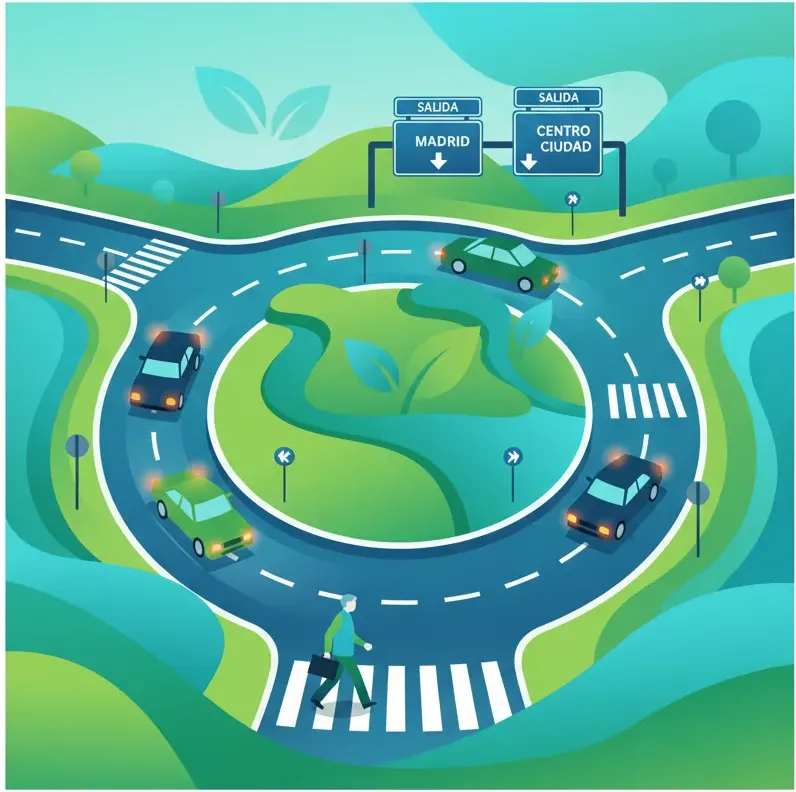
This lesson provides specific instructions on how to safely navigate complex junctions such as roundabouts and intersections with a large vehicle. It explains the rules of priority, the correct lane to use based on the intended exit, and the importance of proper vehicle positioning to account for off-tracking. The content also covers clear signaling to communicate intentions to other road users for safe and efficient passage.

This lesson provides guidance on the practical aspects of parking and making deliveries in urban areas. It covers the techniques for safely maneuvering into and out of loading docks and designated delivery zones, which often involves precise reversing. The content also explains the specific parking regulations that apply to commercial vehicles and best practices for ensuring safety during loading and unloading.

This lesson provides a broad overview of the key traffic regulations in Spain that directly impact professional truck drivers. It details the rules of priority at intersections, the interpretation of different road markings, and the principles of correct lane discipline. Furthermore, it explains the specific speed limits applicable to heavy vehicles and the legal protocols for safe overtaking and signaling.
Learn about specific vulnerabilities of heavy trucks, including blind spots and turning radii, and how to manage these risks. Covers essential DGT regulations and practical hazard identification for professional drivers.

This lesson focuses on identifying blind spot zones created by larger vehicles and the rider’s own positioning. It covers effective mirror usage, lateral awareness techniques, and the importance of head checks before lane changes. DGT blind spot guidelines are referenced, emphasizing situational scanning to maintain safety in traffic.

This lesson examines the interaction between large vehicles, such as trucks, and vulnerable road users within roundabouts. It addresses the wide turning radius of heavy vehicles, the importance of checking blind spots, and the correct yielding behavior toward pedestrians and cyclists. Learners will understand how to maintain safe distances and anticipate the movements of different road users.

This lesson outlines the proper use and legal requirements of vehicle lighting and mirror systems. It covers headlamps, fog lights, turn signals, and brake lights, clarifying when each must be used according to DGT regulations. The lesson also explains the correct adjustment of rearview and side mirrors and strategies for effective blind-spot monitoring.
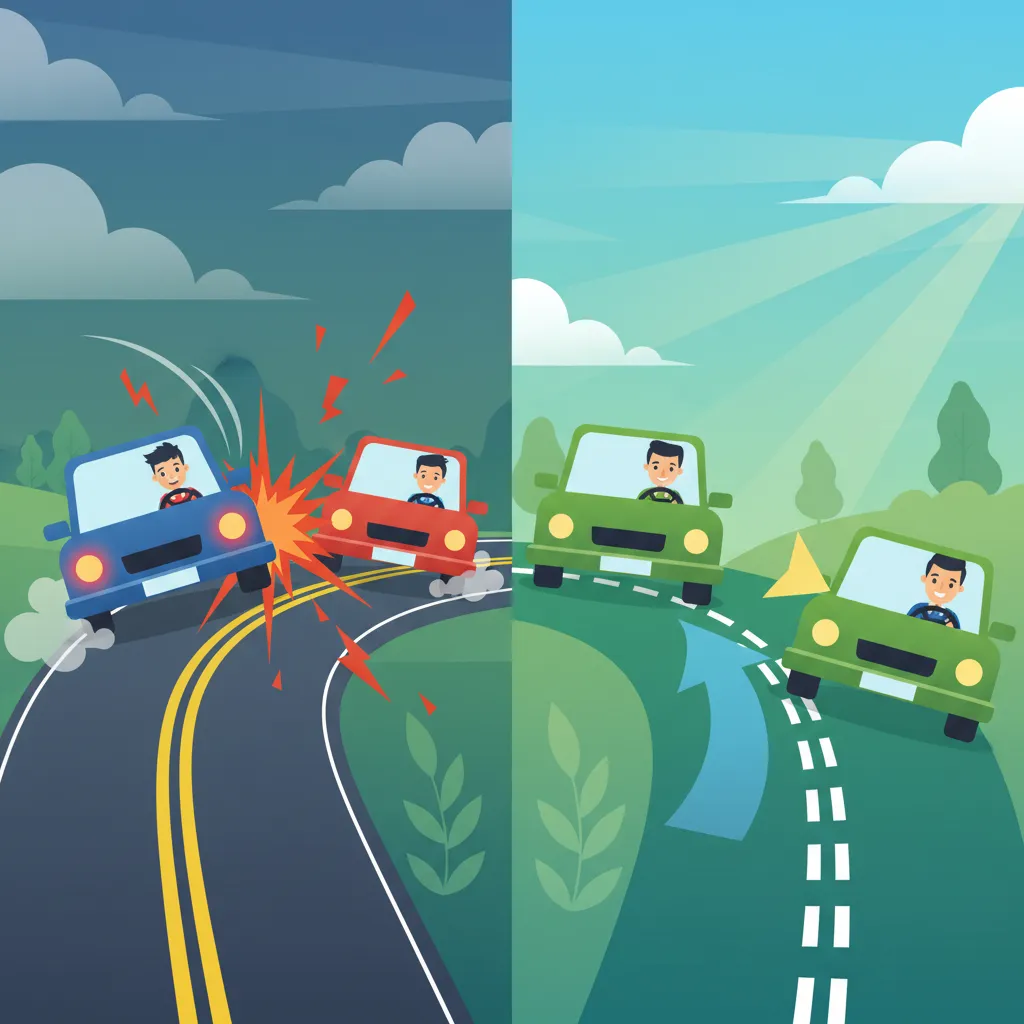
This lesson addresses common errors made by drivers when using roundabouts and presents corrective strategies. It covers issues such as entering from the wrong lane, failing to yield to circulating traffic, exceeding the recommended speed, and not signaling an exit correctly. By understanding these mistakes, drivers can improve their roundabout proficiency and reduce accident risk.

This lesson focuses on interaction dynamics with larger vehicles like cars, trucks, and buses, detailing their specific blind spot zones. Strategies for safely sharing lanes, overtaking etiquette, and proper approach when a bus stops are covered. The lesson also includes guidance on merging onto acceleration lanes following DGT policies.

This lesson covers how environmental conditions such as rain, fog, and darkness affect driving safety. It instructs drivers on adjusting speed, using appropriate lighting, and increasing following distance to compensate for reduced visibility and traction. The lesson incorporates DGT safety recommendations for handling adverse weather to mitigate risk and maintain control.

This lesson outlines the mandatory lighting and visibility equipment as per DGT regulations. It covers the correct use of headlights (low and high beams), taillights, and turn signals, ensuring the moped is visible to others, especially at night or in poor weather. The importance of wearing high-visibility or reflective clothing is also emphasized as a critical measure to enhance personal safety by making the rider more conspicuous.

This lesson focuses on safe nighttime riding, covering headlight alignment, rear-light visibility, and the use of reflective gear to enhance conspicuity. It explains DGT night riding requirements, including mandatory lighting standards. Topics also include managing glare from oncoming vehicles and mitigating rider fatigue during low-light conditions.
Find clear answers to common questions learners have about Defensive Driving Techniques for Trucks. Learn how the lesson is structured, which driving theory objectives it supports, and how it fits into the overall learning path of units and curriculum progression in Spain. These explanations help you understand key concepts, lesson flow, and exam focused study goals.
The most important escape route for truck drivers is always having a planned path of escape to a safe area if the space immediately in front or beside your truck becomes hazardous. This typically involves identifying an open lane, a hard shoulder, or a safe area to pull over, and constantly assessing if these options are available.
Trucks require significantly more space due to their size, weight, and slower reaction times. This includes maintaining much larger following distances, being aware of blind spots that extend far behind and to the sides, and planning turns with extra room for off-tracking. Defensive driving for trucks heavily emphasizes creating and utilizing these larger safety margins.
Anticipation involves observing other road users closely. Watch their wheels, direction signals, and body language (if visible). Look for signs they might turn or change lanes unexpectedly, and assume they might not see you, especially in your blind spots. Always be prepared to react to their potential actions, rather than just their current actions.
Yes, defensive driving absolutely includes adapting your driving to adverse weather. In rain, fog, or snow, you must increase your following distances, reduce your speed, ensure your lights are on, and be extra vigilant for other drivers who may not be adjusting their driving safely. Anticipating reduced visibility and slippery surfaces is key.
The DGT theory exam for truck licences frequently includes questions on hazard perception and safe driving practices. Understanding defensive driving principles, such as managing space, anticipating hazards, and planning escape routes, will directly help you answer scenario-based questions correctly and demonstrate your knowledge of safe truck operation in Spain.
Use our powerful search functionality to pinpoint specific Spanish DGT driving theory practice sets. Filter by road sign categories, traffic law topics, or question difficulty to build custom study sessions and reinforce your knowledge precisely where it matters for your official exam.