
Welcome to the lesson on Maneuvering Space and Clearance Requirements, a key part of your Official DGT Theory Course for Category C & C1 truck licences. Understanding how your truck moves is vital for safe operation in Spain's diverse road environments, especially in complex urban areas. This lesson builds on basic vehicle control knowledge and prepares you for understanding advanced maneuvering scenarios on the road and in your exam.
Lesson content overview
Understanding the spatial needs and clearance requirements of heavy goods vehicles is fundamental for safe and efficient driving, especially for those pursuing a Spanish professional truck driving licence in Category C or C1. This lesson delves into the critical concepts that define how much space a truck occupies and needs to maneuver, preventing collisions with obstacles, infrastructure, and other road users. Mastering these principles is vital for navigating tight corners, loading bays, urban streets, and highways with confidence and precision.
Safe maneuvering for heavy trucks depends on a driver's acute spatial awareness and the ability to accurately anticipate the room required for various movements. Every turn, lane change, and parking maneuver involves a specific geometric envelope that the vehicle occupies. Insufficient clearance in any dimension can lead to serious incidents, from minor scrapes to major collisions, impacting vehicle integrity, infrastructure, and the safety of all road users.
The physics governing vehicle movement, particularly the interaction of multiple axles and a long wheelbase during turns, dictates unique spatial demands. Unlike passenger cars, trucks exhibit phenomena like off-tracking, where the rear wheels follow a different path than the front wheels. Load distribution also plays a significant role, altering a truck's center of gravity and, consequently, its handling and required turning space. Spanish DGT regulations are in place to ensure these factors are properly accounted for, promoting orderly traffic flow and protecting both infrastructure and individuals.
This lesson builds upon your existing knowledge of basic vehicle dimensions—such as length, width, and height—and weight limits, providing the practical foundation needed for complex turning and maneuvering scenarios, particularly in urban environments. It also reinforces concepts from load management, as cargo placement directly influences a vehicle's stability and spatial requirements.
Successfully operating a large vehicle requires a deep understanding of several interconnected concepts that collectively define the space it needs to move safely. These concepts allow professional drivers to predict a truck's behavior and spatial footprint during dynamic maneuvers.
The turning radius (R) is a crucial measurement that defines the minimum space a vehicle needs to complete a turn. It is specifically the radius of the circular path traced by the center of the turning axle—typically the rear axle in a rigid truck or a specific axle on a trailer—when the steering wheel is at its maximum lock. When drivers speak of a "minimum turning circle," they are referring to the diameter of this circle, which is twice the turning radius (2R).
Truck manufacturers provide a nominal turning radius for an unloaded vehicle. However, the effective turning radius can change based on factors like load distribution, road conditions (e.g., wet surfaces reducing tire grip), and even tire pressure. A larger turning radius means the truck requires a wider road or an earlier, more deliberate lane adjustment to complete a turn without encroaching on opposing lanes or obstacles.
According to the DGT's Reglamento General de Circulación (RGC), specifically Article 81, drivers must not move their vehicle into another lane unless it is necessary and they can ensure a safe distance from obstacles. This regulation directly implies the need to understand and apply the turning radius to avoid such encroachments. A common misunderstanding among less experienced drivers is assuming a truck can turn within the visual width of a lane, ignoring the additional space needed, especially with off-tracking. For instance, a 12-meter truck with a nominal turning radius of 10 meters will require substantial clearance from the outside curb during a left turn.
Off-tracking, sometimes called "cut-in," is the phenomenon where the rear wheels of a vehicle follow a tighter, inward path compared to the front wheels during a turn. This occurs because the rear wheels are fixed in relation to the vehicle's centerline, and during a turn, they are effectively "pulled" along a shorter arc. The longer the wheelbase (the distance between the front and rear axles), the more pronounced the off-tracking effect.
This concept is critical for heavy vehicle drivers because it directly impacts clearance, especially in tight turns. In a right turn, for example, the rear wheels will sweep closer to the inside curb or obstacle than the front wheels, potentially causing a collision if not anticipated. Conversely, the front of the vehicle may swing wider to the left. Off-tracking can be categorized as static off-tracking, determined by the vehicle's wheelbase and track width, and dynamic off-tracking, which is influenced by factors like speed, load, and tire slip.
DGT RGC Article 81.3 stresses that drivers must avoid endangering other road users while turning, which inherently requires precise management of the vehicle's path, including accounting for off-tracking. A failure to consider off-tracking often leads to the rear of a long vehicle clipping curbs, traffic signs, or even other parked vehicles. A multi-axle truck or a truck with a trailer can exhibit significant off-tracking, potentially several decimeters, meaning the rear of the vehicle could be much closer to the edge of the road than the driver initially perceives from the front.
The maneuvering envelope is the total three-dimensional space that a vehicle occupies or sweeps through while performing a specific maneuver. It's a dynamic concept that accounts for all physical dimensions of the vehicle, including its length, width, height, wheelbase, articulation points (for articulated vehicles), and any load overhangs. Essentially, it's the "bubble" of space the truck needs to complete a turn, change lanes, or reverse without hitting anything.
This envelope changes depending on the maneuver:
Professional drivers must develop the ability to visualize this envelope before initiating any maneuver. This mental projection ensures that sufficient space is available, preventing collisions with fixed obstacles, other vehicles, or infrastructure. DGT RGC Article 81.5 specifically prohibits maneuvers that risk collision due to inadequate space. Over-reliance on visual estimation, especially in confined urban environments, is a common mistake; instead, drivers should strive to understand the measured clearances their vehicle requires. For example, when attempting to enter a loading bay, the truck's entire maneuvering envelope must be considered, not just its static width, to ensure clearance from the bay's edges and any surrounding structures.
The vehicle footprint refers to the rectangular area on the ground covered by the vehicle's physical hull. It represents the projection of the vehicle's maximum length and width when it is at rest. This includes any fixed overhangs, such as extended rear bumpers or mirrors, that project beyond the main wheelbase.
The vehicle footprint is crucial for determining if a truck can safely occupy a specific space, such as a lane, a parking spot, or a loading dock, without encroaching on adjacent areas. DGT RGC Article 78 mandates that vehicles must remain within lane markings unless performing an unavoidable maneuver like overtaking. Misinterpreting a vehicle's width or ignoring overhangs can lead to dangerous situations, such as side-swiping other vehicles or infrastructure when driving in narrow lanes or parallel parking. For instance, a truck with a static width of 2.55 meters needs to be precisely centered in a lane that is at least 2.60 meters wide to maintain a minimum safety clearance of 0.05 meters on each side.
The distribution and weight of cargo significantly impact a heavy vehicle's handling characteristics, including its turning radius and overall stability. This effect is known as load-induced space variation.
Improper load placement can necessitate greater clearance than an unloaded vehicle would require, increasing the risk of collisions. DGT RGC Article 143 explicitly states that cargo must be properly secured and evenly distributed to maintain vehicle stability and prevent it from affecting maneuverability. A common error is assuming that load placement has no effect on turning dynamics. For example, a heavy load positioned towards the rear of a truck could increase its effective turning radius by up to 10%, potentially requiring an additional 0.5 meters of clearance in tight corners.
Regulatory clearance distances are the specific minimum distances mandated by law that must be maintained between a vehicle's maneuvering envelope and fixed objects or other road users. These regulations are designed to prevent collisions, ensure safe interaction with infrastructure, and protect vulnerable road users.
These clearances can be broken down into:
These distances are non-negotiable and are enforced by DGT regulations to ensure public safety and infrastructure integrity. DGT RGC Article 96 states that drivers must adapt their speed and trajectory to maintain safe distances from obstacles. Failing to adhere to these clearances can result in fines and other legal penalties. For instance, the minimum vertical clearance for a Category C vehicle is generally considered 4.0 meters, and drivers must meticulously calculate their total vehicle height, including any cargo, before attempting to pass under any overhead structure.
The Spanish Reglamento General de Circulación (RGC) provides the legal framework governing how all vehicles, including heavy trucks, must operate on public roads. Several articles specifically address maneuvering space and clearance requirements, underlining the DGT's commitment to safety and orderly traffic flow.
RGC Article 81 lays down general rules for maneuvers. It explicitly states that drivers must not move their vehicle into another lane or direction unless it is necessary and they can ensure it is safe to do so, maintaining a proper distance from any obstacles. This article is foundational for understanding the need to accurately assess the maneuvering envelope and off-tracking before initiating any turn or lane change.
RGC Article 81, General Maneuvering: Drivers must ensure any maneuver is safe and does not obstruct other road users or infrastructure. This includes being aware of your vehicle's full spatial requirements.
RGC Article 84 places specific restrictions on turning. It mandates that trucks must not make turns that exceed the geometric limits of the road, meaning their turning circles must not intersect with opposing traffic flow or other lanes where it would create a hazard. This directly relates to the turning radius and off-tracking concepts discussed earlier.
RGC Article 85 focuses on urban restrictions. In urban zones, heavy vehicles must respect posted width and height limits. They are prohibited from entering streets or areas where the available clearance is insufficient for their dimensions, including their maneuvering envelope. This emphasizes the importance of route planning that accounts for vehicle size.
RGC Article 78 deals with lane discipline. It stipulates that heavy vehicles must generally remain within their designated lane markings when traveling straight. When changing lanes, drivers must signal clearly and ensure there is sufficient space for the entire vehicle, including its maneuvering envelope. This is particularly relevant when considering the vehicle footprint and the wider path a truck takes during a lane change.
RGC Article 78, Lane Discipline: Always signal lane changes well in advance and verify that the entire maneuvering envelope of your truck, including any off-tracking, can fit safely into the new lane without infringing on other traffic.
RGC Article 96 directly addresses obstacle clearance. Drivers are obligated to maintain adequate lateral and vertical clearance when passing any fixed objects, such as buildings, parked vehicles, bridge supports, or tunnels. Failure to do so can lead to significant fines and dangerous situations. This article reinforces the necessity of knowing your vehicle's exact dimensions and predicting its dynamic envelope.
RGC Article 143 is crucial for understanding how cargo affects maneuverability and clearance. It mandates that all cargo must be properly secured and evenly distributed within the vehicle. An unsecured or unevenly distributed load can drastically alter the vehicle's center of gravity, affecting its stability, increasing its effective turning radius, and potentially causing unpredictable movements during turns or braking. Such instability directly impacts the amount of space a truck needs to maneuver safely.
RGC Article 143, Load Securing: Before starting your journey, always check that your cargo is securely fastened and evenly distributed. This not only prevents load shift but also maintains your truck's designed maneuverability characteristics.
Applying the theoretical concepts of maneuvering space and clearance in real-world scenarios is what defines a competent professional truck driver. Ignoring these principles leads to a range of common violations and dangerous situations.
Urban driving presents some of the most challenging conditions for heavy vehicles due to frequent intersections, narrow lanes, parked cars, pedestrians, and cyclists. When making a left turn at a narrow intersection, a 12-meter truck might require a turning envelope that temporarily encroaches on the opposite lane. The driver must accurately calculate this space, ensuring the oncoming lane is clear before initiating the turn and executing it at a reduced speed, with early signaling. A common mistake is underestimating off-tracking, causing the rear wheels to clip curbs, street furniture, or parked vehicles on tight right turns.
Maneuvering into a loading bay or a parking spot requires precise spatial judgment. Before reversing into a 3-meter-wide loading dock, for example, a driver must confirm both lateral and vertical clearance. If the truck's static width is 2.55 meters, adding a safety margin of 0.3 meters means at least 2.85 meters of width is required. Vertical clearance must also be checked, especially if carrying tall cargo, to avoid colliding with the dock ceiling or overhead structures. When backing up from a parking spot on a narrow street, the reverse maneuvering envelope must be assessed, often with the aid of a spotter, to prevent hitting parked vehicles.
One of the most critical clearance considerations is vertical. Before entering any tunnel or passing under a bridge, professional drivers must verify their total vehicle height, including the load, against posted clearance limits. For a Category C vehicle, if the total height is 4.2 meters and a bridge has a 4.0-meter clearance, the driver must detour. Ignoring posted height limits can lead to severe collisions, causing structural damage to both the vehicle and infrastructure, significant delays, and potential injuries. Route planning tools specifically designed for trucks often include height restrictions to help drivers avoid such hazards.
Maneuvering and clearance requirements are not static; they change significantly based on environmental conditions, the type of road, and the vehicle's specific state (loaded, unloaded, with a trailer). A skilled professional driver constantly adapts their judgment to these variables.
Understanding the physics behind a truck's movements is paramount. A larger wheelbase inherently leads to a larger turning radius, and off-tracking means the rear of the vehicle will follow an inward path, reducing inside lateral clearance but extending the overall swept path on the outside of a turn. Drivers often underestimate the vehicle's dynamic envelope, especially under speed, in poor visibility, or when distracted. Implementing a systematic assessment process before every maneuver significantly reduces risk.
Reaction time is another critical factor. Adverse conditions like wet roads demand greater reaction time, which translates to needing more buffer space before initiating maneuvers like braking or turning. Furthermore, proper load distribution is not just a regulatory requirement; it directly influences the vehicle's stability. An improperly placed load raises the center of gravity, making the truck more prone to tipping and increasing the required clearance during turns to avoid body roll and loss of control.
Failure to accurately calculate or respect required clearance distances is a leading cause of collisions, vehicle damage, traffic disruption, and legal penalties. By mastering the concepts presented in this lesson, professional drivers can significantly enhance their safety, protect other road users, and comply with all DGT regulations.
This lesson covers the spatial awareness requirements for operating Category C and C1 trucks in Spain, focusing on turning radius, off-tracking, and the maneuvering envelope. Key concepts include how rear wheels follow a tighter path than front wheels during turns, how load distribution alters effective turning radius, and how regulatory clearance distances (lateral, vertical, longitudinal) are mandated by DGT RGC Articles 78, 81, 85, 96, and 143. Practical applications include navigating tight urban intersections, entering loading bays, and avoiding low bridges, with specific attention to how weather conditions, vehicle state (loaded vs unloaded), and trailer articulation affect the space required for safe maneuvers.
A short set of high-value points that capture the most important learning from this lesson.
Turning radius is measured from the center of the rear axle at maximum steering lock, and the effective radius changes with load, road conditions, and tire pressure.
Off-tracking causes rear wheels to follow a tighter path than front wheels during turns, with the effect becoming more pronounced as wheelbase lengthens.
The maneuvering envelope is the total 3D space a truck occupies during a specific maneuver, including all dynamic extensions from turning radius and off-tracking.
Load distribution directly affects turning radius and stability; a rear-heavy load can increase the effective turning radius by up to 10%.
DGT RGC Article 81 requires drivers to ensure any maneuver is safe and maintains proper distance from obstacles before initiating movement.
Explore all units and lessons included in this driving theory course.
Article 85 prohibits heavy vehicles from entering streets where available clearance is insufficient for their maneuvering envelope.
When reversing with a trailer, the articulation angle makes off-tracking much more pronounced and the rear of the trailer sweeps a tighter path than the tractor unit.
Vertical clearance must account for total vehicle height plus load; a Category C vehicle with a 4.2m total height cannot pass under a 4.0m bridge.
Lateral clearance requirements are non-negotiable under RGC Article 96, which mandates adequate distance from fixed objects including curbs, parked vehicles, and bridge supports.
A 12-meter truck with a nominal turning radius of 10 meters requires substantial clearance from the outside curb during left turns due to off-tracking.
Assuming a truck can turn within the visual width of a lane without accounting for off-tracking, causing the rear wheels to clip curbs or obstacles.
Ignoring how load placement affects turning dynamics, leading to underestimation of required clearance space in tight maneuvers.
Over-reliance on visual estimation in confined urban environments instead of understanding measured clearances the vehicle requires.
Failing to check total vehicle height (chassis plus load) against posted clearance limits before entering tunnels or passing under bridges.
Neglecting to account for the wider path the front of the vehicle swings during turns, potentially encroaching on adjacent lanes or oncoming traffic.
Lesson content overview
A short set of high-value points that capture the most important learning from this lesson.
Turning radius is measured from the center of the rear axle at maximum steering lock, and the effective radius changes with load, road conditions, and tire pressure.
Off-tracking causes rear wheels to follow a tighter path than front wheels during turns, with the effect becoming more pronounced as wheelbase lengthens.
The maneuvering envelope is the total 3D space a truck occupies during a specific maneuver, including all dynamic extensions from turning radius and off-tracking.
Load distribution directly affects turning radius and stability; a rear-heavy load can increase the effective turning radius by up to 10%.
DGT RGC Article 81 requires drivers to ensure any maneuver is safe and maintains proper distance from obstacles before initiating movement.
Explore all units and lessons included in this driving theory course.
Article 85 prohibits heavy vehicles from entering streets where available clearance is insufficient for their maneuvering envelope.
When reversing with a trailer, the articulation angle makes off-tracking much more pronounced and the rear of the trailer sweeps a tighter path than the tractor unit.
Vertical clearance must account for total vehicle height plus load; a Category C vehicle with a 4.2m total height cannot pass under a 4.0m bridge.
Lateral clearance requirements are non-negotiable under RGC Article 96, which mandates adequate distance from fixed objects including curbs, parked vehicles, and bridge supports.
A 12-meter truck with a nominal turning radius of 10 meters requires substantial clearance from the outside curb during left turns due to off-tracking.
Assuming a truck can turn within the visual width of a lane without accounting for off-tracking, causing the rear wheels to clip curbs or obstacles.
Ignoring how load placement affects turning dynamics, leading to underestimation of required clearance space in tight maneuvers.
Over-reliance on visual estimation in confined urban environments instead of understanding measured clearances the vehicle requires.
Failing to check total vehicle height (chassis plus load) against posted clearance limits before entering tunnels or passing under bridges.
Neglecting to account for the wider path the front of the vehicle swings during turns, potentially encroaching on adjacent lanes or oncoming traffic.
Explore search topics learners often look for when studying Maneuvering Space and Clearance Requirements. These topics reflect common questions about road rules, driving situations, safety guidance, and lesson level theory preparation for learners in Spain.
Browse additional driving theory lessons that cover connected traffic rules, road signs, and common driving situations related to this topic. Improve your understanding of how different rules interact across everyday traffic scenarios.
Learn how to safely maneuver large trucks in confined urban spaces. This lesson focuses on understanding truck dimensions, turning radius, and clearance requirements for navigating Spanish city streets and avoiding obstacles according to DGT regulations.

This lesson provides strategies for navigating dense and often unpredictable city traffic. It explains how to maintain a safe following distance and position the vehicle correctly in stop-and-go situations to optimize flow and visibility. The content emphasizes the importance of anticipation, patience, and defensive driving techniques to safely manage the challenges of urban congestion.
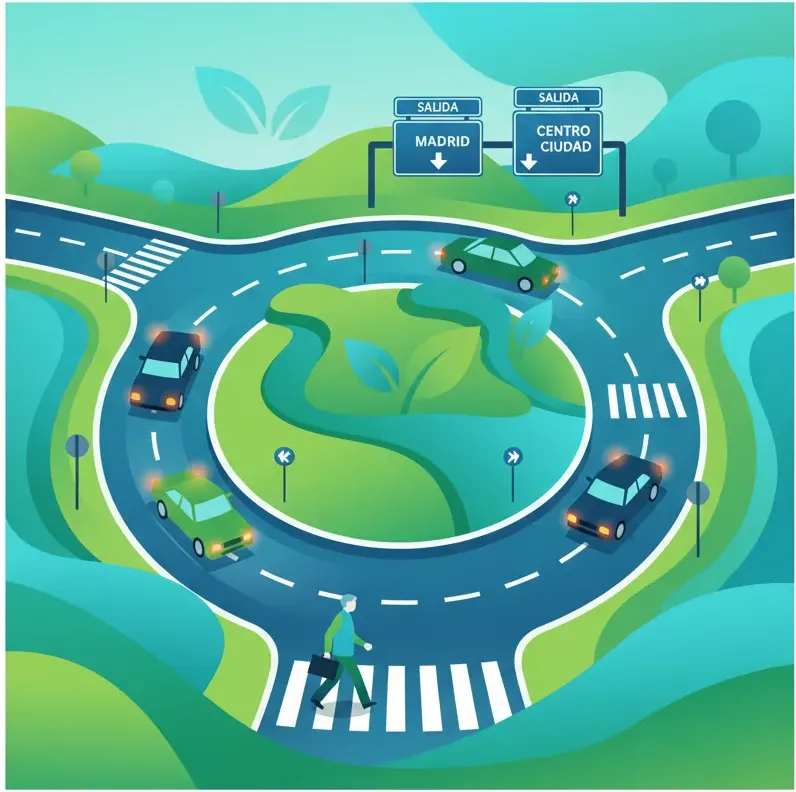
This lesson provides specific instructions on how to safely navigate complex junctions such as roundabouts and intersections with a large vehicle. It explains the rules of priority, the correct lane to use based on the intended exit, and the importance of proper vehicle positioning to account for off-tracking. The content also covers clear signaling to communicate intentions to other road users for safe and efficient passage.
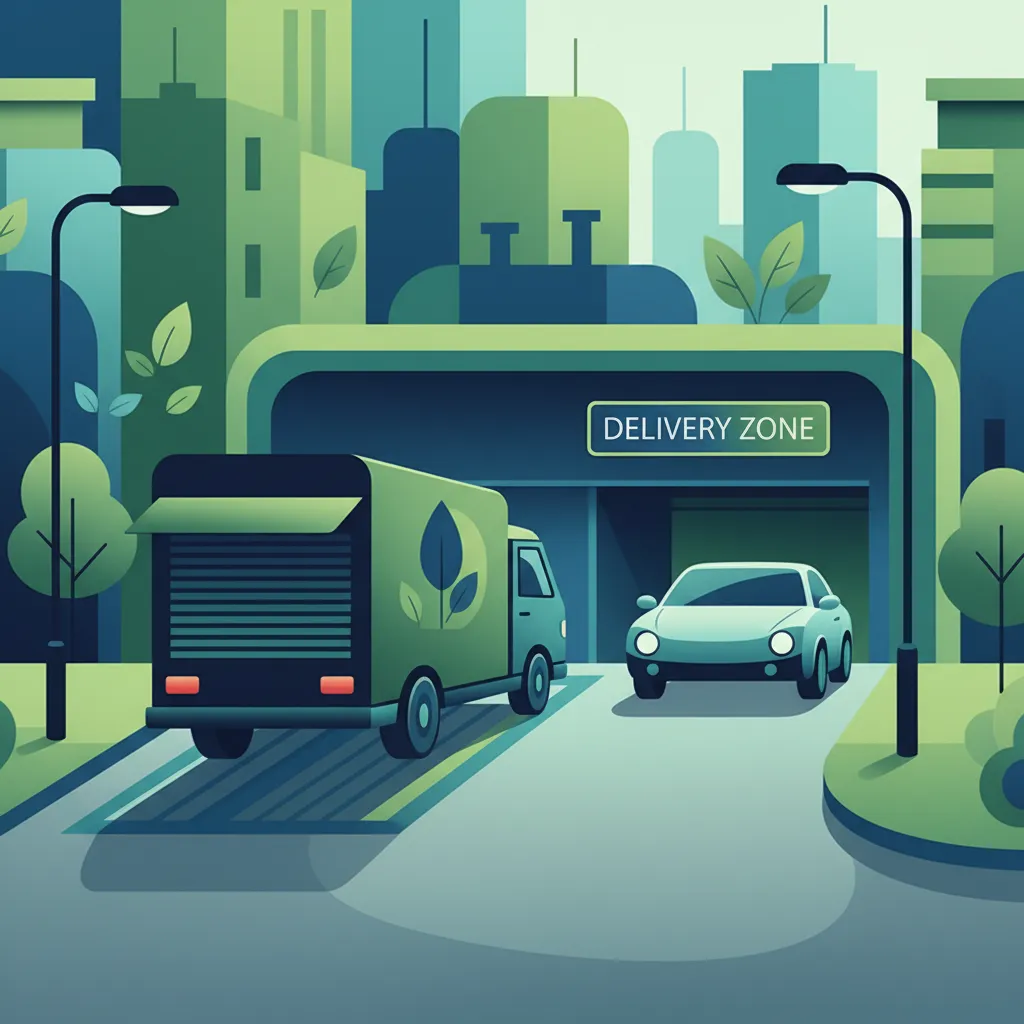
This lesson provides guidance on the practical aspects of parking and making deliveries in urban areas. It covers the techniques for safely maneuvering into and out of loading docks and designated delivery zones, which often involves precise reversing. The content also explains the specific parking regulations that apply to commercial vehicles and best practices for ensuring safety during loading and unloading.

This lesson focuses on the specific restrictions that heavy vehicles face on public infrastructure and in urban centers. It covers how to interpret signs indicating weight limits for bridges and height restrictions for tunnels and overpasses. The content also explains the various municipal regulations that can restrict truck access to certain urban areas, such as low-emission zones or time-based delivery windows.

This lesson focuses on the critical skill of safely interacting with vulnerable road users, such as pedestrians and cyclists, in an urban setting. It highlights the extensive blind spots around a truck and teaches drivers to be extra vigilant, especially at intersections and crosswalks. The content covers the legal requirements for yielding and the importance of making eye contact to confirm intentions.

This lesson focuses on the core principles of defensive driving as they apply to operating a large truck. It explains the importance of managing the space around the vehicle to create a safety buffer and always having an 'escape route' in mind. The content emphasizes anticipating the actions of other road users and being prepared to react calmly and safely to unexpected situations.
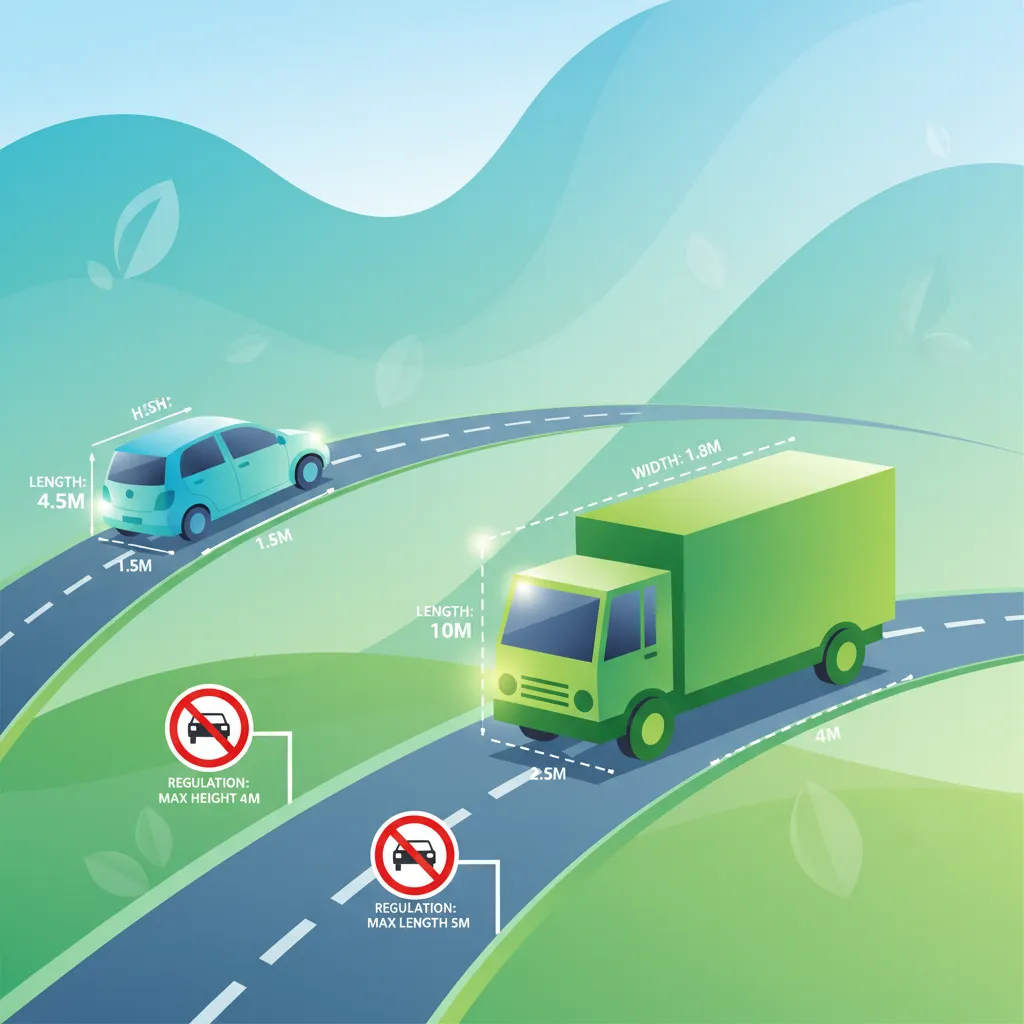
This lesson provides a detailed breakdown of the maximum permissible length, width, and height for heavy vehicles according to Spanish and EU regulations. It explains how these dimensions are measured and how they affect vehicle classification and route planning. The content emphasizes the critical importance of respecting clearance signs for bridges, tunnels, and other overhead structures to prevent accidents.

This lesson explains the various access restrictions that trucks face in modern cities. It covers the rules and requirements for entering low-emission zones (LEZ), including necessary vehicle standards and permits. The content also details time-window restrictions, where deliveries are only permitted during specific hours of the day to reduce congestion, requiring careful logistical planning.
This lesson focuses on the critical relationship between speed, following distance, and overall traffic safety on highways. It explains how to calculate a safe following distance based on speed and weather conditions, accounting for a truck's longer stopping distance. The content also teaches strategies for managing speed to adapt smoothly to changing traffic flow, enhancing both safety and fuel efficiency.

This lesson provides strategies for navigating tight, confined environments such as multi-story car parks and narrow urban lanes. It emphasizes the importance of slow and controlled movements, constant observation, and a thorough understanding of the vehicle's dimensions and turning circle. Learners will develop the skills to maneuver with precision while avoiding obstacles.
Master the concepts of off-tracking and turning radius for trucks. This lesson explains how these factors dictate the space needed for safe turns and maneuvers, crucial for Spanish C/C1 driving theory and avoiding collisions.

This lesson explains the concept of turning radius and how it is influenced by a truck's wheelbase and overall length. It introduces the principle of off-tracking, where the rear wheels follow a tighter path than the front wheels during a turn. Understanding these dynamics is essential for drivers to accurately judge the space needed to navigate corners and turns without incident.

This lesson provides theoretical guidance on the techniques for safely reversing a heavy vehicle, a high-risk maneuver. It emphasizes the correct use of mirrors, managing extensive blind spots, and the importance of using a spotter when available. The content also breaks down the geometric principles of parallel parking and backing into loading docks, focusing on vehicle positioning and spatial awareness.
This lesson focuses on the core principles of defensive driving as they apply to operating a large truck. It explains the importance of managing the space around the vehicle to create a safety buffer and always having an 'escape route' in mind. The content emphasizes anticipating the actions of other road users and being prepared to react calmly and safely to unexpected situations.

This lesson details the standard dimensions of buses and coaches, including length, width, height, and wheelbase. It explains how these measurements determine the vehicle's turning circle and its ability to maneuver in tight urban spaces with lane constraints. Learners will understand how to calculate necessary clearance zones and anticipate spatial needs to ensure safe and efficient operation.

This lesson explains the physical concept of the center of gravity and its critical importance in heavy vehicle stability. It details how the placement and distribution of cargo can raise or lower the center of gravity, affecting rollover risk and handling. The content also covers factors that contribute to vehicle sway and the principles of load balancing to maintain control during turns and maneuvers.

This lesson explores the direct relationship between a vehicle's load and its braking and acceleration performance. It explains how increased mass significantly increases the vehicle's inertia, resulting in longer stopping distances and slower acceleration. Understanding these physical principles helps drivers adjust their driving style, such as increasing following distances, to compensate for the effects of a heavy load.

This lesson addresses the dynamics of accelerating, braking, and turning while towing a trailer. It explains how to adjust for increased load inertia, the impact on stopping distances, and the need for wider turns to account for off-tracking. The content outlines DGT speed guidelines specific to towing and emphasizes smooth control to ensure stability.
This lesson provides specific instructions on how to safely navigate complex junctions such as roundabouts and intersections with a large vehicle. It explains the rules of priority, the correct lane to use based on the intended exit, and the importance of proper vehicle positioning to account for off-tracking. The content also covers clear signaling to communicate intentions to other road users for safe and efficient passage.
This lesson provides strategies for navigating dense and often unpredictable city traffic. It explains how to maintain a safe following distance and position the vehicle correctly in stop-and-go situations to optimize flow and visibility. The content emphasizes the importance of anticipation, patience, and defensive driving techniques to safely manage the challenges of urban congestion.

This lesson provides a detailed guide to performing safe and legal overtaking maneuvers on the highway. It places strong emphasis on the techniques for thoroughly checking the large blind spots around a truck before initiating a lane change. The content also covers judging the necessary speed differential and distance required to complete the pass and return to the lane safely.
Find clear answers to common questions learners have about Maneuvering Space and Clearance Requirements. Learn how the lesson is structured, which driving theory objectives it supports, and how it fits into the overall learning path of units and curriculum progression in Spain. These explanations help you understand key concepts, lesson flow, and exam focused study goals.
Off-tracking is the difference in path between the outermost front wheels and the outermost rear wheels of a vehicle when turning. For trucks in Spain, understanding off-tracking is critical because it means the rear of the trailer or truck body can swing wide, potentially hitting curbs, other vehicles, or obstacles. DGT regulations and theory exam questions often test your awareness of this phenomenon for safe maneuvering.
A longer truck generally has a larger turning radius and experiences more pronounced off-tracking. This means you need a wider area to complete a turn compared to a shorter vehicle. The DGT theory exam assesses your ability to judge whether a given space is sufficient for your truck's dimensions, including its overall length and wheelbase.
DGT theory exam questions for C/C1 licences often present scenarios where you need to determine if a truck can safely turn a corner, enter a loading bay, or navigate an intersection without hitting anything. You might be shown diagrams or asked to consider factors like the truck's length, turning radius, and the presence of obstacles like parked cars or street furniture.
When driving a truck in Spanish urban streets, always consider the full footprint of your vehicle, including off-tracking. Look far ahead through turns, anticipate where your rear wheels will track, and be aware of parked vehicles, street furniture, and pedestrians. If in doubt, reduce speed significantly or seek an alternative route. Practice visualizing this space, as it's a key exam topic.
Yes, significantly. Articulated vehicles (trucks with trailers) have a much larger turning radius and greater off-tracking than rigid trucks of similar length. This requires considerably more space and careful planning when maneuvering. DGT exam questions will account for these differences, so understanding the specific characteristics of your vehicle type is essential.
Use our powerful search functionality to pinpoint specific Spanish DGT driving theory practice sets. Filter by road sign categories, traffic law topics, or question difficulty to build custom study sessions and reinforce your knowledge precisely where it matters for your official exam.