
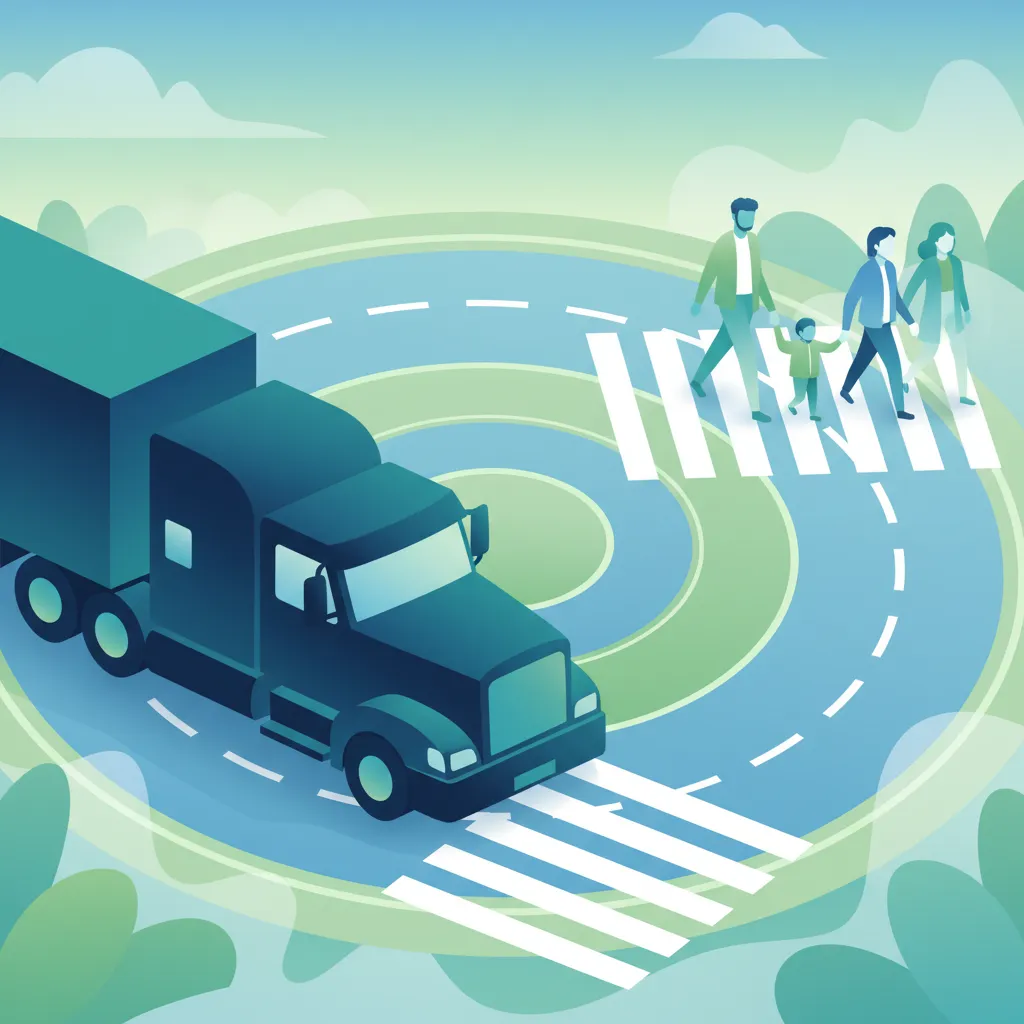
This lesson focuses on the critical interactions at roundabouts involving large vehicles like trucks and vulnerable road users such as pedestrians. Understanding these specific dynamics is crucial for safe navigation in Spain, building upon your knowledge of general roundabout rules and preparing you for complex scenarios often tested in the DGT theory exam for categories B and BE.
Lesson content overview
Roundabouts are common features of road networks in Spain, designed to improve traffic flow and reduce accident severity. However, their navigation becomes significantly more complex when large vehicles, such as trucks, buses, or vehicles towing trailers (categories B and BE), interact with vulnerable road users like pedestrians and cyclists. This lesson provides a comprehensive guide to understanding these interactions, emphasizing the specific challenges posed by vehicle dimensions and the legal obligations outlined in Spanish traffic legislation (DGT) to ensure safety for all.
Understanding the unique dynamics of large vehicles within roundabouts is critical not only for passing the Spanish driving license theory exam but, more importantly, for safe and responsible driving on public roads. It requires an awareness of physical limitations, keen observation of surroundings, and strict adherence to priority rules.
Large vehicles possess distinct physical characteristics that profoundly influence their behavior within roundabouts. Their sheer size affects visibility, maneuverability, and stopping capabilities, demanding a different approach compared to driving a standard passenger car. Recognizing these dynamics is the first step towards safe navigation and minimizing risks to vulnerable road users.
The physical dimensions of heavy vehicles are a primary consideration when entering, circulating, and exiting roundabouts. Vehicles classified under Category B with trailers (BE) or larger commercial vehicles such as rigid trucks, articulated trucks (tractor-trailers), and buses have significantly greater length, width, and often height than typical passenger cars. This geometry directly impacts their turning radius, which is the minimum arc required for a vehicle to complete a turn without leaving its designated lane.
Due to their extended length and wheelbase, large vehicles require a much wider turning radius. This means they cannot turn as sharply as smaller vehicles and often need to approach turns more gradually and occupy more space. In a multi-lane roundabout, this physical constraint might necessitate using the outer lane exclusively or, in some cases, even temporarily encroaching on an adjacent lane (though this should be avoided and is often prohibited, as discussed later) to complete a turn without striking the central island or exiting the carriageway. Drivers must be highly aware of their vehicle's specific dimensions and adjust their lane positioning and speed accordingly.
A blind spot (or ángulo muerto in Spanish) refers to areas around a vehicle that cannot be seen directly by the driver through mirrors, windows, or direct line of sight. These areas are particularly extensive and dangerous in large vehicles due to their size, high driver seating position, and rigid structures. For instance, the left-hand side of a truck, the area immediately in front of the cab, and especially the entire length of a trailer, can completely obscure pedestrians or cyclists.
Inside a roundabout, where vulnerable users might be crossing at entry or exit points or cycling alongside traffic, these blind spots pose a significant collision risk. A cyclist could be riding alongside a bus or truck, completely hidden from the driver's view in the blind spot, especially when the larger vehicle prepares to turn or change lanes. To mitigate this danger, drivers of large vehicles must not rely solely on their mirrors. Performing head checks (glancing over the shoulder) before changing lanes, turning, or exiting the roundabout is an essential safety procedure to scan for unseen road users.
The weight and distribution of cargo, or the presence of a trailer, significantly alter a vehicle's dynamics. A fully loaded truck or a car towing a heavy caravan will have increased momentum compared to an empty vehicle. This increase in momentum directly translates to a longer stopping distance and reduced maneuverability.
When approaching a roundabout, especially one with pedestrian or cyclist crossings, drivers of loaded vehicles must account for this altered dynamic. They need to reduce their speed earlier and more gradually to ensure they can stop safely if a vulnerable user enters a crossing. Sudden braking with a heavy load or trailer can lead to instability, jackknifing (for articulated vehicles), or loss of control. Spanish traffic regulations, specifically Article 101 of the General Traffic Regulations (Reglamento General de Circulación, RGTC), stipulate that vehicles must be loaded safely and in accordance with manufacturer specifications, which inherently impacts handling and braking performance.
Spanish traffic legislation places a high priority on the safety of vulnerable road users. At roundabouts, this translates into specific yielding obligations for drivers, particularly those of larger vehicles, given the greater potential for harm in a collision. Adhering to these rules is not just a matter of compliance but a fundamental aspect of defensive driving.
One of the most crucial rules for roundabout navigation is the obligation to yield to pedestrians. According to Article 12 of the RGTC, drivers must give way to pedestrians who are already on a designated pedestrian crossing, commonly known as a zebra crossing (paso de cebra), or on dedicated pedestrian islands. This rule applies rigorously within roundabouts, particularly at the entry and exit points where these crossings are frequently located.
It is a common misconception that once a vehicle has entered a roundabout, it has continuous right-of-way. This is incorrect when a pedestrian is already engaged in crossing at a marked point. Drivers of large vehicles, who require more time and distance to stop, must approach these crossings with extreme caution, scanning continuously for pedestrians. If a pedestrian steps onto the crosswalk, the driver must be prepared to stop safely, even if it means interrupting their flow through the roundabout.
Cyclists, like pedestrians, are considered vulnerable road users and are afforded specific protections under Spanish law. Article 55 of the RGTC grants cyclists priority over motorists when they are crossing at designated points within roundabouts, such as marked cycle lanes or shared pedestrian-cyclist islands.
This means that if a cyclist has already entered a marked crossing area at a roundabout's entry or exit, vehicle drivers must yield to them. This rule is especially pertinent at roundabouts where dedicated cycle paths run parallel to the main carriageway, as drivers exiting the roundabout might cut across a cyclist's path if not observant. Large vehicle drivers must be acutely aware of these designated crossings and anticipate the presence and movement of cyclists.
When passing pedestrians or cyclists, particularly within the confines of a roundabout, maintaining a safe lateral clearance is mandatory. This rule, outlined in Article 80 of the RGTC, requires drivers to leave a minimum side-to-side distance. For pedestrians, this distance is 1.5 meters. For cyclists, the general rule is 1 meter where no dedicated cycle lane exists. However, if overtaking a cyclist on a conventional road, a minimum of 1.5 meters is required, which often translates to using the entire adjacent lane.
Inside a roundabout, the reduced space and dynamic movements make judging this distance critical. Large vehicles, due to their width and potential for body sway, must exercise even greater care. Passing too closely can startle vulnerable users or, worse, lead to a side-swipe collision. Drivers must assess the available space carefully before proceeding, ensuring ample room for both their vehicle's movement and any unpredictable lateral shifts by pedestrians or cyclists.
Multi-lane roundabouts can be particularly challenging for large vehicles. Article 78 of the RGTC generally requires vehicles to occupy only one lane at a time and to follow lane markings. For heavy vehicles, especially those with wide turning radii, this rule is crucial. While a large truck or bus might appear to need more than one lane to navigate a tight inner curve, straddling lanes is generally prohibited as it creates confusion, obstructs other traffic, and significantly increases the risk of collision, particularly with smaller vehicles or cyclists sharing the roundabout.
When a large vehicle genuinely cannot stay within a single lane due to its dimensions and the roundabout's design, it often means that specific inner lanes are unsuitable or prohibited for that vehicle type. In such cases, the driver must plan to use the outer lane, or if necessary, take extra precautions and signal clearly to alert other road users of their need for additional space. However, deliberate lane straddling is a violation and dangerous.
Even experienced drivers can make mistakes when navigating roundabouts with large vehicles, especially when vulnerable users are present. Awareness of these common pitfalls can help in developing safer driving habits.
Driving a large vehicle safely through roundabouts requires constant adaptation to varying conditions. Environmental factors, the road's context, and the vehicle's specific state all demand modifications to driving technique.
Understanding specific terminology is key to mastering roundabout navigation, especially when dealing with larger vehicles and vulnerable users.
Let's consider practical examples to solidify your understanding of these critical interactions.
The stringent regulations and recommended practices for large vehicle interaction with pedestrians and cyclists at roundabouts are rooted in fundamental principles of physics, human behavior, and accident prevention.
To navigate roundabouts safely and interact responsibly with pedestrians and cyclists while driving a large vehicle in Spain, remember these essential points:
This lesson covers the specific challenges large vehicles face at Spanish roundabouts, including their wide turning radius and extensive blind spots that can hide pedestrians and cyclists from the driver's view. Key legal obligations include yielding to pedestrians at zebra crossings (Art. 12 RGTC) and cyclists at designated points (Art. 55 RGTC), maintaining minimum lateral clearances of 1.5m from pedestrians and 1m from cyclists (Art. 80 RGTC), and occupying only one lane per vehicle (Art. 78 RGTC). Drivers must account for increased stopping distances when loaded, perform head checks before lateral movements, and adapt their speed and observation for weather conditions and vehicle type. Real-world scenarios demonstrate correct behavior for loaded trucks in rain, buses exiting near cycle lanes, and articulated vehicles navigating in fog, emphasizing defensive driving practices essential for both safe driving and DGT exam success.
A short set of high-value points that capture the most important learning from this lesson.
Large vehicles require a wider turning radius due to extended length and wheelbase, meaning they cannot turn as sharply and may need to use the outer lane exclusively.
Blind spots (ángulos muertos) in large vehicles are extensive; drivers must perform head checks over the shoulder before changing lanes or turning, not relying solely on mirrors.
Pedestrians at zebra crossings (paso de cebra) and cyclists at designated crossing points have legal priority over vehicles, even if you are already circulating the roundabout.
A minimum lateral clearance of 1.5 meters must be maintained from pedestrians and 1 meter from cyclists when passing (Art. 80 RGTC).
Heavy vehicles must occupy only one lane in multi-lane roundabouts; straddling lanes is prohibited and dangerous (Art. 78 RGTC).
Explore all units and lessons included in this driving theory course.
Loaded vehicles have increased momentum and longer stopping distances; reduce speed earlier and more gradually when approaching roundabouts with heavy cargo or trailers.
Trailer swing means the rear of a trailer swings wider than the towing vehicle during turns, requiring extra lateral clearance and careful lane planning.
Overtaking inside a roundabout is generally prohibited by Art. 46 RGTC and is especially dangerous for large vehicles due to limited visibility and maneuverability.
In adverse weather (rain, fog, night), braking distances increase dramatically; pedestrians and cyclists are harder to spot, demanding earlier scanning and reduced speeds.
When navigating with an articulated vehicle or towing a caravan, maintain smooth steering inputs and avoid sudden lane changes to prevent jackknifing or loss of control.
Failing to yield to pedestrians already on a crosswalk because the driver believes they have right-of-way within the roundabout.
Relying only on mirrors when changing lanes or exiting, without performing head checks, causing cyclists or pedestrians in blind spots to be missed.
Straddling two lanes in a multi-lane roundabout to accommodate a wide turning radius, obstructing other traffic and creating collision risks.
Approaching roundabouts at speeds suitable for an empty vehicle, underestimating the increased stopping distance when carrying a heavy load or towing a trailer.
Passing too close to pedestrians or cyclists at exits due to insufficient lateral clearance, violating the 1.5-meter and 1-meter minimum distance requirements.
Lesson content overview
A short set of high-value points that capture the most important learning from this lesson.
Large vehicles require a wider turning radius due to extended length and wheelbase, meaning they cannot turn as sharply and may need to use the outer lane exclusively.
Blind spots (ángulos muertos) in large vehicles are extensive; drivers must perform head checks over the shoulder before changing lanes or turning, not relying solely on mirrors.
Pedestrians at zebra crossings (paso de cebra) and cyclists at designated crossing points have legal priority over vehicles, even if you are already circulating the roundabout.
A minimum lateral clearance of 1.5 meters must be maintained from pedestrians and 1 meter from cyclists when passing (Art. 80 RGTC).
Heavy vehicles must occupy only one lane in multi-lane roundabouts; straddling lanes is prohibited and dangerous (Art. 78 RGTC).
Explore all units and lessons included in this driving theory course.
Loaded vehicles have increased momentum and longer stopping distances; reduce speed earlier and more gradually when approaching roundabouts with heavy cargo or trailers.
Trailer swing means the rear of a trailer swings wider than the towing vehicle during turns, requiring extra lateral clearance and careful lane planning.
Overtaking inside a roundabout is generally prohibited by Art. 46 RGTC and is especially dangerous for large vehicles due to limited visibility and maneuverability.
In adverse weather (rain, fog, night), braking distances increase dramatically; pedestrians and cyclists are harder to spot, demanding earlier scanning and reduced speeds.
When navigating with an articulated vehicle or towing a caravan, maintain smooth steering inputs and avoid sudden lane changes to prevent jackknifing or loss of control.
Failing to yield to pedestrians already on a crosswalk because the driver believes they have right-of-way within the roundabout.
Relying only on mirrors when changing lanes or exiting, without performing head checks, causing cyclists or pedestrians in blind spots to be missed.
Straddling two lanes in a multi-lane roundabout to accommodate a wide turning radius, obstructing other traffic and creating collision risks.
Approaching roundabouts at speeds suitable for an empty vehicle, underestimating the increased stopping distance when carrying a heavy load or towing a trailer.
Passing too close to pedestrians or cyclists at exits due to insufficient lateral clearance, violating the 1.5-meter and 1-meter minimum distance requirements.
Explore search topics learners often look for when studying Large Vehicle and Pedestrian Interactions at Roundabouts. These topics reflect common questions about road rules, driving situations, safety guidance, and lesson level theory preparation for learners in Spain.
Browse additional driving theory lessons that cover connected traffic rules, road signs, and common driving situations related to this topic. Improve your understanding of how different rules interact across everyday traffic scenarios.
Understand the specific challenges and priority rules when large vehicles like trucks and buses navigate roundabouts with pedestrians and cyclists. Learn about blind spots, wide turning radii, and yielding obligations for safe driving theory in Spain.
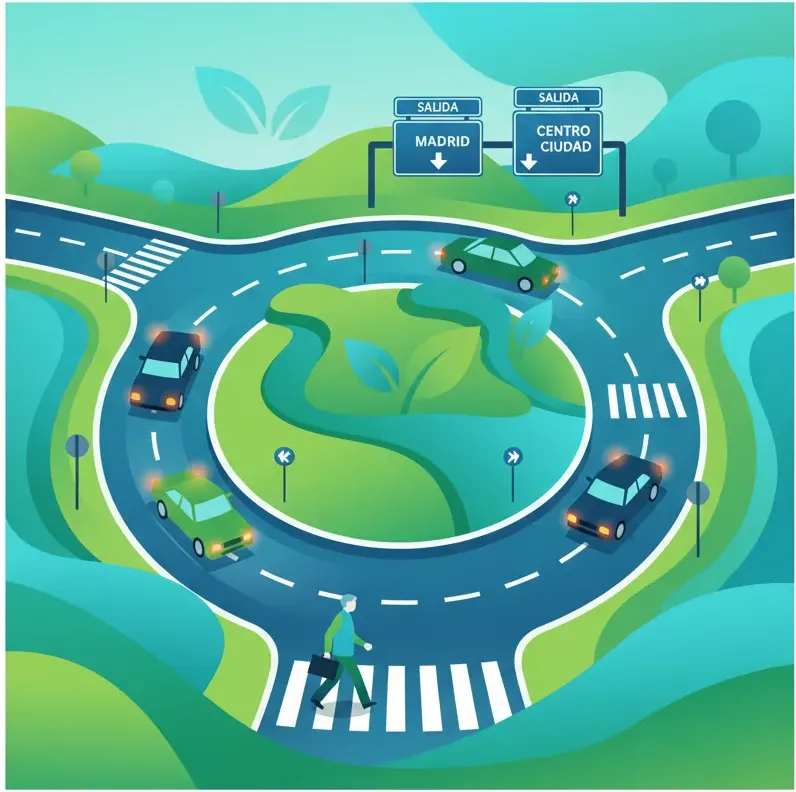
This lesson provides specific instructions on how to safely navigate complex junctions such as roundabouts and intersections with a large vehicle. It explains the rules of priority, the correct lane to use based on the intended exit, and the importance of proper vehicle positioning to account for off-tracking. The content also covers clear signaling to communicate intentions to other road users for safe and efficient passage.
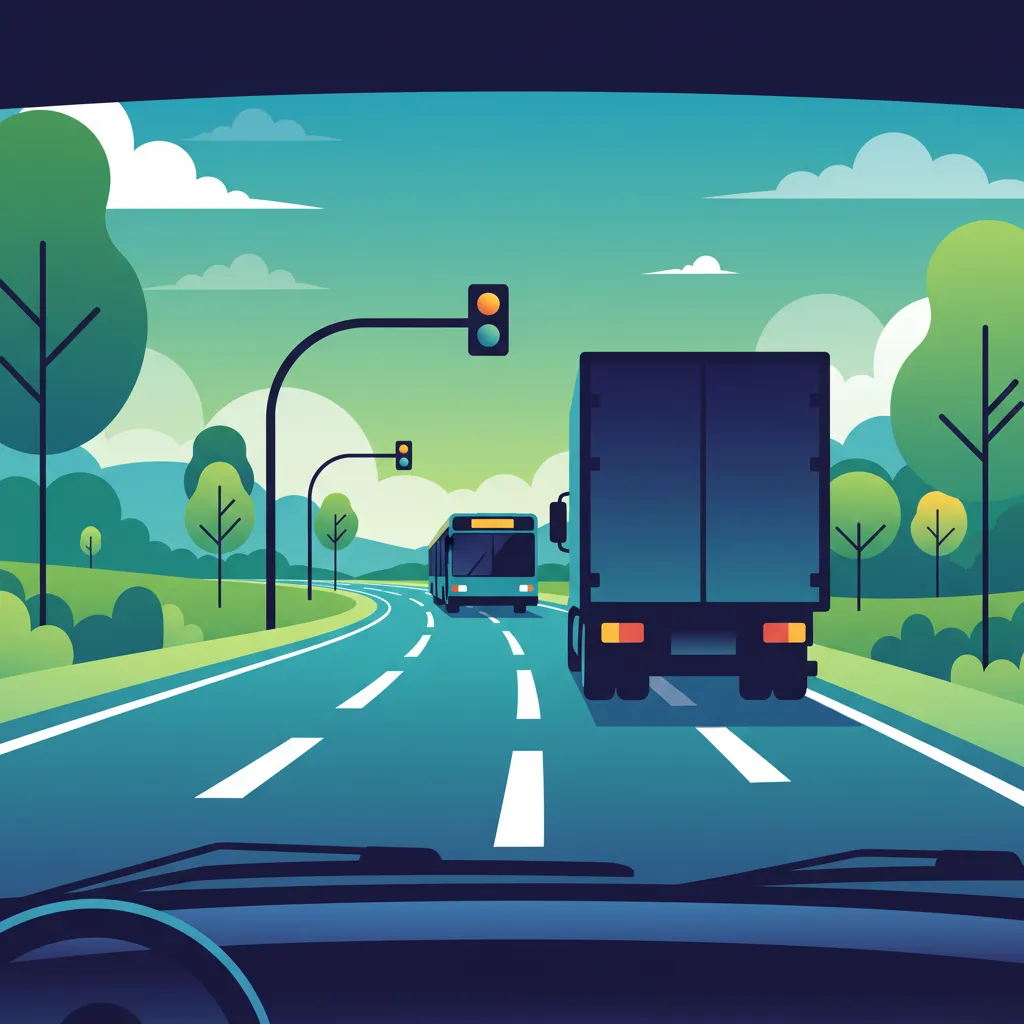
This lesson focuses on interaction dynamics with larger vehicles like cars, trucks, and buses, detailing their specific blind spot zones. Strategies for safely sharing lanes, overtaking etiquette, and proper approach when a bus stops are covered. The lesson also includes guidance on merging onto acceleration lanes following DGT policies.

This lesson focuses on the critical skill of safely interacting with vulnerable road users, such as pedestrians and cyclists, in an urban setting. It highlights the extensive blind spots around a truck and teaches drivers to be extra vigilant, especially at intersections and crosswalks. The content covers the legal requirements for yielding and the importance of making eye contact to confirm intentions.
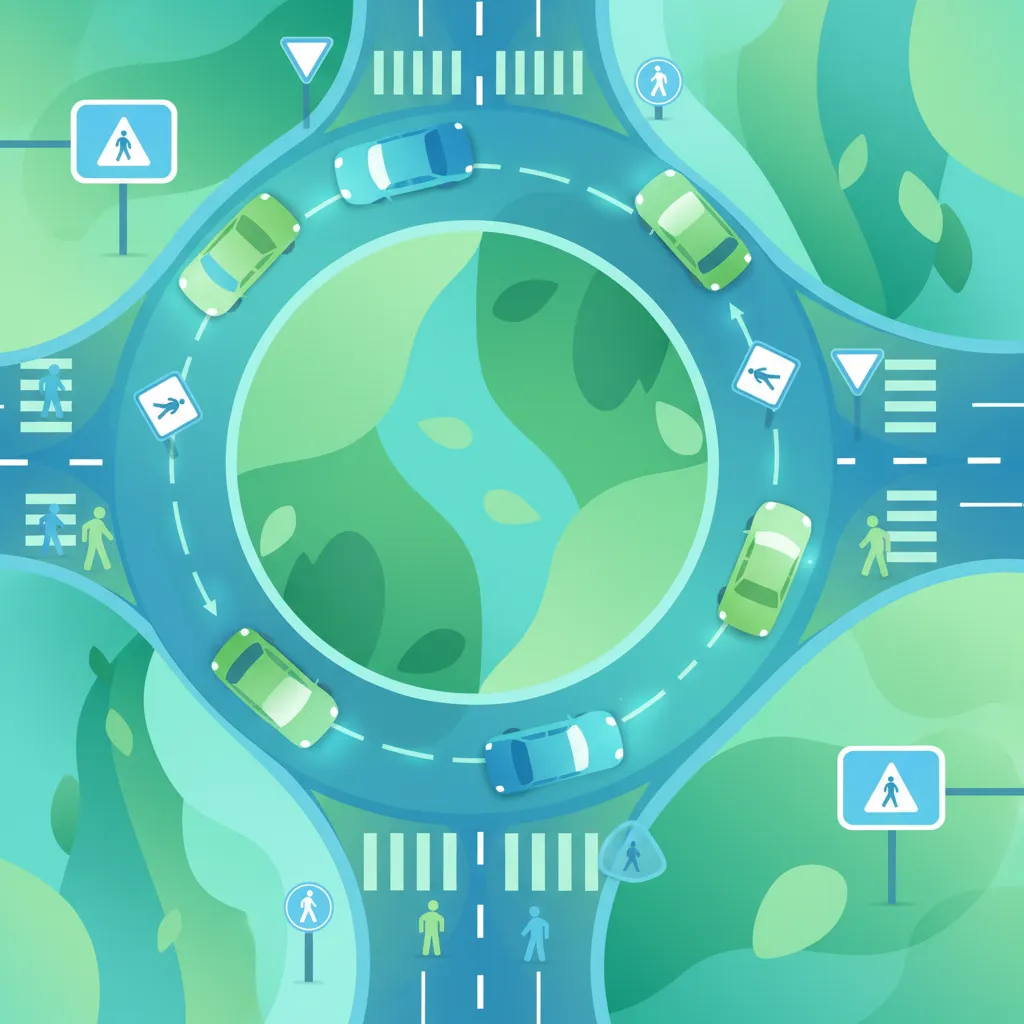
This lesson offers a comprehensive guide to navigating roundabouts in urban settings, explaining the correct protocols for entry, yielding, and circulation. Learners will be taught how to interpret lane markings and signage on multi-lane roundabouts and determine the correct vehicle positioning for safe entry and exit. The content emphasizes full compliance with Spanish city regulations that govern priority and right-of-way at these intersections.

This lesson explores the design and legal requirements of pedestrian crossings in Spanish urban areas. It clarifies the rules at zebra crossings, signal-controlled crossings, and areas where cyclists or other vulnerable users share space. The content explains the required safety distances and signage indicating crossing zones to ensure drivers respect all road users.
This lesson examines the structural components of a typical Spanish roundabout, describing the central island, entry and circulating lanes, and the placement of yield signs. It outlines how DGT standards dictate the geometric design and entry/exit points to ensure smooth traffic flow. Understanding these design elements enables drivers to anticipate vehicle movements and navigate safely.
This lesson addresses the critical skill of safely sharing the road with other vulnerable users like pedestrians, cyclists, and other motorcyclists. It emphasizes the need for increased awareness, speed adaptation, and providing ample space when passing. The content covers DGT regulations regarding minimum passing distances and highlights the importance of making eye contact to ensure mutual awareness and prevent common urban accidents.
This lesson addresses common errors made by drivers when using roundabouts and presents corrective strategies. It covers issues such as entering from the wrong lane, failing to yield to circulating traffic, exceeding the recommended speed, and not signaling an exit correctly. By understanding these mistakes, drivers can improve their roundabout proficiency and reduce accident risk.
This lesson clarifies the primary rule for roundabouts: all vehicles entering must yield to traffic already on the circular roadway. It explains how to approach a roundabout, select the appropriate lane based on the intended exit, and merge safely into the flow of traffic. Proper signaling before exiting is also covered, ensuring other drivers can anticipate the rider's movements for a smooth and safe negotiation of the junction.
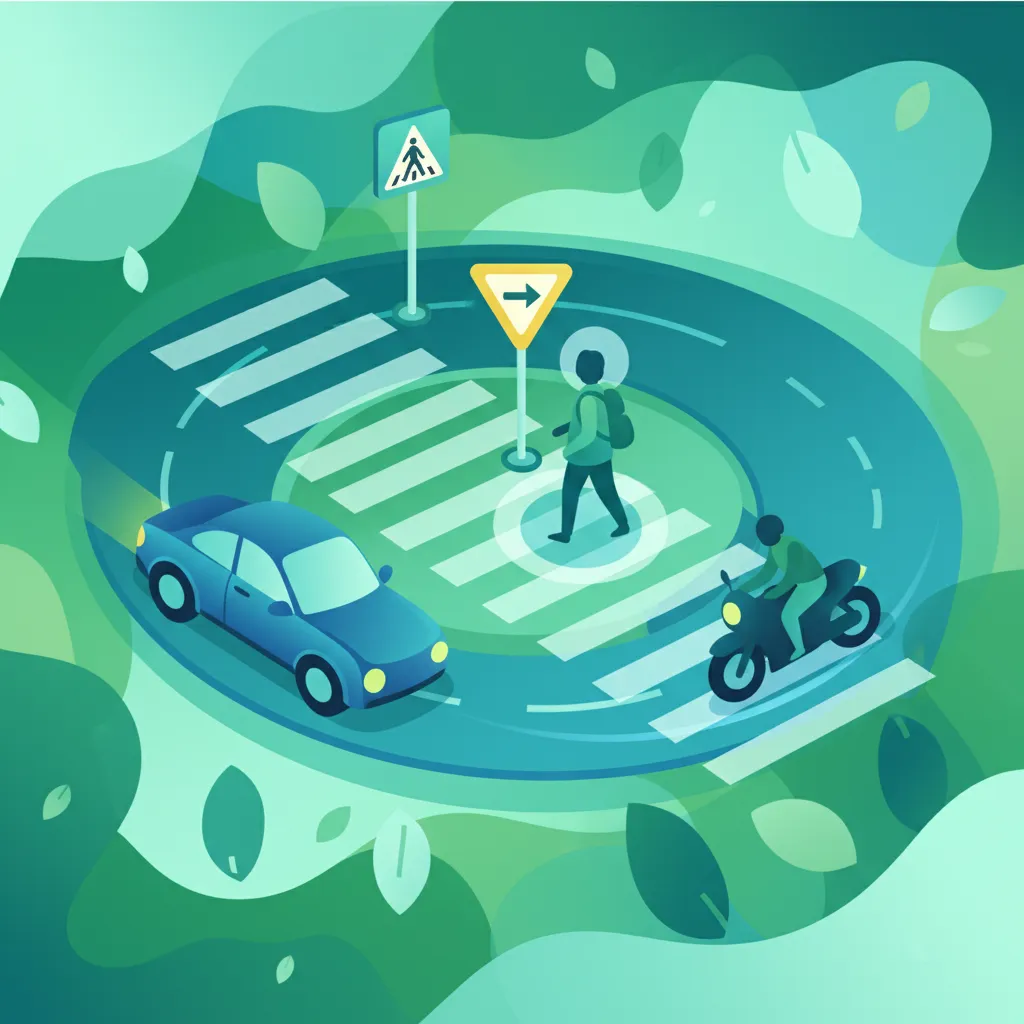
This lesson outlines the proper techniques for negotiating roundabouts and signal-controlled intersections in Spain. It explains priority rules at entry, lane selection based on the intended exit, and yielding to circulating traffic. The content also covers compliance with traffic signals and DGT regulations, including handling cyclist crossings.
Learn to avoid typical errors when driving in roundabouts, focusing on large vehicle dynamics, vulnerable road user interactions, and adapting to adverse conditions. Essential driving theory insights for the DGT exam.
This lesson addresses common errors made by drivers when using roundabouts and presents corrective strategies. It covers issues such as entering from the wrong lane, failing to yield to circulating traffic, exceeding the recommended speed, and not signaling an exit correctly. By understanding these mistakes, drivers can improve their roundabout proficiency and reduce accident risk.
This lesson provides specific instructions on how to safely navigate complex junctions such as roundabouts and intersections with a large vehicle. It explains the rules of priority, the correct lane to use based on the intended exit, and the importance of proper vehicle positioning to account for off-tracking. The content also covers clear signaling to communicate intentions to other road users for safe and efficient passage.
This lesson offers a comprehensive guide to navigating roundabouts in urban settings, explaining the correct protocols for entry, yielding, and circulation. Learners will be taught how to interpret lane markings and signage on multi-lane roundabouts and determine the correct vehicle positioning for safe entry and exit. The content emphasizes full compliance with Spanish city regulations that govern priority and right-of-way at these intersections.
This lesson examines the principles of maintaining a safe following distance, including the 'two-second rule' and its adjustments for speed and weather. It focuses on effective blind-spot management, teaching drivers how to use mirrors and head checks. The content integrates DGT guidelines on creating a safety buffer around the vehicle to allow time to react to unexpected events.
This lesson examines the structural components of a typical Spanish roundabout, describing the central island, entry and circulating lanes, and the placement of yield signs. It outlines how DGT standards dictate the geometric design and entry/exit points to ensure smooth traffic flow. Understanding these design elements enables drivers to anticipate vehicle movements and navigate safely.
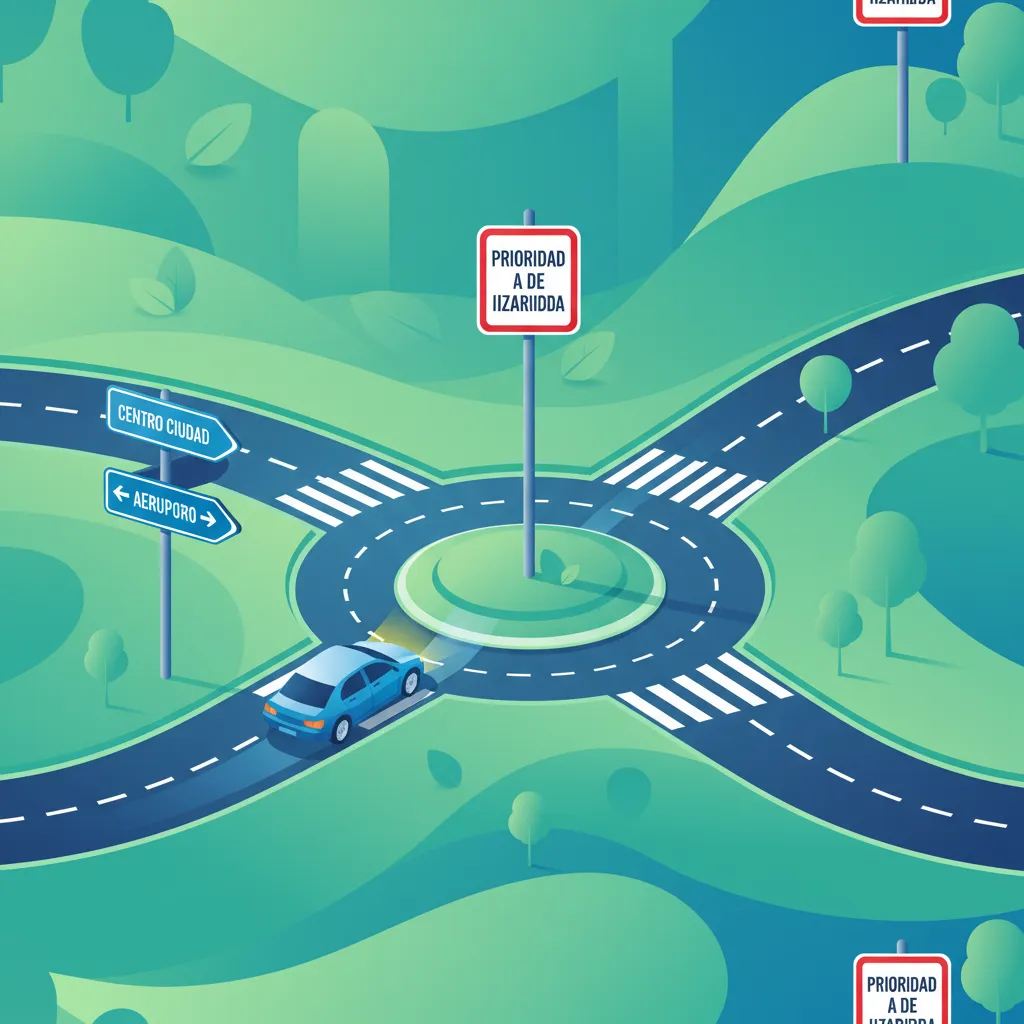
This lesson presents the variety of signs that guide drivers through roundabout navigation. It explains the significance of the roundabout warning symbol, priority signs, lane arrows, and directional signs placed before and within the roundabout. Mastery of roundabout signage ensures that drivers follow legal requirements and maintain safe traffic flow.
This lesson outlines the proper techniques for negotiating roundabouts and signal-controlled intersections in Spain. It explains priority rules at entry, lane selection based on the intended exit, and yielding to circulating traffic. The content also covers compliance with traffic signals and DGT regulations, including handling cyclist crossings.
This lesson clarifies the primary rule for roundabouts: all vehicles entering must yield to traffic already on the circular roadway. It explains how to approach a roundabout, select the appropriate lane based on the intended exit, and merge safely into the flow of traffic. Proper signaling before exiting is also covered, ensuring other drivers can anticipate the rider's movements for a smooth and safe negotiation of the junction.
This lesson focuses on the yielding hierarchy that governs roundabout usage in Spain. It clarifies that vehicles already circulating have priority over those entering and explains the proper lane positioning based on the intended exit. The content includes the correct use of signals for changing lanes and exiting, and safe merging techniques.
This lesson focuses on defensive maneuvers in mixed traffic environments where various vehicles share the road. It outlines lane discipline, appropriate overtaking safety measures, and strategies for maintaining a safety corridor. The content incorporates DGT defensive guidelines, teaching riders to manage space and anticipate unpredictable driver behavior.
Find clear answers to common questions learners have about Large Vehicle and Pedestrian Interactions at Roundabouts. Learn how the lesson is structured, which driving theory objectives it supports, and how it fits into the overall learning path of units and curriculum progression in Spain. These explanations help you understand key concepts, lesson flow, and exam focused study goals.
Large vehicles have a wider turning radius, meaning they need more space to manoeuvre through a roundabout, often encroaching into adjacent lanes or the pedestrian crossing area. Pedestrians and cyclists can be easily obscured by these larger vehicles, making it difficult for both the driver of the large vehicle and other road users to see them, which increases the risk of collisions.
In Spain, pedestrians always have priority, especially at designated crossings. When a large vehicle is turning or navigating a roundabout, drivers should be extra vigilant for pedestrians who might be attempting to cross, even if they are not immediately visible. The driver of the large vehicle must ensure they can complete their manoeuvre without endangering any pedestrians.
Large vehicles have significant blind spots, particularly to the front, rear, and sides. When approaching or navigating a roundabout, assume that the driver of a large vehicle may not see you if you are too close to their front or rear corners, or directly beside them. This is why maintaining a safe distance and anticipating their movements is crucial.
If a large vehicle is exiting, be patient and allow it to complete its manoeuvre. Observe carefully to ensure no pedestrians or cyclists are in its path or about to cross the exit lane. If there is any doubt about visibility or pedestrian presence, wait for the large vehicle to clear the area and ensure the path is safe before proceeding.
While there might not be signs exclusively for pedestrian interaction AT roundabouts themselves, standard pedestrian crossing signs (a blue square with a white figure walking) will be present approaching roundabout exits or entrances where pedestrians are expected. Drivers must always be aware of these signs and the general priority rules for pedestrians in Spain.
Use our powerful search functionality to pinpoint specific Spanish DGT driving theory practice sets. Filter by road sign categories, traffic law topics, or question difficulty to build custom study sessions and reinforce your knowledge precisely where it matters for your official exam.