
This lesson focuses on the unique challenges of driving a bus or coach through high-traffic tourist areas. You will learn to identify potential hazards posed by distracted pedestrians and erratic vehicle movements, ensuring you maintain a professional safety bubble at all times.
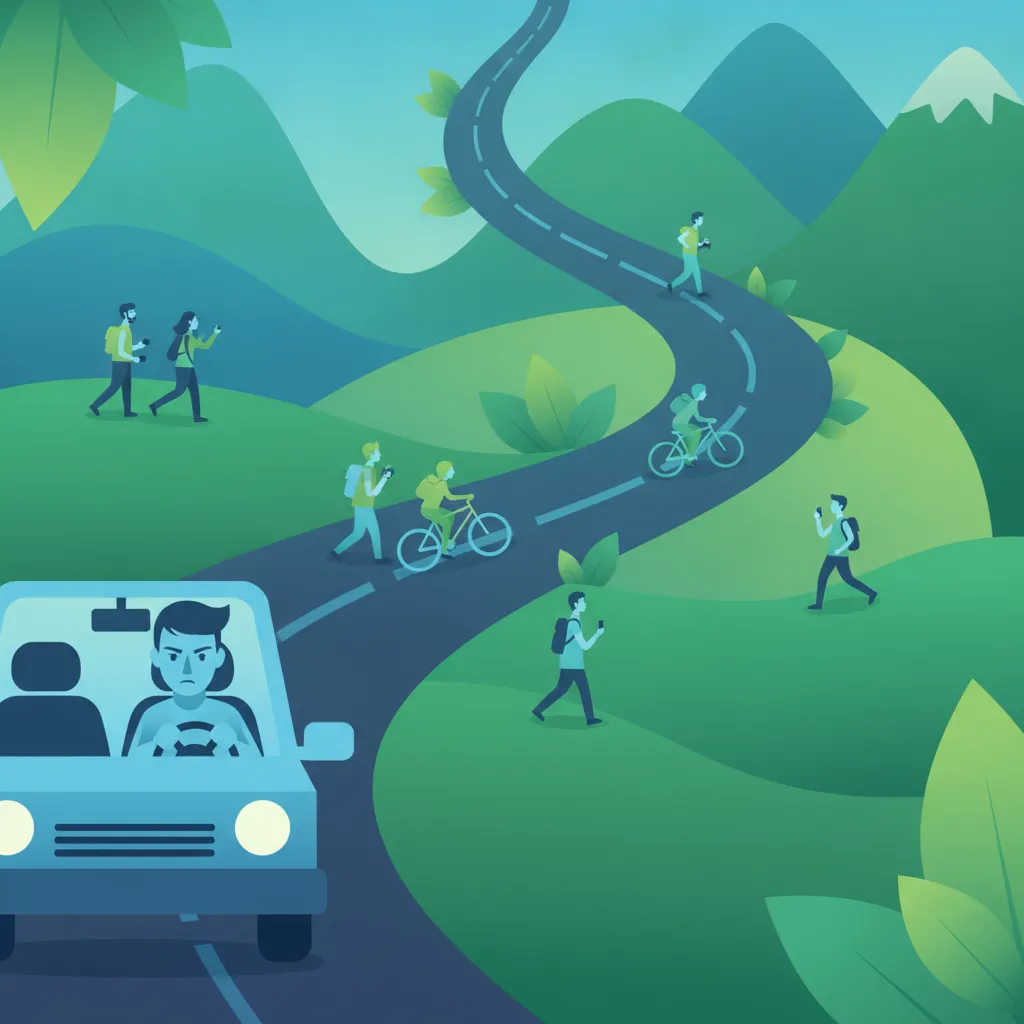
Lesson content overview
Operating a bus or coach in areas bustling with tourists presents a unique set of challenges that demand heightened awareness and specialized driving strategies. As a professional driver undertaking the Swiss Category D Driving License Theory Course (Bus & Coach), understanding these dynamics is crucial for ensuring the safety of your passengers, pedestrians, and other road users. This lesson will equip you with the knowledge and techniques to navigate such environments effectively, focusing on anticipation, spatial awareness, and clear communication.
Tourist-heavy areas, whether they are historic town centers, lakeside promenades, or popular viewpoints, often differ significantly from typical urban driving environments. Tourists are frequently unfamiliar with local traffic rules and customs, may be engrossed in sightseeing, or preoccupied with their groups, leading to unpredictable behavior. This can manifest as sudden crossings, lingering near the roadway, or inattentiveness to traffic signals and approaching vehicles.
The increased density of various road users—including other tour buses, private vehicles, rental bicycles, and pedestrians often burdened with luggage or camera gear—further complicates the driving task. These zones demand a shift in a driver's mindset from simply adhering to speed limits to actively managing a dynamic and often chaotic environment. Proper management of these distractions is paramount to preventing accidents, minimizing liability, and maintaining a professional standard of care.
To operate safely in areas with a high density of tourists, professional bus and coach drivers must adopt several core principles. These principles build upon fundamental driving skills, enhancing them to address the specific risks posed by tourist behavior and congestion.
A safety buffer, often referred to as a "safety bubble," is an expanded peripheral zone around your bus. This zone typically extends at least 2 meters laterally (to each side) and provides ample longitudinal space (front and back) where you consciously avoid encroachments and ensure a clear path. The primary purpose is to create extra reaction space for the sudden and often unpredictable actions of pedestrians and cyclists common in tourist areas. By maintaining this buffer, drivers significantly reduce the risk of collisions with moving or stationary objects and individuals.
Anticipatory scanning is the practice of continuously observing the entire driving environment, looking well ahead, to the sides, and behind the bus. This proactive approach aims to identify potential hazards before they become immediate threats. In tourist zones, this means actively looking for individuals who might step off curbs without warning, pause unexpectedly near the roadway, or wander into traffic while distracted by sights. Early detection allows for timely adjustments to speed and positioning.
Mode 2 Operation involves intentionally driving at a reduced speed, often significantly below the posted speed limit, especially when an area is congested with tourist activity. This reduced speed enhances your reaction time, making it possible to negotiate complex, pedestrian-rich environments safely. Coupled with increased vigilance, it ensures you can stop the bus within your visible stopping distance, even if an unexpected obstacle or pedestrian appears.
Dynamic risk assessment is the continuous evaluation of changing conditions that influence your driving decisions. Factors such as crowd density, time of day, weather conditions, and the specific layout of the road must be constantly assessed. This ongoing process supports situationally appropriate responses, ensuring that you adapt your speed, following distance, and observation frequency to the varying levels of risk present in a tourist zone.
Effective clear communication involves using both visual and auditory cues to inform pedestrians and other road users of your bus’s intentions. This includes activating indicators, stop signals, and hazard lights, as well as judicious use of warning bells or public address (PA) system announcements. Clear communication reduces ambiguity, helping to guide pedestrians who may be unfamiliar with local traffic customs and preventing misunderstandings that could lead to dangerous situations.
Maintaining an adequate safety buffer is perhaps one of the most critical defensive driving techniques in tourist-heavy zones. This concept moves beyond standard following distances to encompass a comprehensive protective zone around your entire vehicle.
A safety buffer is a designated zone that extends outwards from your bus, typically at least 2 meters laterally from the sides and several meters longitudinally from the front and rear. This expanded space is not static; it must be actively created and maintained by the driver through careful lane positioning and speed control.
The lateral buffer is the space maintained on either side of the bus. In tourist areas, this is vital to protect against pedestrians who might suddenly step off a curb, cyclists weaving close to the vehicle, or individuals lingering near parked cars. Swiss road traffic regulations, such as those related to maintaining appropriate distance from stationary objects (e.g., Art. 51 RVV) and pedestrians (Art. 15 RVV), underpin this principle. For a bus driver, this means consciously positioning the vehicle at least 2 meters from the curb, parked vehicles, or any other roadside obstacle. Failing to do so can lead to dangerous side collisions or injuries, especially with the wide mirrors and overhangs of a large coach.
The longitudinal buffer refers to the additional space maintained ahead of and behind the bus. This space is crucial for accommodating sudden stops, unexpected slowdowns, or evasive maneuvers. In tourist areas, where traffic flow can be highly unpredictable due to multiple tour vehicles stopping, starting, and disembarking passengers, an increased longitudinal buffer provides the necessary reaction time. This buffer should be adjusted based on speed, vehicle weight, road conditions, and the density of traffic.
A common misunderstanding is assuming that a safety buffer automatically exists or that merely driving slowly creates it. In reality, drivers must actively modify their lane positioning, adjust their speed, and constantly scan their environment to ensure this protective zone is present at all times. For example, if navigating a narrow street with tourists stopping intermittently, the driver must reduce speed significantly to maintain the 2-meter lateral distance from the curb and be prepared to stop if the buffer is compromised.
In unpredictable tourist environments, reactive driving is insufficient. Instead, bus drivers must engage in a continuous cycle of anticipatory scanning and dynamic risk assessment. These two concepts are intrinsically linked, forming the foundation of proactive hazard avoidance.
Anticipatory scanning involves a methodical and continuous observation of your entire driving environment. It's not just about looking straight ahead; it's about constantly checking your left and right peripheries (horizontal scan) for potential cross-traffic or pedestrians, and observing the road surface and potential obstacles further down the road (vertical scan). In tourist areas, this includes:
Swiss Art. 12 RVV (Verkehrsregelnverordnung – Road Traffic Regulations) implicitly supports this by obliging drivers to keep a safe distance and adapt speed to conditions, which naturally requires continuous observation. The misconception that scanning is only necessary at intersections is dangerous; in tourist zones, it's a constant requirement.
Dynamic risk assessment is the ongoing mental process of evaluating the level of risk based on evolving factors. It means constantly asking: "What is happening now, what might happen next, and what should I do about it?" This involves assessing:
For example, if you are driving through a market square where a sudden influx of tourists appears, your dynamic risk assessment should prompt you to increase your vigilance, reduce your speed further, and actively expand your safety bubble. Another example would be adjusting your driving style during bright sunshine if tourists are wearing sunglasses, as they might not see bright headlights as clearly; you might choose to use your headlights more deliberately, or increase your following distance. Swiss Art. 3 RVV requires drivers to adapt speed and behavior to the conditions of the road, directly supporting dynamic risk assessment.
By continuously scanning and assessing risk, you empower yourself to make proactive decisions, adjusting your speed, following distance, and observation frequency well in advance of potential hazards. This integrated approach ensures you maintain control and significantly reduce the likelihood of incidents in complex tourist environments.
In high-density tourist areas, simply adhering to the posted speed limit is often insufficient for safety. Professional bus drivers must adopt Mode 2 Operation, which entails operating the bus at a deliberately reduced speed, coupled with an enhanced level of vigilance. This approach maximizes reaction time and control in environments where sudden, unpredictable movements are common.
The average human reaction time is approximately 0.75 seconds. In that brief moment, even at a relatively low speed, a bus travels a significant distance before the driver can even begin to apply the brakes. In a tourist zone, where a pedestrian might step into the road without warning, this distance can be the difference between a safe stop and a collision.
Mode 2 Operation emphasizes that the driver should operate at a speed that allows them to stop the bus safely within the distance they can clearly see ahead. This is often significantly lower than the posted speed limit.
Swiss regulation (Art. 3 RVV) mandates that drivers adapt their speed to the prevailing road and traffic conditions. This legal framework explicitly permits, and indeed requires, reducing speed below the limit when conditions warrant it for safety. It's not about driving "illegally slow"; it's about driving safely and responsibly given the circumstances. For instance, a bus reducing its speed to 25 km/h while approaching a historic town square where tourists are known to frequently cross the street is demonstrating correct Mode 2 Operation. This allows the driver ample time to react to a sudden crossing, activate warning signals, or come to a complete stop if necessary, all while maintaining control and passenger comfort.
The key benefit of Mode 2 Operation is the significant increase in available reaction time. This buffer in time allows for smoother braking, less abrupt maneuvers, and a greater opportunity to avoid dangerous situations, safeguarding everyone in and around the bus.
Clear communication is a vital tool for bus drivers navigating tourist areas, where pedestrians may be distracted or unfamiliar with local traffic norms. Utilizing the bus's visual and auditory signals effectively can prevent misunderstandings and enhance safety.
The primary means of visual communication for a bus driver involves the careful use of vehicle lighting:
Auditory signals must be used judiciously in tourist areas to avoid startling pedestrians or creating confusion:
The goal of clear communication is to reduce ambiguity. Tourists, especially those not fluent in the local language, may rely heavily on visual cues. By using signals correctly and consistently, drivers help to create a predictable and safer environment for everyone.
Operating a Category D vehicle in Switzerland requires strict adherence to national road traffic regulations, especially when navigating sensitive tourist areas. These rules are designed to ensure safety and maintain traffic flow.
Drivers must always adapt their speed to the prevailing traffic, road, visibility, and weather conditions. In tourist-heavy areas, where pedestrian density is high and unpredictable behavior is common, this rule mandates reducing speed significantly below the posted limit to ensure sufficient reaction time. This is a mandatory and foundational principle for safety.
Hazard warning lights may only be used when the vehicle is stationary or moving extremely slowly to indicate a temporary obstruction or danger. In tourist zones, a bus driver may activate these lights when stopping to allow passengers to sightsee, board, or alight, particularly if the stop is informal or could temporarily obstruct traffic. It is crucial to deactivate them before resuming normal travel to avoid misleading other road users. This usage is mandatory when applicable for safety, but prohibited during normal movement.
Drivers are legally obligated to maintain a sufficient lateral distance from pedestrians, especially those standing near the curb. This is particularly relevant in tourist areas where individuals may linger or suddenly step into the road. A general guideline for buses is to maintain at least 2 meters lateral clearance from the curb and other stationary obstacles to prevent collisions. This is a mandatory safety requirement.
When a bus is pulling away from a designated bus stop, it generally has the right-of-way over traffic approaching from behind, provided it signals its intention clearly. However, in tourist areas, stops may be informal, and drivers must exercise extreme caution. They must ensure they do not obstruct the flow of traffic unnecessarily and must yield to other road users if pulling out from an undesignated or hazardous location. This rule is mandatory and requires careful judgment in tourist zones.
Drivers are permitted to use the vehicle's public address (PA) system to announce upcoming stops, safety instructions, or changes in direction. This is highly beneficial in tourist areas for passenger management and to provide ambient warnings. However, the use must not cause unnecessary disturbance or excessive noise. This is a permitted action with conditions attached.
At all marked pedestrian crossings (zebra crossings), buses, like all vehicles, must yield to pedestrians who are already on the crossing or clearly indicating their intention to cross. This rule is absolute and heightened in tourist zones where pedestrians may be distracted and less attentive to approaching traffic. This is a mandatory right-of-way rule for pedestrian safety.
Adhering to these specific Swiss regulations, combined with the core driving principles discussed, forms the legal and operational framework for safe bus and coach driving in tourist-heavy areas.
Even experienced bus drivers can encounter difficulties in tourist-heavy areas. Awareness of common violations and edge cases, along with their correct behaviors, is essential for professional operation.
Incorrect behavior: A driver maintains the posted speed limit (e.g., 50 km/h) despite a high density of tourists, groups of children, or a street market being active. Correct behavior: The driver reduces speed significantly, adopting Mode 2 Operation (e.g., 20-30 km/h), to ensure an ample safety margin and reaction time for sudden pedestrian movements. Consequence: Increased risk of collision, severe fines, and potential legal liability in case of an incident.
Incorrect behavior: The driver operates the bus too close to the curb, where tourists are lingering, photographing, or stepping in and out of shops. Correct behavior: The driver actively maintains at least a 2-meter lateral clearance from the curb, parked cars, and any roadside obstacles, even if it means adjusting lane position or pausing. Consequence: Risk of side collisions with pedestrians or property, injury to passengers due to abrupt braking or swerving, and potential damage to the bus.
Incorrect behavior: The bus pulls over suddenly at an informal viewpoint to allow passengers to sightsee, but the driver forgets to activate hazard lights. Correct behavior: The driver activates hazard warning lights immediately upon stopping and deactivates them only when resuming normal travel. If possible, a PA announcement should also be made. Consequence: High risk of rear-end collisions from following vehicles that may not anticipate a stopped bus, especially if visibility is poor.
Incorrect behavior: A driver uses a loud, prolonged horn blast to clear the road of a group of tourists blocking the path. Correct behavior: The driver uses auditory warnings sparingly, if at all, preferably with a soft tap of the horn or a calm announcement via the PA system. Patience and a willingness to wait are often the safest approaches. Consequence: Causing panic, leading to unpredictable movements from pedestrians, noise pollution fines, and negative perception of the bus service.
Incorrect behavior: A following vehicle attempts to overtake a tour bus that is stopped and disembarking passengers too closely or too quickly. Correct behavior: Other drivers must maintain a safe following distance, be prepared to stop, and avoid overtaking until the bus moves and it is safe to do so, especially when passengers are likely to be crossing. (This is a risk for the other drivers, but good bus drivers mitigate it by signaling clearly). Consequence: Danger of striking disembarking passengers or those crossing in front/behind the bus.
Incorrect behavior: A bus attempts to drive through a designated pedestrian-only zone or a shared space near a tourist site without giving absolute priority to pedestrians. Correct behavior: The driver must yield absolutely to pedestrians in such zones or use designated entry/exit points, driving at walking speed, if permitted to enter at all. Consequence: Fines, endangerment of pedestrians, and potential legal action.
Incorrect behavior: A driver neglects to increase vigilance in low-light tourist areas, missing pedestrians who are poorly lit or standing in shadows. Correct behavior: The driver uses appropriate headlights (dipped beam in traffic, full beam where safe and permitted), increases scanning frequency, and reduces speed further to compensate for reduced visibility. Consequence: Severely reduced reaction time, increased risk of striking pedestrians who are difficult to see, and serious accidents.
Safe driving in tourist areas is not a one-size-fits-all approach; it requires constant adaptation based on prevailing conditions. Professional bus drivers must dynamically adjust their strategies to variations in weather, lighting, road type, vehicle state, and the specific behavior of vulnerable road users.
By proactively adjusting to these diverse contextual factors, bus drivers can effectively mitigate risks and maintain a high standard of safety in all tourist-heavy environments.
The strategies outlined for driving in tourist-heavy areas are not arbitrary; they are based on fundamental principles of physics, human psychology, and road safety. Understanding the reasoning behind these practices reinforces their importance for professional bus drivers.
The average human reaction time is approximately 0.75 seconds. This is the delay between perceiving a hazard and initiating a response.
Tourists are often visually distracted by sightseeing, taking photos, or navigating with maps/phones. This means their situational awareness regarding traffic may be significantly reduced.
Road safety relies heavily on predictability. When drivers communicate their intentions clearly, other road users can anticipate actions and react safely.
By understanding these underlying principles, professional bus drivers can make more informed decisions, not just following rules, but truly embodying a proactive and safety-conscious approach in every tourist-heavy environment.
The skills and knowledge gained in managing distractions in tourist-heavy areas are deeply interconnected with other fundamental aspects of professional bus driving covered in the Swiss Category D Driving License Theory Course. This lesson reinforces and builds upon several previous topics, creating a holistic safety perspective.
By integrating the strategies learned here with knowledge from these interdependent lessons, a professional bus driver develops a comprehensive and adaptive skillset necessary for safe and responsible operation in all environments.
Understanding the theory is only half the battle; applying these principles in real-world scenarios is what defines a safe and professional bus driver. Here are a few practical examples.
Setting: A coach is driving along a popular promenade adjacent to a Swiss lake, where numerous tourists are strolling, stopping frequently to take photos, and occasionally stepping towards the roadway without looking. The speed limit is 50 km/h. Rule/Decision: The driver recognizes the high pedestrian density and potential for distraction. They activate Mode 2 Operation, reducing their speed to 25 km/h, and actively maintain a 2-meter lateral buffer from the edge of the promenade. When stopping to allow passengers to view the lake, they activate hazard warning lights and make a brief announcement via the PA system. Correct Behavior: The bus slows smoothly, maintaining its distance. Passengers disembark safely onto a designated viewing area. The driver continuously scans for pedestrians who might cross between the bus and the lake pathway, and remains stationary with hazard lights on until safe to proceed. Incorrect Behavior: The driver maintains the speed limit of 50 km/h, assumes pedestrians will stay on the promenade, and halts abruptly without hazard lights when a passenger requests an unscheduled stop. Passengers alight directly onto the busy lakeside walkway, causing other pedestrians to dodge and potentially stumble.
Setting: The bus approaches a narrow, winding historic street that opens into a bustling town square. Tourists are clustered in groups, some crossing the street haphazardly from different directions, while others are browsing market stalls that spill close to the roadway. Rule/Decision: The driver employs intense anticipatory scanning, observing groups of tourists, looking for gaps in their movements. They initiate Mode 2 Operation by slowing to walking pace (around 10-15 km/h) well before entering the square, and prepare to stop completely. Dynamic risk assessment leads them to prioritize pedestrian flow. Correct Behavior: The bus yields completely, waiting patiently for a large group to clear the crossing or path. The driver maintains eye contact with pedestrians where possible and uses minimal, gentle horn taps if absolutely necessary to alert an inattentive individual, then proceeds very cautiously at a slow speed once the path is clear. Incorrect Behavior: The driver assumes right-of-way, accelerates into the square, uses a loud horn blast to try and clear the path, startling a tourist who then steps backward into the bus's path, leading to an emergency stop or a collision.
Setting: The bus is descending a narrow mountain road near a popular hiking trail junction at dusk. There are no streetlights, and visibility is poor, though the speed limit is 60 km/h. Tourists may be walking on the road shoulder after their hike. Rule/Decision: The driver uses dipped beam headlights, increasing observation frequency to every 1-2 seconds. They significantly reduce speed (e.g., to 40 km/h) and enlarge their longitudinal buffer to account for reduced visibility and increased braking distance on a downhill slope. Dynamic risk assessment considers the potential for unlit hikers. Correct Behavior: The driver spots a hiker emerging from a trail entrance ahead, partially obscured by shadows. Due to the reduced speed and increased scanning, they have ample time to slow down further and safely allow the hiker to cross, using the dipped beams to illuminate the area without blinding the pedestrian or oncoming traffic. Incorrect Behavior: The driver relies solely on high beams, fails to reduce speed significantly, and does not increase scanning frequency. The glare from the high beams makes it difficult for the hiker to see, and the driver notices the hiker too late, resulting in a sudden, potentially dangerous, swerve or emergency braking.
To ensure safety and professionalism when operating a bus or coach in Swiss tourist-heavy areas, remember these critical takeaways:
By consistently applying these principles, you will enhance your ability to navigate complex tourist environments safely, ensuring the well-being of your passengers and all other road users.
This lesson teaches Swiss Category D bus drivers to navigate tourist-heavy areas safely by establishing a safety buffer (typically 2 meters laterally), adopting Mode 2 Operation with reduced speeds of 20-30 km/h, and maintaining continuous anticipatory scanning. Key Swiss regulations (Art. 3, 15, 38 RVV) underpin the legal requirement to adapt speed to conditions, maintain lateral distance from pedestrians, and use hazard lights appropriately when stopped. Dynamic risk assessment helps drivers evaluate crowd density, weather, lighting, and road type to make proactive adjustments. Clear communication through hazard lights, signals, and PA announcements reduces ambiguity for distracted tourists, while understanding the 0.75-second reaction time explains why speed reduction is critical for safety.
A short set of high-value points that capture the most important learning from this lesson.
Maintain at least a 2-meter lateral safety buffer and appropriate longitudinal clearance around the bus to react to unpredictable tourist movements
Mode 2 Operation requires reducing speed to 20-30 km/h in dense tourist zones while increasing observation frequency to every 2 seconds
Anticipatory scanning must be continuous, covering all directions, not just ahead, to spot distracted pedestrians before they step into the road
Hazard warning lights must be activated when stopped or moving very slowly, and deactivated before resuming normal travel
Dynamic risk assessment means constantly evaluating crowd density, weather, lighting, and road geometry to adapt your driving proactively
Explore all units and lessons included in this driving theory course.
Swiss Art. 3 RVV mandates speed adaptation to conditions, permitting speeds below the posted limit when safety requires it
Swiss Art. 15 RVV requires sufficient lateral distance from pedestrians, with 2 meters being the recommended minimum for buses
Hazard lights (Art. 38 RVV) are permitted only when stationary or moving extremely slowly, not during normal travel
The PA system (Art. 46 RVV) may be used for passenger instructions but must not cause unnecessary disturbance
Average human reaction time is approximately 0.75 seconds, which is why reduced speed dramatically increases available response time
Maintaining posted speed limits (e.g., 50 km/h) despite high pedestrian density, instead of adopting Mode 2 Operation
Operating too close to the curb with insufficient lateral buffer, risking collisions with pedestrians stepping off sidewalks
Forgetting to activate hazard warning lights when stopping for informal tourist viewpoint stops
Using loud prolonged horn blasts to clear pedestrians, which can cause panic and unpredictable movements
Failing to increase scanning frequency and reduce speed further during reduced visibility conditions like dusk, fog, or night
Lesson content overview
A short set of high-value points that capture the most important learning from this lesson.
Maintain at least a 2-meter lateral safety buffer and appropriate longitudinal clearance around the bus to react to unpredictable tourist movements
Mode 2 Operation requires reducing speed to 20-30 km/h in dense tourist zones while increasing observation frequency to every 2 seconds
Anticipatory scanning must be continuous, covering all directions, not just ahead, to spot distracted pedestrians before they step into the road
Hazard warning lights must be activated when stopped or moving very slowly, and deactivated before resuming normal travel
Dynamic risk assessment means constantly evaluating crowd density, weather, lighting, and road geometry to adapt your driving proactively
Explore all units and lessons included in this driving theory course.
Swiss Art. 3 RVV mandates speed adaptation to conditions, permitting speeds below the posted limit when safety requires it
Swiss Art. 15 RVV requires sufficient lateral distance from pedestrians, with 2 meters being the recommended minimum for buses
Hazard lights (Art. 38 RVV) are permitted only when stationary or moving extremely slowly, not during normal travel
The PA system (Art. 46 RVV) may be used for passenger instructions but must not cause unnecessary disturbance
Average human reaction time is approximately 0.75 seconds, which is why reduced speed dramatically increases available response time
Maintaining posted speed limits (e.g., 50 km/h) despite high pedestrian density, instead of adopting Mode 2 Operation
Operating too close to the curb with insufficient lateral buffer, risking collisions with pedestrians stepping off sidewalks
Forgetting to activate hazard warning lights when stopping for informal tourist viewpoint stops
Using loud prolonged horn blasts to clear pedestrians, which can cause panic and unpredictable movements
Failing to increase scanning frequency and reduce speed further during reduced visibility conditions like dusk, fog, or night
Explore search topics learners often look for when studying Managing Distractions in Tourist-Heavy Areas. These topics reflect common questions about road rules, driving situations, safety guidance, and lesson level theory preparation for learners in Switzerland.
Browse additional driving theory lessons that cover connected traffic rules, road signs, and common driving situations related to this topic. Improve your understanding of how different rules interact across everyday traffic scenarios.
Learn essential strategies for identifying and safeguarding pedestrians, cyclists, and other vulnerable road users in high-density tourist areas across Switzerland. Understand specific hazards and how to anticipate unpredictable behavior to ensure passenger and public safety.
Pedestrians, cyclists, motorcyclists, and e-scooter riders are extremely vulnerable in any interaction with a heavy vehicle. This lesson instills a defensive mindset, teaching drivers to be hyper-aware of VRUs, especially near junctions, crossings, and cycle lanes. It focuses on anticipation and giving VRUs extra space, as they can be unpredictable and are often hidden in blind spots.

This lesson focuses on general driving safety in areas with a high concentration of children. It stresses the importance of significantly reducing speed, being prepared for unexpected events, and scanning for children between parked cars. The driver must exhibit maximum vigilance in these high-risk environments at all times.

This lesson trains drivers to look beyond other vehicles and actively search for pedestrians, cyclists, and motorcyclists, especially those who may be distracted or unaware. It covers common behavioral patterns of different VRU groups. The goal is to see potential hazards developing early and create time and space to react safely.
This lesson explores the specific considerations for cyclists and pedestrians, who are among the most vulnerable road users. It covers the proper use of bicycle lanes, the minimum safe overtaking distance for cyclists, and the legal requirements for yielding at pedestrian crossings. The content reinforces the need for heightened vigilance around these users.
This lesson focuses on strategies for safely interacting with non-standard traffic common on rural roads. It covers how to anticipate the behaviour of slow-moving farm equipment and tourist vehicles, and the legal requirement to yield to emergency services. The importance of patience and safe passing opportunities is stressed.

This lesson delineates the various categories of road users on Swiss roads, highlighting their specific rights and responsibilities. It explains the legal hierarchy that determines priority at intersections and in shared spaces. The content also discusses the unique considerations for vulnerable users, such as children, emphasizing the need for heightened caution.

This lesson explores pedestrian right-of-way at various crossings, including zebra crossings and pedestrian islands. It emphasizes the need for drivers to reduce speed, anticipate pedestrian movement, and stop safely when required. The content also covers special regulations that apply in school zones, such as reduced speed limits and heightened vigilance.
This lesson covers the immediate actions to take following a collision. The priorities are to prevent further incidents by securing the scene, to assess the situation for injuries, and to alert the emergency services. You will learn the correct procedures for making the area safe for yourself, your passengers, and other road users.

This lesson explores the complexities of riding in busy urban areas with a mix of traffic types. It covers strategies for safely navigating alongside buses, trams, cyclists, and pedestrians. Key topics include respecting designated lanes, anticipating the movements of vulnerable road users, and maintaining heightened situational awareness.
Sharing road space with trams presents unique challenges, including different priority rules and physical hazards like tracks. This lesson covers the Swiss regulations regarding tram priority at junctions and stops. It also provides practical advice on crossing tram tracks safely and maintaining awareness of tram movements.
Discover how to adjust your driving techniques based on specific conditions like weather, lighting, road types, and vehicle load when operating in Swiss tourist areas. This lesson focuses on dynamic risk assessment and contextual driving for professional bus drivers.
This lesson focuses on general driving safety in areas with a high concentration of children. It stresses the importance of significantly reducing speed, being prepared for unexpected events, and scanning for children between parked cars. The driver must exhibit maximum vigilance in these high-risk environments at all times.
Weather has a profound impact on vehicle handling and visibility. This lesson teaches you how to reduce speed, increase following distances, and use controls smoothly to maintain traction in poor conditions. It also covers the legal requirements and practical application of snow chains in winter.

Driving a large vehicle on mountain passes is a demanding skill. This lesson covers selecting the correct gear for both ascents and descents to maintain control and avoid overheating the brakes. It also explains the specific priority rules that apply on mountain roads and the importance of being aware of sudden weather changes.
This lesson introduces defensive driving principles, focusing on hazard anticipation, continuous scanning, and proactive positioning. You will learn how to anticipate potential hazards by observing traffic patterns and maintaining situational awareness. Emphasis is placed on proactive speed management to avoid dangerous situations before they arise.

This lesson focuses on driving on mountain roads, addressing steep gradients, hairpin bends, and altitude-related challenges. You will learn proper techniques for climbing ascents and using engine braking on descents. The content also covers the use of snow chains, recognizing avalanche risks, and interpreting mountain road signs for safe alpine navigation.

Driving in the Alps requires a high level of skill and vehicle sympathy. This lesson covers techniques for climbing steep gradients by selecting the correct gear to maintain momentum without straining the engine. It reiterates the critical importance of using low gears and auxiliary brakes for descending, to ensure the service brakes remain cool and effective for the entire descent.

Rural driving requires a different mindset from urban driving. This lesson covers how to position your vehicle on narrow roads, how to use passing places effectively, and how to anticipate hazards like slow-moving farm machinery, animals, and concealed junctions. Managing vehicle width and height is a key focus.

This lesson examines the impact of various weather conditions on driving safety. It explains how to adjust speed in low visibility and the risks of aquaplaning in heavy rain. The content also covers using snow chains in snowy conditions, handling icy surfaces, and dealing with strong winds, particularly on bridges and open roads.

This lesson examines the impact of weather and visibility on driving safety and speed selection. It covers how fog, rain, snow, and darkness affect visibility and reaction times, providing guidelines on adjusting speed. It also includes strategies for improving visibility, such as proper headlamp use, to ensure you can adapt to varying weather conditions.
Motorway driving involves high speeds and requires constant concentration. This lesson covers correct lane discipline, safe procedures for joining and leaving the motorway, and techniques for overtaking other large vehicles. Maintaining appropriate speed and a safe following distance is emphasized throughout.
Find clear answers to common questions learners have about Managing Distractions in Tourist-Heavy Areas. Learn how the lesson is structured, which driving theory objectives it supports, and how it fits into the overall learning path of units and curriculum progression in Switzerland. These explanations help you understand key concepts, lesson flow, and exam focused study goals.
Category D drivers are responsible for the safety of many passengers and must navigate larger vehicles with limited visibility. The combination of dense tourist foot traffic and the physical constraints of a coach requires constant vigilance to prevent accidents.
Always assume that tourists may be distracted by sightseeing or unfamiliar with Swiss road signs. Maintain a lower speed when approaching tourist hubs, keep your mirrors clear, and be prepared to yield, even if you have the right of way, to prevent a collision.
The theory exam often presents hazard perception scenarios where multiple risks exist. This lesson teaches you to scan effectively, prioritize hazards, and choose the safest response, which is a core requirement for passing the Category D theory sections.
Yes. In tourist-heavy areas, traffic is often erratic, with frequent stopping and unexpected lane changes. Maintaining a larger safety bubble gives you the necessary time and space to react to sudden hazards without needing to perform harsh braking that could endanger your passengers.
Pinpoint specific Swiss traffic rules, road signs, or driving situations you need to master. Use the practice search to start a focused revision session now and build confidence for your official driving theory exam.