
This lesson, part of our 'Roundabouts & Priority Rules' unit for the Spanish DGT B & BE license, addresses common errors drivers make when navigating roundabouts. You'll learn to identify typical mistakes such as incorrect lane entry, failing to yield, and improper signaling. By understanding these pitfalls and applying corrective strategies, you will significantly improve your roundabout proficiency, reduce accident risk, and gain confidence for both your theory exam and practical driving.
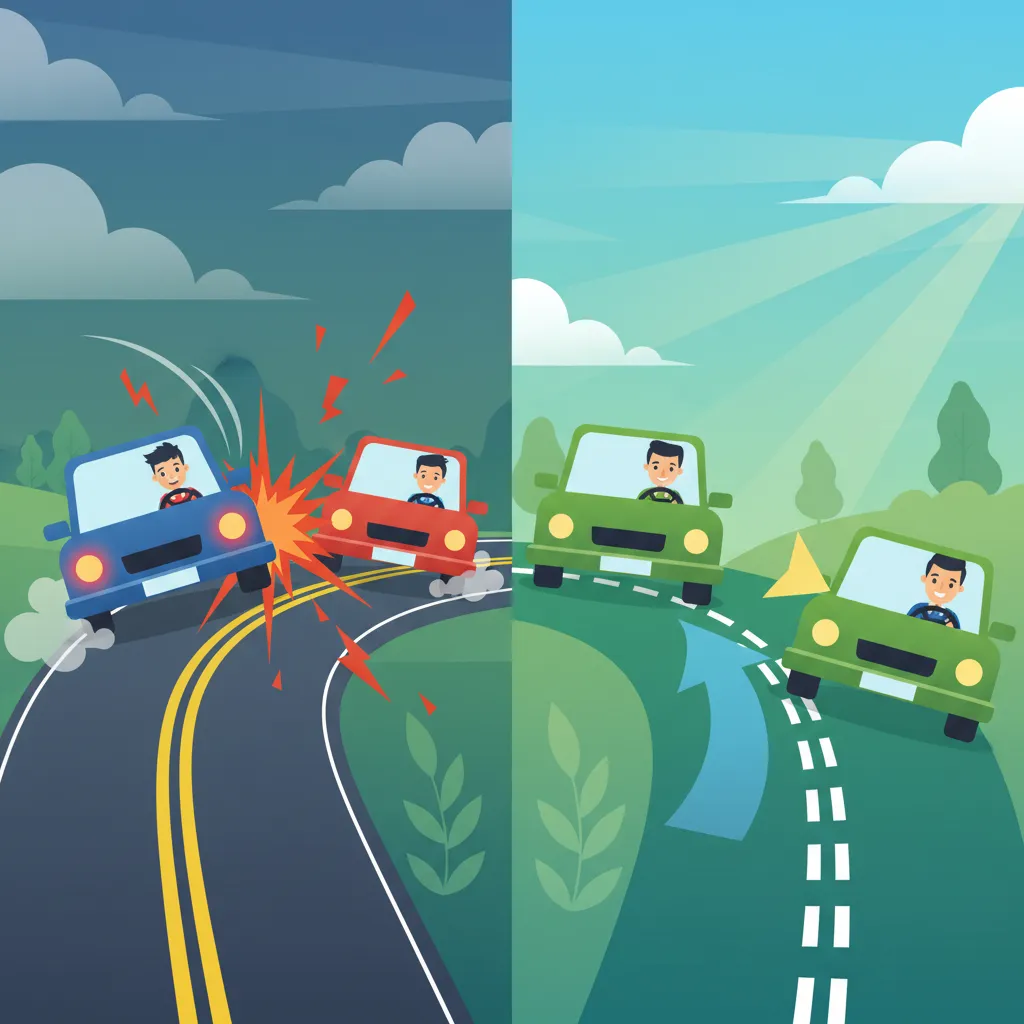
Lesson content overview
Roundabouts, known as rotondas in Spain, are a fundamental part of the Spanish road network, designed to improve traffic flow and reduce conflict points compared to traditional intersections. While efficient, they present unique challenges for drivers, often leading to common mistakes that can cause collisions or traffic disruptions. This lesson, part of your Complete Spanish Driving License Theory Course for Categories B & BE (DGT), delves into these frequent errors and provides clear, actionable corrective strategies to help you navigate roundabouts safely and confidently.
Understanding the correct procedures for entering, circulating, and exiting a roundabout is not merely about convenience; it is a critical skill for road safety and compliance with DGT (Dirección General de Tráfico) regulations. By mastering these strategies, you will not only enhance your driving proficiency but also contribute to smoother traffic flow and reduce the risk of accidents, which are unfortunately common at these junctions.
Effective roundabout navigation hinges on adherence to several core principles, each reinforced by specific DGT regulations. These principles ensure predictability and safety for all road users.
The paramount rule at any Spanish roundabout is to yield to circulating traffic. Vehicles already within the roundabout, moving around the central island, always have priority over vehicles intending to enter. This principle is enshrined in DGT Article 84, which mandates that drivers entering a roundabout must give way to traffic already inside. This rule is designed to prevent collisions at the entry points and maintain a continuous flow of traffic within the circular roadway.
Drivers must approach the entry line – typically a solid white line – with caution, prepared to stop if necessary. Only when a safe and sufficient gap appears in the circulating traffic should you proceed. Misjudging the speed of circulating vehicles or assuming priority can lead to dangerous situations.
Lane discipline is crucial for predictable movement through multi-lane roundabouts. DGT Article 105 specifies that drivers must select the correct approach lane based on their intended exit. This means that your lane choice before entering the roundabout should ideally correspond to the exit you plan to take. Generally, the outermost lane is for the first or second exit, while inner lanes are for later exits (third, fourth, or to continue straight if the roundabout has more than two exits).
Once inside the roundabout, it is prohibited to change lanes unless absolutely necessary and safe to do so. Maintaining your lane through the roundabout ensures a predictable path for other drivers, significantly reducing the risk of side-swipe collisions.
Appropriate speed control is vital for safely navigating the curved path of a roundabout. DGT Article 93 generally establishes a maximum speed limit of 50 km/h within urban roundabouts, unless specific signage indicates a different limit. However, this is a maximum, not a target. Drivers must adjust their speed based on the roundabout's size, traffic density, prevailing weather conditions, and the type of vehicle they are driving.
Reducing your speed before entering allows more time to assess circulating traffic, identify your exit, and react to unforeseen circumstances. Maintaining a controlled speed throughout the roundabout prevents the vehicle from being destabilised by centrifugal force and ensures you have enough reaction time if other drivers make mistakes.
Clear communication of your intentions is a cornerstone of safe driving, and signaling correctly at roundabouts is no exception. DGT Article 66 requires drivers to use their turn signals whenever changing direction or lane, which explicitly includes exiting a roundabout. The right-turn signal must be activated well before reaching your intended exit, specifically before you move into the exit lane.
Failing to signal, or signaling too late, can lead to confusion, causing other drivers to misjudge your intentions and increasing the risk of rear-end or side collisions, especially with vulnerable road users like cyclists.
Two further crucial rules govern conduct within the roundabout:
Despite their intended simplicity, roundabouts are sites of frequent errors. Recognizing these mistakes and applying corrective strategies is essential for passing your Spanish driving test and for safe driving beyond.
This is one of the most common and dangerous errors, often stemming from misreading road markings or failing to plan ahead.
Definition: Entering a multi-lane roundabout from a lane that does not align with your intended exit (e.g., using an inner lane when you plan to take the first exit, or an outer lane when you need to go around to the third exit). Practical Meaning: If you choose the wrong entry lane, you will be forced to make a sudden and often unsafe lane change inside the roundabout to reach your desired exit. This unpredictable maneuver can easily lead to sideswipe collisions with other vehicles that are correctly maintaining their lanes. Associated Rule: DGT Article 105 emphasizes the importance of selecting the correct lane. Example: A driver approaches a three-lane roundabout wanting to take the first exit. Instead of staying in the rightmost lane, they mistakenly enter from the middle or even leftmost lane. Once inside, they realize their error and attempt to cross two lanes to exit, cutting off other drivers.
This mistake directly violates the fundamental right-of-way rule at roundabouts and is a leading cause of collisions.
Definition: Entering the roundabout without giving way to vehicles that are already circulating within it. This can range from a complete failure to stop to entering when the gap in traffic is insufficient. Practical Meaning: When a driver fails to yield, they force circulating traffic to brake suddenly or swerve to avoid a collision. This creates a high-risk situation, often resulting in side-impact or rear-end collisions. Associated Rule: DGT Article 84 explicitly states that drivers entering a roundabout must give way to those already inside. Example: A driver approaches a roundabout and sees a circulating car. Believing they have enough time, or simply ignoring the priority rule, they accelerate into the roundabout, causing the circulating car to brake sharply or swerve to avoid impact. Even if there's a green light at a signalized roundabout entry, you must still yield to circulating traffic unless specific signs indicate otherwise.
Speeding in a roundabout significantly increases the risk of losing control and reduces reaction time.
Definition: Driving faster than the recommended 50 km/h (or the posted limit) inside the roundabout, or failing to adjust speed for conditions. Practical Meaning: Higher speeds increase the vehicle's centrifugal force, making it harder to maintain the circular path and increasing the risk of skidding or veering out of your lane. It also drastically reduces your reaction time and increases stopping distance, making collisions more severe. Associated Rule: DGT Article 93 sets the general speed limits, including the 50 km/h urban limit applicable to most roundabouts. Example: A driver approaches a roundabout at 70 km/h on a wet road and attempts to maintain this speed through the curve. The vehicle loses traction, slides, and potentially collides with the central island or another vehicle.
A lack of clear signaling creates uncertainty and can lead to dangerous misunderstandings between drivers.
Definition: Failing to activate the right-turn signal before exiting the roundabout, signaling too late (e.g., only once already in the exit lane), or using an incorrect signal (e.g., signaling left). Practical Meaning: When you don't signal your exit, drivers waiting to enter the roundabout cannot anticipate your departure and may hesitate unnecessarily or, worse, enter when it's unsafe, causing a conflict. Cyclists or motorcyclists in adjacent lanes may also misinterpret your intentions, leading to collisions. Associated Rule: DGT Article 66 clearly mandates the use of turn signals when changing direction or lanes, which includes exiting roundabouts. Example: A driver intends to take the second exit but does not signal. A cyclist in the outer lane, expecting the car to continue circulating, rides alongside, and when the car suddenly exits, they are forced to brake abruptly or swerve to avoid a collision.
Stopping without cause within the circular flow is disruptive and dangerous.
Definition: Bringing the vehicle to a halt within the circulating roadway of a roundabout due to indecision, over-cautiousness, or misunderstanding of priority rules. Practical Meaning: Stopping unnecessarily creates a sudden obstruction to vehicles behind you, increasing the risk of rear-end collisions. It also disrupts the smooth flow of traffic, which is the primary design purpose of a roundabout. Associated Rule: DGT Article 99 prohibits stopping within a roundabout unless it is due to an emergency or traffic conditions that force you to stop (e.g., heavy congestion that brings traffic to a standstill). Example: A driver enters a roundabout, becomes unsure of their exit, and stops abruptly in the middle of a lane. This forces the driver behind them to brake hard, potentially causing a chain reaction.
The correct use of roundabouts is explicitly detailed within the Reglamento General de Circulación (General Traffic Regulations). Adherence to these articles is mandatory for all drivers.
Safe roundabout navigation is not static; it requires dynamic adjustments based on various external factors.
Adverse weather significantly impacts vehicle control and visibility.
Nighttime driving reduces visual cues, making lane markings and other vehicles harder to perceive.
The type of vehicle you drive and the presence of other road users demand specific considerations.
Let's illustrate these concepts with real-world scenarios that drivers might encounter.
Mastering roundabout navigation is a hallmark of a proficient and safe driver in Spain. By understanding and actively correcting common mistakes, you contribute significantly to road safety, reduce traffic congestion, and ensure compliance with DGT regulations. Always remember the fundamental principles: yield to circulating traffic, choose your lane wisely, control your speed, signal your exits clearly, and avoid stopping or overtaking inside the roundabout.
These corrective strategies are not merely academic; they are practical tools for real-world driving. Consistent application of these techniques will build your confidence and ensure smooth, safe journeys through any Spanish roundabout. Practice makes perfect, and with each successful roundabout maneuver, you reinforce the habits of a responsible driver, ready for your Spanish driving license exam and beyond.
This lesson addresses the five most common mistakes drivers make at Spanish roundabouts: incorrect lane selection, failing to yield to circulating traffic, excessive speed, improper signaling, and unnecessary stopping. Each mistake is analyzed with its practical dangers, associated DGT article, and clear corrective strategies. The lesson also covers conditional adjustments for weather, night driving, and heavy vehicles (B+E), plus practical scenarios demonstrating both correct and incorrect behavior. Mastering these corrective strategies will help you pass your DGT B & BE theory exam and navigate Spanish roundabouts safely.
A short set of high-value points that capture the most important learning from this lesson.
Always yield to circulating traffic already inside the roundabout before entering (DGT Art. 84) - this is the cornerstone priority rule.
Match your approach lane to your intended exit: outermost lane for first/second exit, inner lanes for later exits (DGT Art. 105).
Activate your right-turn signal as you pass the exit immediately before your intended exit to warn other road users.
Urban roundabouts have a maximum speed limit of 50 km/h, but you must reduce speed further for adverse weather, vehicle type, or poor visibility (DGT Art. 93).
Never change lanes inside the roundabout and never stop or overtake within the circular roadway (DGT Arts. 99, 105).
Explore all units and lessons included in this driving theory course.
If you miss your exit, continue around the roundabout rather than making a dangerous lane change or stopping.
Do not signal right upon entry unless taking the first exit - signaling early can confuse drivers waiting to enter.
In wet or slippery conditions, reduce speed significantly below the 50 km/h limit to maintain vehicle control through curves.
Heavy vehicles (B+E) have wider turning radii and longer braking distances - they need more space and should use the outer lane earlier.
Cyclists often share the outer lane; always check for them before exiting and give them ample space.
Entering from the wrong lane and then attempting last-minute lane changes inside the roundabout, causing side-swipe collisions.
Failing to yield properly by misjudging gaps in circulating traffic or making a rolling stop at the entry line.
Exceeding the recommended speed for conditions, leading to loss of vehicle control or insufficient reaction time.
Not signaling the exit or signaling too late, confusing cyclists and drivers waiting to enter the roundabout.
Stopping unnecessarily inside the roundabout due to indecision, which disrupts traffic flow and risks rear-end collisions.
Lesson content overview
A short set of high-value points that capture the most important learning from this lesson.
Always yield to circulating traffic already inside the roundabout before entering (DGT Art. 84) - this is the cornerstone priority rule.
Match your approach lane to your intended exit: outermost lane for first/second exit, inner lanes for later exits (DGT Art. 105).
Activate your right-turn signal as you pass the exit immediately before your intended exit to warn other road users.
Urban roundabouts have a maximum speed limit of 50 km/h, but you must reduce speed further for adverse weather, vehicle type, or poor visibility (DGT Art. 93).
Never change lanes inside the roundabout and never stop or overtake within the circular roadway (DGT Arts. 99, 105).
Explore all units and lessons included in this driving theory course.
If you miss your exit, continue around the roundabout rather than making a dangerous lane change or stopping.
Do not signal right upon entry unless taking the first exit - signaling early can confuse drivers waiting to enter.
In wet or slippery conditions, reduce speed significantly below the 50 km/h limit to maintain vehicle control through curves.
Heavy vehicles (B+E) have wider turning radii and longer braking distances - they need more space and should use the outer lane earlier.
Cyclists often share the outer lane; always check for them before exiting and give them ample space.
Entering from the wrong lane and then attempting last-minute lane changes inside the roundabout, causing side-swipe collisions.
Failing to yield properly by misjudging gaps in circulating traffic or making a rolling stop at the entry line.
Exceeding the recommended speed for conditions, leading to loss of vehicle control or insufficient reaction time.
Not signaling the exit or signaling too late, confusing cyclists and drivers waiting to enter the roundabout.
Stopping unnecessarily inside the roundabout due to indecision, which disrupts traffic flow and risks rear-end collisions.
Explore search topics learners often look for when studying Common Mistakes and Corrective Strategies. These topics reflect common questions about road rules, driving situations, safety guidance, and lesson level theory preparation for learners in Spain.
Browse additional driving theory lessons that cover connected traffic rules, road signs, and common driving situations related to this topic. Improve your understanding of how different rules interact across everyday traffic scenarios.
Understand the essential DGT articles 84 and 105 governing priority and lane discipline on Spanish roundabouts. Learn correct entry, circulation, and exit procedures to avoid common errors and ensure safe navigation.
This lesson focuses on the yielding hierarchy that governs roundabout usage in Spain. It clarifies that vehicles already circulating have priority over those entering and explains the proper lane positioning based on the intended exit. The content includes the correct use of signals for changing lanes and exiting, and safe merging techniques.
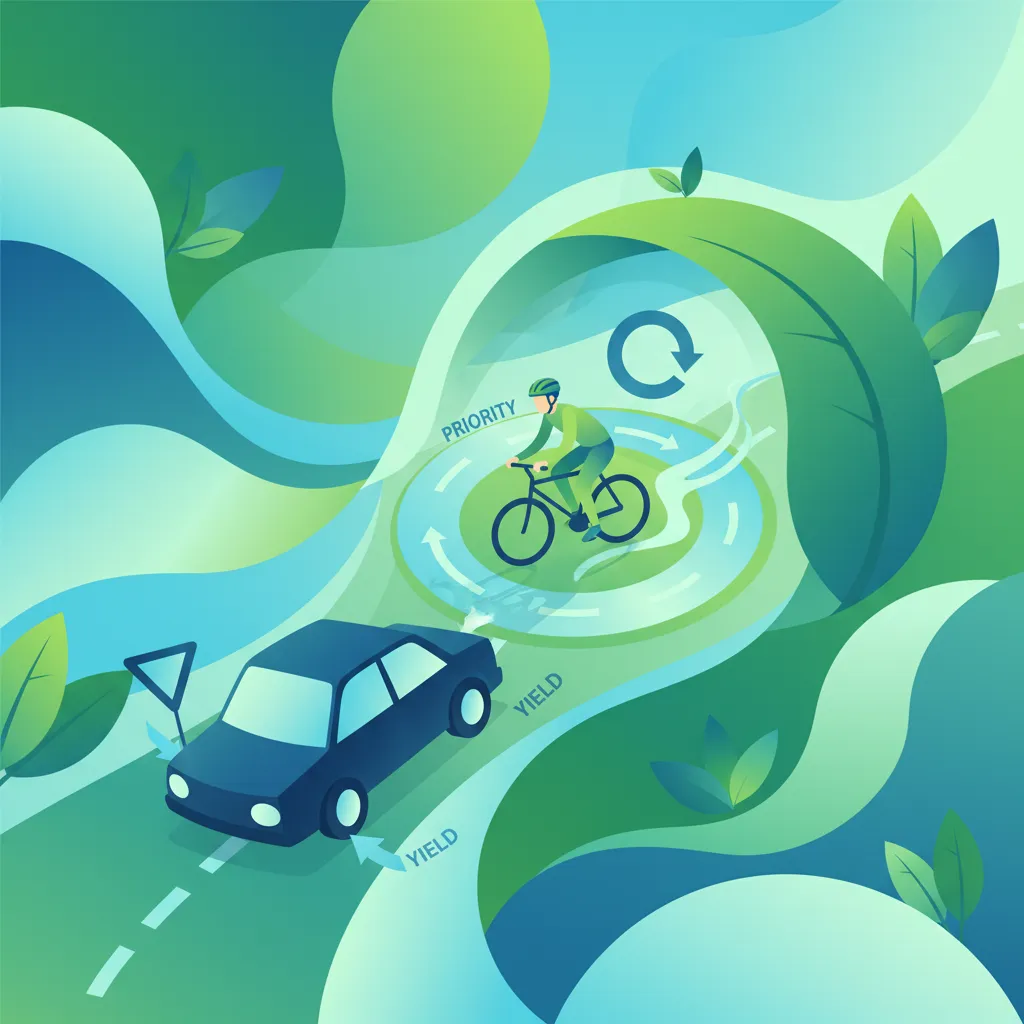
This lesson clarifies the primary rule for roundabouts: all vehicles entering must yield to traffic already on the circular roadway. It explains how to approach a roundabout, select the appropriate lane based on the intended exit, and merge safely into the flow of traffic. Proper signaling before exiting is also covered, ensuring other drivers can anticipate the rider's movements for a smooth and safe negotiation of the junction.
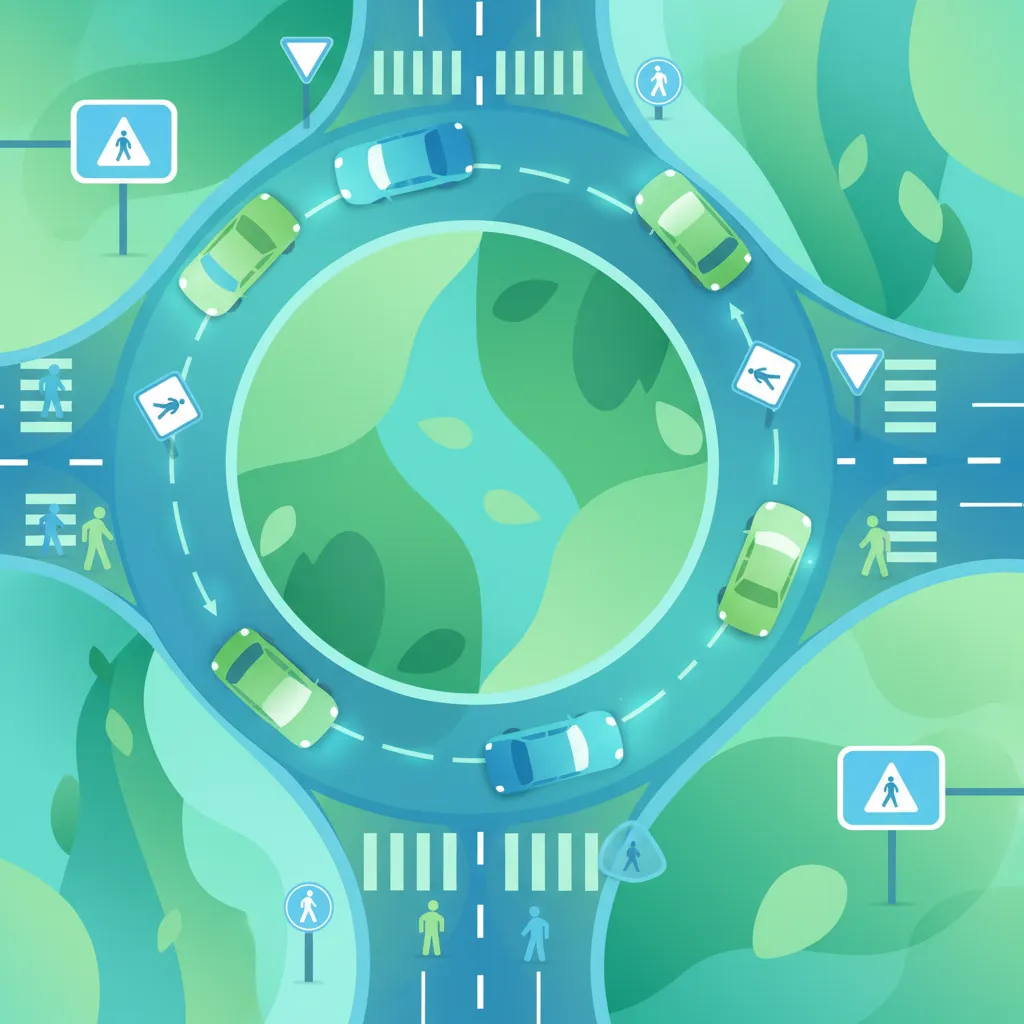
This lesson offers a comprehensive guide to navigating roundabouts in urban settings, explaining the correct protocols for entry, yielding, and circulation. Learners will be taught how to interpret lane markings and signage on multi-lane roundabouts and determine the correct vehicle positioning for safe entry and exit. The content emphasizes full compliance with Spanish city regulations that govern priority and right-of-way at these intersections.
This lesson examines the structural components of a typical Spanish roundabout, describing the central island, entry and circulating lanes, and the placement of yield signs. It outlines how DGT standards dictate the geometric design and entry/exit points to ensure smooth traffic flow. Understanding these design elements enables drivers to anticipate vehicle movements and navigate safely.
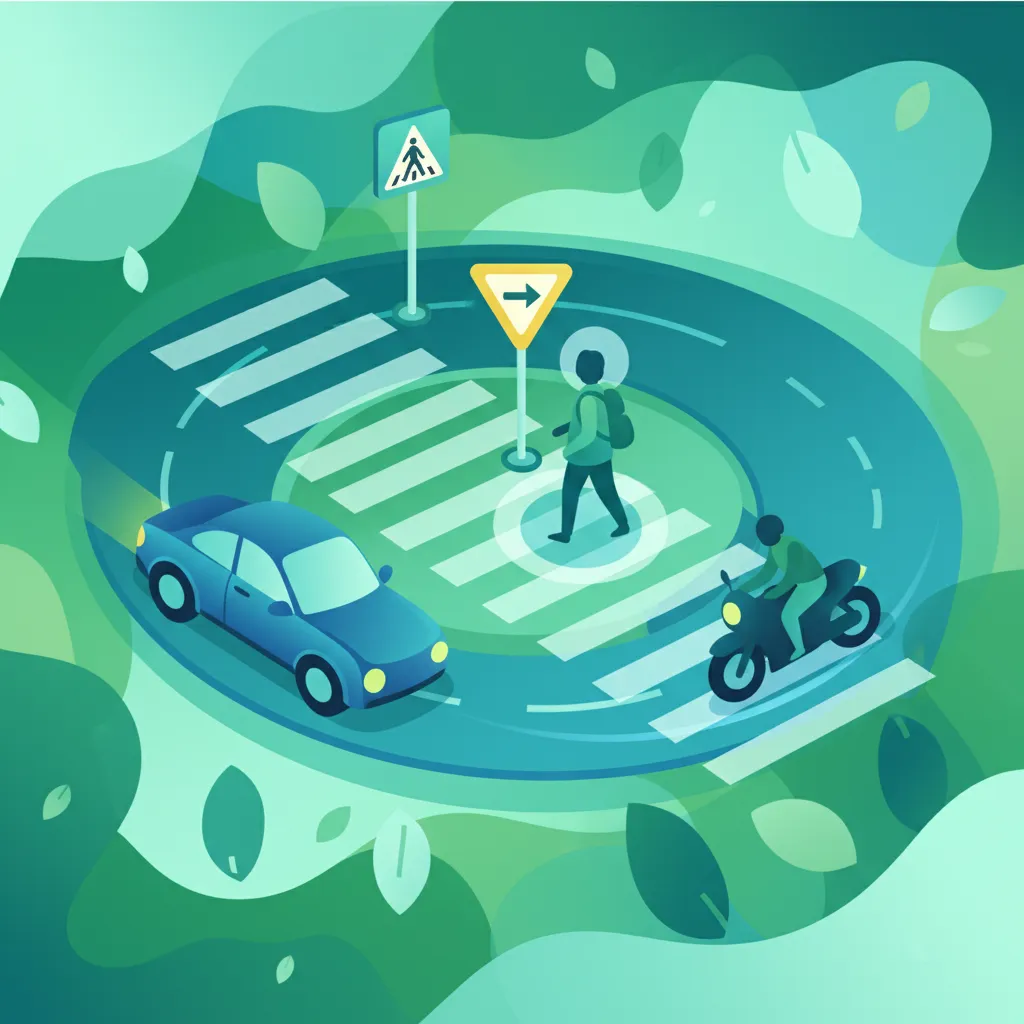
This lesson outlines the proper techniques for negotiating roundabouts and signal-controlled intersections in Spain. It explains priority rules at entry, lane selection based on the intended exit, and yielding to circulating traffic. The content also covers compliance with traffic signals and DGT regulations, including handling cyclist crossings.
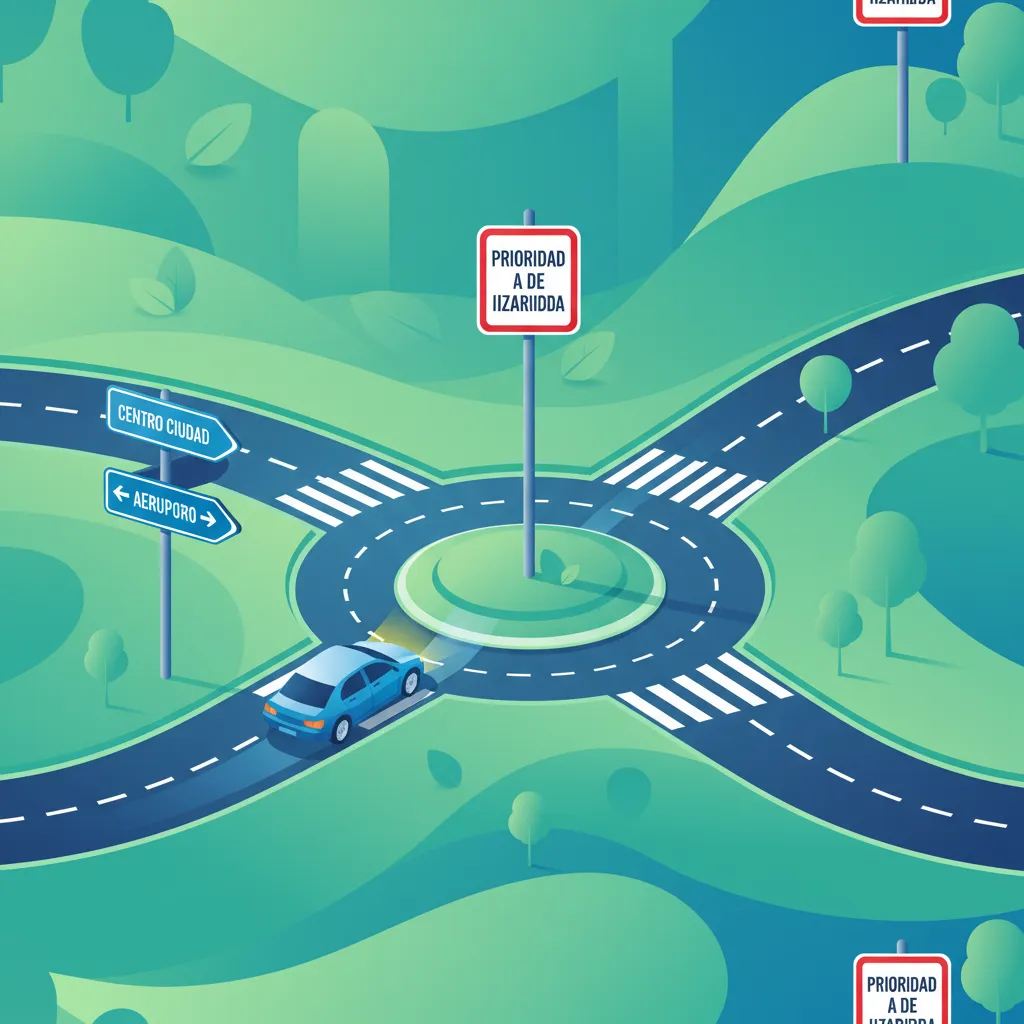
This lesson presents the variety of signs that guide drivers through roundabout navigation. It explains the significance of the roundabout warning symbol, priority signs, lane arrows, and directional signs placed before and within the roundabout. Mastery of roundabout signage ensures that drivers follow legal requirements and maintain safe traffic flow.

This lesson analyzes the various intersection configurations found in Spanish cities, such as controlled and uncontrolled junctions. It explains the hierarchy of right-of-way, detailing when vehicles must yield, when pedestrians have priority, and how traffic signs dictate movement. Learners are guided through DGT signage conventions that determine priority at each intersection type.
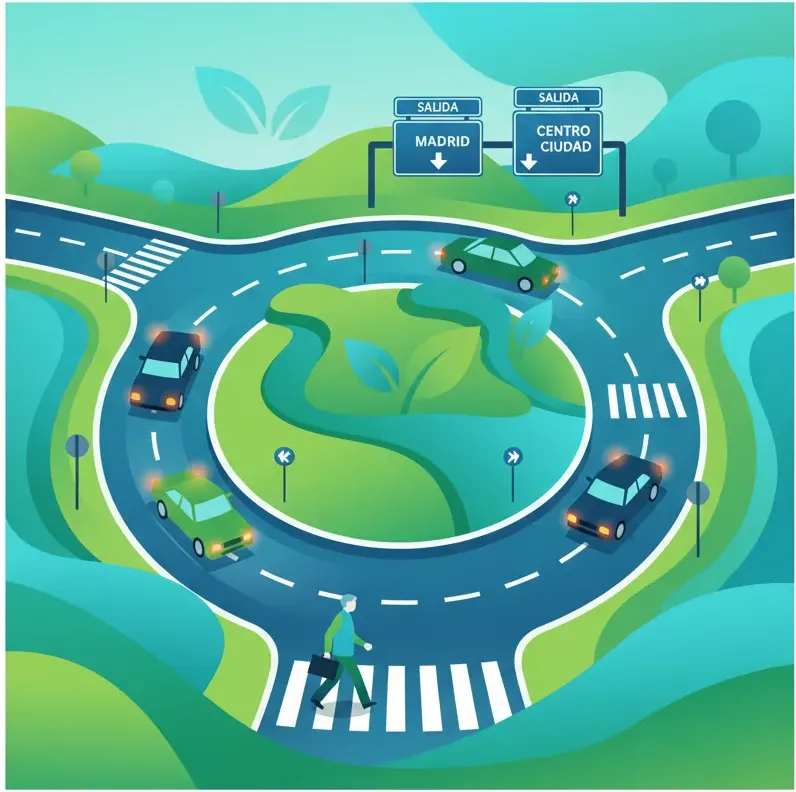
This lesson provides specific instructions on how to safely navigate complex junctions such as roundabouts and intersections with a large vehicle. It explains the rules of priority, the correct lane to use based on the intended exit, and the importance of proper vehicle positioning to account for off-tracking. The content also covers clear signaling to communicate intentions to other road users for safe and efficient passage.
This lesson addresses the crucial 'priority to the right' rule that governs traffic at intersections without signs or signals. It explains that drivers must yield to any vehicle approaching from their right-hand side. The content provides practical examples of how to assess traffic, determine the correct order of passage, and proceed with caution to safely navigate these common but potentially confusing intersections.

This lesson introduces the visual language of road markings, focusing on the distinction between solid and broken lines and what they permit regarding lane changes and overtaking. It explains the meaning of directional arrows painted on the road surface, which guide drivers into the correct lane for their intended maneuver. Understanding these markings is crucial for maintaining proper lane discipline and navigating complex intersections and multi-lane roads.
Identify frequent errors drivers make on Spanish roundabouts, such as incorrect lane use, failure to yield, and improper signaling. This lesson provides DGT-aligned strategies to improve your roundabout proficiency and safety.
This lesson examines the structural components of a typical Spanish roundabout, describing the central island, entry and circulating lanes, and the placement of yield signs. It outlines how DGT standards dictate the geometric design and entry/exit points to ensure smooth traffic flow. Understanding these design elements enables drivers to anticipate vehicle movements and navigate safely.

This lesson examines the interaction between large vehicles, such as trucks, and vulnerable road users within roundabouts. It addresses the wide turning radius of heavy vehicles, the importance of checking blind spots, and the correct yielding behavior toward pedestrians and cyclists. Learners will understand how to maintain safe distances and anticipate the movements of different road users.
This lesson outlines the proper techniques for negotiating roundabouts and signal-controlled intersections in Spain. It explains priority rules at entry, lane selection based on the intended exit, and yielding to circulating traffic. The content also covers compliance with traffic signals and DGT regulations, including handling cyclist crossings.
This lesson focuses on the yielding hierarchy that governs roundabout usage in Spain. It clarifies that vehicles already circulating have priority over those entering and explains the proper lane positioning based on the intended exit. The content includes the correct use of signals for changing lanes and exiting, and safe merging techniques.
This lesson offers a comprehensive guide to navigating roundabouts in urban settings, explaining the correct protocols for entry, yielding, and circulation. Learners will be taught how to interpret lane markings and signage on multi-lane roundabouts and determine the correct vehicle positioning for safe entry and exit. The content emphasizes full compliance with Spanish city regulations that govern priority and right-of-way at these intersections.
This lesson presents the variety of signs that guide drivers through roundabout navigation. It explains the significance of the roundabout warning symbol, priority signs, lane arrows, and directional signs placed before and within the roundabout. Mastery of roundabout signage ensures that drivers follow legal requirements and maintain safe traffic flow.
This lesson clarifies the primary rule for roundabouts: all vehicles entering must yield to traffic already on the circular roadway. It explains how to approach a roundabout, select the appropriate lane based on the intended exit, and merge safely into the flow of traffic. Proper signaling before exiting is also covered, ensuring other drivers can anticipate the rider's movements for a smooth and safe negotiation of the junction.
This lesson provides specific instructions on how to safely navigate complex junctions such as roundabouts and intersections with a large vehicle. It explains the rules of priority, the correct lane to use based on the intended exit, and the importance of proper vehicle positioning to account for off-tracking. The content also covers clear signaling to communicate intentions to other road users for safe and efficient passage.

This lesson provides strategies for navigating tight, confined environments such as multi-story car parks and narrow urban lanes. It emphasizes the importance of slow and controlled movements, constant observation, and a thorough understanding of the vehicle's dimensions and turning circle. Learners will develop the skills to maneuver with precision while avoiding obstacles.

This lesson covers the essential techniques for perpendicular parking (reversing into a bay) and executing a three-point turn. It details the approach, turning points, and use of mirrors and observation to ensure proper vehicle positioning. Learners will understand how to assess the required space and comply with DGT regulations for these common maneuvers.
Find clear answers to common questions learners have about Common Mistakes and Corrective Strategies. Learn how the lesson is structured, which driving theory objectives it supports, and how it fits into the overall learning path of units and curriculum progression in Spain. These explanations help you understand key concepts, lesson flow, and exam focused study goals.
The most critical mistake is failing to yield to vehicles already circulating within the roundabout. Spanish DGT rules explicitly state that traffic inside the roundabout has priority. Always approach with caution, prepare to stop, and only enter when there is a clear and safe gap, ensuring you do not force other drivers to brake or swerve.
To avoid confusion, remember to signal your exit only when you are about to leave the roundabout. If you intend to take the first exit, signal right upon entry. For subsequent exits, maintain your position and only signal right once you have passed the exit before the one you intend to take, ensuring your signal is clear and timely for other drivers.
If you find yourself in the wrong lane, the safest and legally correct action is to continue around the roundabout until you can safely switch lanes or exit at a later point, even if it means taking a longer route. Never force a lane change, cut across lanes, or reverse within a roundabout, as these actions are dangerous and strictly prohibited by the DGT, leading to serious infractions.
Yes, exceeding a safe speed is a very common mistake. Many drivers fail to adjust their speed sufficiently, which can lead to loss of control, reduced reaction time, and difficulty in yielding or positioning correctly. The correct approach is to significantly reduce your speed upon approach, assess the traffic, and maintain a slow, controlled pace throughout your maneuver, accelerating gently only upon exiting.
Use our powerful search functionality to pinpoint specific Spanish DGT driving theory practice sets. Filter by road sign categories, traffic law topics, or question difficulty to build custom study sessions and reinforce your knowledge precisely where it matters for your official exam.