
This lesson delves into the crucial topic of speed management on Spain's rural roads and autovías, a vital component of safe driving and DGT exam success for Categories B & BE. You'll learn the official speed limits for various road types, how to interpret variable signage, and techniques to adapt your speed to specific conditions. Mastering these rules is essential for navigating outside urban areas confidently and passing your Spanish driving theory test.
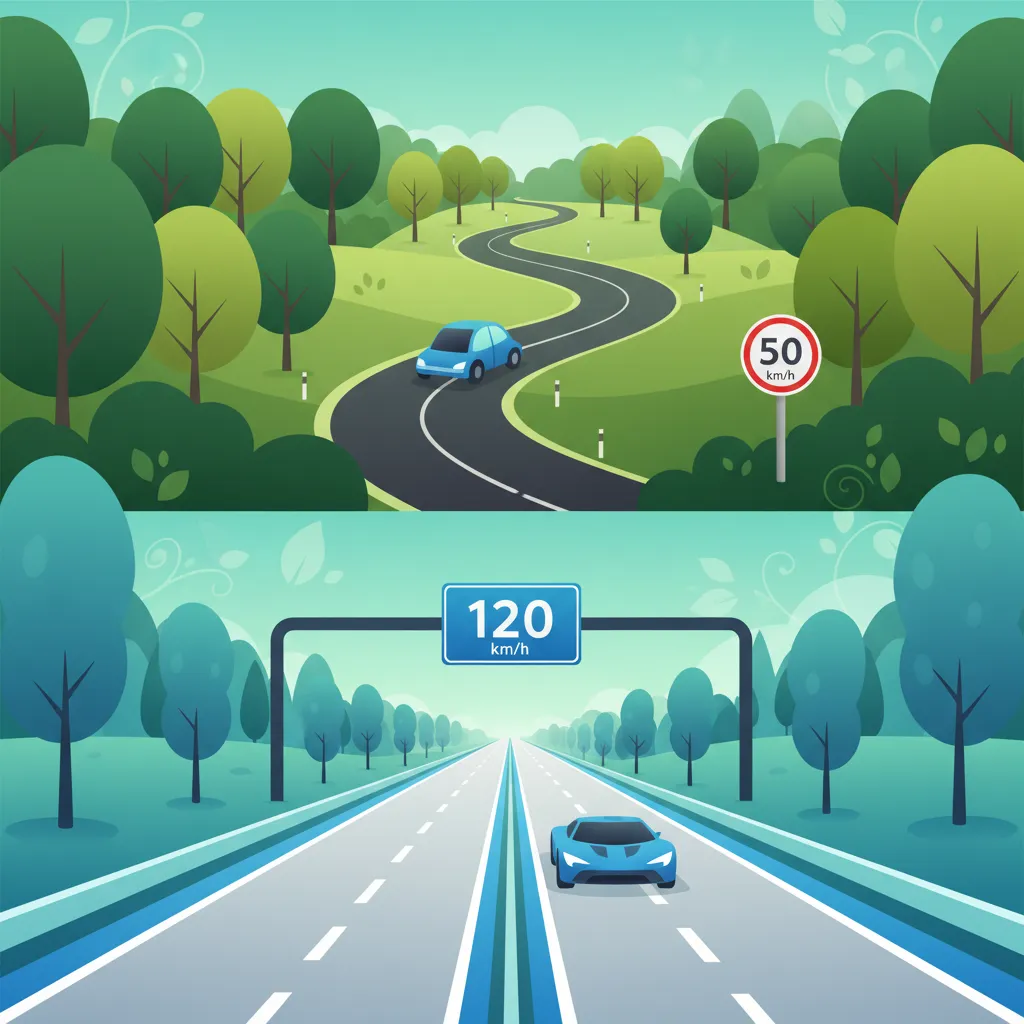
Lesson content overview
Navigating the diverse road network of Spain requires a keen understanding of speed limits and effective speed management. This lesson is designed to equip you with the essential knowledge to safely and legally control your vehicle's speed on rural roads (carreteras rurales), autovías, and autopistas, which is crucial for the Complete Spanish Driving License Theory Course for Categories B & BE (DGT) and for real-world driving. Proper speed management not only ensures compliance with traffic laws but significantly reduces the risk of collisions, improves traffic flow, and enhances overall road safety.
We will delve into the official classification of Spanish road types, the specific default speed limits mandated by the DGT for each, and how to interpret dynamic variable speed limit (VSL) signs. Furthermore, this chapter will cover crucial techniques for adapting your speed to prevailing road conditions, traffic density, and environmental factors, ensuring you maintain control and drive responsibly at all times.
In Spain, road classification is fundamental to determining the applicable default speed limits. The legal system categorizes roadways based on their design, function, and the environment they traverse. Recognizing these distinctions through their signage and characteristics is the first step in applying the correct speed limit.
Rural roads, known as carreteras rurales in Spain, are typically non-urban, single-carriageway roads. They often feature intermittent passing lanes and may have direct access points to properties, which increases the likelihood of encountering slower-moving vehicles, pedestrians, or animals. These roads are designed for varied traffic, including local agricultural vehicles, and demand heightened driver vigilance.
The default maximum speed limit for passenger vehicles (Category B) on rural roads is 90 km/h, unless specific signage indicates otherwise. It is imperative to remember that this is a maximum limit, and conditions frequently necessitate driving at a lower speed.
Autovías are high-capacity, dual-carriageway roads designed for higher speeds, connecting major towns and cities. They feature limited access points, grade-separated junctions (no intersections at the same level), and do not typically charge tolls. Autovías are characterized by their green signage, often displaying the word "Autovía" along with route numbers.
The default maximum speed limit for passenger vehicles (Category B) on autovías is 100 km/h, unless a different limit is specified by signage. Due to their design, autovías generally offer more consistent driving conditions, but drivers must still remain alert to traffic flow and any variable speed limits.
Autopistas are similar to autovías in their design, featuring dual carriageways, limited access, and grade-separated junctions, but they are typically toll roads. They are designed for the highest speeds within the Spanish road network and are identified by blue signage. Autopistas often represent the most direct routes between distant locations, offering a smooth and uninterrupted journey.
The default maximum speed limit for passenger vehicles (Category B) on autopistas is 120 km/h, unless otherwise indicated. As with all road types, drivers must adhere to any lower limits displayed on specific signs or variable message panels.
The Reglamento General de Circulación (RGC) — Spain's General Traffic Regulations — establishes the baseline maximum speeds for various vehicle types on different road classifications. For drivers holding a Category B license, these default limits are your primary guide, forming a crucial part of DGT regulations.
For standard passenger vehicles (Category B) without a trailer, the default maximum speed limits are:
It is critical to understand that these are maximum permissible speeds. Drivers are legally obligated to drive at a lower speed if road, weather, or traffic conditions demand it for safety.
These limits apply unless specific road signs indicate a different speed. Always obey the posted signs, as they take precedence over the general default limits. Exceeding these values, even marginally, constitutes a traffic infraction and carries penalties.
When driving a vehicle from Category B and towing a trailer (which would typically fall under a Category B+E license for larger/heavier trailers), specific, reduced speed limits apply. These lower limits account for the increased length, weight, and reduced maneuverability of the combined vehicle.
For Category B vehicles towing a trailer (requiring a B+E license for trailers exceeding 750 kg Maximum Authorised Mass where the combination exceeds 3,500 kg, or for trailers over 750 kg where the combination exceeds 4,250 kg):
These limits are mandatory regardless of the default limits for solo passenger vehicles. Always ensure you are aware of and adhere to the specific speed limits for your vehicle combination.
Variable Speed Limits (VSL) play a vital role in modern traffic management on Spanish autovías and autopistas. These dynamic limits are displayed on electronic panels, typically on overhead gantries, and are designed to adjust in real-time to prevailing road conditions. They are a powerful tool for enhancing safety and managing traffic flow efficiently.
VSLs are implemented for several reasons:
It is a legal requirement to obey the displayed VSL. These limits always supersede the default speed limits for the road type. Ignoring a VSL is a traffic violation and can be considered dangerous driving, particularly if conditions are poor. Drivers must be prepared to reduce their speed immediately when a VSL is displayed, even if it feels significantly slower than the default.
While default and variable speed limits provide a framework, safe driving in Spain – and a core principle of the DGT – emphasizes the legal obligation to adapt your speed to actual driving conditions. Article 79 of the Reglamento General de Circulación explicitly states that drivers must drive with "due caution" and at a speed adapted to their circumstances. Failure to do so, even if below the maximum posted limit, can be considered negligent or dangerous driving.
Adverse weather significantly impacts road safety and demands a substantial reduction in speed.
The condition of the road surface directly affects your vehicle's grip and braking capability.
Your ability to see and be seen plays a critical role in speed choice.
Your vehicle's state also dictates appropriate speed.
The density and nature of other road users must influence your speed.
Your vehicle's speedometer is your primary tool for monitoring your speed and ensuring compliance with limits. It is therefore legally mandated that this instrument provides an accurate reading. Article 61 of the Reglamento General de Circulación specifies that "the vehicle’s speed-reading instrument must be accurate."
For speeds up to 100 km/h, the speedometer must reflect the actual speed within a tolerance of ±5 km/h. Above 100 km/h, the tolerance is ±5%. This means, for example, that if you are driving at a true speed of 100 km/h, your speedometer could legally show anything between 95 km/h and 105 km/h. Manufacturers often calibrate speedometers to read slightly higher than the actual speed to err on the side of caution.
Drivers must ensure their speedometer is correctly calibrated, especially after any repairs or modifications that could affect wheel size or sensor systems, such as changing tire sizes. Driving based on a faulty speedometer can lead to inadvertent speeding violations and can be considered negligent if it results in an infraction or accident. Regular verification of your speedometer's accuracy is a responsible driving practice.
Maintaining an appropriate and consistent speed on rural roads and autovías goes beyond simply watching your speedometer; it involves a combination of technical skills and anticipatory driving. Implementing effective speed management techniques can reduce driver fatigue, improve fuel efficiency, and minimize the risk of inadvertently exceeding limits.
Cruise control is a valuable tool for maintaining a steady speed on long stretches of autovías and autopistas. It can reduce driver fatigue by allowing you to take your foot off the accelerator.
Constantly be aware of your speed. This involves:
Anticipatory driving is key to smooth speed management.
Understanding common mistakes related to speed management is vital for both passing your DGT exam and ensuring safety on Spanish roads. Many violations stem from misjudgment or a lack of awareness regarding specific rules.
Understanding the underlying principles and legal framework reinforces the importance of speed management.
The speed limits and adjustment requirements discussed are not mere suggestions; they are legally binding.
The principles of physics unequivocally demonstrate the profound impact of speed on safety.
Human capabilities are finite and directly influenced by speed.
Beyond safety, speed also has environmental consequences. Lower, more consistent speeds generally lead to:
Effective speed management is a cornerstone of safe and legal driving on Spanish rural roads and autovías. As you prepare for your Spanish driving license, remember these critical takeaways:
By consistently applying these principles, you will not only be well-prepared for your DGT driving theory exam but, more importantly, become a safer and more responsible driver on Spain's diverse road network.
This lesson covers Spain's speed limit framework for rural roads (90 km/h), autovías (100 km/h), and autopistas (120 km/h) for Category B vehicles, with lower limits applying when towing trailers under B+E rules. Variable Speed Limits displayed on electronic panels are legally binding and always take precedence over defaults. Drivers must also adapt speed based on weather, visibility, road surface, and traffic conditions as mandated by Article 79 of the Reglamento General de Circulación. The content details seven common mistakes including ignoring VSLs, misjudging trailer limits, and relying on cruise control inappropriately, while also explaining the physics of speed, human reaction limitations, and speedometer calibration requirements essential for both exam success and safe real-world driving.
A short set of high-value points that capture the most important learning from this lesson.
Rural roads default to 90 km/h, autovías to 100 km/h, and autopistas to 120 km/h for Category B vehicles
Variable Speed Limits (VSL) on electronic panels always override default speed limits and must be obeyed immediately
When towing a trailer under B+E rules, speeds drop to 70 km/h on rural roads and 90 km/h on autovías/autopistas
Article 79 of the RGC legally obliges drivers to reduce speed below posted limits when conditions demand it
Speed limits only change when explicitly signposted; road design alone does not raise or lower limits
Explore all units and lessons included in this driving theory course.
Autopistas are toll roads with blue signs; autovías are free dual carriageways with green signs
Speedometer tolerance is ±5 km/h up to 100 km/h and ±5% above that, so readings may be slightly higher than true speed
In fog with visibility below 50 metres, the absolute speed limit is 50 km/h regardless of road type
Cruise control must be disengaged manually when encountering VSL changes, traffic, or adverse weather
Changing tire size can affect speedometer calibration and lead to inaccurate readings
Assuming speed automatically increases when entering a dual carriageway without checking for explicit signage
Ignoring a VSL during poor conditions because the posted default limit seems safe enough
Driving at 90 km/h on a rural road in heavy rain, believing the maximum limit applies regardless of conditions
Using cruise control on wet or slippery surfaces where engine braking and full driver control are needed
Driving with a trailer at 100 km/h on an autovía instead of the mandatory 90 km/h limit for B+E combinations
Lesson content overview
A short set of high-value points that capture the most important learning from this lesson.
Rural roads default to 90 km/h, autovías to 100 km/h, and autopistas to 120 km/h for Category B vehicles
Variable Speed Limits (VSL) on electronic panels always override default speed limits and must be obeyed immediately
When towing a trailer under B+E rules, speeds drop to 70 km/h on rural roads and 90 km/h on autovías/autopistas
Article 79 of the RGC legally obliges drivers to reduce speed below posted limits when conditions demand it
Speed limits only change when explicitly signposted; road design alone does not raise or lower limits
Explore all units and lessons included in this driving theory course.
Autopistas are toll roads with blue signs; autovías are free dual carriageways with green signs
Speedometer tolerance is ±5 km/h up to 100 km/h and ±5% above that, so readings may be slightly higher than true speed
In fog with visibility below 50 metres, the absolute speed limit is 50 km/h regardless of road type
Cruise control must be disengaged manually when encountering VSL changes, traffic, or adverse weather
Changing tire size can affect speedometer calibration and lead to inaccurate readings
Assuming speed automatically increases when entering a dual carriageway without checking for explicit signage
Ignoring a VSL during poor conditions because the posted default limit seems safe enough
Driving at 90 km/h on a rural road in heavy rain, believing the maximum limit applies regardless of conditions
Using cruise control on wet or slippery surfaces where engine braking and full driver control are needed
Driving with a trailer at 100 km/h on an autovía instead of the mandatory 90 km/h limit for B+E combinations
Explore search topics learners often look for when studying Speed Management on Rural Roads and Autovías. These topics reflect common questions about road rules, driving situations, safety guidance, and lesson level theory preparation for learners in Spain.
Browse additional driving theory lessons that cover connected traffic rules, road signs, and common driving situations related to this topic. Improve your understanding of how different rules interact across everyday traffic scenarios.
Learn the specific speed limits for Spanish autovías and autopistas. Understand how to interpret variable speed limits (VSL) and adapt your speed to highway conditions as part of your DGT driving theory.
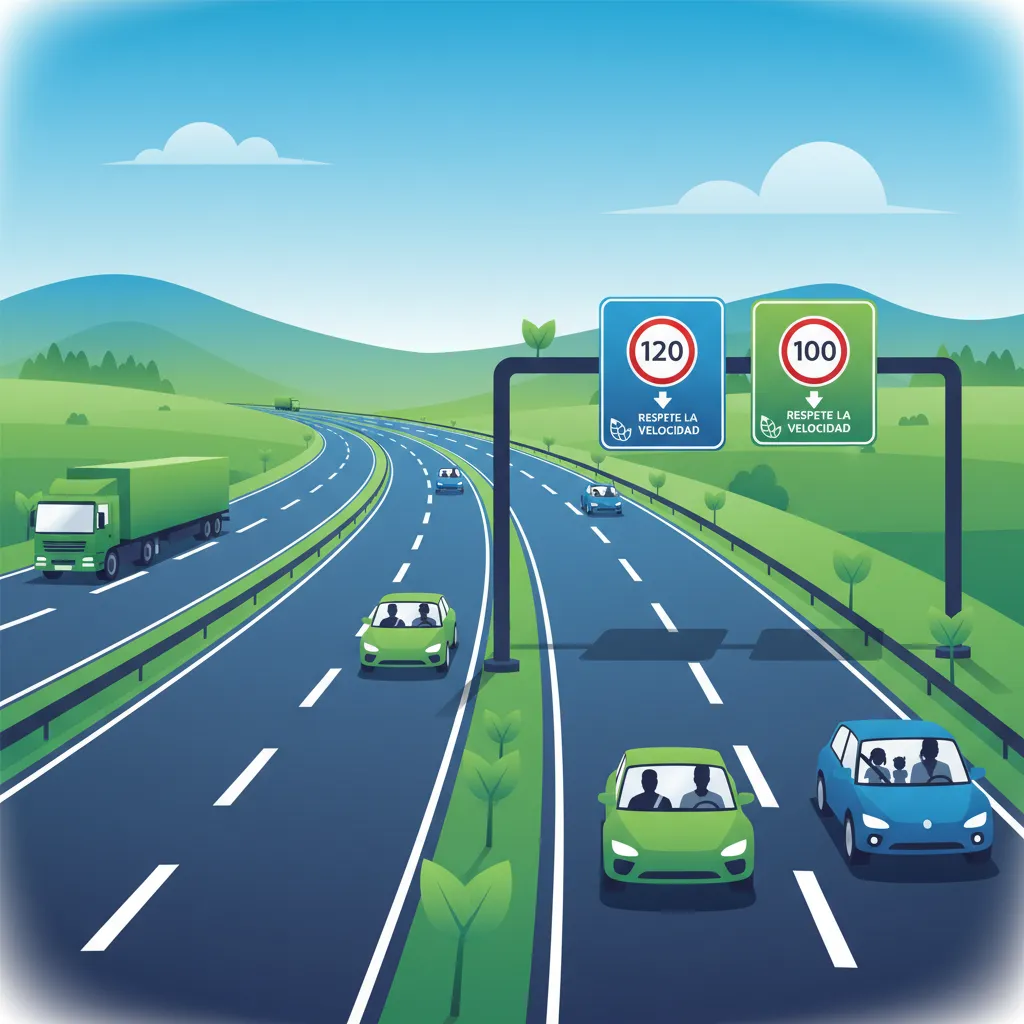
This lesson explains the classification differences between Spanish autovías and autopistas, detailing the specific speed limits and lane restrictions applicable to coaches on each. Learners will become proficient in interpreting motorway signage, adhering to minimum speed requirements, and recognizing vehicle type restrictions as enforced by the DGT. The module also covers the correct procedures for using entry and exit ramps to ensure safe and fluid traffic flow.
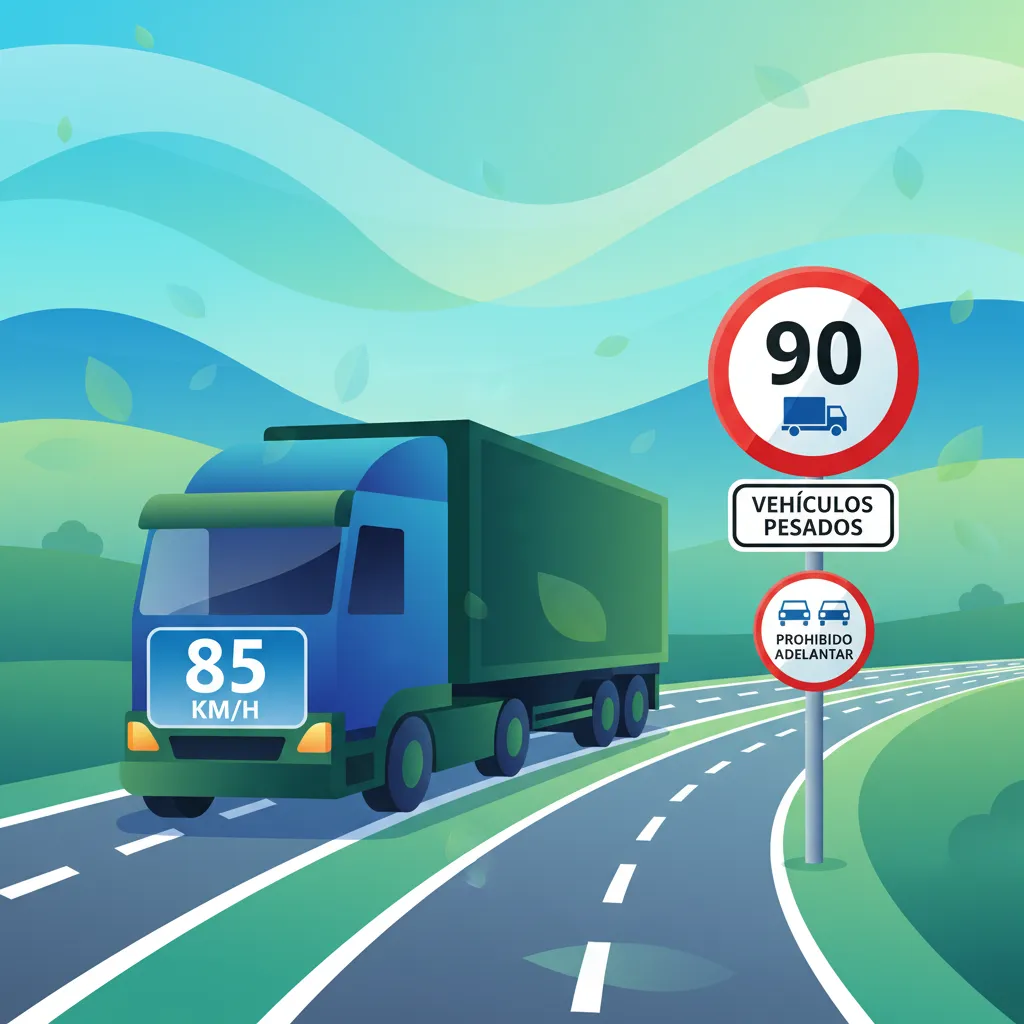
This lesson details the specific legal speed limits that apply to heavy passenger vehicles on Spanish highways, including variable speed zones that adjust based on traffic and weather conditions. Learners will understand the methods for speed monitoring, the function of speed control devices, and the legal consequences of non-compliance. The content also provides guidance on calculating a safe operating speed based on vehicle load and road conditions.
This lesson explains the specific legal framework governing truck operations on Spain's high-speed road network. It details the different speed limits for trucks on autovías versus autopistas and the regulations regarding which lanes heavy vehicles are permitted to use. Learners will also understand how to interpret specific highway signage relevant to commercial vehicles and any applicable toll regulations.
This lesson focuses on the specific signage systems used in rural and highway environments in Spain. It explains how to interpret directional signs, exit numbering, distance markers, and signs for services like fuel and rest areas. Understanding these signs is crucial for effective navigation and safe driving at high speeds.
This lesson outlines the speed limits applicable to different types of urban streets and the corresponding road signs that communicate them. It explains the interpretation of speed zone markings, signs indicating reduced speed areas like 30 km/h zones, and the rationale behind speed enforcement in city settings. Learners will understand how to maintain compliance to enhance safety for all road users.
Master the art of adapting your speed on rural roads in Spain according to weather, visibility, and road surface. Understand the legal obligations for condition-based speed reduction in driving theory.
This lesson examines the principles of maintaining a safe following distance, including the 'two-second rule' and its adjustments for speed and weather. It focuses on effective blind-spot management, teaching drivers how to use mirrors and head checks. The content integrates DGT guidelines on creating a safety buffer around the vehicle to allow time to react to unexpected events.
This lesson addresses the specific challenges posed by rain and fog, focusing on reduced visibility and loss of traction. It explains the proper use of windshield wipers and fog lights, and the need to adjust speed and increase following distance. The content covers how to prevent and react to hydroplaning (aquaplaning) to maintain vehicle control.
This lesson covers how environmental conditions such as rain, fog, and darkness affect driving safety. It instructs drivers on adjusting speed, using appropriate lighting, and increasing following distance to compensate for reduced visibility and traction. The lesson incorporates DGT safety recommendations for handling adverse weather to mitigate risk and maintain control.
In this lesson, drivers learn how to identify risk zones where potential hazards are likely to develop. The content explains the use of proactive observation and scanning techniques to detect evolving dangers in the driving environment. Learners will practice anticipating the actions of other road users based on traffic patterns and context, adjusting their speed and position accordingly.
This lesson teaches the crucial skill of adapting speed to match prevailing environmental conditions. It explains that the posted speed limit is a maximum for ideal conditions and that riders must slow down significantly in rain, fog, or darkness. The content emphasizes maintaining a larger safety margin to account for reduced visibility and longer stopping distances, ensuring the rider can always stop within the distance they can see clearly.

This lesson provides a detailed examination of the components that determine a vehicle’s stopping distance: perception time, reaction time, and braking distance. It outlines how to calculate safe stopping distances under various speeds and road conditions like wet or dry surfaces. Learners will be equipped to compute appropriate safety margins and understand the physics of emergency braking.

This lesson outlines the core principles of defensive driving, focusing on maintaining a safe following distance, creating a protective space cushion around the vehicle, and anticipating potential hazards. Learners will be taught how to develop contingency plans for unexpected events and employ risk mitigation techniques to actively avoid accidents. The content reinforces the vital importance of remaining vigilant and proactive at all times when driving.
This lesson examines the significant impact of various weather conditions on driving safety, including rain, fog, snow, ice, and high winds. Learners will understand how each condition can affect vehicle traction, reduce visibility, and alter driver perception, learning the appropriate adjustments to speed, following distance, and braking. The module also covers the use of vehicle safety features to mitigate risks in adverse weather.
This lesson focuses on defensive maneuvers in mixed traffic environments where various vehicles share the road. It outlines lane discipline, appropriate overtaking safety measures, and strategies for maintaining a safety corridor. The content incorporates DGT defensive guidelines, teaching riders to manage space and anticipate unpredictable driver behavior.
This lesson focuses on the coordination of acceleration and deceleration to maintain vehicle stability. It explains how to modulate the accelerator pedal for smooth acceleration and how to apply the brake pedal for controlled deceleration. The content covers the role of the ABS system, the calculation of stopping distances, and the importance of maintaining stability during speed changes.
Find clear answers to common questions learners have about Speed Management on Rural Roads and Autovías. Learn how the lesson is structured, which driving theory objectives it supports, and how it fits into the overall learning path of units and curriculum progression in Spain. These explanations help you understand key concepts, lesson flow, and exam focused study goals.
On conventional rural roads without clearly defined hard shoulders or those less than 1.5 meters wide, the general speed limit for passenger cars (Category B) is typically 90 km/h. However, this can be reduced by signage, or if conditions demand a lower speed.
For passenger cars and light vehicles (Category B), the general maximum speed limit is 120 km/h on both autovías and autopistas in Spain. However, specific signage or road conditions can alter this. Vehicles with trailers (BE category) usually have lower specific limits, often 90 km/h on these roads.
Variable speed limit signs use electronic displays to show temporary speed limits, often due to traffic congestion, adverse weather, or roadworks. You must always obey the displayed limit, even if it's lower than the general limit for that road type. Failure to do so can result in fines and DGT penalty points.
Many factors require you to reduce speed below the legal maximum, including poor visibility (fog, heavy rain, snow), hazardous road conditions (ice, gravel, wet leaves), heavy traffic, approaching sharp bends, or driving near vulnerable road users. Always prioritize safety over the posted limit.
Yes, vehicles towing a trailer (Category BE) have specific, generally lower, speed limits. On conventional rural roads, the limit is often 80 km/h, and on autovías and autopistas, it's typically 90 km/h. It's crucial to check official DGT regulations for precise figures and ensure your speed always reflects the combined vehicle's capabilities and stability.
Use our powerful search functionality to pinpoint specific Spanish DGT driving theory practice sets. Filter by road sign categories, traffic law topics, or question difficulty to build custom study sessions and reinforce your knowledge precisely where it matters for your official exam.