
Welcome to the fundamental principles of road safety for professional truck drivers in Spain. This lesson is crucial for understanding how to operate heavy vehicles safely, building upon basic driving knowledge and preparing you for specific challenges on the road. Mastering these concepts is essential for the Category C and C1 DGT theory exam.
Lesson content overview
Navigating the roads safely is paramount for all drivers, but for those operating heavy vehicles in Category C & C1, an elevated understanding and application of road safety principles are crucial. This lesson introduces the fundamental concepts that form the bedrock of safe driving practices within the Official DGT Theory Course for Spanish Truck Licence Category C & C1. We will explore how anticipating hazards, managing speed, maintaining safe distances, and respecting the hierarchy of road users are not just legal obligations but essential strategies for preventing accidents and ensuring smooth traffic flow.
Defensive driving is a proactive approach to operating a vehicle that prioritises risk avoidance. It involves anticipating potential hazards and the actions of other road users, even before they occur, and adapting your driving behavior accordingly. For professional truck drivers, this anticipatory style is particularly vital due to the size, weight, and longer stopping distances of heavy vehicles.
Effective defensive driving relies on several interconnected skills and habits:
Practical Meaning for Heavy Vehicles: Defensive driving for truck operators includes maintaining a significantly larger personal space zone around the vehicle and allowing extra distance and time for all manoeuvres, especially when overtaking or entering junctions.
This approach aligns with the DGT's "Duty of Care" principle (Art. 25 of the Reglamento General de Circulación), which obliges all drivers to avoid creating unnecessary hazards. Misconceptions often arise, such as believing defensive driving simply means adhering strictly to the speed limit. In reality, it means adapting speed to conditions, which might mean driving below the posted limit when safety demands it.
Speed management is the critical process of selecting and adjusting your vehicle's speed not just according to legal limits, but also based on the specific road type, prevailing weather, traffic density, and, crucially, the condition and load of your vehicle. For heavy vehicles, operating at an appropriate speed directly impacts safety, vehicle stability, and braking performance.
Several factors dictate the safe operational speed for Category C & C1 vehicles:
Common Misunderstanding: Many drivers mistakenly believe that driving at the maximum speed limit is always safe. However, for heavy vehicles, this is rarely the case, particularly when loaded or in challenging conditions. Ignoring load-dependent braking performance is a significant risk.
For example, a C-class vehicle might travel at 80 km/h on a motorway with a 90 km/h limit because its heavy cargo weight requires significantly longer braking distances to ensure safety. Proper speed management ensures adequate stopping distance and reaction time, preventing accidents and promoting compliance with legal limits.
A safe following distance refers to the space or time gap you maintain between your vehicle and the one immediately ahead. This gap must be sufficient to allow you to stop safely without colliding with the leading vehicle if it brakes abruptly. This principle is even more critical for heavy vehicles due to their substantial mass and correspondingly longer braking distances.
While passenger cars often use a 2-second rule, the DGT generally recommends a minimum 3-second gap for heavy vehicles under normal, dry conditions. This time-based rule is practical because it adjusts for your current speed: the faster you go, the more distance you cover in three seconds, naturally increasing your following distance.
Choose a fixed point ahead, such as a road sign, bridge, or tree.
When the rear of the vehicle ahead passes that point, begin counting "one thousand one, one thousand two, one thousand three."
If the front of your vehicle reaches the chosen point before you finish counting, you are following too closely. Increase your distance.
DGT Guidance: The DGT Art. 84 (Following Distance) mandates that drivers keep sufficient distance to avoid collisions, with specific guidance recommending at least a 3-second gap for heavy vehicles.
The 3-second rule is a minimum. This gap must be extended under various conditions:
Misunderstandings often arise from using the same following distance rule for passenger cars and trucks or neglecting the effect of wet roads. A heavy vehicle needs far more space. For instance, on a dry highway, a truck driver travelling at 90 km/h should maintain a gap of approximately 75 metres (corresponding to a 3-second gap) behind a car.
Understanding the hierarchy of road users is fundamental to road safety. It's an ordered classification of road participants based on their vulnerability and legal priority. This principle acknowledges that some road users are more exposed to serious injury in the event of a collision and thus deserve greater protection. The general hierarchy is:
Pedestrians > Cyclists > Motorcyclists > Cars > Heavy Vehicles > Buses/Trams
For truck drivers, recognizing this hierarchy has direct implications for safe driving behavior:
A common misunderstanding is assuming trucks have equal priority to cars in all situations. However, due to their size and potential impact, truck drivers carry a greater responsibility to protect all other road users. An example is a truck driver stopping well in advance to allow pedestrians to cross at an uncontrolled intersection, even if they have to slow down considerably.
Hazard anticipation is the mental process of recognizing potential dangers on the road before they fully materialise. It involves using visual cues, understanding traffic patterns, and interpreting environmental conditions to foresee and prepare for possible risks. For heavy vehicle drivers, effective hazard anticipation allows for smoother, earlier responses, reducing the need for sudden, aggressive manoeuvres that can destabilise a truck, especially when loaded.
Hazard anticipation can be categorised based on the nature of the threat:
This skill relies heavily on experience, effective scanning patterns (continuously moving your eyes, not just staring straight ahead), and a deep understanding of common risk points. DGT Art. 32 (Anticipatory Driving) obligates drivers to adapt their speed and conduct to road conditions, which directly relates to hazard anticipation. Relying solely on immediate reactions rather than proactive scanning is a common mistake. For instance, approaching a blind corner, a professional driver reduces speed pre-emptively, using their experience to anticipate potential unseen obstacles.
The DGT (Dirección General de Tráfico) sets forth specific regulations to govern road safety in Spain. For Category C & C1 drivers, understanding and adhering to these articles of the Reglamento General de Circulación (RGC) is not only mandatory but forms the legal framework for safe operation.
| Regulation | Statement | Applicability | Legal Status | Rationale | Correct/Incorrect Example |
|---|---|---|---|---|---|
| DGT Art. 71 (Right-of-Way for Pedestrians) | Vehicles must yield to pedestrians at marked crosswalks. | All road types; specifically applies to trucks when a pedestrian is present or clearly intending to cross. | Mandatory | To protect the most vulnerable road users from the inherent dangers of vehicle traffic. | Correct: A truck driver stops well before a crosswalk to allow a group of pedestrians to cross safely. Incorrect: A truck proceeds through a crosswalk, forcing a pedestrian to stop or hurry. |
| DGT Art. 72 (Overtaking Restrictions) | Heavy vehicles (Category C) may not overtake other vehicles on a road with a solid continuous line, near a pedestrian crossing (within 150m), or where visibility is limited. | Motorways, inter-urban roads, urban roads with specific lane markings or vulnerable user presence. | Mandatory | To prevent dangerous manoeuvres, ensure clear visibility for all road users, and reduce collision risk, especially with VRUs. | Correct: A truck driver waits for a broken line segment and clear visibility before initiating an overtake. Incorrect: A truck overtakes on a solid line, creating a dangerous situation and potentially obscuring a crossing pedestrian. |
| DGT Art. 30 (Speed Limits) | Establishes maximum speeds for each vehicle category on different road types (e.g., 90 km/h for trucks on motorways, 80 km/h on conventional inter-urban roads). | Applies to all drivers; trucks have distinct, often lower, limits than passenger cars. | Mandatory | To ensure safe stopping distances, manage vehicle control, and maintain orderly traffic flow, considering vehicle dynamics. | Correct: A truck adheres to the 80 km/h limit on an inter-urban road, even if passenger cars are permitted higher speeds. Incorrect: A truck exceeds the posted limit, underestimating the increased stopping distance required. |
| DGT Art. 84 (General Following Distance) | Drivers must always maintain a sufficient distance from the vehicle ahead to allow for a safe stop and avoid collisions. | Universal principle, with specific distance calculations differing significantly for heavy vehicles. | Mandatory | To prevent rear-end collisions, particularly crucial for heavy vehicles due to their longer braking distances and reaction times. | Correct: A truck driver consistently maintains a 3-second following distance from the vehicle ahead on a dry road. Incorrect: A truck follows too closely, leaving insufficient space to react to sudden braking. |
| DGT Art. 25 (Duty of Care) | All drivers have a general obligation to drive with due care and attention, avoiding any action that could create unnecessary hazards or endanger others. | Applies universally to all driving situations and road users. | Mandatory | This is a foundational general safety principle that underpins all defensive driving practices and responsible road use. | Correct: A driver reduces speed and increases following distance when approaching a large puddle to avoid aquaplaning. Incorrect: A driver continues at full speed into heavy rain, disregarding reduced visibility and road grip. |
| DGT Art. 84-2 (Load-Specific Stopping Distances) | Heavy vehicles, especially when fully loaded, must increase their following distance proportionally to the load weight to compensate for increased braking distances. | Specifically applicable to heavy vehicles (Category C & C1), particularly when carrying cargo. | Mandatory | Heavier loads significantly increase vehicle inertia, demanding longer braking distances and thus greater following gaps to maintain safety. | Correct: A truck driver carrying a maximum permissible load increases their following distance to a 4-second gap. Incorrect: A fully loaded truck driver uses the same following distance as an empty truck or a passenger car. |
Regulation Verification: Always refer to the latest DGT "Manual de Conductores Profesionales" and the "Reglamento General de Circulación" for the most up-to-date numerical values, specific distance rules, and any amendments regarding speed limits for Category C & C1 vehicles.
Failure to adhere to basic road safety principles and DGT regulations can lead to serious consequences, ranging from fines and license points to severe accidents. Professional drivers must be acutely aware of these common violations.
| Violation | Why Wrong (Principle Violated) | Correct Behavior (Principle Applied) | Consequence |
|---|---|---|---|
| Following too closely behind a slower vehicle | Insufficient time to react and stop safely (Safe Following Distance, Hazard Anticipation) | Maintain at least a 3-second gap for trucks; increase significantly in adverse weather conditions. | Rear-end collisions, significant fines, accumulation of license points, increased insurance premiums. |
| Overtaking on a solid continuous line or near a pedestrian crossing | Unsafe manoeuvre, reduces visibility for VRU (Overtaking Restrictions, Hierarchy of Road Users) | Only overtake when the line is broken, visibility is clear, and it is safe and legal to do so, adhering to DGT Art. 72. | High accident risk, substantial fines, loss of license points, potential disqualification. |
| Driving at maximum legal speed while fully loaded in conditions that demand lower speed | Ignoring load-dependent braking distance and vehicle stability (Speed Management, Operational Speed) | Reduce speed below the posted limit to accommodate the increased braking distance and reduced handling capacity due to the load. | Increased stopping distance, potential loss of control (e.g., jack-knifing), serious accidents. |
| Neglecting to reduce speed in rain, fog, or snow | Hazard anticipation ignored, higher collision risk (Speed Management, Environmental Adjustment) | Adjust speed to a significantly lower, safe threshold; substantially increase following distance and use appropriate lighting. | Greatly increased accident probability, reduced visibility and control, severe fines. |
| Failing to yield to pedestrians at crosswalks or cyclists in shared lanes | Disregard for hierarchy of road users and their vulnerability (Hierarchy of Road Users, DGT Art. 71) | Stop well in advance and allow pedestrians to cross safely; provide ample space for cyclists. | Legal penalties, potential severe injuries or fatalities to vulnerable users, criminal charges. |
| Inadequate scanning at blind corners or junctions | Missed hazards, sudden braking required (Hazard Anticipation, Defensive Driving) | Slow down significantly before blind spots; actively scan the environment and use mirrors effectively. | Unexpected collisions, especially with vulnerable road users or oncoming traffic. |
| Ignoring trailer sway warnings or feeling instability | Trailer stability compromised, improper load distribution (Vehicle State, Load Management, Speed Management) | Immediately reduce speed gently, avoid abrupt steering or braking, and address load distribution issues at the next safe stop. | Loss of control, trailer jack-knifing, multi-vehicle accidents. |
Road safety principles are not static; their application must be dynamically adjusted based on the prevailing driving conditions. Professional heavy vehicle drivers must possess the judgment to modify their behavior in response to environmental and situational changes.
Applying road safety principles in real-world situations is key to safe heavy vehicle operation.
Scenario: Highway Driving with Variable Speed Traffic
Scenario: Urban Street with Rain and Cyclists
Scenario: Approaching a Blind Bend on an Inter-urban Road at Night
Understanding the underlying principles of physics and human psychology provides critical insights into why road safety rules are designed as they are. This knowledge reinforces the importance of diligent adherence to these principles for professional drivers.
Studies consistently demonstrate the efficacy of basic safety principles. For instance, data shows that rear-end collisions, a common type of accident for heavy vehicles, can decrease by up to 30% when a consistent 3-second following distance is maintained. This empirical evidence underscores the tangible safety benefits of applying these principles.
This lesson covers fundamental road safety principles for Category C and C1 drivers in Spain, emphasising that safety extends beyond legal compliance to practical awareness and adaptability. Key topics include defensive driving techniques with emphasis on scanning, predictive awareness, and creating safety buffers; proper speed management considering vehicle load and environmental conditions; and the legal framework set by DGT regulations governing following distances, speed limits, and yielding obligations. Understanding stopping distance physics—including reaction distance and braking distance—and how they increase with vehicle weight is essential for safe heavy vehicle operation. The hierarchy of road users prioritises vulnerable participants, meaning truck drivers must exercise heightened caution around pedestrians, cyclists, and motorcyclists. These principles are directly tested in the DGT theory exam.
A short set of high-value points that capture the most important learning from this lesson.
Truck drivers must apply a minimum 3-second following distance (not the 2-second rule for cars), extending it significantly in wet, icy, or foggy conditions
Speed management means adjusting to vehicle load, weather, and road conditions—not just obeying posted limits
The road user hierarchy places pedestrians, cyclists, and motorcyclists as most vulnerable, requiring maximum caution from heavy vehicle operators
Defensive driving relies on continuous visual scanning, predictive awareness, and proactive avoidance strategies rather than reactive responses
Heavy vehicles require substantially longer stopping distances due to mass and inertia, especially when fully loaded
Explore all units and lessons included in this driving theory course.
Art. 84 mandates sufficient following distance; Art. 84-2 requires distance proportional to load weight for heavy vehicles
Trucks have lower speed limits than cars: 90 km/h on motorways, 80 km/h on inter-urban roads
Art. 72 prohibits overtaking within 150 metres of pedestrian crossings or on solid lines to protect VRUs
Adverse weather can double or triple braking distances; wind severely affects high-sided vehicle stability
Vigilance and fatigue management are critical—reaction time of approximately 1.5 seconds can be significantly lengthened
Using the 2-second following distance rule meant for passenger cars instead of the required 3-second gap for trucks
Driving at the maximum legal speed while fully loaded, ignoring the significantly increased braking distance
Failing to yield to pedestrians at crosswalks or not giving cyclists adequate space in shared lanes
Not reducing speed for rain, fog, or ice, assuming the posted limit is safe regardless of conditions
Scanning only immediately ahead instead of continuously checking mirrors and blind spots for hazards
Lesson content overview
A short set of high-value points that capture the most important learning from this lesson.
Truck drivers must apply a minimum 3-second following distance (not the 2-second rule for cars), extending it significantly in wet, icy, or foggy conditions
Speed management means adjusting to vehicle load, weather, and road conditions—not just obeying posted limits
The road user hierarchy places pedestrians, cyclists, and motorcyclists as most vulnerable, requiring maximum caution from heavy vehicle operators
Defensive driving relies on continuous visual scanning, predictive awareness, and proactive avoidance strategies rather than reactive responses
Heavy vehicles require substantially longer stopping distances due to mass and inertia, especially when fully loaded
Explore all units and lessons included in this driving theory course.
Art. 84 mandates sufficient following distance; Art. 84-2 requires distance proportional to load weight for heavy vehicles
Trucks have lower speed limits than cars: 90 km/h on motorways, 80 km/h on inter-urban roads
Art. 72 prohibits overtaking within 150 metres of pedestrian crossings or on solid lines to protect VRUs
Adverse weather can double or triple braking distances; wind severely affects high-sided vehicle stability
Vigilance and fatigue management are critical—reaction time of approximately 1.5 seconds can be significantly lengthened
Using the 2-second following distance rule meant for passenger cars instead of the required 3-second gap for trucks
Driving at the maximum legal speed while fully loaded, ignoring the significantly increased braking distance
Failing to yield to pedestrians at crosswalks or not giving cyclists adequate space in shared lanes
Not reducing speed for rain, fog, or ice, assuming the posted limit is safe regardless of conditions
Scanning only immediately ahead instead of continuously checking mirrors and blind spots for hazards
Explore search topics learners often look for when studying Basic Road Safety Principles. These topics reflect common questions about road rules, driving situations, safety guidance, and lesson level theory preparation for learners in Spain.
Browse additional driving theory lessons that cover connected traffic rules, road signs, and common driving situations related to this topic. Improve your understanding of how different rules interact across everyday traffic scenarios.
Understand the comprehensive framework of traffic regulations, driver obligations, and safety principles essential for professional truck drivers operating under Spanish DGT law. Covers core legal aspects for Category C and C1 licences.
This lesson provides a broad overview of the key traffic regulations in Spain that directly impact professional truck drivers. It details the rules of priority at intersections, the interpretation of different road markings, and the principles of correct lane discipline. Furthermore, it explains the specific speed limits applicable to heavy vehicles and the legal protocols for safe overtaking and signaling.

This lesson provides a detailed explanation of the legal definitions for Category C and C1 driving licences under Spanish law. It clarifies the maximum authorised mass (MAM) and gross vehicle weight limits that distinguish each category. The content also outlines the prerequisites for applicants, including minimum age, medical fitness, and required training qualifications for professional drivers.

This lesson provides a step-by-step guide to the licensing process for professional truck drivers in Spain. It covers the necessary administrative procedures, including the mandatory medical examination and psychotechnical tests required for eligibility. Learners will understand the full scope of documentation needed for the application, such as training certificates and identity verification, to ensure a smooth process.
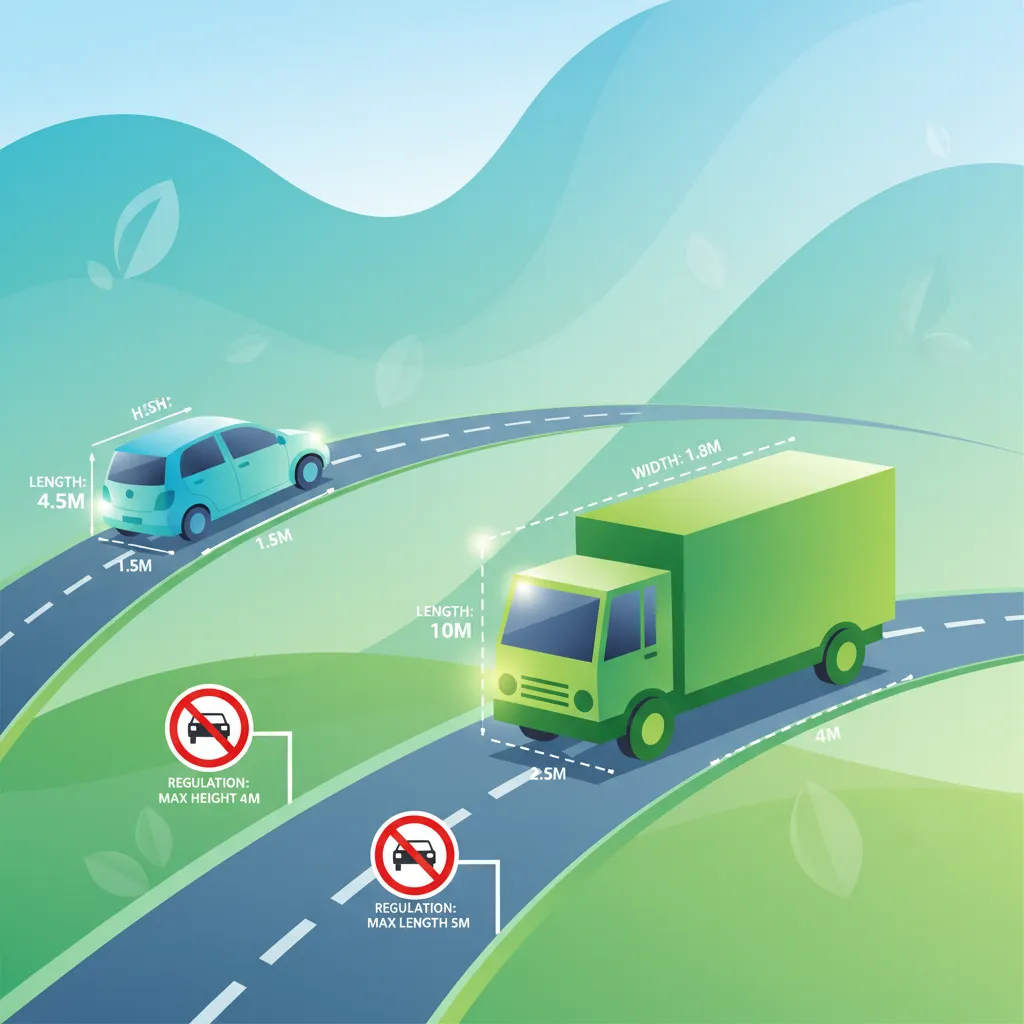
This lesson provides a detailed breakdown of the maximum permissible length, width, and height for heavy vehicles according to Spanish and EU regulations. It explains how these dimensions are measured and how they affect vehicle classification and route planning. The content emphasizes the critical importance of respecting clearance signs for bridges, tunnels, and other overhead structures to prevent accidents.

This lesson focuses on the critical relationship between speed, following distance, and overall traffic safety on highways. It explains how to calculate a safe following distance based on speed and weather conditions, accounting for a truck's longer stopping distance. The content also teaches strategies for managing speed to adapt smoothly to changing traffic flow, enhancing both safety and fuel efficiency.

This lesson explains the specific legal framework governing truck operations on Spain's high-speed road network. It details the different speed limits for trucks on autovías versus autopistas and the regulations regarding which lanes heavy vehicles are permitted to use. Learners will also understand how to interpret specific highway signage relevant to commercial vehicles and any applicable toll regulations.

This lesson details the strict EU and Spanish regulations governing drivers' working hours, driving times, and mandatory rest periods. It explains how to use a tachograph to record activity and ensure compliance with daily and weekly limits. The content also provides practical strategies for managing fatigue to maintain driver alertness and prevent accidents, a critical aspect of professional road safety.

This lesson examines the overarching legal framework that governs professional drivers in Spain, focusing on the Reglamento General de Circulación. It details the statutory obligations of a driver, such as maintaining mandatory insurance, ensuring vehicle roadworthiness, and carrying all required documentation. Learners will understand their legal responsibilities and the importance of compliance with DGT regulations to operate lawfully.

This lesson focuses on the principles of safe lane selection and overtaking on multi-lane roads and highways. It covers the importance of maintaining proper lane discipline and the legal protocols for executing a safe pass, including checking blind spots and ensuring sufficient speed differential. The content also stresses the need for clear signaling and judging adequate space before returning to the original lane.
Learn to identify road hazards and apply defensive driving techniques crucial for heavy vehicles. Focuses on understanding and protecting vulnerable road users like pedestrians and cyclists according to Spanish DGT rules.

This lesson teaches drivers how to proactively identify potential road hazards, from potholes and debris to unpredictable driver behavior. It provides specific guidance on how to adjust driving techniques to cope with adverse weather conditions such as heavy rain, fog, high winds, and icy roads. The content focuses on managing reduced visibility and traction to maintain vehicle control and safety.

This lesson focuses on the core principles of defensive driving as they apply to operating a large truck. It explains the importance of managing the space around the vehicle to create a safety buffer and always having an 'escape route' in mind. The content emphasizes anticipating the actions of other road users and being prepared to react calmly and safely to unexpected situations.

This lesson is focused on the early identification of road hazards through the application of effective scanning techniques and the use of peripheral vision. Learners will practice recognizing visual cues that signal potential dangers, such as erratic vehicle movements, unexpected obstacles, or pedestrian behavior. The module also teaches proactive response strategies designed to mitigate these risks before they can escalate into dangerous situations.

This lesson focuses on the critical skill of safely interacting with vulnerable road users, such as pedestrians and cyclists, in an urban setting. It highlights the extensive blind spots around a truck and teaches drivers to be extra vigilant, especially at intersections and crosswalks. The content covers the legal requirements for yielding and the importance of making eye contact to confirm intentions.

This lesson examines the interaction between large vehicles, such as trucks, and vulnerable road users within roundabouts. It addresses the wide turning radius of heavy vehicles, the importance of checking blind spots, and the correct yielding behavior toward pedestrians and cyclists. Learners will understand how to maintain safe distances and anticipate the movements of different road users.
This lesson provides a step-by-step guide on what to do when a vehicle breaks down on the road. It explains how to safely bring the truck to a stop, activate hazard warnings, and place reflective warning triangles as required by law. The content also covers the procedures for contacting roadside assistance and communicating the nature of the problem and the vehicle's location accurately.

This lesson provides a detailed guide to performing safe and legal overtaking maneuvers on the highway. It places strong emphasis on the techniques for thoroughly checking the large blind spots around a truck before initiating a lane change. The content also covers judging the necessary speed differential and distance required to complete the pass and return to the lane safely.
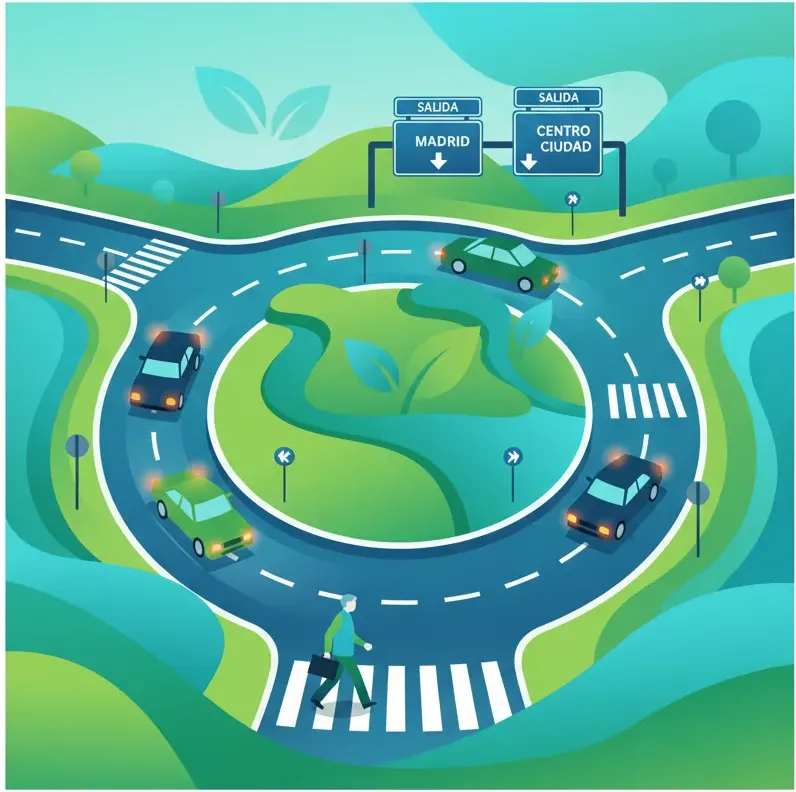
This lesson provides specific instructions on how to safely navigate complex junctions such as roundabouts and intersections with a large vehicle. It explains the rules of priority, the correct lane to use based on the intended exit, and the importance of proper vehicle positioning to account for off-tracking. The content also covers clear signaling to communicate intentions to other road users for safe and efficient passage.

This lesson outlines the correct and legally required procedures to follow in the event of a traffic incident or accident. It covers the driver's immediate responsibilities at the scene, including securing the area and contacting emergency services. The content details the process for documenting the incident and formally reporting it to the DGT and insurance companies as required by law.
This lesson focuses on the critical relationship between speed, following distance, and overall traffic safety on highways. It explains how to calculate a safe following distance based on speed and weather conditions, accounting for a truck's longer stopping distance. The content also teaches strategies for managing speed to adapt smoothly to changing traffic flow, enhancing both safety and fuel efficiency.
Find clear answers to common questions learners have about Basic Road Safety Principles. Learn how the lesson is structured, which driving theory objectives it supports, and how it fits into the overall learning path of units and curriculum progression in Spain. These explanations help you understand key concepts, lesson flow, and exam focused study goals.
Defensive driving for truck drivers in Spain involves actively anticipating potential hazards and making safe driving decisions to avoid collisions. It means always assuming other road users might make mistakes and being prepared to react, rather than simply reacting to events as they happen. This includes maintaining safe speeds, adequate following distances, and being aware of your surroundings.
Trucks have significantly longer braking distances than cars due to their weight. Maintaining a safe following distance provides the necessary space and time to brake gradually and effectively if the vehicle ahead stops suddenly. It also gives you better visibility of the road ahead and reduces the risk of being caught in a rear-end collision.
The hierarchy of road users prioritizes the safety of the most vulnerable. For truck drivers, this means being extra vigilant around pedestrians, cyclists, and motorcyclists. You must anticipate their movements, give them ample space, and ensure they are aware of your presence, especially at intersections, during turns, and in congested areas.
Speed must always be adjusted to match conditions, not just the posted limit. Factors such as weather (rain, fog, ice), road surface quality, traffic density, visibility, and the vehicle's load all influence the safe speed. Trucks require slower speeds in adverse conditions and on curves due to their higher center of gravity and inertia.
Key hazards include blind spots, other vehicles cutting you off, sudden braking by vehicles ahead, unpredictable behaviour from pedestrians and cyclists, reduced visibility in poor weather, and specific risks associated with the vehicle's size and weight, such as wider turns and longer braking distances.
Use our powerful search functionality to pinpoint specific Spanish DGT driving theory practice sets. Filter by road sign categories, traffic law topics, or question difficulty to build custom study sessions and reinforce your knowledge precisely where it matters for your official exam.