
Welcome to the Reversing and Parking Techniques lesson, a crucial part of your Official DGT Theory Course for Spanish Truck Licences. This lesson focuses on mastering high-risk maneuvers essential for safe operation of Category C and C1 vehicles, building upon the general driving principles you've learned.

Lesson content overview
Reversing and precise parking are among the most challenging and high-risk maneuvers for heavy goods vehicles (HGVs) in the Official DGT Theory Course for Spanish Truck Licence Category C & C1. Due to their considerable length, width, and extensive blind spots, trucks require exceptional skill and spatial awareness when moving backward or positioning within confined areas. This lesson provides theoretical guidance to master these critical techniques, ensuring safety, compliance with DGT regulations, and the protection of cargo and other road users.
Reversing a heavy vehicle significantly increases the risk of collisions, not only with static objects but also with pedestrians, cyclists, and other vehicles. The sheer size of trucks, especially those with trailers, creates vast blind spots that conventional mirrors cannot fully mitigate. Furthermore, the dynamics of a heavy load can change drastically during deceleration or acceleration while reversing, potentially leading to instability or cargo damage.
Mastery of these maneuvers is paramount for professional drivers. It directly reduces the likelihood of accidents, minimizes damage to the vehicle and infrastructure, and ensures adherence to stringent DGT safety standards. A thorough understanding of vehicle dimensions, mirror capabilities, and load securing principles, as covered in earlier modules, forms a crucial foundation for this lesson.
Before initiating any reverse maneuver, a professional driver must conduct a meticulous check of all mirrors and an assessment of potential blind spots. Proper adjustment and continuous monitoring of mirrors are fundamental to maintaining situational awareness. Heavy vehicles are equipped with multiple mirrors, each designed to cover specific areas around the truck.
The primary goal is to achieve maximum visibility of the rear and side areas of the vehicle.
Wide-Angle and Convex Mirrors: Heavy trucks often feature wide-angle mirrors (sometimes called 'spot mirrors') and additional convex mirrors. These are specifically designed to extend the field of vision and help detect objects in areas that would otherwise be entirely hidden. Learn to use each mirror effectively for its intended purpose.
Drivers must develop a habit of checking their mirrors at least twice before beginning to reverse and continuously throughout the maneuver. This constant scanning technique helps to compensate for the dynamic nature of blind spots as the vehicle changes direction. A common misunderstanding is assuming a single glance or relying solely on the interior mirror is sufficient; this is highly inadequate for heavy vehicles.
Even with optimally adjusted mirrors, heavy vehicles will always have inherent blind spots that cannot be fully eliminated. In such situations, especially in congested areas, tight loading docks, or environments with vulnerable road users, a spotter becomes an indispensable safety asset.
A spotter provides an external set of eyes, communicating critical information about clearances, obstacles, and the presence of other road users. According to DGT Article 144.2, a spotter is mandatory when mirrors cannot guarantee an adequate view.
Pre-Maneuver Briefing: Before starting, the driver and spotter must agree on standard hand signals and verbal commands (e.g., "stop," "go," "turn left/right," "clear," "slow down").
Maintain Eye Contact: The spotter must maintain constant eye contact with the driver, ensuring signals are seen and understood. If eye contact is lost, the driver must stop immediately.
Safe Positioning: The spotter should stand in a safe, visible position, preferably behind and slightly to the side of the vehicle, never directly behind or between the vehicle and an obstacle. They should also be aware of the truck's swing-out path.
Clear Signals: Use large, unambiguous hand signals. For verbal communication, use a clear, loud voice or a two-way radio if available, especially in noisy environments.
Walking Spotter: In complex scenarios, a "walking spotter" may move around the vehicle to provide panoramic guidance, continuously updating the driver on their surroundings.
A common mistake is for drivers to rely solely on mirrors even when a spotter is available or required. The spotter's role is to provide an extra layer of safety, not to replace the driver's responsibility to check mirrors and be aware.
Precision is key when parking a heavy vehicle, especially in parallel parking scenarios or when backing into a confined space like a loading dock. Understanding the geometric principles governing a truck's movement is crucial for success. These principles involve the vehicle's pivot points, turning radii, and how they interact with surrounding spaces.
For parallel parking, drivers must calculate the "turn-in point" – the specific location where initial steering input is applied to enter a parking space. This calculation depends on the vehicle's wheelbase and the required clearance. A common technique is the "Reference Line Method," where the driver aligns a specific point on their vehicle (e.g., the rear bumper) with a reference point on the adjacent parked vehicle before initiating the reverse turn.
Parallel parking a heavy vehicle demands careful planning and execution. It's often required in urban environments where space is limited.
Assess the Space: Ensure the parking space is large enough to accommodate the truck, allowing for DGT-mandated minimum clearances. Typically, a space 1.5 times the length of the truck is required.
Position Alongside: Pull up alongside the vehicle in front of the target space, maintaining a lateral distance of approximately 1 to 1.5 metres. Align your rear bumper with the rear bumper of the vehicle you are parking behind (Reference Line Method).
Initial Reverse Turn: Engage reverse gear, activate reverse lights, and check all mirrors. Begin reversing slowly while turning the steering wheel fully towards the curb. Monitor your right-side mirror to observe the truck's rear approaching the curb.
Straighten Up: When the vehicle's rear (or the trailer's rear, for articulated vehicles) is approximately at a 45-degree angle to the curb, begin to straighten the steering wheel. Continue reversing slowly.
Counter-Steer: As the front of the truck clears the vehicle in front, turn the steering wheel fully in the opposite direction (away from the curb) while still reversing. This will bring the front of the truck into the space.
Adjust and Align: Once parallel to the curb, make small forward and backward adjustments to center the truck within the space and achieve the legal minimum lateral clearance.
Over-steering is a common mistake. It often leads to the wheels hitting the curb or the vehicle ending up too far from the curb. Small, controlled steering inputs are crucial.
Backing into a loading dock is a specialized reversing maneuver that requires exceptional precision, especially when driving an articulated vehicle. The goal is to align the trailer perfectly with the dock opening without striking the dock structure or other obstacles.
The technique for backing into a loading dock often involves a series of forward and backward adjustments, making small steering corrections to control the trailer's path. Due to the limited visibility and tight clearances, the use of a spotter is almost always necessary and strongly recommended, if not mandatory.
Drivers must pay close attention to the pivot point of the trailer, understanding how steering the tractor affects the trailer's angle and direction. Gradual acceleration and deceleration are vital to prevent sudden load shifts and maintain control.
Reversing an articulated vehicle (a tractor-unit with a semi-trailer) is significantly more complex than reversing a rigid truck. The presence of a pivot point between the tractor and trailer introduces unique challenges, primarily the risk of a "jackknife."
The key to successfully reversing with a trailer is to make small, smooth steering inputs and to continuously monitor the trailer's angle in the mirrors. A common technique is "slow-steer-and-reverse":
DGT Article 145 explicitly states that trailers must be controlled from the cab and not manually pushed or pulled by the driver. This underscores the need for precise control through steering and throttle.
Adhering to minimum clearance requirements is not just about preventing damage; it is a legal obligation under DGT regulations. These distances ensure that parked vehicles do not obstruct traffic flow, create hazards, or encroach upon pedestrian areas.
According to DGT Article 86 (and Article 46 for urban parking), the following minimum clearances are generally required:
Drivers often underestimate the space required for large vehicles, leading to parking too close to curbs or adjacent vehicles. Before attempting to park, visually assess the space and consider using a spotter to confirm clearances, especially in tight spots.
The stability of a heavy vehicle is profoundly influenced by its cargo. During any change in motion – acceleration, deceleration, or turning – the load can shift. This "load shift" is a significant concern during reversing, as it can compromise vehicle stability and control.
DGT Article 143.2 mandates that all cargo must be properly secured to prevent movement that could endanger vehicle stability or fall from the vehicle. This is critical during reversing, even at low speeds.
A common misunderstanding is that low speeds negate load shift concerns. Even slight shifts can be amplified in sensitive maneuvers, impacting steering response and braking.
Compliance with DGT regulations is not just a legal formality but a cornerstone of safe heavy vehicle operation. Several key rules govern reversing and parking maneuvers.
| Rule | Statement | Applicability | Legal Status | Rationale |
|---|---|---|---|---|
| Mirror Coverage | Side mirrors must provide at least 150° combined rear view before reversing. | All reversing maneuvers, especially with cargo. | Mandatory (DGT Art. 143.1) | Reduces blind spots and prevents collisions. |
| Spotter Requirement | A spotter must be used when mirrors cannot guarantee a clear view. | Heavy vehicle reversing in congested areas or loading docks. | Mandatory when mirrors insufficient (Art. 144.2) | Provides external visual confirmation, enhancing safety. |
| Minimum Lateral Clearance | Minimum distance from curb or parked vehicle must be 0.5 m. | Parallel parking on city streets. | Mandatory (DGT Art. 86) | Protects vehicle body and curb integrity, prevents obstruction. |
| Load Securing | All cargo must be restrained to prevent movement during any vehicle motion. | All freight transport. | Mandatory (DGT Art. 143.2) | Prevents load shifting, maintaining vehicle stability. |
| Suggested Reverse Speed | Maximum suggested speed while reversing is 5 km/h for heavy vehicles. | Any reverse operation. | Recommended (DGT guidance) | Allows sufficient reaction time to avoid obstacles. |
| Use of Reverse Lights | Reverse lights must be activated whenever the vehicle is moving backward. | All reverse maneuvers. | Mandatory (DGT Art. 47) | Warns other road users and pedestrians of reversing action. |
Even experienced drivers can fall prey to common errors during reversing and parking. Being aware of these pitfalls is the first step towards avoiding them.
Driving conditions can significantly impact the safety and difficulty of reversing and parking maneuvers. Professional drivers must learn to adapt their techniques to environmental and contextual variations.
Mastering reversing and parallel parking techniques for heavy vehicles is an indispensable skill for any professional driver seeking a Spanish Truck Licence Category C or C1. It combines theoretical knowledge with practical application, demanding constant vigilance and adherence to DGT regulations.
By diligently applying these principles, you will significantly reduce the risk of incidents, protect yourself and others, and demonstrate the professionalism required for heavy vehicle operation.
Reversing and parking heavy vehicles demands exceptional precision due to extensive blind spots and unique geometric challenges. Drivers must optimize mirror coverage providing at least 150° combined rear view, deploy a spotter whenever mirrors are insufficient, and maintain ≤5 km/h reverse speed. Parallel parking requires using the Reference Line Method with a space 1.5 times the vehicle length, while articulated vehicles require counterintuitive steering and constant trailer angle monitoring to prevent jackknifing. DGT regulations mandate specific clearances (0.5m lateral, 1m longitudinal), proper cargo securing, and reverse light activation for legal compliance and safety.
A short set of high-value points that capture the most important learning from this lesson.
Heavy vehicles require optimal mirror adjustment providing at least 150° combined rear view before any reversing maneuver.
A spotter is mandatory when mirrors cannot guarantee adequate visibility, and the driver must stop immediately if eye contact is lost.
Parallel parking heavy vehicles requires a space approximately 1.5 times the truck's length, using the Reference Line Method for positioning.
Reversing with a trailer requires counterintuitive steering: turn the wheel opposite to where you want the trailer rear to go.
DGT mandates minimum 0.5m lateral clearance and 1m longitudinal clearance from obstacles when parking heavy vehicles.
Explore all units and lessons included in this driving theory course.
DGT Article 144.2 requires a spotter whenever mirrors cannot guarantee clear rear visibility during reversing.
For articulated vehicles, jackknife risk is prevented by using small, smooth steering inputs and continuously monitoring the trailer angle in mirrors.
Maximum recommended reverse speed for heavy vehicles is 5 km/h to allow sufficient reaction time.
The Reference Line Method aligns your rear bumper with the adjacent vehicle's rear bumper before initiating the reverse turn.
Always activate reverse lights when moving backward to warn other road users, per DGT Article 47.
Adjusting mirrors only for forward driving and beginning reverse without optimizing rear visibility coverage.
Attempting to reverse in congested areas without deploying a spotter, relying solely on mirrors.
Reversing at excessive speed, reducing reaction time to sudden obstacles or load shift effects.
Failing to properly secure cargo before reversing, allowing load movement that compromises vehicle stability.
Sharp steering inputs when reversing a trailer, causing the articulation angle to become too acute and risking jackknife.
Lesson content overview
A short set of high-value points that capture the most important learning from this lesson.
Heavy vehicles require optimal mirror adjustment providing at least 150° combined rear view before any reversing maneuver.
A spotter is mandatory when mirrors cannot guarantee adequate visibility, and the driver must stop immediately if eye contact is lost.
Parallel parking heavy vehicles requires a space approximately 1.5 times the truck's length, using the Reference Line Method for positioning.
Reversing with a trailer requires counterintuitive steering: turn the wheel opposite to where you want the trailer rear to go.
DGT mandates minimum 0.5m lateral clearance and 1m longitudinal clearance from obstacles when parking heavy vehicles.
Explore all units and lessons included in this driving theory course.
DGT Article 144.2 requires a spotter whenever mirrors cannot guarantee clear rear visibility during reversing.
For articulated vehicles, jackknife risk is prevented by using small, smooth steering inputs and continuously monitoring the trailer angle in mirrors.
Maximum recommended reverse speed for heavy vehicles is 5 km/h to allow sufficient reaction time.
The Reference Line Method aligns your rear bumper with the adjacent vehicle's rear bumper before initiating the reverse turn.
Always activate reverse lights when moving backward to warn other road users, per DGT Article 47.
Adjusting mirrors only for forward driving and beginning reverse without optimizing rear visibility coverage.
Attempting to reverse in congested areas without deploying a spotter, relying solely on mirrors.
Reversing at excessive speed, reducing reaction time to sudden obstacles or load shift effects.
Failing to properly secure cargo before reversing, allowing load movement that compromises vehicle stability.
Sharp steering inputs when reversing a trailer, causing the articulation angle to become too acute and risking jackknife.
Explore search topics learners often look for when studying Reversing and Parallel Parking Techniques. These topics reflect common questions about road rules, driving situations, safety guidance, and lesson level theory preparation for learners in Spain.
Browse additional driving theory lessons that cover connected traffic rules, road signs, and common driving situations related to this topic. Improve your understanding of how different rules interact across everyday traffic scenarios.
Explore advanced theory on reversing and parking heavy trucks and articulated vehicles in Spain. Learn detailed strategies for trailer articulation, jackknife prevention, and precise maneuvering in confined spaces, essential for Category C and C1 licences.

This lesson focuses on the complexities of reversing while towing a trailer. It explains the phenomenon of trailer swing and the counter-steering inputs required to guide it correctly. The content details proper use of mirrors and observation to control the trailer's path, adhering to DGT rules and ensuring the maneuver is planned and executed safely.

This lesson focuses on the core principles of defensive driving as they apply to operating a large truck. It explains the importance of managing the space around the vehicle to create a safety buffer and always having an 'escape route' in mind. The content emphasizes anticipating the actions of other road users and being prepared to react calmly and safely to unexpected situations.

This lesson addresses the dynamics of accelerating, braking, and turning while towing a trailer. It explains how to adjust for increased load inertia, the impact on stopping distances, and the need for wider turns to account for off-tracking. The content outlines DGT speed guidelines specific to towing and emphasizes smooth control to ensure stability.

This lesson provides guidance on the practical aspects of parking and making deliveries in urban areas. It covers the techniques for safely maneuvering into and out of loading docks and designated delivery zones, which often involves precise reversing. The content also explains the specific parking regulations that apply to commercial vehicles and best practices for ensuring safety during loading and unloading.

This lesson covers the essential techniques for perpendicular parking (reversing into a bay) and executing a three-point turn. It details the approach, turning points, and use of mirrors and observation to ensure proper vehicle positioning. Learners will understand how to assess the required space and comply with DGT regulations for these common maneuvers.

This lesson provides a detailed guide to performing safe and legal overtaking maneuvers on the highway. It places strong emphasis on the techniques for thoroughly checking the large blind spots around a truck before initiating a lane change. The content also covers judging the necessary speed differential and distance required to complete the pass and return to the lane safely.

This lesson provides specific instructions on how to safely navigate complex junctions such as roundabouts and intersections with a large vehicle. It explains the rules of priority, the correct lane to use based on the intended exit, and the importance of proper vehicle positioning to account for off-tracking. The content also covers clear signaling to communicate intentions to other road users for safe and efficient passage.

This lesson addresses the practical aspects of maneuvering a large vehicle in various environments. It explains concepts like turning radius, off-tracking, and the vehicle's total footprint, which determine the space needed for turns and other maneuvers. Learners will develop the spatial awareness required to navigate tight corners, loading bays, and urban streets while maintaining safe clearance from obstacles.

In this lesson, learners will acquire the necessary skills to maneuver buses and coaches within confined areas such as narrow city streets, bus depots, and passenger terminals. It details techniques for reverse driving, tight cornering, and parallel parking, emphasizing the critical importance of blind spot awareness and precise low-speed control. The content focuses on developing spatial awareness to avoid collisions while maintaining passenger comfort.

This lesson focuses on the critical skill of safely interacting with vulnerable road users, such as pedestrians and cyclists, in an urban setting. It highlights the extensive blind spots around a truck and teaches drivers to be extra vigilant, especially at intersections and crosswalks. The content covers the legal requirements for yielding and the importance of making eye contact to confirm intentions.
Understand the critical safety risks associated with reversing heavy vehicles in Spain. This lesson covers DGT regulations on mirror usage, blind spots, the mandatory use of spotters, and essential checks to ensure safe maneuvering and compliance.
This lesson provides a detailed guide to performing safe and legal overtaking maneuvers on the highway. It places strong emphasis on the techniques for thoroughly checking the large blind spots around a truck before initiating a lane change. The content also covers judging the necessary speed differential and distance required to complete the pass and return to the lane safely.
This lesson provides guidance on the practical aspects of parking and making deliveries in urban areas. It covers the techniques for safely maneuvering into and out of loading docks and designated delivery zones, which often involves precise reversing. The content also explains the specific parking regulations that apply to commercial vehicles and best practices for ensuring safety during loading and unloading.
This lesson focuses on the core principles of defensive driving as they apply to operating a large truck. It explains the importance of managing the space around the vehicle to create a safety buffer and always having an 'escape route' in mind. The content emphasizes anticipating the actions of other road users and being prepared to react calmly and safely to unexpected situations.
This lesson provides specific instructions on how to safely navigate complex junctions such as roundabouts and intersections with a large vehicle. It explains the rules of priority, the correct lane to use based on the intended exit, and the importance of proper vehicle positioning to account for off-tracking. The content also covers clear signaling to communicate intentions to other road users for safe and efficient passage.
This lesson focuses on the critical skill of safely interacting with vulnerable road users, such as pedestrians and cyclists, in an urban setting. It highlights the extensive blind spots around a truck and teaches drivers to be extra vigilant, especially at intersections and crosswalks. The content covers the legal requirements for yielding and the importance of making eye contact to confirm intentions.

This lesson focuses on the principles of safe lane selection and overtaking on multi-lane roads and highways. It covers the importance of maintaining proper lane discipline and the legal protocols for executing a safe pass, including checking blind spots and ensuring sufficient speed differential. The content also stresses the need for clear signaling and judging adequate space before returning to the original lane.

This lesson focuses on interaction dynamics with larger vehicles like cars, trucks, and buses, detailing their specific blind spot zones. Strategies for safely sharing lanes, overtaking etiquette, and proper approach when a bus stops are covered. The lesson also includes guidance on merging onto acceleration lanes following DGT policies.

This lesson provides a broad overview of the key traffic regulations in Spain that directly impact professional truck drivers. It details the rules of priority at intersections, the interpretation of different road markings, and the principles of correct lane discipline. Furthermore, it explains the specific speed limits applicable to heavy vehicles and the legal protocols for safe overtaking and signaling.

This lesson examines the interaction between large vehicles, such as trucks, and vulnerable road users within roundabouts. It addresses the wide turning radius of heavy vehicles, the importance of checking blind spots, and the correct yielding behavior toward pedestrians and cyclists. Learners will understand how to maintain safe distances and anticipate the movements of different road users.
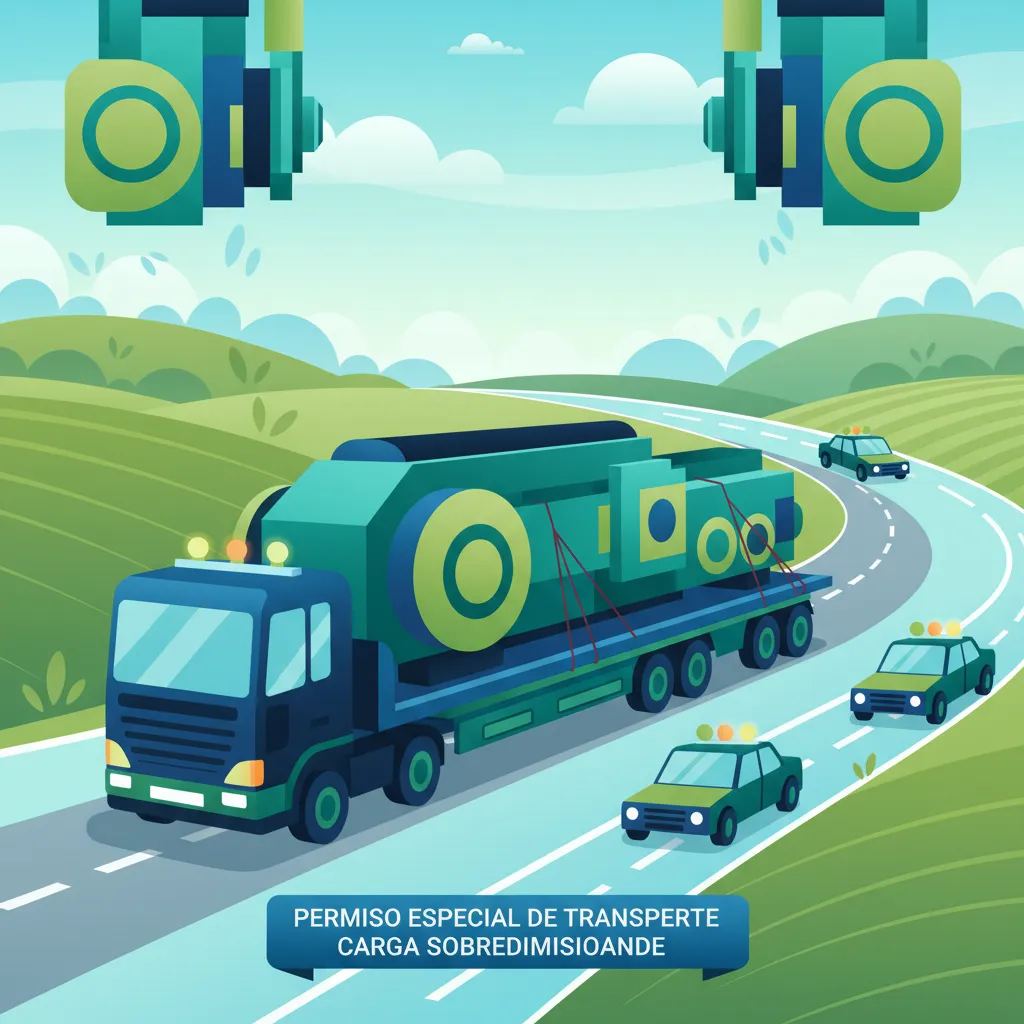
This lesson addresses the special regulations that apply to transporting loads that exceed standard legal dimensions or weight. It explains the process for obtaining the necessary special permits from the DGT and other authorities. The content also covers the requirements for route planning, the use of escort vehicles (pilot cars), and the mandatory signage and lighting for the vehicle.
Find clear answers to common questions learners have about Reversing and Parallel Parking Techniques. Learn how the lesson is structured, which driving theory objectives it supports, and how it fits into the overall learning path of units and curriculum progression in Spain. These explanations help you understand key concepts, lesson flow, and exam focused study goals.
Reversing a large truck in Spain presents several challenges, primarily due to their size and extensive blind spots. Maneuvering in tight urban areas, navigating narrow streets, and precisely positioning the vehicle for parking or loading require constant vigilance. Understanding your vehicle's turning radius and off-tracking is crucial, along with effective use of mirrors and, if possible, a trained spotter to guide you.
Mirrors are absolutely critical for safe reversing of trucks under DGT regulations. You must constantly monitor your side mirrors and rear-view mirrors to understand your vehicle's position relative to obstacles and the road. The theory exam often includes questions about using mirrors correctly to maintain awareness of your surroundings and avoid collisions.
While not always legally mandatory for every reversing situation, using a spotter is highly recommended and often considered best practice by the DGT, especially in complex environments or when visibility is severely limited. The theory exam may present scenarios where a spotter is essential for safety, and you'll be tested on how to coordinate with one.
Off-tracking refers to the phenomenon where the rear wheels of a truck follow a different, tighter path than the front wheels when turning. For parallel parking and navigating corners, understanding off-tracking is vital. It ensures you don't hit curbs, other vehicles, or infrastructure with your trailer or rear axles, a concept frequently tested in the Spanish truck driving theory exam.
The DGT theory exam for Category C and C1 licences includes questions that assess your understanding of safe reversing and parking procedures. These questions often focus on mirror usage, blind spot awareness, identifying potential hazards, understanding maneuvering principles like off-tracking, and the importance of spotters in specific situations.
Use our powerful search functionality to pinpoint specific Spanish DGT driving theory practice sets. Filter by road sign categories, traffic law topics, or question difficulty to build custom study sessions and reinforce your knowledge precisely where it matters for your official exam.