Logo
Spanish Driving Theory Courses

Lesson 4 of the Turning & Manoeuvring unit

Spanish Truck Driving Theory C/C1: Navigating Roundabouts and Intersections

This lesson covers critical DGT regulations for safely navigating complex junctions like roundabouts and intersections, specifically for Category C and C1 truck drivers. Building on fundamental road rules, you'll learn how to manage priority, select the correct lane, and account for your vehicle's size to ensure safe passage. Mastering these skills is vital for both your theory exam and everyday professional driving.
roundaboutsintersectionstruck drivingDGT rulespriority
Spanish Truck Driving Theory C/C1: Navigating Roundabouts and Intersections

Lesson content overview

Spanish Truck Driving Theory C/C1

Navigating Roundabouts and Intersections with Heavy Vehicles

Navigating junctions, especially roundabouts and multi-way intersections, presents unique challenges for professional drivers of Category C and C1 vehicles. These areas are high-risk zones where errors, amplified by the size and weight of a truck, can lead to severe collisions. This lesson provides essential guidance for safely maneuvering these complex points, integrating legal requirements with the physical realities of operating a large vehicle.

Understanding the specific rules of priority, mastering lane selection, anticipating vehicle off-tracking, and communicating intentions clearly are paramount. A thorough grasp of these principles is not only crucial for passing your Spanish professional truck driving theory exam but also for ensuring a safe and efficient career on the road.

Core Principles for Safe Junction Navigation in Trucks

Successfully negotiating roundabouts and intersections with a Category C vehicle hinges on a few fundamental principles that combine legal mandates, vehicle dynamics, and proactive communication.

Right-of-Way Hierarchy: Understanding Priority Rules

Definition

Right-of-Way

The legal order dictating which vehicle or road user has precedence to proceed first at a junction or during a maneuver.
The right-of-way, or priority, defines the legal order in which vehicles and other road users are permitted to proceed at a junction. This hierarchy is established through traffic signs, signals, and general traffic rules, and its strict observance prevents conflicts and ensures a predictable flow of traffic. As a professional driver, it is your responsibility to accurately assess who has priority and yield accordingly, even if it means waiting longer than smaller vehicles. Misjudging priority is a leading cause of collisions at intersections.

Lane Discipline: Selecting the Correct Path

Definition

Lane Discipline

The practice of choosing and maintaining the appropriate lane for a vehicle's intended direction of travel, particularly important at junctions.
Lane discipline involves selecting the correct lane well in advance of a junction, based on your intended exit. For heavy vehicles, this is even more critical due to their larger dimensions and reduced agility. Choosing the correct lane early prevents the need for hazardous last-minute lane changes within the junction itself, which can be extremely dangerous with a truck. Maintaining your chosen lane throughout the maneuver ensures a predictable trajectory for other road users.

Off-Tracking Management: Accounting for Rear Wheel Movement

Definition

Off-Tracking

The phenomenon where the rear wheels of a vehicle follow a smaller radius than the front wheels during a turn, resulting in the rear of the vehicle cutting inside the path of the front.
Off-tracking is a physical characteristic of all vehicles with multiple axles, but it is significantly more pronounced in long-wheelbase vehicles like trucks and combinations. During a turn, the rear wheels do not follow the exact path of the front wheels; instead, they cut a tighter arc. Failing to account for this can lead to the rear of your truck or trailer encroaching into adjacent lanes, hitting curbs, street furniture, pedestrians, or other vehicles. Professional drivers must anticipate this deviation and position their vehicle accordingly to ensure all parts clear the turn safely.

Clear Signaling: Communicating Your Intentions

Definition

Signaling

The use of a vehicle's turn indicators or other means to clearly communicate a driver's intended maneuver to other road users.
Effective signaling provides anticipatory information to other road users, allowing them to adjust their speed and position safely. For large vehicles with longer reaction times and braking distances, early and continuous signaling is paramount. Signaling late or incorrectly can lead to confusion, sudden braking by other drivers, and increased collision risk. Drivers must use turn signals to indicate lane changes, entries into roundabouts, and exits from roundabouts, ensuring the signal is maintained throughout the maneuver.

The weight and distribution of your cargo significantly affect your vehicle's handling characteristics, including its stopping distance, stability, and turning radius. Heavier loads increase kinetic energy, demanding greater stopping distances and smoother, more gradual braking and acceleration. They can also influence vehicle stability, especially during turns, increasing the risk of rollovers if cornered too quickly. Drivers must constantly adjust their speed, braking, and turning radius to account for the vehicle's current load.

Visibility Compensation: Overcoming Blind Spots

Large vehicles inherently have significant blind spots, often referred to as A-, B-, and C-zones, which are areas around the vehicle not visible through mirrors alone. Junctions are particularly dangerous because other, smaller road users (like cyclists, motorcyclists, and pedestrians) can easily disappear into these zones. Professional drivers must actively compensate for these limitations by performing thorough head checks and using all available mirrors before and during any maneuver at a junction.

Roundabouts are designed to improve traffic flow, but they demand specific attention from truck drivers due to their geometry and the need to accommodate large turning radii.

Right-of-Way at Roundabouts: Entry and Circulation Priority

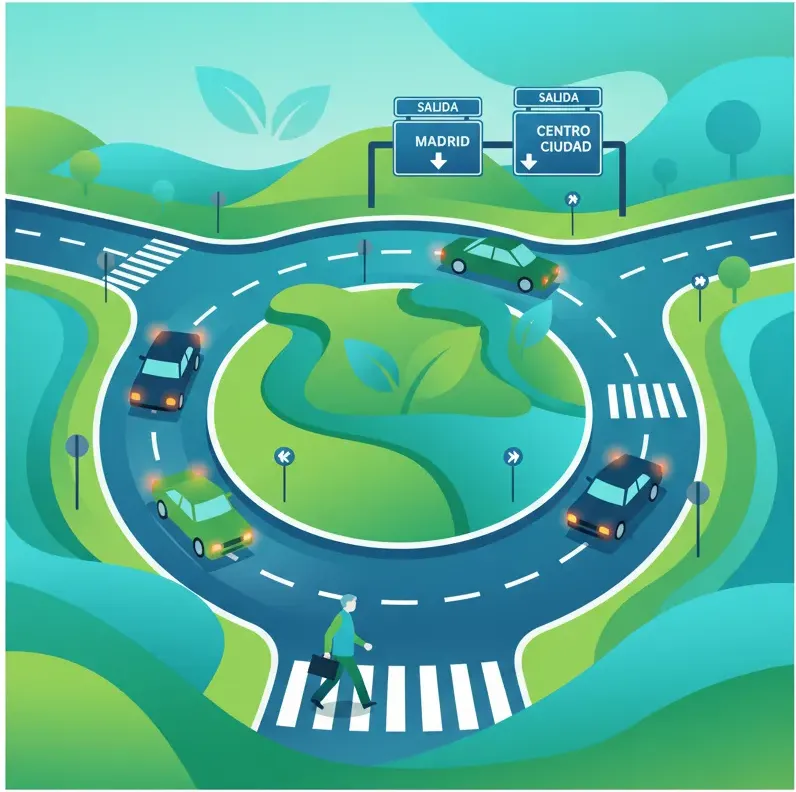
In Spain, as per DGT Order 319/99, Annex I, the fundamental rule for roundabouts is that vehicles already circulating within the roundabout have priority over those intending to enter. This means you must yield to any traffic already inside the roundabout before you can enter. Once inside, you maintain priority over vehicles wishing to enter from subsequent entry points.

Yielding to pedestrians is also critical. If pedestrians are crossing at designated points on approach or exit, they always have priority. A common misunderstanding is assuming entry is always free or neglecting to yield to circulating traffic. Always approach with caution, scan the roundabout thoroughly, and be prepared to stop.

Lane Selection for Roundabouts (Category C Vehicles)

Choosing the correct lane before entering a multi-lane roundabout is crucial for heavy vehicles. DGT Circular 1/2020 specifies that trucks over 3,500 kg must occupy the lane that aligns with their intended exit and may not change lanes inside the roundabout. This rule is designed to prevent conflicts and accommodate the truck's larger turning radius.

  • First Exit (Immediate Right): Position your vehicle in the rightmost lane on approach. Signal right as you approach the roundabout.
  • Second/Third Exit (Straight or Left): For exits beyond the first, you may need to use middle or even leftmost lanes, depending on the roundabout's design and the number of lanes. However, remember the rule about not changing lanes inside. If a roundabout design makes it impossible to reach your intended exit without changing lanes inside due to your vehicle's size, you must consider using an outer lane and circling the roundabout multiple times if necessary, or seeking an alternative route. Always prioritize safety and maintain the outermost lane if possible to minimize conflicts, even if it means taking a wider arc.

Off-Tracking in Roundabouts: Anticipating the Sweep

The turning radius of a Category C vehicle, combined with its inherent off-tracking, means your truck will occupy a larger area of the road than its physical width suggests, especially in roundabouts. DGT Technical Specification 8/1992 mandates that drivers observe the minimum turning circle for their vehicle and allow sufficient space.

When navigating a tight roundabout curve, the rear wheels of your truck or trailer will cut significantly inside the path of your front wheels. This requires you to position your vehicle further away from the inner curb upon entry and to maintain a wider path through the curve to prevent the rear from mounting the curb or encroaching into adjacent lanes. Failing to compensate can lead to hitting road furniture, sideswiping other vehicles, or even running over pedestrians or cyclists on the central island.

Signaling Requirements at Roundabouts

Proper and timely signaling is critical for trucks at roundabouts. DGT Order 225/1998 states that turn signals must be activated at least 50 metres before entering a roundabout and maintained throughout the maneuver until you have safely exited.

  • Entering: Signal your intention to enter the roundabout in the direction you plan to exit (e.g., right for the first exit, or left/straight if you need to position to the left, which you would then change to right as you pass the exit before yours).
  • Circulating: Maintain your signal as you pass exits until you are ready to leave.
  • Exiting: Crucially, signal your intention to exit the roundabout by activating your right turn signal as you pass the exit before your intended one. This tells other drivers exactly when you are leaving, preventing uncertainty and potential collisions.

Warning

Delaying signals until you are already in the roundabout, or failing to signal your exit, creates ambiguity and significantly increases the risk of accidents, especially with your vehicle's size.

Beyond roundabouts, standard intersections (crossroads, T-junctions) also demand careful navigation from truck drivers. These can be signal-controlled, priority-controlled, or uncontrolled, each with its own set of rules.

Priority Rules at Intersections

The DGT Reglamento General de Conductores outlines specific articles on "Prioridad de paso" that apply to all intersections. The primary goal is always to yield to those with priority and proceed only when it is safe and clear to do so.

Signal-Controlled Intersections

At intersections regulated by traffic lights, your primary obligation is to obey the light phases: green to proceed, amber (yellow) to stop if safe to do so, and red to stop completely.

  • Green Light: Proceed only after confirming the intersection is clear of other vehicles, pedestrians, or cyclists, and you have sufficient space to clear the intersection without stopping within it.
  • Amber Light: Prepare to stop. If you are so close to the stop line that an abrupt stop would be dangerous, you may proceed cautiously. However, with a heavy vehicle, stopping safely takes longer, so anticipate changes earlier. Do not accelerate to "beat" the light.
  • Red Light: Stop completely before the stop line. For heavy vehicles, remember that the increased braking distance when loaded means you should anticipate stopping even earlier than smaller vehicles.

Priority-Controlled Intersections

These intersections are managed by signs such as "Stop" (R-1) or "Yield" (R-2).

  • Stop Sign (R-1): You must bring your vehicle to a complete stop before the stop line. After stopping, you must yield to all traffic on the intersecting road, regardless of their direction, and only proceed when the way is clear. For a heavy vehicle, ensure your full vehicle clears the line of sight before you proceed, which might mean a brief second stop if initial visibility is poor.
  • Yield Sign (R-2): You must give way to traffic on the main road. This means you must slow down and be prepared to stop. You only proceed when it is safe to do so, ensuring you do not force other vehicles to change speed or direction.

Note

Never assume the right-hand rule applies universally at uncontrolled intersections. Always look for signs, signals, or markings that dictate priority. If no signs are present, the general rule is to yield to vehicles approaching from your right, but approach with extreme caution, ready to stop.

Critical Safety Considerations for Large Vehicles

Operating a Category C vehicle demands heightened awareness, especially at junctions where the risks are inherently higher.

Visibility Zones: Managing Blind Spots (A-, B-, C-zones)

Large vehicles have extensive blind spots that significantly hinder a driver's direct field of vision. DGT Order 331/2009 emphasizes the obligation of drivers to conduct visual checks of these blind zones.

  • A-zone (Front Blind Spot): The area directly in front of the vehicle, particularly significant for high-cab trucks, where smaller vehicles, cyclists, or pedestrians can be completely obscured. Always check this zone before moving off or proceeding through a junction.
  • B-zone (Side Blind Spots): The areas along the sides of the vehicle, often not fully covered by mirrors, especially on the right-hand side. This is where cyclists and motorcyclists often "disappear." Always perform thorough mirror checks and head checks (briefly turning your head to directly observe) before changing lanes or turning.
  • C-zone (Rear Blind Spot): The area directly behind the vehicle, which can be vast, especially with trailers. This zone is primarily managed during reversing maneuvers, but awareness of it is crucial to avoid rear-end collisions if you have to stop unexpectedly.

The mass of your load directly impacts your vehicle's kinetic energy and, consequently, its stopping distance and stability.

  • Increased Stopping Distance: A fully loaded truck requires significantly more distance to stop than an empty one, or a passenger car. At junctions, this means approaching at a lower speed, increasing your following distance from the vehicle ahead, and starting to brake earlier.
  • Vehicle Stability: High or unstable loads can affect the vehicle's center of gravity, making it more prone to rollovers during sharp turns or sudden maneuvers. Always reduce your speed significantly when turning, especially in roundabouts, to maintain stability.
  • Following Distance: Always maintain a greater follow-distance (or safety distance) between your truck and the vehicle in front, especially when loaded. This provides more time to react to sudden stops at junctions.

DGT Regulations for Junctions (Category C)

Adherence to specific Spanish DGT regulations is mandatory for professional drivers:

  • DGT Order 319/99 (Annex I): Circulating vehicles in a roundabout have priority over those entering.
  • DGT Circular 1/2020: Trucks over 3,500 kg must occupy the lane matching their intended exit and may not change lanes inside a roundabout.
  • DGT Technical Specification 8/1992: Drivers must respect the minimum turning circle of their Category C vehicle and allow sufficient space, accounting for off-tracking.
  • DGT Reglamento General de Conductores: General articles governing "Prioridad de paso" (right-of-way) at all intersections, including obedience to traffic lights and signs.
  • DGT Order 331/2009: Drivers are legally obligated to conduct visual checks of blind zones (A-, B-, C-zones) before entering or exiting any junction.
  • DGT Order 225/1998: Turn signals must be activated at least 50 metres before entering a roundabout and maintained throughout the maneuver.

Common Violations and Advanced Scenarios

Understanding common mistakes and how to handle various conditions is vital for becoming a proficient professional driver.

Frequent Violations to Avoid

  1. Late Entry Despite Yield: Entering a roundabout without yielding to circulating traffic, leading to collisions.
  2. Lane Change Inside Roundabout: Switching lanes while navigating the roundabout, often resulting in side-swipe accidents with smaller vehicles.
  3. Insufficient Gap Assessment: Attempting to enter a roundabout or intersection when the available gap is too short for the truck’s length, causing the vehicle to stop mid-junction and create a blockage.
  4. Failure to Signal Exit: Not using turn signals when exiting a roundabout, which confuses other drivers and can cause sudden braking or collisions.
  5. Ignoring Blind Spots: Relying solely on mirrors without performing physical head checks, especially when entering or exiting an intersection, leading to missing cyclists or pedestrians.
  6. Excessive Speed with Loaded Truck: Maintaining high speed when loaded, especially in roundabouts, which increases stopping distance and heightens the risk of rollover or loss of control.
  7. Misinterpreting Priority: Assuming equal priority at unsignalized intersections or failing to correctly interpret "Stop" or "Yield" signs, leading to failure to yield.
  8. Improper Off-Tracking Compensation: Not accounting for the rear-wheel drift on a tight turn, causing encroachment onto adjacent lanes, curbs, or other obstacles.
  9. Proceeding on Amber Light Unsafely: Entering an intersection on amber without ensuring it's safe to clear, potentially leading to being trapped in the middle.
  10. Improper Use of Hazard Lights: Using hazard lights while moving through an intersection. Hazard lights should only be used to indicate a stationary hazard or emergency, not to signal intent while driving.

Conditional Logic and Contextual Variations

Driving conditions significantly influence how you navigate junctions:

  • Weather Conditions:
    • Rain/Snow: Drastically reduce speed to account for longer braking distances and decreased tire grip. Increased risk of wheel slip during off-tracking maneuvers.
    • Fog: Extend visual checks and rely more heavily on all mirrors. Be prepared for significantly reduced visibility in blind zones and slow down.
  • Lighting Conditions:
    • Night: Ensure headlights (dipped beam) are functioning and clean. Increase reliance on mirrors and be extra vigilant due to reduced peripheral vision.
    • Dawn/Dusk: Use position lights or dipped beams to improve your vehicle's visibility to other road users, especially during these low-light periods.
  • Road Type:
    • Urban Intersections: Characterized by higher pedestrian and cyclist density, requiring more frequent checks of the A-zone and B-zones, and a slower approach speed.
    • Highway Interchanges: Involve higher approach speeds, demanding earlier signaling and greater emphasis on load-related stopping distances.
  • Vehicle State:
    • Fully Loaded: Demands a significant increase in following distance, much lower entry speeds at junctions, and anticipation of a much larger off-tracking footprint. Braking must be smoother and earlier.
    • Empty Trailer: While maneuverability is slightly improved, you must still respect the full off-tracking geometry. Be mindful of potential instability or "bouncing" with an empty trailer.
  • Vulnerable Users:
    • Cyclists/Pedestrians: Exercise extreme caution, especially when exiting roundabouts or turning at intersections. Always yield to pedestrians crossing at designated points. These users are easily obscured by a large vehicle's blind spots.
    • Motorcyclists: Frequently check mirrors; motorcyclists are small and fast, and can easily be in your blind zones.

Safety and Reasoning Insights

Physics of Mass and Momentum

A heavier truck possesses significantly more kinetic energy at any given speed compared to a lighter vehicle. This physical principle directly translates to:

  • Longer Stopping Distances: More energy requires more distance and time to dissipate during braking. Misjudging this can lead to overrunning stop lines or rear-ending other vehicles.
  • Greater Impact Force: In a collision, the immense mass of a truck results in a much greater destructive force.
  • Reduced Agility: Greater mass means slower acceleration, slower deceleration, and less agile maneuvering. All actions must be planned further in advance.

Human Perception Limits and Reaction Time

The average human reaction time is approximately 1.5 seconds from perceiving a hazard to initiating a response. For large vehicle drivers, this period is often longer due to:

  • Elevated Driving Position: While offering a commanding view, it can obscure closer objects (A-zone).
  • Complexity of Controls: Operating a heavy vehicle often involves more complex controls.
  • Blind Spots: The inherent blind spots reduce the immediate sensory input available to the driver. Professional drivers must compensate for these factors by increasing their vigilance, scanning further ahead, and maintaining larger safety margins.

Psychology of Predictability

Other road users (cars, motorcycles, cyclists, pedestrians) rely on predictable behavior from all drivers. When a truck driver uses consistent signaling, maintains correct lane discipline, and adheres to priority rules, it reduces uncertainty and the likelihood of accidents. Erratic or unexpected maneuvers from a large vehicle are particularly dangerous as they can induce panic or misjudgment in others, who may not have time or space to react safely.

Data Insights

Studies, including those referenced by the DGT, consistently show that collisions at junctions, especially roundabouts involving heavy vehicles, can be significantly reduced when professional drivers meticulously follow proper lane selection, signaling, and speed management protocols. For example, collisions decrease when correct lane usage and signaling are observed.

Final Concept Summary

  • Priority rules dictate that circulating traffic has precedence in roundabouts; trucks must yield on entry. At intersections, signals and signs dictate right-of-way.
  • Lane discipline is paramount, requiring Category C drivers to select the correct lane based on their intended exit before entering a roundabout or intersection, and to avoid lane changes within the junction.
  • Off-tracking is an inherent characteristic of heavy vehicle geometry; drivers must anticipate the lateral drift of rear wheels and position the vehicle accordingly to prevent encroachment.
  • Signaling must be early (≥ 50 metres before roundabout entry) and continuous throughout the maneuver to clearly communicate intentions to other road users.
  • Blind zone checks (A-, B-, C-zones) are mandatory. Drivers must perform thorough head checks to supplement mirror checks, especially for vulnerable road users.
  • Load considerations directly affect stopping distance, turning radius, and speed management. Heavier loads demand slower entry speeds, greater following distances, and smoother maneuvers.
  • Environmental factors (weather, lighting) necessitate adjustments to speed, signaling timing, and the intensity of visual checks.
  • The legal framework for junction navigation in Spain is governed by specific DGT regulations, which drivers must know and obey.
  • Common errors include late yielding, lane changes inside roundabouts, insufficient gap assessment, and neglecting blind spot verification.
  • The safety rationale for these rules stems from the physics of mass and momentum, the limitations of human perception, and the psychological need for predictability on the road.

Learn more with these articles

Learn more with these articles

Learn more with these articles

Check out these practice sets

Check out these practice sets

Lesson recap

Quick summary before you move on

Fast revision

This lesson covers the essential DGT regulations for safely navigating roundabouts and intersections with Category C/C1 vehicles in Spain. Key topics include priority rules where circulating traffic has precedence in roundabouts, strict lane discipline prohibiting lane changes inside the junction for heavy vehicles, and the physics of off-tracking which requires anticipating the rear wheels cutting inside the front wheels' path. The content emphasizes mandatory early signaling at least 50 metres before roundabout entry, comprehensive blind spot checks across A-, B-, and C-zones, and load-related adjustments affecting stopping distance and stability. Learners will also find specific guidance on handling environmental conditions, recognizing vulnerable road users, and avoiding the ten most common violations that lead to accidents or exam failures.


Core takeaways

Main ideas from this lesson

A short set of high-value points that capture the most important learning from this lesson.

Circulating vehicles inside a roundabout have priority over those attempting to enter, per DGT Order 319/99 Annex I.

Trucks over 3,500 kg must select the lane matching their intended exit before entering and may not change lanes inside the roundabout (DGT Circular 1/2020).

Off-tracking causes rear wheels to follow a tighter arc than front wheels, requiring drivers to position further from inner curbs to prevent rear encroachment.

Turn signals must be activated at least 50 metres before entering a roundabout and maintained throughout the maneuver.

Drivers must perform physical head checks to supplement mirror checks, as blind zones (A-, B-, C-zones) can hide cyclists, pedestrians, and other vehicles.

Remember this

Details worth keeping in mind

Point 1

DGT Technical Specification 8/1992 requires drivers to observe minimum turning circles and allow sufficient space for their vehicle's off-tracking footprint.

Point 2

For the first exit (immediate right), position in the rightmost lane and signal right; for subsequent exits, position in the lane aligning with your intended exit before entry.

Point 3

Heavier loads increase stopping distance and can affect vehicle stability during turns, requiring slower speeds and smoother braking at junctions.

Point 4

Signal your exit by activating the right turn signal as you pass the exit before your intended one, not when you are already at your exit.

Point 5

At signal-controlled intersections, heavy vehicles require earlier braking anticipation due to increased braking distance.

Watch for this

Frequent learner mistakes

Entering a roundabout without yielding to circulating traffic, assuming entry is free or underestimating approaching vehicle speed.

Changing lanes inside a roundabout, which is prohibited for trucks over 3,500 kg and creates side-swipe risks with other vehicles.

Attempting to enter a junction with insufficient gap for the truck's length, causing the vehicle to stop mid-junction and block traffic.

Failing to signal the exit from a roundabout, leaving other drivers uncertain about your intentions and increasing collision risk.

Relying solely on mirrors without performing head checks, leading to missed cyclists, pedestrians, or motorcyclists in blind zones.

Search topics related to Navigating Roundabouts and Intersections

Explore search topics learners often look for when studying Navigating Roundabouts and Intersections. These topics reflect common questions about road rules, driving situations, safety guidance, and lesson level theory preparation for learners in Spain.

how to navigate roundabouts with a truck in SpainDGT theory rules for intersections truckspriority on Spanish roundabouts truck category Ctruck lane selection for exits SpainSpanish driving test questions roundabouts heavy vehiclesoff-tracking rules for trucks at junctionssignalling at intersections for trucks Spainsafe truck maneuvering at junctions DGT

Related driving theory lessons for Navigating Roundabouts and Intersections

Browse additional driving theory lessons that cover connected traffic rules, road signs, and common driving situations related to this topic. Improve your understanding of how different rules interact across everyday traffic scenarios.

Priority Rules and Off-Tracking Management for Trucks at Spanish Junctions

Understand the critical DGT rules for right-of-way at intersections and roundabouts. Learn how to manage truck off-tracking to ensure safe passage through complex junctions in Spain.
priority rulesoff-trackingintersectionsroundaboutstruck drivingDGT rulesmaneuvering
Priorities at Intersections without Signals lesson image

Priorities at Intersections without Signals

This lesson addresses the crucial 'priority to the right' rule that governs traffic at intersections without signs or signals. It explains that drivers must yield to any vehicle approaching from their right-hand side. The content provides practical examples of how to assess traffic, determine the correct order of passage, and proceed with caution to safely navigate these common but potentially confusing intersections.

Spanish Moped Theory AMRoundabouts & Intersection Priorities
View lesson
Intersection Types and Right‑of‑Way Rules lesson image

Intersection Types and Right‑of‑Way Rules

This lesson analyzes the various intersection configurations found in Spanish cities, such as controlled and uncontrolled junctions. It explains the hierarchy of right-of-way, detailing when vehicles must yield, when pedestrians have priority, and how traffic signs dictate movement. Learners are guided through DGT signage conventions that determine priority at each intersection type.
Spanish Driving Theory B & BEUrban Driving
View lesson
Overview of Traffic Regulations lesson image

Overview of Traffic Regulations

This lesson provides a broad overview of the key traffic regulations in Spain that directly impact professional truck drivers. It details the rules of priority at intersections, the interpretation of different road markings, and the principles of correct lane discipline. Furthermore, it explains the specific speed limits applicable to heavy vehicles and the legal protocols for safe overtaking and signaling.
Spanish Truck Driving Theory C/C1Introduction to Professional Truck Driving
View lesson
Roundabouts and Priority Rules in Urban Settings lesson image

Roundabouts and Priority Rules in Urban Settings

This lesson offers a comprehensive guide to navigating roundabouts in urban settings, explaining the correct protocols for entry, yielding, and circulation. Learners will be taught how to interpret lane markings and signage on multi-lane roundabouts and determine the correct vehicle positioning for safe entry and exit. The content emphasizes full compliance with Spanish city regulations that govern priority and right-of-way at these intersections.
Spanish Driving Theory D & D1Urban Bus Driving
View lesson
Large Vehicle and Pedestrian Interactions at Roundabouts lesson image

Large Vehicle and Pedestrian Interactions at Roundabouts

This lesson examines the interaction between large vehicles, such as trucks, and vulnerable road users within roundabouts. It addresses the wide turning radius of heavy vehicles, the importance of checking blind spots, and the correct yielding behavior toward pedestrians and cyclists. Learners will understand how to maintain safe distances and anticipate the movements of different road users.

Spanish Driving Theory B & BERoundabouts & Priority Rules
View lesson
Lane Selection and Overtaking Protocols lesson image

Lane Selection and Overtaking Protocols

This lesson focuses on the principles of safe lane selection and overtaking on multi-lane roads and highways. It covers the importance of maintaining proper lane discipline and the legal protocols for executing a safe pass, including checking blind spots and ensuring sufficient speed differential. The content also stresses the need for clear signaling and judging adequate space before returning to the original lane.
Spanish Truck Driving Theory C/C1Turning & Manoeuvring
View lesson
Yielding Rules and Lane Positioning in Rotaries lesson image

Yielding Rules and Lane Positioning in Rotaries

This lesson focuses on the yielding hierarchy that governs roundabout usage in Spain. It clarifies that vehicles already circulating have priority over those entering and explains the proper lane positioning based on the intended exit. The content includes the correct use of signals for changing lanes and exiting, and safe merging techniques.
Spanish Driving Theory B & BERoundabouts & Priority Rules
View lesson
Yield Rules at Roundabouts lesson image

Yield Rules at Roundabouts

This lesson clarifies the primary rule for roundabouts: all vehicles entering must yield to traffic already on the circular roadway. It explains how to approach a roundabout, select the appropriate lane based on the intended exit, and merge safely into the flow of traffic. Proper signaling before exiting is also covered, ensuring other drivers can anticipate the rider's movements for a smooth and safe negotiation of the junction.
Spanish Moped Theory AMRoundabouts & Intersection Priorities
View lesson
Negotiating Roundabouts and Intersections lesson image

Negotiating Roundabouts and Intersections

This lesson outlines the proper techniques for negotiating roundabouts and signal-controlled intersections in Spain. It explains priority rules at entry, lane selection based on the intended exit, and yielding to circulating traffic. The content also covers compliance with traffic signals and DGT regulations, including handling cyclist crossings.
Spanish Motorcycle Theory (A, A1, A2)Road Positioning & Traffic Interaction
View lesson
Design and Function of Spanish Roundabouts lesson image

Design and Function of Spanish Roundabouts

This lesson examines the structural components of a typical Spanish roundabout, describing the central island, entry and circulating lanes, and the placement of yield signs. It outlines how DGT standards dictate the geometric design and entry/exit points to ensure smooth traffic flow. Understanding these design elements enables drivers to anticipate vehicle movements and navigate safely.

Spanish Driving Theory B & BERoundabouts & Priority Rules
View lesson

Truck Visibility, Load Effects, and Safe Maneuvering at Spanish Junctions

Master DGT guidance on compensating for truck blind spots and understanding how cargo load impacts stability and braking. Essential theory for safe junction navigation with heavy vehicles.

blind spotsload managementvehicle handlingjunctionstruck drivingsafetyDGT theory
Overtaking Strategies and Blind Spot Awareness lesson image

Overtaking Strategies and Blind Spot Awareness

This lesson provides a detailed guide to performing safe and legal overtaking maneuvers on the highway. It places strong emphasis on the techniques for thoroughly checking the large blind spots around a truck before initiating a lane change. The content also covers judging the necessary speed differential and distance required to complete the pass and return to the lane safely.

Spanish Truck Driving Theory C/C1Highway Driving & Overtaking
View lesson
Stop-and-Go Situations and Pedestrian Interaction lesson image

Stop-and-Go Situations and Pedestrian Interaction

This lesson focuses on the critical skill of safely interacting with vulnerable road users, such as pedestrians and cyclists, in an urban setting. It highlights the extensive blind spots around a truck and teaches drivers to be extra vigilant, especially at intersections and crosswalks. The content covers the legal requirements for yielding and the importance of making eye contact to confirm intentions.

Spanish Truck Driving Theory C/C1Urban Driving with Trucks
View lesson
Lane Selection and Overtaking Protocols lesson image

Lane Selection and Overtaking Protocols

This lesson focuses on the principles of safe lane selection and overtaking on multi-lane roads and highways. It covers the importance of maintaining proper lane discipline and the legal protocols for executing a safe pass, including checking blind spots and ensuring sufficient speed differential. The content also stresses the need for clear signaling and judging adequate space before returning to the original lane.

Spanish Truck Driving Theory C/C1Turning & Manoeuvring
View lesson
Reversing and Parallel Parking Techniques lesson image

Reversing and Parallel Parking Techniques

This lesson provides theoretical guidance on the techniques for safely reversing a heavy vehicle, a high-risk maneuver. It emphasizes the correct use of mirrors, managing extensive blind spots, and the importance of using a spotter when available. The content also breaks down the geometric principles of parallel parking and backing into loading docks, focusing on vehicle positioning and spatial awareness.
Spanish Truck Driving Theory C/C1Turning & Manoeuvring
View lesson
Defensive Driving Techniques for Trucks lesson image

Defensive Driving Techniques for Trucks

This lesson focuses on the core principles of defensive driving as they apply to operating a large truck. It explains the importance of managing the space around the vehicle to create a safety buffer and always having an 'escape route' in mind. The content emphasizes anticipating the actions of other road users and being prepared to react calmly and safely to unexpected situations.

Spanish Truck Driving Theory C/C1Hazard Perception & Safety
View lesson
Identifying Road Hazards and Weather Impacts lesson image

Identifying Road Hazards and Weather Impacts

This lesson teaches drivers how to proactively identify potential road hazards, from potholes and debris to unpredictable driver behavior. It provides specific guidance on how to adjust driving techniques to cope with adverse weather conditions such as heavy rain, fog, high winds, and icy roads. The content focuses on managing reduced visibility and traction to maintain vehicle control and safety.

Spanish Truck Driving Theory C/C1Hazard Perception & Safety
View lesson
Interaction with Cars, Trucks, and Buses lesson image

Interaction with Cars, Trucks, and Buses

This lesson focuses on interaction dynamics with larger vehicles like cars, trucks, and buses, detailing their specific blind spot zones. Strategies for safely sharing lanes, overtaking etiquette, and proper approach when a bus stops are covered. The lesson also includes guidance on merging onto acceleration lanes following DGT policies.

Spanish Motorcycle Theory (A, A1, A2)Road Positioning & Traffic Interaction
View lesson
Lighting, Mirrors, and Visibility Systems lesson image

Lighting, Mirrors, and Visibility Systems

This lesson outlines the proper use and legal requirements of vehicle lighting and mirror systems. It covers headlamps, fog lights, turn signals, and brake lights, clarifying when each must be used according to DGT regulations. The lesson also explains the correct adjustment of rearview and side mirrors and strategies for effective blind-spot monitoring.

Spanish Driving Theory B & BEVehicle Basics & Controls
View lesson
Large Vehicle and Pedestrian Interactions at Roundabouts lesson image

Large Vehicle and Pedestrian Interactions at Roundabouts

This lesson examines the interaction between large vehicles, such as trucks, and vulnerable road users within roundabouts. It addresses the wide turning radius of heavy vehicles, the importance of checking blind spots, and the correct yielding behavior toward pedestrians and cyclists. Learners will understand how to maintain safe distances and anticipate the movements of different road users.
Spanish Driving Theory B & BERoundabouts & Priority Rules
View lesson
Maneuvering Space and Clearance Requirements lesson image

Maneuvering Space and Clearance Requirements

This lesson addresses the practical aspects of maneuvering a large vehicle in various environments. It explains concepts like turning radius, off-tracking, and the vehicle's total footprint, which determine the space needed for turns and other maneuvers. Learners will develop the spatial awareness required to navigate tight corners, loading bays, and urban streets while maintaining safe clearance from obstacles.

Spanish Truck Driving Theory C/C1Vehicle Dimensions & Limitations
View lesson

Frequently asked questions about Navigating Roundabouts and Intersections

Find clear answers to common questions learners have about Navigating Roundabouts and Intersections. Learn how the lesson is structured, which driving theory objectives it supports, and how it fits into the overall learning path of units and curriculum progression in Spain. These explanations help you understand key concepts, lesson flow, and exam focused study goals.

What are the priority rules for trucks on a standard Spanish intersection with traffic lights?

For standard intersections with traffic lights in Spain, the signals dictate priority. You must obey the traffic lights. If the light is green, proceed with caution and yield to vehicles already within the intersection or pedestrians crossing. If the light is red, stop. In the absence of lights, general priority rules apply, meaning vehicles on the right usually have priority, unless signs indicate otherwise.

How does a truck's size affect navigating a roundabout in Spain?

A truck's size, particularly its length and width, significantly impacts roundabout navigation. You must be aware of your vehicle's turning radius and off-tracking. This means you may need to take a wider path on entry or exit, and potentially use multiple lanes on larger roundabouts to complete your turn safely without hitting curbs, other vehicles, or road furniture. Always check signage and road markings for specific lane guidance for large vehicles.

When should I signal when approaching a roundabout or intersection?

In Spain, you must signal your intention to turn right or left well in advance of reaching the roundabout or intersection. For roundabouts, signal right if taking an exit that requires you to go right or straight on in some multi-lane configurations, and indicate left if going left or making a U-turn. Always signal again to the right when passing the exit before yours to indicate you are leaving the roundabout. At intersections, signal clearly in the direction you intend to go.

What is 'off-tracking' and why is it important for trucks at junctions?

Off-tracking refers to the tendency of the rear wheels of a truck to follow a path inside the path of the front wheels when turning. This is critical at junctions because it means the rear of your trailer or truck can swing out wider than the front. Understanding and anticipating off-tracking is essential to avoid hitting curbs, parked cars, or other obstacles when making turns, especially on tighter Spanish streets or at complex intersections.

Are there specific DGT rules for trucks on multi-lane roundabouts?

Yes, for multi-lane roundabouts, the DGT generally requires you to choose the lane appropriate to your intended exit before entering. Typically, the right lane is for exits to the right or straight ahead, and the left lane is for turns to the left or U-turns. However, always pay close attention to road signs and markings (including arrows on the road) as they override general rules and may specify lane usage for different exits. Ensure you signal correctly and check for other vehicles, especially cyclists.

Start Your Targeted DGT Theory Practice Search

Use our powerful search functionality to pinpoint specific Spanish DGT driving theory practice sets. Filter by road sign categories, traffic law topics, or question difficulty to build custom study sessions and reinforce your knowledge precisely where it matters for your official exam.

Search Practice Questions

Continue your Spanish driving theory learning journey

Spanish road signsSpanish article topicsSearch Spanish road signsSpanish driving theory homeSpanish road sign categoriesSpanish driving theory topicsSpanish Moped Theory AM courseSearch Spanish theory articlesSpanish driving theory coursesSpanish driving theory articlesSpanish driving theory practiceSpanish practice set categoriesSpanish driving licence proceduresSpanish Driving Theory D & D1 courseSpanish Driving Theory B & BE courseSearch Spanish driving theory practiceSpanish driving theory terminology A–ZSpanish Truck Driving Theory C/C1 courseSpanish driving theory terms and glossarySpanish Motorcycle Theory (A, A1, A2) courseSpeed Management & Braking unit in Spanish Moped Theory AMVehicle Basics & Controls unit in Spanish Driving Theory B & BEWeather, Visibility & Night Riding unit in Spanish Moped Theory AMHazard Awareness & Vulnerable Users unit in Spanish Moped Theory AMStarting, Stopping & Gear Control unit in Spanish Driving Theory B & BELane Selection and Overtaking Protocols lesson in Turning & ManoeuvringEnvironmental and Legal Responsibilities unit in Spanish Moped Theory AMNavigating Roundabouts and Intersections lesson in Turning & ManoeuvringTurning Radii and Minimum Turning Circle lesson in Turning & ManoeuvringBalance & Low-Speed Control unit in Spanish Motorcycle Theory (A, A1, A2)Reversing and Parallel Parking Techniques lesson in Turning & ManoeuvringHazard Perception & Defensive Driving unit in Spanish Driving Theory B & BEProtective Gear & Rider Safety unit in Spanish Motorcycle Theory (A, A1, A2)Licensing & Motorcycle Fundamentals unit in Spanish Motorcycle Theory (A, A1, A2)